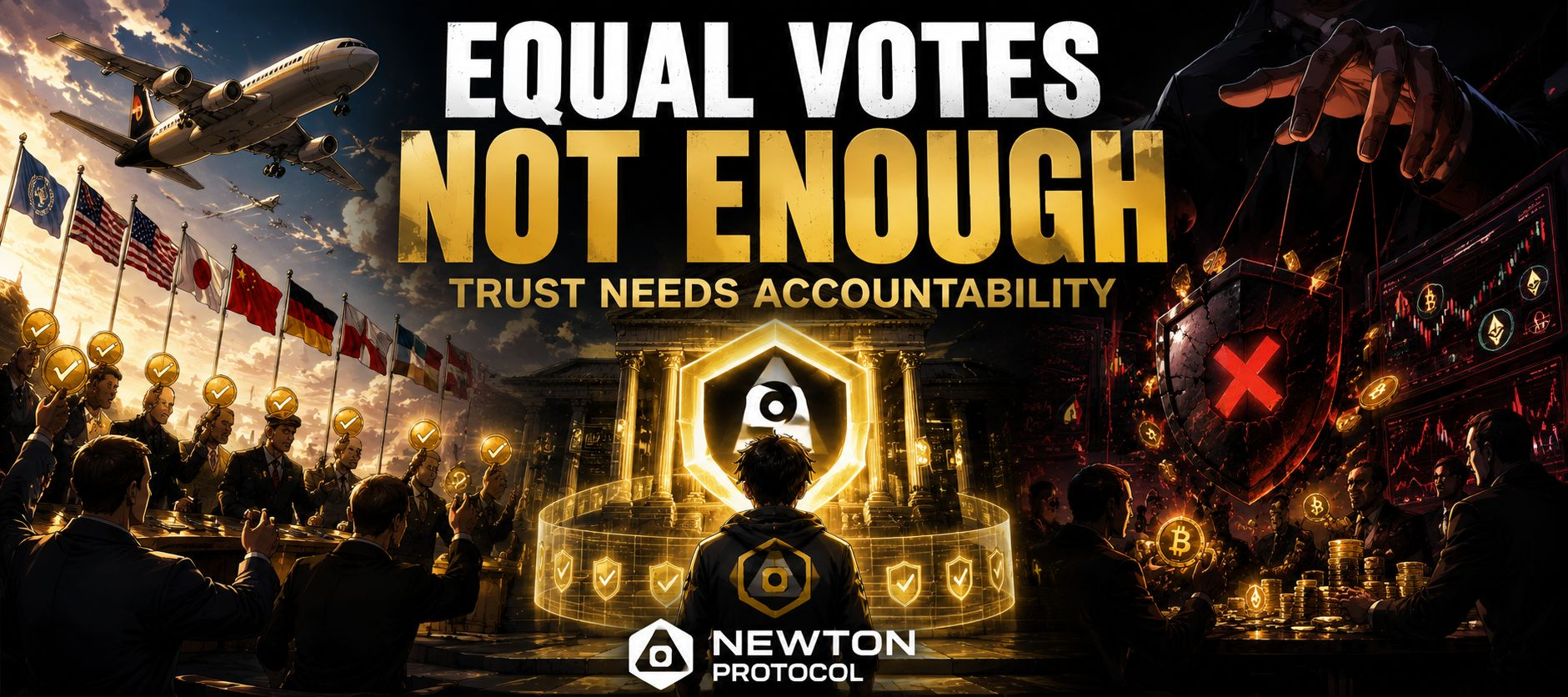
I’ve been thinking lately about how international aviation standards managed to hold together for decades despite massive differences in power between countries. After several devastating crashes caused by conflicting national rules, the industry created a global body where every member nation received exactly one vote on standards, no matter how many planes they flew. What made this system durable wasn’t the perfection of the rules themselves, but something more fundamental: participating countries carried real political accountability. If standards failed and lives were lost, governments faced direct consequences from their own citizens. That created a built-in pressure to protect the integrity of the system over time, even when it was inconvenient.
This model feels relevant to Newton Protocol’s ambition of becoming a neutral standard layer for on-chain policy and authorization. The idea of giving every participant an equal vote has clear appeal. It prevents the largest protocols or capital holders from simply rewriting the rules in their favor. On paper, it looks like a fairer foundation than pure token-weighted governance.
Yet when I apply the aviation lesson more carefully, a critical gap appears. Nations in that system had something most participants in decentralized networks lack: genuine long-term accountability beyond short-term profit. A government that allowed unsafe standards risked political fallout and loss of public trust. In contrast, many entities that would participate in Newton are primarily profit-driven organizations. An equal vote gives them influence, but it does not automatically create pressure to prioritize the long-term stability of the policy layer over opportunities for short-term extraction.
This problem isn’t theoretical. We’ve already seen versions of it in crypto governance. Several protocols began with relatively flat or egalitarian voting structures, only to see influence gradually concentrate around actors whose incentives were more short-term than the health of the overall system. Equal distribution of power on paper did not prevent misalignment when the cost of damaging the shared standard was low for individual participants.
What @NewtonProtocol needs, then, is not simply equal voting, but governance mechanisms that deliberately raise the cost of short-term opportunism. This could include time-weighted voting power that only strengthens with sustained commitment, or requiring real economic exposure that can be penalized when governance decisions harm the network’s credibility. The goal isn’t perfect equality, but making the rational choice for participants align with preserving trust in the standard over many years rather than quarters.
For $NEWT , the real test won’t be whether it adopts equal voting. It will be whether its governance design makes protecting the long-term integrity of the policy layer the path of least resistance for those who hold influence.