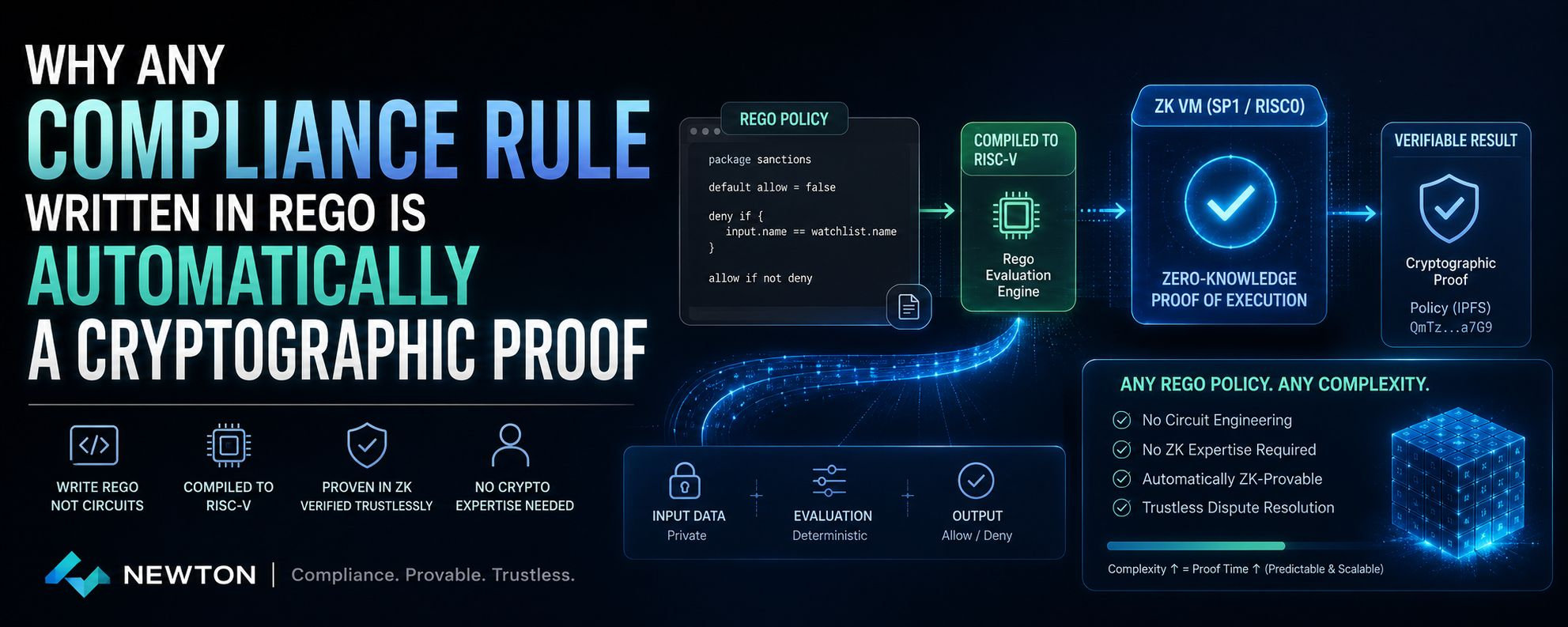
@NewtonProtocol spent a long time with this section this morning because the claim it makes is stronger than i initially gave it credit for. the claim is not just that Newton can produce ZK proofs for specific compliiance checks. the claim is that any policy written in Rego is automatically ZK-provable, without any per-policy circuit engineering, without any specialized knowledge from the policy author, and without any change to how the policy is written.
that is a genuinely significant claim and i want to trace through exactly why it holds.
most applications of zero nowledge proofs in blockchain contexts target specific, well-structured computations. you write a circuit for a specific Operation a hash function, a signature verification, a token transfer and that circuit produces proofs for that specific operation. if you want to prove something different, you write a different circuit. this approach works well for bounded, predictable computations but it scales poorly. every new compliance rule would require a new circuit. every update to an existing rule would require re-engineering its circuit. policy
authors who Are compliance experts rather than cryptographers would be unable to participate in circuit development at all.
Newton takes a fundamentally differant approach. instead of writing circuits for individual policies, Newton compiles the entire Rego evaluation engine to a RISC-V target. RISC-V is an open-source instruction set architecture a general-purpose computational model. the compiled Rego engine then executes inside a general-purpose zero-knowledge virtual machine, specifically SP1 or RISC0, both
of which can produce ZK proofs of arbitrary RISC-V program execution.
the ZK proof that results from this process certifies something precise and powerful. it certifies that a specific Rego policy identified by its IPFS content address, so the exact text of the policy is pinned and verifiable given specific input data, when evaluated by the Rego engine, produces a specific output. the proof is a mathematical certificate of that entire computation. it demonstrates that the computation happened correctly without
revealing the inputs or the intermediate steps to whoever an verifying the proof/
the bridge that makes this possible is a property of Rego that i mentioned in passing earlier but want to be precise about here. Rego is a pure func tional language. given the same inputs and the same rules, evaluation always produces the same result. there are no side effects, no external state mutations, no non-determinism.....
this determinism is what makes the computation zk-provable a ZK proof of computation is only possible when the computation is detrministic, because the proof has to certify a specific execution trace and that trace needs to be reproducible.
And the consequence for policy authors is the part that i think deserves to be stated plainly. a compliance officer who writes a sanctions check in Rego does not need to undarstand zero-knowledge proofs. they do not need to understand circuit design. they do not need to understand RISC-V or ZK virtual machines. they write standard Rego the same declarative language they might already use for Kubernetes admission control or
API gateway authorization and the cryptographic verifiability is a property they get automatically, because Newton's architecture handles the entire compiilation and proof generation pipeline invisibly.
what this means practically is that Newton's trustless dispute resolution applies universally. every policy the system can evaluate can also be challenged with a ZK proof. a simple two-line snctions check and a complex multi-data-source risk scoring policy that spans dozens of lines of Rego are both equally ZK-provable.
the complexity of the policy has no bearing on whether it can be crypto graphically verified only on how long proof generation takes, which scales with the computational complexity of the policy evaluation.
actually let me be more precise about that last point because i glossed over something important. ZK proof generation is not instant. the whitepaper places ZKML overhead at 1000 to 10000 times the cost of standard execution for machine learning models. for Rego policy evaluation the overhead is lower because Rego policies are primarily boolean logic and threshold comparisons rather than floating-point matrix operations. but there still a meaningful computational cost to generating the proof. the challenge mechanism accounts for this by running proof generation off the critical path a challenger generates an proof after the fact, not in real time during the authorization flow....
the real-time path produces BLS attested results. the ZK proof path is the dispute mechanism that veriifies those results after the fact.
what i want to understand better is how proof generation time scales with policy complexity in practice. a chalenger submitting a challenge needs to generate a valid ZK proof within the challenge window. if a complex multi-module policy takes hours to generate a proof for, the challenge window needs to be long enough to accommodate that.
but a longer challenge window mean a longer provisional period during which the attestation cant be used. im trying to understand whether there is a practical complexity ceiling on policies that can be meaningfully challenged??