
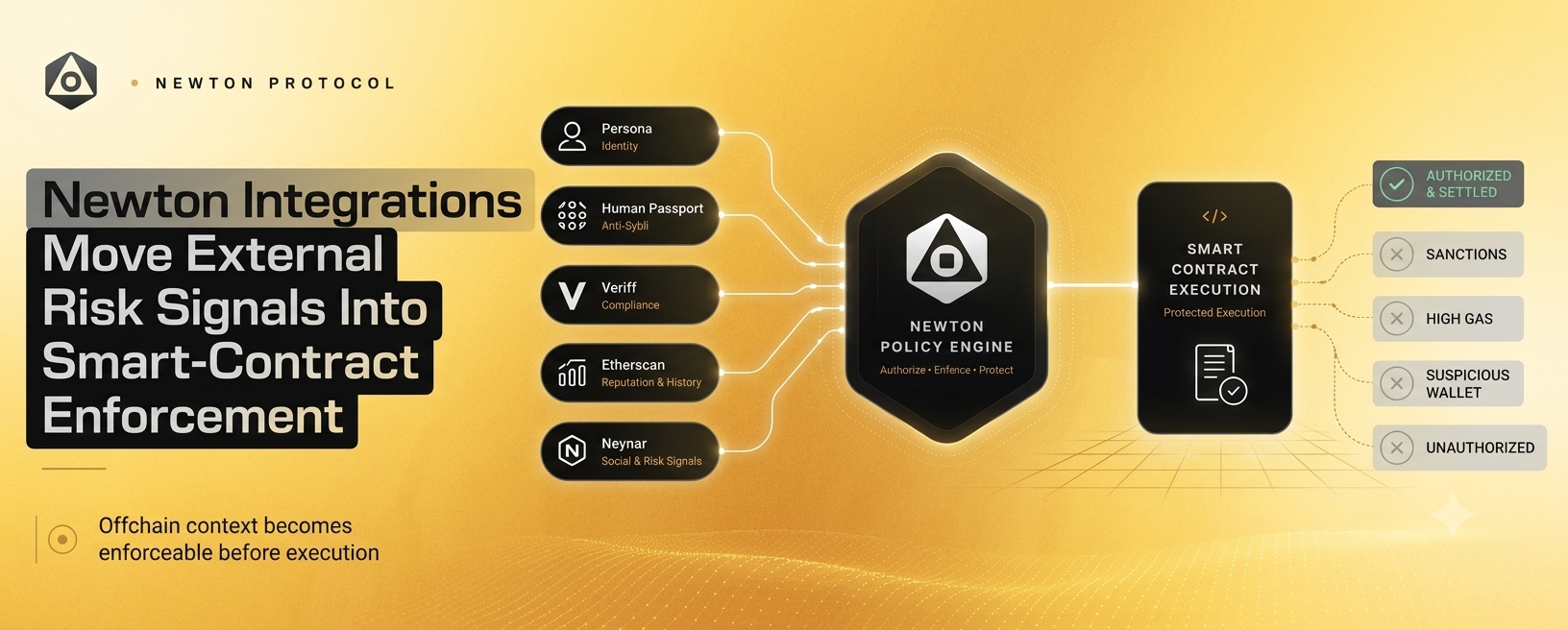
@NewtonProtocol Blockchainhas always excelled at recording what happened. Every transfer, swap, and contract interaction becomes a permanent part of an immutable ledger. Yet there is an important limitation: by the time the blockchain confirms an action, the decision has already been made.
That reality explains why many security dashboards and monitoring platforms often feel reactive. They identify suspicious wallets, detect unusual activity, or flag compliance concerns only after a transaction has entered history. Their analysis may be accurate, but accuracy after settlement rarely protects capital.
This is why I believe the next stage of blockchain infrastructure will focus less on observation and more on authorization.
Instead of asking, "What happened?", protocols are beginning to ask, "Should this happen at all?"
This shift changes the role of external data.
Traditional oracle integrations usually deliver information such as prices, identity checks, market conditions, or risk scores. Applications consume that information individually, often building custom logic around each provider. While effective, this approach can become increasingly complex as more data sources are added.
A policy-based authorization model approaches the same challenge differently.
Rather than treating every provider as a separate decision-maker, external signals become inputs to a unified policy. Identity verification, sanctions screening, market volatility, vault health, liquidity conditions, gas costs, and fraud detection can all contribute to one authorization process before assets move.
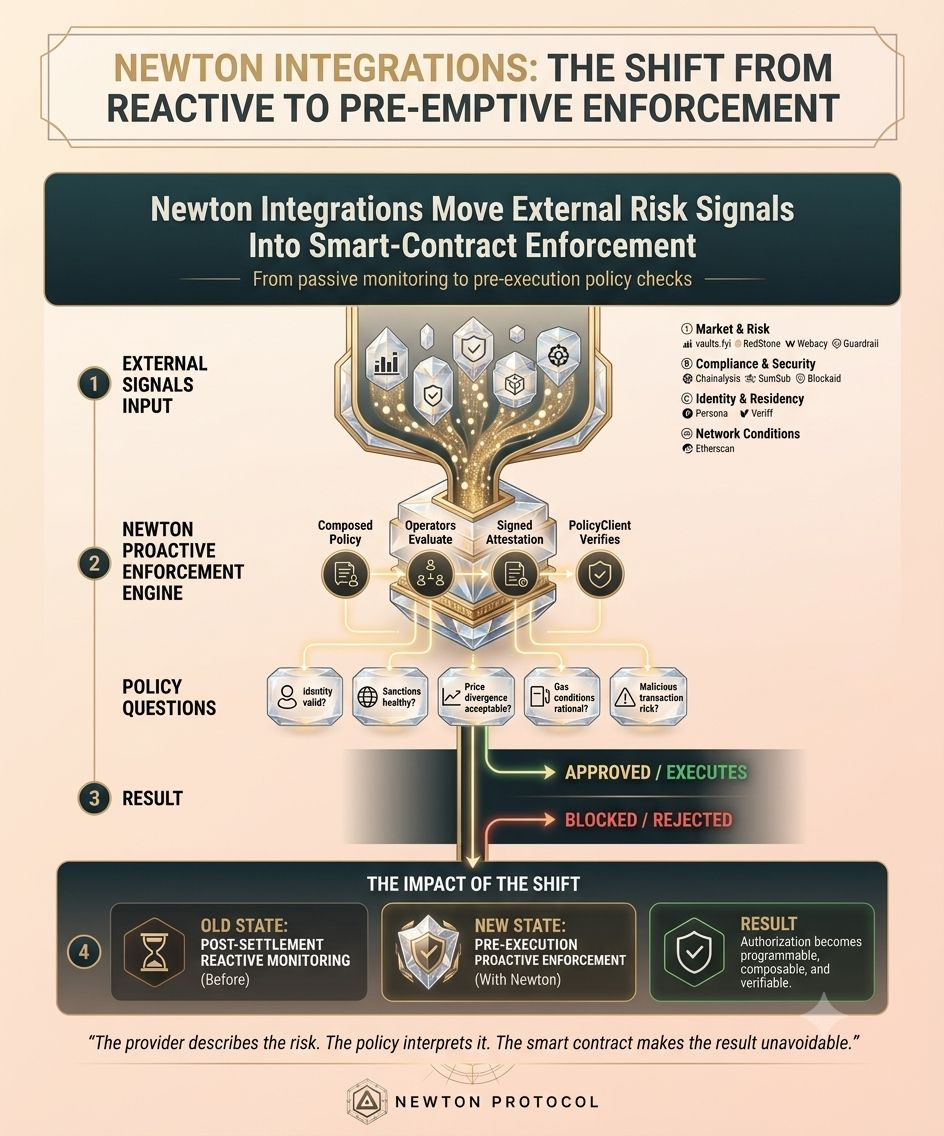
The transaction is no longer evaluated through a single checkpoint.
It is evaluated through a collection of conditions that together determine whether execution should proceed.
That distinction matters.
Financial decisions are rarely based on one variable. Institutional workflows already combine compliance requirements, operational rules, market data, and internal governance before approving capital movement. Bringing similar logic into decentralized finance makes blockchain applications feel closer to real financial infrastructure.
Another interesting aspect is the separation of responsibilities.
Risk providers remain specialists in generating information. Identity services validate users. Market data providers report prices. Security platforms identify suspicious behavior.
The authorization layer is responsible for interpreting those signals according to predefined rules.
No individual provider controls execution. Instead, multiple independent inputs contribute to a final policy decision that can be verified before a smart contract performs its action.
This creates a more modular architecture.
Applications can update individual data providers without redesigning the underlying smart contract. Policies evolve while execution logic remains relatively stable, improving adaptability as regulations, market conditions, or security requirements change.
Privacy also benefits from this model.
Many compliance processes require sensitive information that should not become permanently visible on public blockchains. Evaluating those details off-chain while recording only a cryptographic proof of successful policy evaluation offers a practical balance between transparency and confidentiality.
Of course, this approach introduces its own challenges.
Policies become only as reliable as the quality of their inputs.
Outdated market data, unavailable providers, inconsistent scoring methodologies, or overly restrictive thresholds can all produce incorrect authorization outcomes. Cryptographic verification proves that the configured process was followed—it does not guarantee that every external signal was accurate.
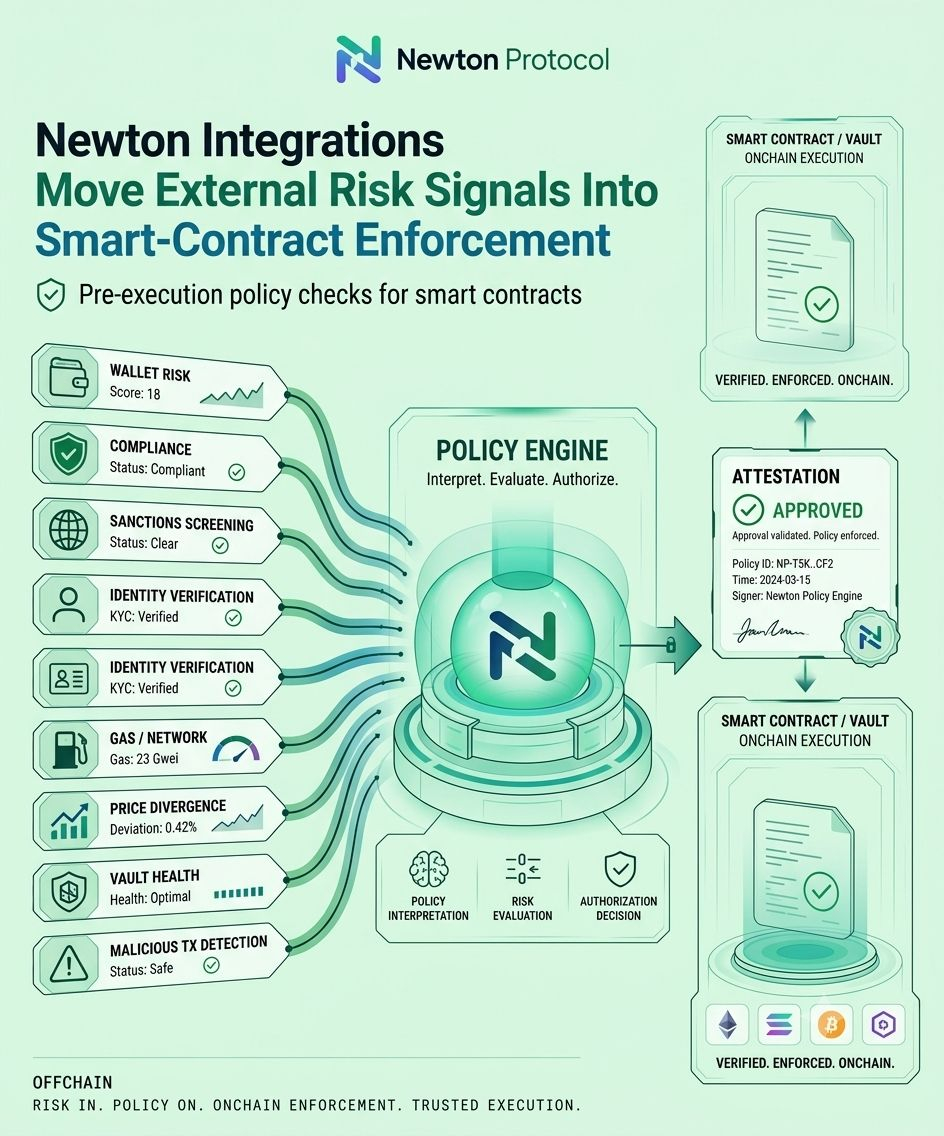
Designing resilient policies therefore becomes just as important as designing secure smart contracts.
Developers must decide how multiple signals interact, which providers deserve trust, how conflicts are resolved, and when manual intervention should override automated decisions.
Ultimately, I think the long-term value of authorization infrastructure will not be measured by the number of integrations it supports.
The real test is whether applications repeatedly depend on policy evaluation during everyday operations.
If every vault rebalance, token issuance, treasury payment, AI-generated transaction, or institutional settlement consistently consults programmable authorization before execution, then policy engines become recurring infrastructure rather than optional security tools.
That represents a subtle but significant evolution.
Data no longer exists simply to inform users after events occur.
It becomes an active participant in determining whether those events should occur at all.
In that future, blockchain is no longer just a ledger that records transactions.
It becomes a platform where programmable trust determines which transactions deserve to exist in the first place.