

I first paid closer attention to Newton when I was looking at vault risk, not the token chart.
That sounds backwards, but stay with me. Most small-cap infrastructure charts can look the same for a while. A spike, a fade, a few narrative candles, then everyone waits for the next update. What made Newton different for me was the idea that the project is not only trying to automate transactions. It is trying to decide whether a transaction should be allowed before it settles.
That is where the EigenLayer AVS design really matters to me.
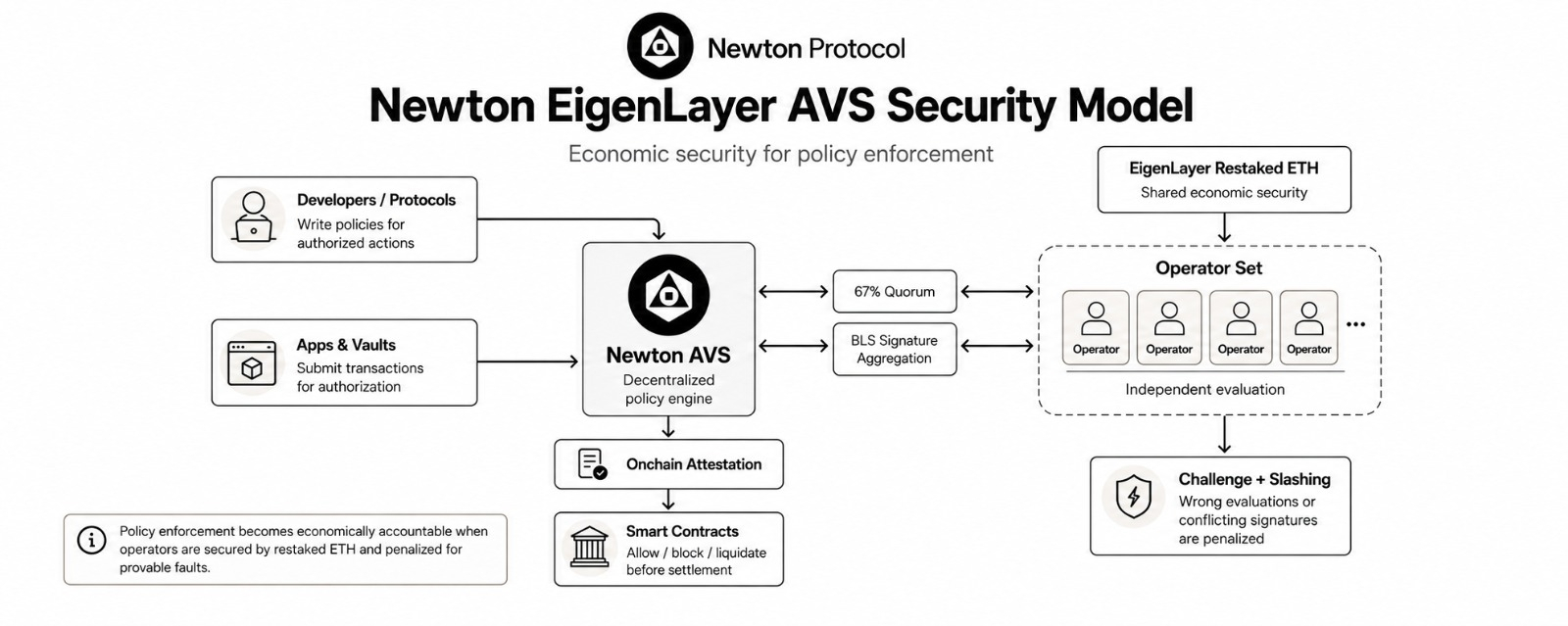
Newton’s own docs describe it as a decentralized policy engine for onchain transaction authorization, built as an EigenLayer AVS. In simple terms, a developer can write rules for what a transaction is allowed to do, then Newton operators check the transaction against those rules and return a cryptographic attestation that a smart contract can verify before execution.Why does this matter for traders?
Because DeFi has usually treated policy as soft infrastructure. A vault says it has risk limits. An agent says it follows user permissions. A protocol says it checks compliance. But the real question is simple: what happens at the exact moment money moves? Newton is trying to put that checkpoint directly into the transaction path.
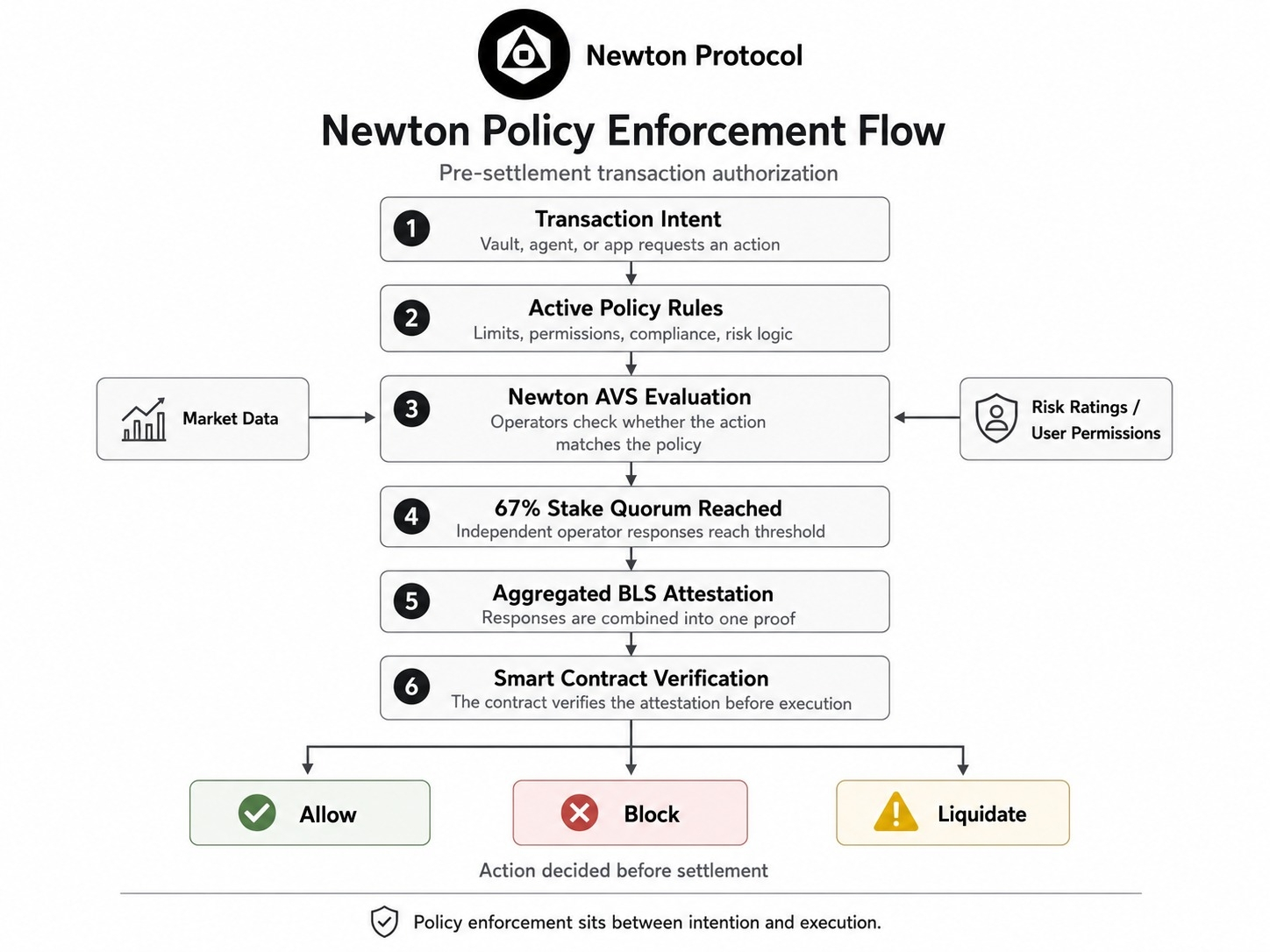
Think of it like a risk desk sitting between intention and execution. Not a dashboard that tells you later something went wrong. Not a curator promising discipline. A pre-settlement gate that says, “This action matches the rule,” or “No, this breaks the policy.” RedStone’s mainnet beta write-up framed the first use case around vaults, where policies can read market data and risk ratings before allowing, blocking, or liquidating a position.
Now here’s the important part. If Newton were only one centralized server checking these rules, I would not care that much. The stronger design choice is the AVS model. EigenLayer says AVSs can use restaked assets and operators instead of building their own security base from scratch, with operators running AVS-specific software and slashing acting as the penalty when commitments are broken.
Newton applies that idea to policy enforcement. Its docs mention operators independently evaluating tasks, BLS signatures being aggregated into one proof, a default 67% stake quorum threshold, and incorrect evaluations being challengeable. The security model is backed by EigenLayer restaked ETH, with slashing for provably wrong evaluations or conflicting signatures.
That is the thesis for me: Newton is trying to make policy enforcement economically accountable.
Still, I would not call this proven yet. The market is not pricing it like proven infrastructure either. Around July 3, NEWT was trading near $0.049, with CoinGecko showing roughly a $10M to $14M market cap depending on circulating supply assumptions, and a 1B max supply. That tells me traders are still treating it like an early narrative asset, not a deeply adopted authorization layer.
The bull case is not hard to understand. If Newton becomes a real policy layer for vaults, stablecoin flows, agent permissions, and institutional DeFi, then the market can start valuing it closer to useful middleware instead of launch-week speculation. From around $0.049, a move to $0.10 would put the fully diluted value near $100M. A move to $0.15 would imply roughly $150M FDV. Those are not wild numbers for infrastructure if actual integrations, transaction volume, and operator participation start growing.
But the bear case is also real. Policy enforcement sounds powerful, but it only matters if builders integrate it into flows where capital is actually moving. If vaults test it once and do not keep using it, the AVS design becomes a nice technical story with weak demand. Another risk is data quality. A policy is only as good as the information it reads. Bad oracle data, stale risk scores or poorly written policy logic can still create bad decisions. And EigenLayer restaking adds its own complexity, including operator concentration, smart contract risk, and correlated slashing concerns.
What would change my mind?
i would get more bullish if I saw policy evaluations growing, more vaults using Newton in production, clearer fee demand, stronger operator diversity, and public receipts that show enforcement actually happening. I would get cautious if the story stays stuck around announcements, or if token demand does not connect back to real usage.
So for me, Newton’s AVS design is not just a technical detail. It is the part that decides whether policy enforcement has teeth. Rules without economic security are just promises. Rules checked by a decentralized operator set, with proofs, quorum, and slashing, start to look more like infrastructure.
If you’re eyeing at NEWT, I would not only watch the chart. I would watch the boring metrics: how many policies are active, how many transactions get evaluated, how many integrations go beyond demos, how often policies block risky actions, and whether restaked security grows with usage. That is where the real signal will show up first.
