

A Market Suddenly Forced to Change Direction
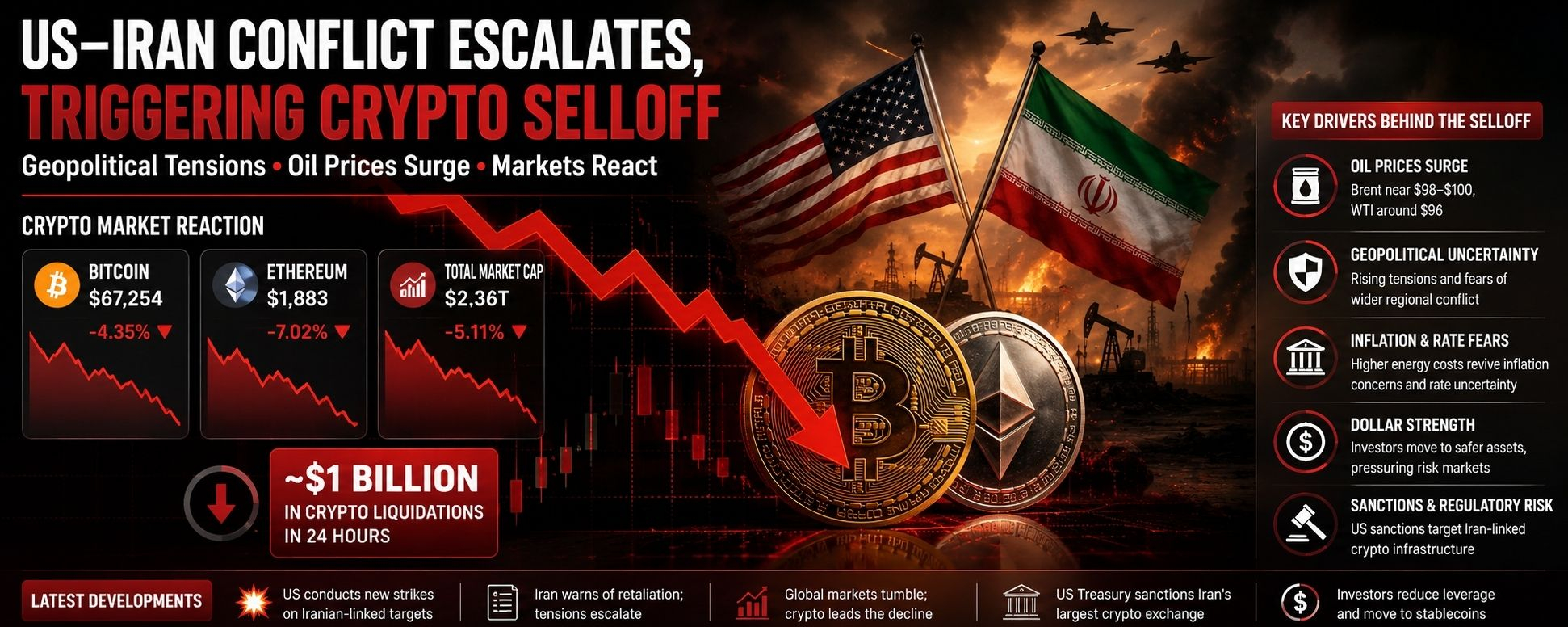
the crypto market react to the latest escalation between the United States and Iran, and what strikes me most is how quickly confidence can disappear when geopolitical tensions become real. Just days ago, the conversation was centered around Bitcoin momentum, institutional demand, and whether the market was preparing for another leg higher. Today, traders are talking about military developments, oil prices, sanctions, and risk management.
The shift happened almost overnight.
Bitcoin, Ethereum, and the broader crypto market came under pressure as investors responded to growing uncertainty across global markets. While crypto is often promoted as an alternative financial system, moments like these remind everyone that digital assets do not operate in isolation. They are now deeply connected to the same macroeconomic forces that influence stocks, commodities, and currencies.
Why the Conflict Is Affecting Crypto
On the surface, the connection may not seem obvious. A conflict in the Middle East and a decline in crypto prices appear to belong to completely different worlds.
Underneath, however, they are closely connected.
Whenever tensions rise between major powers in a strategically important region, investors immediately begin assessing the potential impact on energy markets. Concerns about disruptions to oil supplies often push crude prices higher. Rising energy costs can fuel inflation fears, and inflation fears can reshape expectations around interest rates and liquidity.
Crypto markets pay close attention to liquidity.
When investors expect easier financial conditions and lower rates, risk assets tend to benefit. When uncertainty grows and inflation concerns return, investors often become more defensive. That shift in sentiment is exactly what the market is experiencing now.
Bitcoin and Ethereum Feel the Pressure
Bitcoin was already facing resistance after a strong rally earlier in the year. The latest geopolitical developments created an additional reason for traders to reduce risk.
As selling pressure increased, many leveraged positions became vulnerable. Once prices began moving lower, liquidations accelerated the decline. Long positions that had been built on expectations of further upside were suddenly forced to close, adding more selling into an already nervous market.
Ethereum faced similar pressure.
Historically, Ethereum often experiences larger percentage swings during risk-off periods because it sits at the center of many speculative activities within the crypto ecosystem. When traders become cautious, they frequently reduce exposure not only to smaller tokens but also to Ethereum itself.
The result was a broad market decline that extended far beyond Bitcoin.
The Role of Oil and Inflation
One of the biggest stories developing alongside the conflict is the movement in oil prices.
Markets are increasingly focused on the possibility that prolonged tensions could disrupt energy flows or create uncertainty around key shipping routes. Even the perception of risk can be enough to drive oil prices higher.
This matters because higher energy prices can keep inflation elevated.
For months, investors have been hoping that inflation would continue cooling, creating room for more supportive monetary conditions. A sustained increase in oil prices could complicate that outlook.
For crypto investors, this creates a difficult environment. Rising inflation concerns often reduce appetite for speculative assets and encourage a more cautious approach across financial markets.
That doesn't mean crypto's long-term story has changed.
It simply means that short-term macroeconomic fears are currently outweighing long-term narratives.
The Digital Gold Debate Returns
Every major geopolitical event seems to reignite the same debate.
If Bitcoin is often compared to digital gold, shouldn't it perform well during periods of uncertainty?
The answer is more complicated than many people expect.
In theory, decentralized assets should become more attractive when trust in traditional systems weakens. In practice, however, the first reaction to uncertainty is usually a search for liquidity.
Investors tend to prioritize flexibility and capital preservation during periods of stress. Rather than moving immediately into alternative assets, they often reduce exposure to risk and wait for greater clarity.
This explains why Bitcoin can sometimes fall alongside stocks during the initial stages of a geopolitical shock, even when its long-term supporters argue that the broader environment strengthens the case for decentralized money.
Sanctions Add Another Layer of Uncertainty
The conflict is not influencing crypto only through market sentiment.
Recent actions targeting Iran-linked crypto activity have also placed digital assets directly into the geopolitical discussion.
This is an important development because it highlights how crypto has evolved over the past decade. Digital assets are no longer viewed solely as speculative investments. They are increasingly seen as financial infrastructure that can influence cross-border transactions, capital movement, and economic activity.
As a result, geopolitical tensions often bring increased regulatory attention.
For investors, this creates another variable to consider. Markets are not just reacting to military developments. They are also assessing how governments, regulators, and financial institutions might respond if tensions continue to escalate.
Why Altcoins Are Under Even More Pressure
When uncertainty rises, investors typically become more selective.
Capital tends to flow toward assets with the deepest liquidity and strongest market presence. That usually benefits Bitcoin relative to the rest of the crypto market.
Smaller cryptocurrencies often experience larger declines because traders become less willing to hold positions perceived as higher risk.
This pattern has appeared repeatedly throughout crypto history.
During periods of optimism, capital spreads across the market in search of higher returns. During periods of fear, capital retreats toward safety.
The latest selloff is following a similar path.
A Reminder That Crypto Is Now Part of the Global Financial System
One of the most important lessons from this situation is how much the crypto market has matured.
Years ago, crypto prices were primarily influenced by industry-specific events such as exchange activity, network upgrades, and adoption milestones.
Today, Bitcoin reacts to inflation data, interest-rate expectations, institutional flows, geopolitical conflicts, and energy markets.
That transformation reflects the growing integration of digital assets into the broader financial system.
The benefits are obvious. More institutional participation has brought greater legitimacy and larger pools of capital into the industry.
The downside is that crypto now experiences many of the same external pressures that affect traditional markets.
What Traders Are Watching Next
The next phase of the market will likely depend on developments outside the crypto industry itself.
If tensions begin to ease, risk appetite could recover quickly. Markets often rebound after periods of panic once uncertainty starts to fade.
If the conflict expands or energy markets remain under pressure, investors may continue reducing exposure to risk assets.
For now, traders are watching every headline, every policy response, and every movement in oil prices.
The focus is no longer just on charts and technical indicators. It is on understanding how geopolitical events could influence inflation, liquidity, regulation, and investor behavior in the weeks ahead.
The Bigger Picture
I think the biggest takeaway from the latest selloff is that crypto has reached a point where it can no longer be separated from global events.
A military escalation can influence oil prices. Oil prices can influence inflation. Inflation can influence monetary policy. Monetary policy can influence liquidity. And liquidity can influence the entire crypto market.
That chain reaction is now part of everyday market reality.
The current decline may eventually prove to be a temporary response to uncertainty, or it could become part of a larger risk-off environment. Either way, the episode serves as another reminder that crypto is no longer a niche market operating on its own.
The industry has become part of the global financial conversation.
And when the world becomes more uncertain, crypto feels it too.