
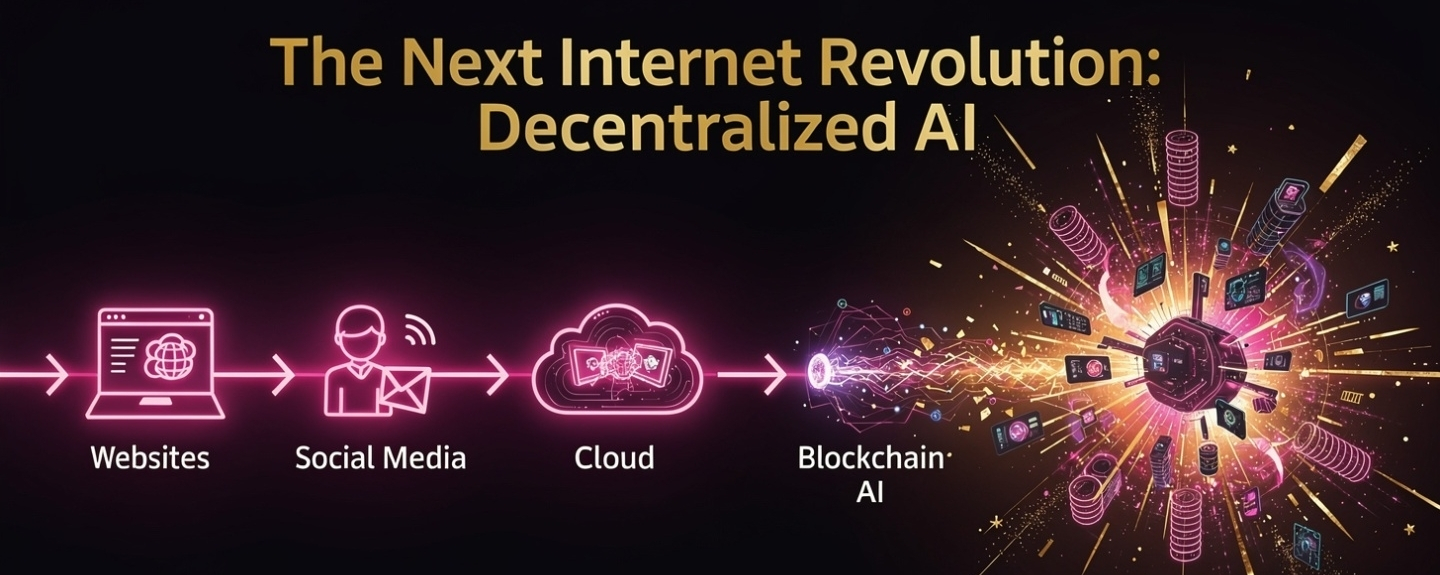
The Next Internet Revolution May Not Be Social Media — It Could Be Decentralized AI
Over the last two decades, the internet has gone through several major revolutions. First came websites, then social media, followed by mobile applications, cloud computing, and blockchain technology. Now, the world is entering another transformation driven by Artificial Intelligence.
AI is already changing how people work, communicate, learn, trade, and create content. But while the technology itself is evolving rapidly, one critical issue continues growing in the background: centralization.
Today, most AI systems are controlled by a small number of giant corporations with massive computing power and unlimited access to user data. These companies build powerful AI models using information generated by billions of people around the world. Yet ordinary users rarely receive ownership, transparency, or rewards from the ecosystems they help create every day.
This growing imbalance is exactly why decentralized AI may become one of the most important narratives of the next generation internet economy.
@OpenLedger is one of the projects attempting to build infrastructure for this future. Instead of relying entirely on centralized systems, OpenLedger focuses on creating decentralized AI infrastructure powered by blockchain technology. The project aims to support a more open ecosystem where contributors, developers, researchers, and communities can participate more fairly in the growth of AI networks.
One of the most powerful ideas behind OpenLedger is the concept of community-driven value creation. Data has become one of the most valuable resources in the digital world, but most people never directly benefit from the value generated through their online activity. OpenLedger introduces a vision where contributors may eventually have greater participation, transparency, and opportunity within AI ecosystems.
Another important factor is trust. As AI systems become more advanced, concerns around privacy, manipulation, centralized control, and data ownership continue increasing globally. Blockchain technology can help solve some of these problems by introducing transparency, verifiable systems, and decentralized participation models that reduce dependence on single authorities.
The timing for decentralized AI is becoming increasingly important. Governments, businesses, investors, and technology companies worldwide are racing to dominate the AI sector. At the same time, Web3 communities are searching for projects building long-term utility instead of short-term hype. Infrastructure-focused ecosystems capable of supporting future AI development may become extremely valuable as adoption accelerates globally.
What makes OpenLedger particularly interesting is that it is positioned at the intersection of two of the biggest technological movements of this generation: blockchain and Artificial Intelligence. AI can drive automation and intelligence at global scale, while blockchain can introduce transparency, ownership, and decentralized coordination. Together, these technologies could completely reshape how future digital economies operate.
The next era of the internet may not belong only to centralized corporations. It may belong to ecosystems powered by communities, contributors, and decentralized innovation. OpenLedger and the growing $OPEN ecosystem are definitely among the projects worth following closely as this transformation continues unfolding worldwide.
$OPEN #OpenLedger