

Key Highlights
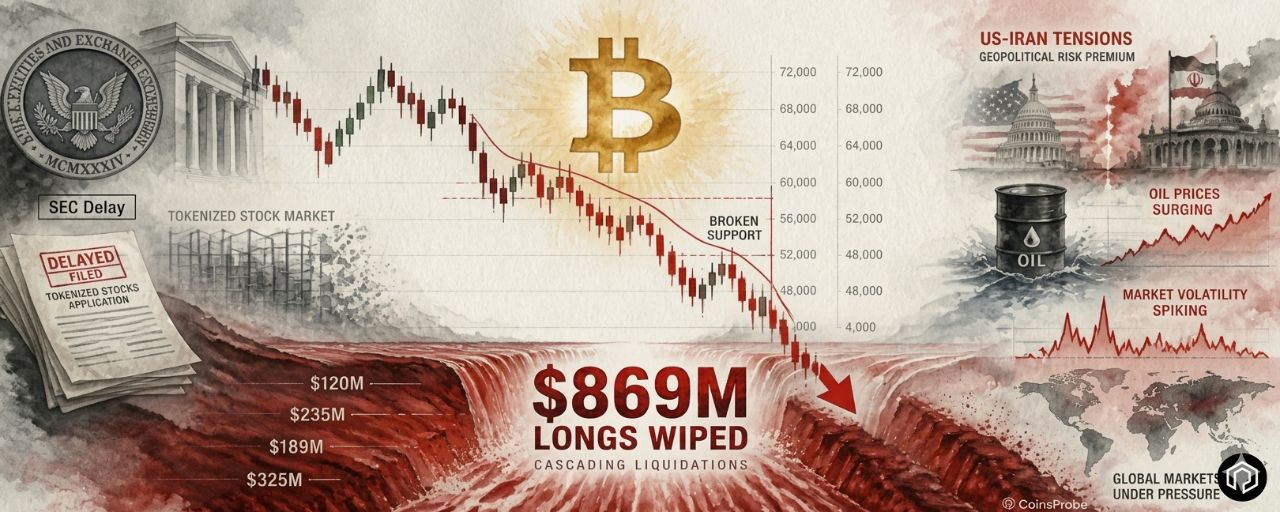
Bitcoin is trading at $74,654 — down -3.37% in 24 hours — with a market cap of approximately $1.495 trillion as geopolitical risk drives broad market selling.
Total crypto liquidations hit $941.17 million in 24 hours — with $869.91 million from long positions — reflecting how leveraged positioning amplified the downside move.
Analyst warns BTC has rejected the 200D, 100W and lost D50 and D100 support — flagging low $70Ks as the next stop and ~$65K if that level fails.
The sell-off appears macro-driven — US-Iran geopolitical escalation pushing oil higher, SEC delayed its plan to allow crypto versions of US stocks and triggering broad risk-off sentiment — rather than any crypto-specific fundamental deterioration.
The crypto market is under significant pressure today — and the catalyst is not on-chain. Escalating US-Iran geopolitical tensions following President Trump’s warning that the “clock is ticking” have triggered a broad risk-off wave across global markets — pushing oil prices higher, compressing equity sentiment, and sending Bitcoin down sharply to $74,654.
 Bitcoin (BTC) Price/Source: Coinmarketcap
As we covered in our Iran nuclear talks deadlock and oil surge analysis, the collision between Iran’s Supreme Leader directive on uranium exports and the U.S.-Israel position has created a genuine diplomatic impasse — and energy markets and risk assets are pricing in prolonged uncertainty rather than near-term resolution.
Market Snapshot — May 23, 2026
Bitcoin (BTC) Price/Source: Coinmarketcap
MetricData Bitcoin Price $74,654.74 24h Change-3.37% BTC Market Cap~ $1.495 trillion Total Crypto Market Cap~$2.5 trillion (-2.36%) Total Liquidations (24h) $941.17 million Long Liquidations $869.91 million Short Liquidations $71.26 million
The liquidation composition tells the story of what happened. With $869.91 million — 92.4% of total liquidations — coming from long positions, this was a leveraged long flush rather than a two-sided market move. Traders who had been positioned for a BTC recovery toward and above the 200-day MA at $82,333 — as we analysed in our Bitcoin 200 SMA fractal article — were caught on the wrong side of a sharp macro-driven reversal.
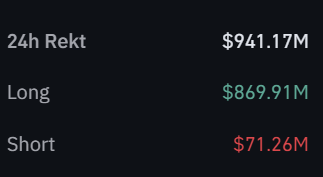 Crypto Liquidations on May 23/Source: coinglass
Why Bitcoin Is Down Today? — The Macro Drivers
Two significant catalysts have converged today to trigger the sell-off — one geopolitical and one regulatory.
US-Iran Geopolitical Escalation
President Trump’s warning that the “clock is ticking” on Iran has intensified fears of military conflict in the Middle East — triggering immediate flight from risk assets into traditional safe havens. As we covered in our Iran nuclear talks deadlock analysis, the collision between Iran’s uranium export ban and the U.S.-Israel position has created a genuine diplomatic impasse — and markets are pricing in prolonged uncertainty rather than near-term resolution.
The direct impact flows through two channels: oil prices rising — reinforcing inflation concerns and tightening the macro environment for risk assets — and broad risk-off sentiment pulling capital away from speculative positions.
As we covered in our Bitcoin USDT Dominance and macro analysis, Bitcoin remains highly correlated with traditional risk assets during periods of acute geopolitical stress — and elevated leveraged long positioning made the correlation more painful than usual.
SEC Delays Crypto Versions of US Stocks on Regulated Exchanges
The second and equally significant catalyst: the SEC has delayed its plan to allow crypto versions of US stocks to trade on regulated exchanges — and the crypto market reacted immediately to the news. This is a direct blow to one of the most powerful narratives driving HYPE and the broader RWA sector in recent weeks.
As we covered in our SEC innovation exemption and HYPE surge article, the anticipated regulatory green light for tokenized securities on-chain had been a significant bullish catalyst — with Hyperliquid specifically positioned as the primary infrastructure beneficiary. The SEC’s delay removes that near-term catalyst and reintroduces regulatory uncertainty into a narrative that had been pricing in approval.
The market’s reaction to the delay reflects how much of the recent RWA and tokenized stock optimism had already been priced in. When a catalyst that markets are counting on gets delayed rather than confirmed — the repricing is typically swift and sharp.
The combined effect — US-Iran geopolitical risk driving oil higher and triggering risk-off sentiment, simultaneously with the SEC’s tokenized securities delay removing a key regulatory tailwind — created a perfect two-catalyst environment for leveraged long liquidations to cascade. The result was $941 million in liquidations in 24 hours — with 92.4% from long positions.
$BTC Technical Analysis
Analyst @ReddBanksss laid out the technical damage clearly on X:
“Bitcoin rejected from the 200D, 100W and now lost support from the D50 and D100. If the bulls don’t step up soon then we will revisit the low 70s soon. Lose that and we are looking for ~65K. Stairs up, elevator down.”
The sequence of technical failures is significant and worth understanding in full context:
200-day MA rejected — As we flagged as the most critical level in our Bitcoin 200 SMA bearish fractal analysis, the 200-day MA at approximately $82,333 was the line that separated the bullish recovery thesis from the 2022 bearish fractal confirmation. BTC attempted to reclaim it and was rejected — and today’s move is a direct consequence of that failed reclaim.
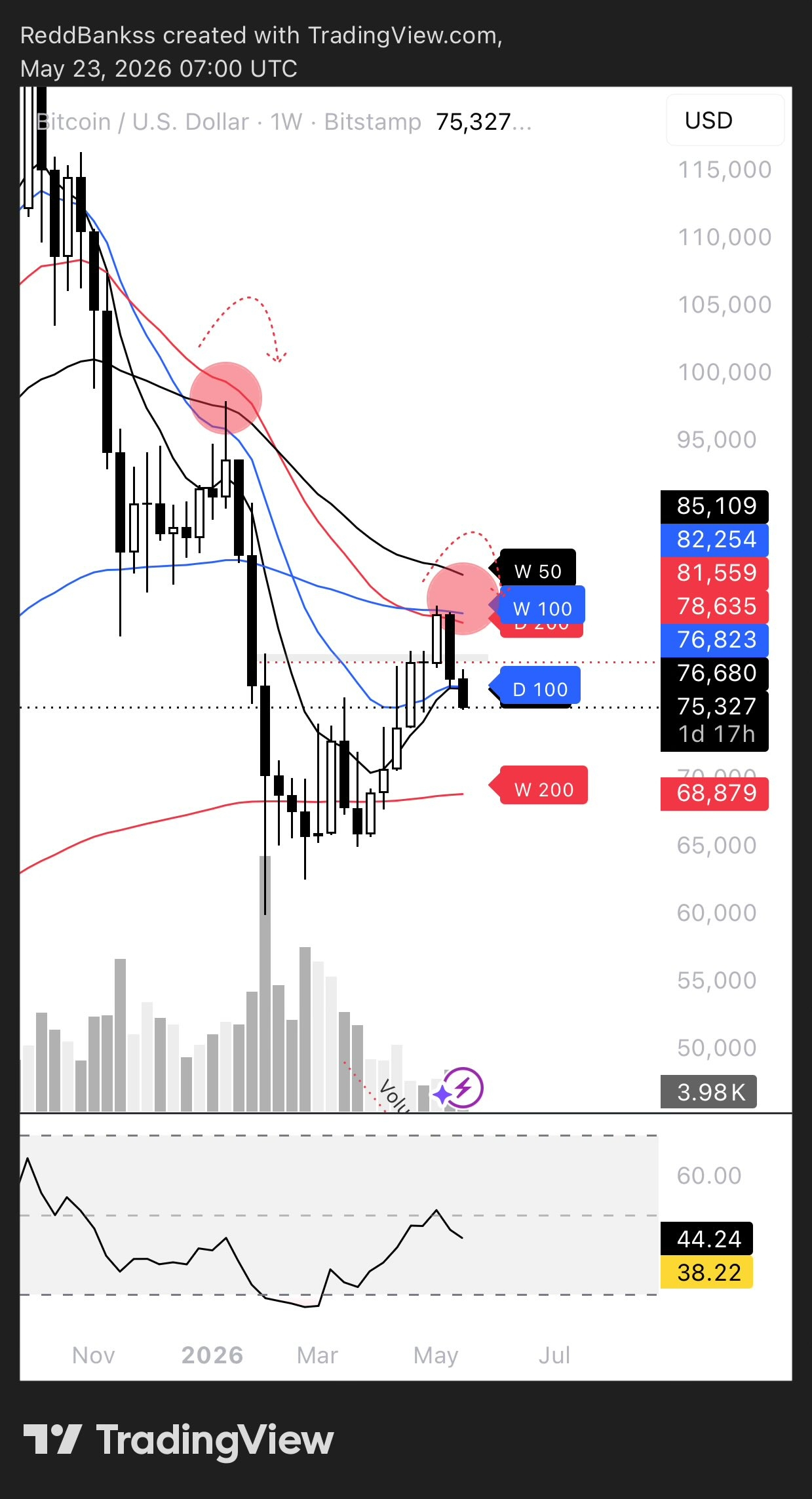 Bitcoin (BTC) Chart/Credits: @ReddBanksss (X)
100-week MA lost — An additional longer-term moving average confirmation that the macro trend has not shifted from bearish to bullish.
D50 and D100 support lost — The daily 50 and 100 moving averages — which had been acting as dynamic support during the recovery from the $60,061 February low — have now been broken. This is the level that previously supported BTC’s bounce back toward the 200 MA. Losing them removes the near-term support structure.
What’s Next — Two Scenarios
Bullish Scenario
Bulls reclaim the D50 and D100 on a sustained daily close — restoring the moving average support structure and stabilising sentiment. A successful reclaim of these levels would provide immediate relief — potentially sparking a short-term recovery back toward the $78,000–$80,000 zone. Any de-escalation in US-Iran tensions or positive macro development could be the trigger for this scenario — geopolitical risk moves fast in both directions.
Bearish Scenario
Failure to reclaim D50 and D100 brings the weekly 200 MA around $68,879 into focus as the next major support. A sustained breakdown below that level would open the path toward the low $60,000s — aligning with the 2022 bearish fractal we have been tracking since BTC first failed to reclaim the 200-day MA. As @ReddBanksss noted: “Stairs up, elevator down” — the speed of the current decline is consistent with the elevator half of that observation.
Bottom Line
Today’s Bitcoin decline to $74,654 and the $941 million liquidation event are macro-driven — not a reflection of any deterioration in crypto’s fundamental picture. The geopolitical catalyst is real and the technical damage is significant — BTC has now lost the D50, D100, and failed to reclaim the 200-day MA.
The immediate focus is whether bulls can reclaim D50 and D100 support before the weekly 200 MA at $68,879 becomes the next test. A resolution in US-Iran tensions could reverse the move as quickly as it appeared. But until the macro environment clarifies — and the 200-day MA is decisively reclaimed — the 2022 bearish fractal remains structurally alive.
Watch D50/D100 for recovery confirmation. Watch $68,879 as the next floor if they fail.
Disclaimer: The views and analysis presented in this article are for informational purposes only and reflect the author’s perspective, not financial advice. Technical patterns and indicators discussed are subject to market volatility and may or may not yield the anticipated results. Investors are advised to exercise caution, conduct independent research, and make decisions aligned with their individual risk tolerance.