
I didn’t expect Pixels to pull me back in.
Not because it’s doing anything wrong on the surface—but because I’ve trained myself to look past surfaces. After watching so many Web3 games rise and quietly collapse, you start recognizing patterns before they fully form. A certain kind of softness. A certain kind of loop. A certain kind of promise that doesn’t sound like a promise, but behaves like one.
Pixels fits that shape a little too well.
It’s calm. Almost gentle. You log in, plant something, move around, maybe craft, maybe chat. Nothing feels forced. And that’s exactly what makes it interesting to me, because most crypto games fail by being too loud—too demanding, too reward-heavy, too eager to prove themselves.
Pixels doesn’t shout. It just exists.
But I’ve learned not to trust that feeling immediately.
Because in Web3, the real game usually isn’t what you see—it’s what people do once they’re inside.
And behavior changes everything.
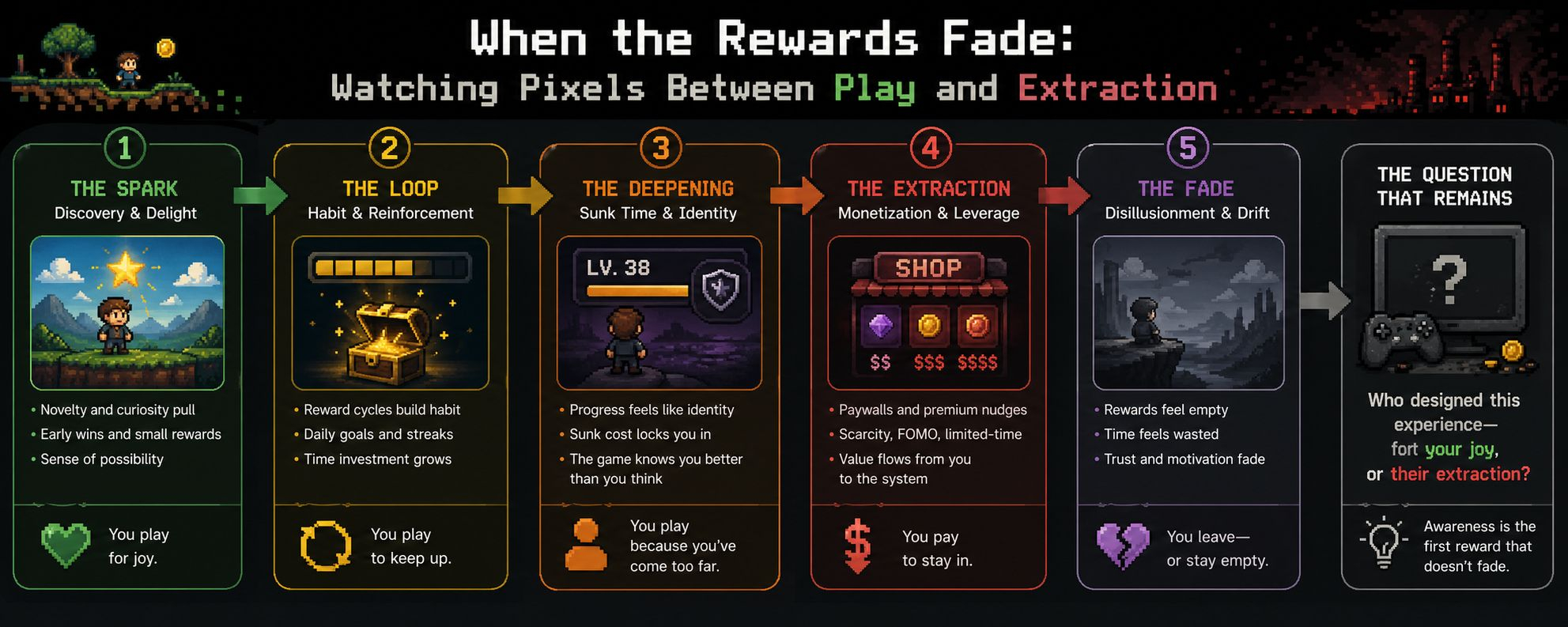
At first, players arrive like players. Curious, relaxed, exploring. But if there’s a token attached—and there always is—that curiosity slowly starts bending toward efficiency. Time becomes measurable. Actions become optimized. And before long, what felt like a world starts feeling like a system to extract from.
That shift is subtle. You don’t notice it all at once.
You just wake up one day and realize people aren’t really “playing” anymore—they’re operating.
That’s the cycle I keep in my head when I look at Pixels.
To its credit, it doesn’t feel completely naive about this. You can see the team trying to shape behavior instead of just rewarding it blindly. There’s friction layered into the system now—energy constraints, crafting requirements, progression gates. You can’t just run an infinite loop and print value without thinking. At least, not easily.
And that matters.
Because unlimited output is where most GameFi economies quietly die. It feels good at first—everyone’s earning, activity looks high, numbers go up. But behind that, there’s no resistance. No cost. No reason to slow down. And eventually, everything starts flowing in one direction: out of the system.
Pixels seems to be trying to push against that.
Land ownership plays a role here. Not just as an asset, but as a kind of anchor. It creates a sense—maybe artificial, maybe real—of having something at stake. Resources flow differently when players feel like they’re tied to a place, not just passing through.
Crafting loops also help. Instead of rewards being immediately liquid, there’s an attempt to keep value moving inside the ecosystem. You gather, you refine, you trade, you use. It’s a small thing, but it changes the texture of the economy. It slows things down, even if only slightly.
And slowing things down is important.
Because attention in crypto moves fast, but sustainability doesn’t.
When Pixels expanded through the Ronin ecosystem, you could feel that speed pick up. More players, easier onboarding, more visibility. On paper, it looked like growth. And maybe it was. But growth in this space is always double-edged.
More people doesn’t always mean more health.
Sometimes it just means more pressure.
New players don’t arrive with the same mindset. Some explore, sure. But many come with intent. They’ve seen this before too. They know where the value sits, and they move toward it quickly. Faster than the system expects.
That’s where things get tested.
Because a system doesn’t break when it’s small—it breaks when it’s used at scale.
I’ve been paying attention to how Pixels responds to that pressure. There have been adjustments. Emissions tweaked, rewards rebalanced, loops tightened. It’s not static, which is a good sign. But constant adjustment also tells you something else: the balance isn’t fully solved yet.
And maybe it never is.
What matters more is whether those adjustments actually shape behavior over time, or just temporarily patch leaks.
Because players adapt faster than systems do.
If there’s still an easy path to extract, it will be found again. Maybe not in the same place, but somewhere else. That’s just how this space works.
So I keep coming back to a quieter question: what makes someone stay here when the easy value isn’t obvious anymore?
Not when rewards are high. Not when attention is fresh.
But later—when things slow down.
Right now, Pixels offers a kind of low-pressure presence. You can dip in and out without feeling punished. And I like that. It respects time in a way most GameFi projects don’t. But it also makes me wonder what holds people emotionally.
Because if it’s easy to enter, it should also be easy to leave.
Unless something deeper forms.
That’s where I think the social layer becomes important. Not just chat features or shared spaces, but actual interdependence between players. Trade, cooperation, small reputations that build over time. Those things don’t show up in token charts, but they’re often what keep systems alive when incentives weaken.
I’m not sure Pixels is fully there yet.
It has the pieces, but they still feel a bit loose. Like they haven’t locked into something meaningful enough to resist the pull of pure optimization.
And optimization is always waiting in the background.
That’s the quiet truth of all of this.
No matter how soft the world looks, no matter how friendly the design feels—if the incentives allow it, behavior will eventually turn sharp. Efficient. Extractive. Focused on output over experience.
The system doesn’t get to decide that. People do.
So when I look at Pixels, I don’t really ask if it’s “good” or “bad.” That framing feels too shallow.
I ask whether it’s learning.
Whether it’s building enough friction to slow extraction without killing curiosity. Whether it’s creating enough internal movement of value to avoid constant leakage. Whether it’s giving people reasons to stay that aren’t purely financial.
And I don’t have clean answers yet.
It doesn’t feel broken. But it doesn’t feel secure either.
It feels… in progress.
Like something that’s aware of the mistakes that came before it, but still figuring out how to fully avoid them.
And maybe that’s the most honest place a project like this can be.
Because in this space, confidence is easy to fake—but sustainability is not.
So I keep checking in, not out of belief, but out of interest.
Watching how behavior shifts. Watching how the system responds. Watching what happens when attention fades a little, or when pressure quietly builds.
That’s when the real story starts to show.
Not in the moments when everything is working—but in the moments when it’s forced to prove that it can keep working.
Pixels hasn’t reached that moment yet.
But it will.
And when it does, that’s when I’ll know what it really is.
And maybe that’s where the real story of Pixels begins.
Not in the calm moments when everything feels easy—but in the quiet pressure that builds underneath.
Because sooner or later, the rewards slow down… and the intention gets exposed.
That’s when the farmers drift, the numbers thin out, and what’s left behind starts to speak for itself.
Not through hype, not through metrics—but through behavior that can’t be faked anymore.
I’m not watching to see it succeed.
I’m watching to see what survives when there’s nothing left to extract.
