
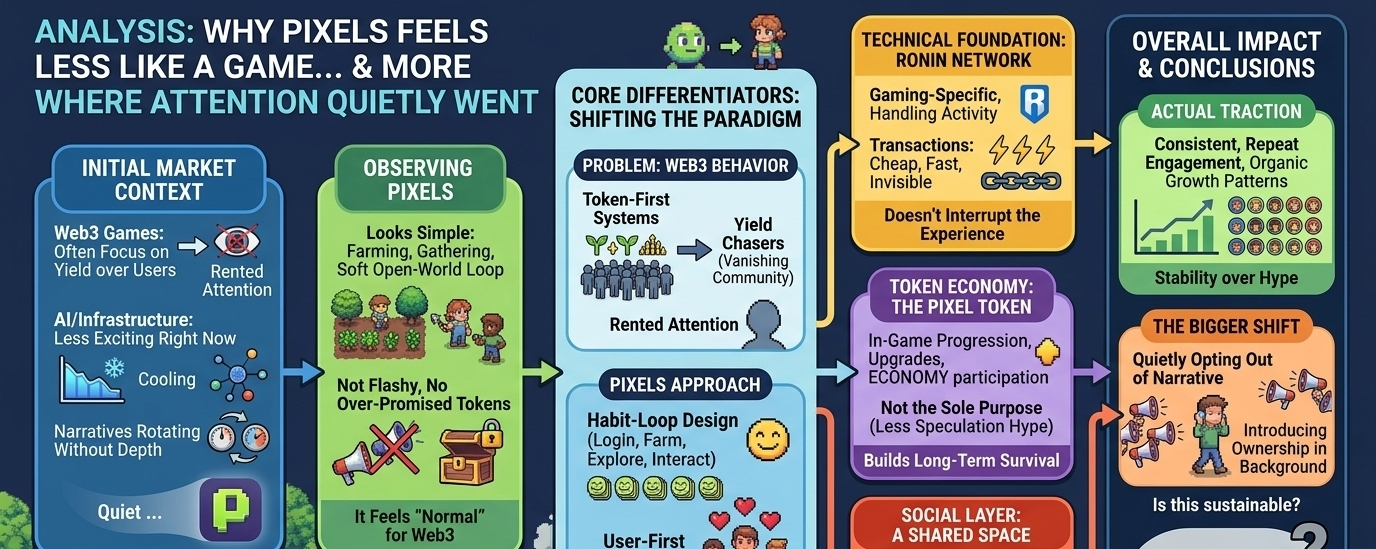

I wasn’t even looking at Web3 games when Pixels crossed my screen again. Lately I’ve been more focused on where liquidity is hesitating, not where it’s rushing. You can feel it in the market right now. Things still move, but conviction doesn’t stick the way it used to. AI had its run, infrastructure still feels necessary but not exciting, and a lot of narratives are just… rotating without depth. So when something keeps showing up quietly, without forcing itself into the spotlight, I tend to pay attention.
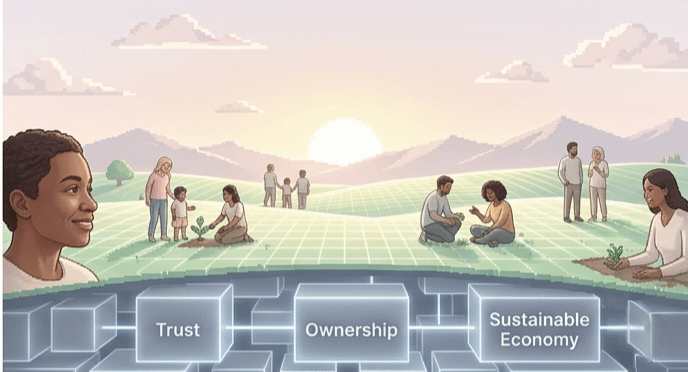
That’s what happened with Pixels.
At first glance, it doesn’t look like much. Farming, gathering, a soft open-world loop that feels almost too simple. No aggressive token promises, no over-engineered mechanics trying to prove a point. And honestly, that’s what caught me off guard. I didn’t expect a Web3 game to feel this… normal.
But the more I sat with it, the more I realized that might actually be the point.
One of the biggest problems I’ve noticed with Web3 gaming isn’t technology. It’s behavior. Most projects build around tokens first and users second. You end up with systems where people show up for yield, not because they want to be there. The moment incentives shift, the entire “community” disappears. It’s not retention, it’s rented attention.
Pixels seems to be approaching that differently. From what I’m seeing, it’s designed around habit loops rather than financial loops. You log in, you farm, you explore, you interact. It’s not trying to overwhelm you with complexity. It’s trying to keep you coming back without making it feel like work.
That distinction matters more than people think.
Under the hood, it’s powered by the Ronin Network, which already has a reputation for handling gaming-specific activity better than most chains. Transactions are cheap, fast, and more importantly, invisible enough that they don’t interrupt the experience. That’s something a lot of projects underestimate. If users feel the chain, you’ve already lost them.
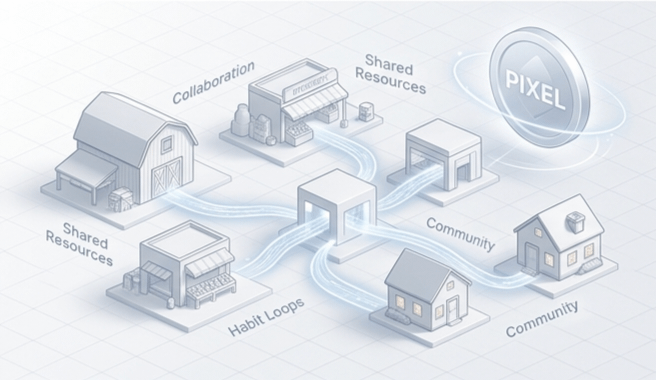
The PIXEL token sits on top of this ecosystem, but it doesn’t feel like the entire point of the system. It’s used for in-game progression, upgrades, and participation in the economy, but the game itself doesn’t collapse without constant token speculation. That’s a subtle but important shift. It suggests the team is trying to build something that can survive beyond short-term hype cycles.
I’ve also noticed how the social layer plays into everything. Pixels isn’t just about farming mechanics, it’s about shared space. People trading, collaborating, just existing in the same environment. That might sound basic, but in Web3, it’s actually rare. Most “multiplayer” experiences feel isolated once the rewards dry up. Here, the interaction seems to have its own weight.

And then there’s the traction. You don’t need to dig too deep to see that users are actually showing up. Not just wallets, but behavior. Consistent activity, repeat engagement, organic growth patterns. That’s different from the usual spike-and-fade cycles I’ve seen in other Web3 games. It doesn’t feel explosive, but it feels stable. And right now, stability might be more valuable than hype.
If I compare it to other projects in the space, a lot of them are still trying to prove that Web3 gaming can be “better” than traditional gaming. Pixels doesn’t seem interested in that argument. It’s not trying to outcompete AAA titles or reinvent gameplay. It’s doing something quieter. It’s blending in, while slowly introducing ownership and economy in the background.
That approach might actually be more dangerous in the long run. Not because it’s flashy, but because it’s sustainable.
That said, I don’t think it’s risk-free. The token model still has to hold up over time. If emissions outpace real demand, the same issues we’ve seen before could creep in. There’s also the broader question of whether casual gameplay alone can maintain long-term engagement without deeper content layers. And of course, competition isn’t standing still. Other ecosystems are watching this shift toward simplicity and social-first design.
But here’s the part I keep coming back to.
Pixels doesn’t feel like it’s trying to win the narrative. It feels like it’s quietly opting out of it.
And in a market where everything is constantly fighting for attention, that might be its biggest advantage.

I didn’t expect to spend this much time thinking about a farming game. But the more I look at it, the more it feels like a small signal of a bigger shift. Maybe Web3 gaming doesn’t need to be louder or more complex. Maybe it just needs to feel natural enough that people forget they’re even participating in a blockchain system.
I’m still not fully convinced this is the final form of where things go. But I can’t ignore what I’m seeing either.
If attention is the most valuable asset in this market, then the real question isn’t whether Pixels can scale.
It’s whether this kind of quiet, behavior-first design is where attention actually wants to stay next.
