
In recent years, the rapid development of decentralized finance (DeFi) has injected new vitality into the blockchain ecosystem, with lending as one of the core tracks of DeFi always being the focus of user and capital attention. The launch of ListaLending on the BNB Chain, an efficient and low-cost public chain ecosystem, marks another significant innovation in the lending market. It not only optimizes the efficiency issues of traditional lending models but also provides users and developers with more flexible and efficient financial services through innovative mechanism design.
1. The Perfect Combination of Efficiency and Low Cost
With its high throughput and low transaction costs, the BNB Chain has become the platform of choice for many DeFi projects. ListaLending fully leverages this advantage by automating the lending process through smart contracts, reducing the intermediary steps found in traditional finance, allowing users to complete lending operations at a lower cost. Whether for collateral lending or liquidity mining, ListaLending maximizes fund utilization efficiency while ensuring safety.
2. Innovative Collateral and Liquidation Mechanisms
ListaLending introduces dynamic collateral rate adjustments and a progressive liquidation mechanism, which can respond more accurately to market fluctuations compared to traditional lending protocols, reducing the risk of forced liquidation for users due to sharp price volatility. At the same time, its unique risk control model balances the rights and interests of both lenders and borrowers, enhancing the overall market stability.
3. Multi-Asset Support and Cross-Chain Compatibility
ListaLending not only supports mainstream assets on the BNB Chain but also utilizes cross-chain technology to accommodate high-quality assets from other ecosystems, further broadening users' options for collateral and lending. This openness allows more funds to flow into the BNB Chain, promoting the prosperity of the entire ecosystem.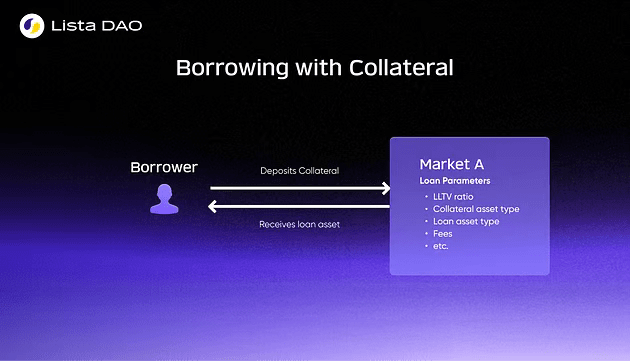
4. User Incentives and Community Governance
ListaLending allows users to not only participate in lending through token incentives and a DAO governance model but also to share in the dividends of protocol development through staking and voting. This decentralized governance approach enhances community cohesion, enabling the protocol to iterate and optimize more quickly.
Conclusion: The launch of ListaLending is not only an upgrade of the lending market on the BNB Chain but also an important step towards a more efficient and inclusive financial system in the DeFi space. In the future, with the implementation of more innovative features and the expansion of ecological cooperation, ListaLending is expected to become one of the most influential lending protocols on the BNB Chain, further promoting the popularization and development of decentralized finance.