
#ironclaw
ironclaw
3,883 visualizações
16 a discutir
Popular
Mais recente

Verificado
Artigo
Ver tradução
NEAR IronClaw 1.0: WHEN AI AGENTS LEARN TO THINK, ACT AND RECOVERArtificial intelligence is moving beyond chatbots.
The next generation of AI is being built around agents that can reason, use tools, execute tasks and continue working with minimal human intervention.
But greater autonomy creates a fundamental challenge:
How do we give AI the ability to act without giving up security, privacy and user control?
@NEAR_Protocol ’s IronClaw 1.0 offers an interesting answer.
IronClaw 1.0: A Different Architecture for AI Agents
IronClaw 1.0 is built around a simple but important architectural distinction: separating the part of an AI system that decides from the part that acts.
NEAR AI describes the architecture this way:
“the part that decides is distinct from the part that acts”
Between those two components sits a secure coordination layer called the guard.
The architecture can be understood as:
Think → Guard → Act
The AI model handles decision making.
The guard evaluates and controls the proposed action.
The execution layer then performs the approved action.
This separation creates a clearer boundary between intelligence and authority.
Instead of allowing an AI model to directly control every tool available to it, the guard becomes the checkpoint through which actions pass.
For sensitive operations, #IronClaw can require explicit approval before execution.
That distinction could become increasingly important as AI agents move from generating information to taking meaningful actions on behalf of users.
Benchmark Performance: Capability Meets Architecture
Security alone is not enough.
An AI agent also needs to perform.
IronClaw 1.0 has reported strong results across three benchmarks using the deepseek-v4-flash base model:
93.5% on PinchBench
88.6% on ClawBench
76.4% on OfficeQA
#NEARAI reports that IronClaw takes the top position across all three benchmarks highlighted in its announcement. The tests cover different aspects of agent performance, from real-world task execution and live web interactions to reasoning over enterprise documents.
What makes these results particularly interesting is the combination of performance and architecture.
PinchBench evaluates agents across 147 real tasks, including scheduling meetings, managing email, coding, research and file management.
ClawBench moves agents onto more than 140 real production websites and evaluates multi-step tasks.
OfficeQA focuses on grounded reasoning across a huge collection of enterprise documents.
So the numbers are not simply about how well a model can answer a question.
They are about how effectively an agent can get things done.
That is an important distinction in the emerging agent economy.
The Architecture Behind the Numbers
NEAR AI makes an interesting argument about why IronClaw was rebuilt rather than simply patched.
“Properties like those are not features you add; they are foundations you build on.”
That philosophy is visible in several IronClaw features.
1. Safer by Design
Every action passes through the guard.
Sensitive actions can require explicit approval instead of allowing the agent to act first and explain later.
IronClaw also uses protections around credentials and secrets, creating a more controlled environment for autonomous execution.
The bigger lesson is that security is being treated as part of the architecture rather than a feature added after the agent has already been built.
2. Persistent State
Autonomous workflows can involve multiple steps and may take considerable time.
An interruption should not mean losing everything.
IronClaw continuously checkpoints its progress, allowing work to resume instead of forcing the agent to start from scratch.
NEAR AI puts it particularly clearly:
“an interruption costs a pause, not the task.”
That may sound like a small technical improvement, but it changes the usability of autonomous AI considerably.
An assistant that remembers where it stopped can support longer and more complicated workflows.
3. Omni Channel Memory
IronClaw is designed to operate across:
CLI
Web
Slack
Telegram
More importantly, these channels operate as one assistant with shared memory and safety rules.
NEAR AI describes the experience as:
“CLI, web, Slack, and Telegram run as one assistant”
This matters because users increasingly work across multiple environments.
The value of an AI agent should not disappear simply because the user moves from a terminal to a messaging application.
4. Team Isolation
Enterprise AI introduces another challenge: who gets access to what?
Different employees and teams may need different workspaces, permissions and data boundaries.
IronClaw supports multi-tenant deployments where tools and capabilities can be shared across an organization while individual workspaces remain separated.
Organizations that require stronger isolation can also use single-tenant deployments.
This gives IronClaw a more practical enterprise dimension.
The challenge is no longer just creating an intelligent agent.
It is creating one that can operate inside an organization without turning every permission boundary into a security problem.
NEAR AI: The Bigger Vision
IronClaw 1.0 should not be viewed in isolation.
It is part of the broader NEAR AI vision around private, verifiable and user controlled artificial intelligence.
The infrastructure behind that vision includes confidential computing and Trusted Execution Environments, which are designed to protect sensitive workloads while providing ways to verify where computation took place.
This becomes increasingly important when AI moves from answering questions to handling private information and performing actions.
An agent may need access to email, documents, applications, financial information or business workflows.
In that environment, privacy cannot simply be a promise.
It needs to be part of the infrastructure.
Where NEAR Staking Fits
This is where the staking component becomes especially interesting.
NEAR AI has introduced Staking for NEAR AI, allowing users to stake $NEAR to obtain credits for confidential inference and agent hosting.
According to NEAR AI:
“You keep the NEAR, and it funds your NEAR AI usage at the same time.”
The model supports both confidential inference and IronClaw agent hosting.
For IronClaw specifically, the staked amount determines the monthly credit budget and how many agents can run in parallel.
This creates an interesting relationship between ownership and AI usage.
Instead of simply paying a centralized provider with a conventional subscription, users can connect their NEAR holdings directly to access AI infrastructure.
But there is a deeper point here.
Staking is not only about yield.
It can also be viewed as participation in the infrastructure that decentralized applications depend on.
AI agents need compute.
They need secure execution.
They need persistent infrastructure.
And decentralized infrastructure needs an economic mechanism that supports participation and security.
NEAR AI's staking model attempts to bring those elements closer together.
As NEAR AI explains:
“Staking closes the loop between what you hold and what you run”
That is perhaps one of the most interesting ideas surrounding the development of decentralized AI.
Why IronClaw Matters
The most interesting part of IronClaw 1.0 is not simply that it is another AI agent framework.
It represents a broader shift in how we think about autonomous AI.
The traditional model is:
AI generates → Human decides → Human acts
The emerging agentic model is closer to:
AI reasons → Guard verifies → Agent acts
That requires a different approach to security.
An autonomous agent needs boundaries.
It needs memory.
It needs persistence.
It needs controlled permissions.
And ultimately, users need confidence that the system remains accountable to them.
IronClaw addresses several of these challenges at the framework level.
NEAR AI extends the conversation into privacy, verifiability and user ownership.
Staking adds another layer by connecting users to the infrastructure powering AI services.
The Bigger Picture
The AI race is often framed around who has the smartest model.
But the next stage may be less about models alone and more about infrastructure.
Who controls the agent?
Who controls the data?
Who verifies the computation?
Who decides what actions can be executed?
And who secures the infrastructure underneath it all?
IronClaw 1.0 provides one possible answer to the first layer of that problem: build agents with a clear separation between thinking and acting.
NEAR AI addresses the infrastructure layer with privacy and verifiability.
Staking connects users to AI services through their NEAR holdings.
Together, these developments point toward a model of AI that is not simply more autonomous, but potentially more secure, persistent, verifiable and user controlled.
The real breakthrough in AI may therefore not be an agent that can do everything.
It may be an agent that can do more without taking control away from the person it serves.
References
1. NEAR AI — Introducing IronClaw 1.0: The Leader Across PinchBench, ClawBench, and OfficeQA Agent Benchmarks
July 27, 2026.
Primary source for IronClaw 1.0’s architecture, guard layer, benchmark performance, persistent state, omni channel support and team isolation.
2. NEAR AI — Announcing Staking for NEAR AI: Put Your NEAR to Work Powering Confidential AI
July 30, 2026.
Primary source for NEAR AI staking, confidential inference, AI compute credits and IronClaw agent hosting.
3. NEAR AI — Confidential AI Infrastructure
Official overview of NEAR AI’s confidential AI infrastructure and IronClaw ecosystem.
4. NEAR — The currency of agents
Official NEAR overview of its infrastructure for the emerging agent economy, including NEAR AI, confidential inference and IronClaw.
$NVDAB
NEAR IronClaw 1.0: WHEN AI AGENTS LEARN TO THINK, ACT AND RECOVER
Artificial intelligence is moving beyond chatbots.
The next generation of AI is being built around agents that can reason, use tools, execute tasks and continue working with minimal human intervention.
But greater autonomy creates a fundamental challenge:
How do we give AI the ability to act without giving up security, privacy and user control?
@NEAR Protocol ’s IronClaw 1.0 offers an interesting answer.
IronClaw 1.0: A Different Architecture for AI Agents
IronClaw 1.0 is built around a simple but important architectural distinction: separating the part of an AI system that decides from the part that acts.
NEAR AI describes the architecture this way:
“the part that decides is distinct from the part that acts”
Between those two components sits a secure coordination layer called the guard.
The architecture can be understood as:
Think → Guard → Act
The AI model handles decision making.
The guard evaluates and controls the proposed action.
The execution layer then performs the approved action.
This separation creates a clearer boundary between intelligence and authority.
Instead of allowing an AI model to directly control every tool available to it, the guard becomes the checkpoint through which actions pass.
For sensitive operations, #IronClaw can require explicit approval before execution.
That distinction could become increasingly important as AI agents move from generating information to taking meaningful actions on behalf of users.
Benchmark Performance: Capability Meets Architecture
Security alone is not enough.
An AI agent also needs to perform.
IronClaw 1.0 has reported strong results across three benchmarks using the deepseek-v4-flash base model:
93.5% on PinchBench
88.6% on ClawBench
76.4% on OfficeQA
#NEARAI reports that IronClaw takes the top position across all three benchmarks highlighted in its announcement. The tests cover different aspects of agent performance, from real-world task execution and live web interactions to reasoning over enterprise documents.
What makes these results particularly interesting is the combination of performance and architecture.
PinchBench evaluates agents across 147 real tasks, including scheduling meetings, managing email, coding, research and file management.
ClawBench moves agents onto more than 140 real production websites and evaluates multi-step tasks.
OfficeQA focuses on grounded reasoning across a huge collection of enterprise documents.
So the numbers are not simply about how well a model can answer a question.
They are about how effectively an agent can get things done.
That is an important distinction in the emerging agent economy.
The Architecture Behind the Numbers
NEAR AI makes an interesting argument about why IronClaw was rebuilt rather than simply patched.
“Properties like those are not features you add; they are foundations you build on.”
That philosophy is visible in several IronClaw features.
1. Safer by Design
Every action passes through the guard.
Sensitive actions can require explicit approval instead of allowing the agent to act first and explain later.
IronClaw also uses protections around credentials and secrets, creating a more controlled environment for autonomous execution.
The bigger lesson is that security is being treated as part of the architecture rather than a feature added after the agent has already been built.
2. Persistent State
Autonomous workflows can involve multiple steps and may take considerable time.
An interruption should not mean losing everything.
IronClaw continuously checkpoints its progress, allowing work to resume instead of forcing the agent to start from scratch.
NEAR AI puts it particularly clearly:
“an interruption costs a pause, not the task.”
That may sound like a small technical improvement, but it changes the usability of autonomous AI considerably.
An assistant that remembers where it stopped can support longer and more complicated workflows.
3. Omni Channel Memory
IronClaw is designed to operate across:
CLI
Web
Slack
Telegram
More importantly, these channels operate as one assistant with shared memory and safety rules.
NEAR AI describes the experience as:
“CLI, web, Slack, and Telegram run as one assistant”
This matters because users increasingly work across multiple environments.
The value of an AI agent should not disappear simply because the user moves from a terminal to a messaging application.
4. Team Isolation
Enterprise AI introduces another challenge: who gets access to what?
Different employees and teams may need different workspaces, permissions and data boundaries.
IronClaw supports multi-tenant deployments where tools and capabilities can be shared across an organization while individual workspaces remain separated.
Organizations that require stronger isolation can also use single-tenant deployments.
This gives IronClaw a more practical enterprise dimension.
The challenge is no longer just creating an intelligent agent.
It is creating one that can operate inside an organization without turning every permission boundary into a security problem.
NEAR AI: The Bigger Vision
IronClaw 1.0 should not be viewed in isolation.
It is part of the broader NEAR AI vision around private, verifiable and user controlled artificial intelligence.
The infrastructure behind that vision includes confidential computing and Trusted Execution Environments, which are designed to protect sensitive workloads while providing ways to verify where computation took place.
This becomes increasingly important when AI moves from answering questions to handling private information and performing actions.
An agent may need access to email, documents, applications, financial information or business workflows.
In that environment, privacy cannot simply be a promise.
It needs to be part of the infrastructure.
Where NEAR Staking Fits
This is where the staking component becomes especially interesting.
NEAR AI has introduced Staking for NEAR AI, allowing users to stake $NEAR to obtain credits for confidential inference and agent hosting.
According to NEAR AI:
“You keep the NEAR, and it funds your NEAR AI usage at the same time.”
The model supports both confidential inference and IronClaw agent hosting.
For IronClaw specifically, the staked amount determines the monthly credit budget and how many agents can run in parallel.
This creates an interesting relationship between ownership and AI usage.
Instead of simply paying a centralized provider with a conventional subscription, users can connect their NEAR holdings directly to access AI infrastructure.
But there is a deeper point here.
Staking is not only about yield.
It can also be viewed as participation in the infrastructure that decentralized applications depend on.
AI agents need compute.
They need secure execution.
They need persistent infrastructure.
And decentralized infrastructure needs an economic mechanism that supports participation and security.
NEAR AI's staking model attempts to bring those elements closer together.
As NEAR AI explains:
“Staking closes the loop between what you hold and what you run”
That is perhaps one of the most interesting ideas surrounding the development of decentralized AI.
Why IronClaw Matters
The most interesting part of IronClaw 1.0 is not simply that it is another AI agent framework.
It represents a broader shift in how we think about autonomous AI.
The traditional model is:
AI generates → Human decides → Human acts
The emerging agentic model is closer to:
AI reasons → Guard verifies → Agent acts
That requires a different approach to security.
An autonomous agent needs boundaries.
It needs memory.
It needs persistence.
It needs controlled permissions.
And ultimately, users need confidence that the system remains accountable to them.
IronClaw addresses several of these challenges at the framework level.
NEAR AI extends the conversation into privacy, verifiability and user ownership.
Staking adds another layer by connecting users to the infrastructure powering AI services.
The Bigger Picture
The AI race is often framed around who has the smartest model.
But the next stage may be less about models alone and more about infrastructure.
Who controls the agent?
Who controls the data?
Who verifies the computation?
Who decides what actions can be executed?
And who secures the infrastructure underneath it all?
IronClaw 1.0 provides one possible answer to the first layer of that problem: build agents with a clear separation between thinking and acting.
NEAR AI addresses the infrastructure layer with privacy and verifiability.
Staking connects users to AI services through their NEAR holdings.
Together, these developments point toward a model of AI that is not simply more autonomous, but potentially more secure, persistent, verifiable and user controlled.
The real breakthrough in AI may therefore not be an agent that can do everything.
It may be an agent that can do more without taking control away from the person it serves.
References
1. NEAR AI — Introducing IronClaw 1.0: The Leader Across PinchBench, ClawBench, and OfficeQA Agent Benchmarks
July 27, 2026.
Primary source for IronClaw 1.0’s architecture, guard layer, benchmark performance, persistent state, omni channel support and team isolation.
2. NEAR AI — Announcing Staking for NEAR AI: Put Your NEAR to Work Powering Confidential AI
July 30, 2026.
Primary source for NEAR AI staking, confidential inference, AI compute credits and IronClaw agent hosting.
3. NEAR AI — Confidential AI Infrastructure
Official overview of NEAR AI’s confidential AI infrastructure and IronClaw ecosystem.
4. NEAR — The currency of agents
Official NEAR overview of its infrastructure for the emerging agent economy, including NEAR AI, confidential inference and IronClaw.
$NVDAB
The next generation of AI is being built around agents that can reason, use tools, execute tasks and continue working with minimal human intervention.
But greater autonomy creates a fundamental challenge:
How do we give AI the ability to act without giving up security, privacy and user control?
@NEAR Protocol ’s IronClaw 1.0 offers an interesting answer.
IronClaw 1.0: A Different Architecture for AI Agents
IronClaw 1.0 is built around a simple but important architectural distinction: separating the part of an AI system that decides from the part that acts.
NEAR AI describes the architecture this way:
“the part that decides is distinct from the part that acts”
Between those two components sits a secure coordination layer called the guard.
The architecture can be understood as:
Think → Guard → Act
The AI model handles decision making.
The guard evaluates and controls the proposed action.
The execution layer then performs the approved action.
This separation creates a clearer boundary between intelligence and authority.
Instead of allowing an AI model to directly control every tool available to it, the guard becomes the checkpoint through which actions pass.
For sensitive operations, #IronClaw can require explicit approval before execution.
That distinction could become increasingly important as AI agents move from generating information to taking meaningful actions on behalf of users.
Benchmark Performance: Capability Meets Architecture
Security alone is not enough.
An AI agent also needs to perform.
IronClaw 1.0 has reported strong results across three benchmarks using the deepseek-v4-flash base model:
93.5% on PinchBench
88.6% on ClawBench
76.4% on OfficeQA
#NEARAI reports that IronClaw takes the top position across all three benchmarks highlighted in its announcement. The tests cover different aspects of agent performance, from real-world task execution and live web interactions to reasoning over enterprise documents.
What makes these results particularly interesting is the combination of performance and architecture.
PinchBench evaluates agents across 147 real tasks, including scheduling meetings, managing email, coding, research and file management.
ClawBench moves agents onto more than 140 real production websites and evaluates multi-step tasks.
OfficeQA focuses on grounded reasoning across a huge collection of enterprise documents.
So the numbers are not simply about how well a model can answer a question.
They are about how effectively an agent can get things done.
That is an important distinction in the emerging agent economy.
The Architecture Behind the Numbers
NEAR AI makes an interesting argument about why IronClaw was rebuilt rather than simply patched.
“Properties like those are not features you add; they are foundations you build on.”
That philosophy is visible in several IronClaw features.
1. Safer by Design
Every action passes through the guard.
Sensitive actions can require explicit approval instead of allowing the agent to act first and explain later.
IronClaw also uses protections around credentials and secrets, creating a more controlled environment for autonomous execution.
The bigger lesson is that security is being treated as part of the architecture rather than a feature added after the agent has already been built.
2. Persistent State
Autonomous workflows can involve multiple steps and may take considerable time.
An interruption should not mean losing everything.
IronClaw continuously checkpoints its progress, allowing work to resume instead of forcing the agent to start from scratch.
NEAR AI puts it particularly clearly:
“an interruption costs a pause, not the task.”
That may sound like a small technical improvement, but it changes the usability of autonomous AI considerably.
An assistant that remembers where it stopped can support longer and more complicated workflows.
3. Omni Channel Memory
IronClaw is designed to operate across:
CLI
Web
Slack
Telegram
More importantly, these channels operate as one assistant with shared memory and safety rules.
NEAR AI describes the experience as:
“CLI, web, Slack, and Telegram run as one assistant”
This matters because users increasingly work across multiple environments.
The value of an AI agent should not disappear simply because the user moves from a terminal to a messaging application.
4. Team Isolation
Enterprise AI introduces another challenge: who gets access to what?
Different employees and teams may need different workspaces, permissions and data boundaries.
IronClaw supports multi-tenant deployments where tools and capabilities can be shared across an organization while individual workspaces remain separated.
Organizations that require stronger isolation can also use single-tenant deployments.
This gives IronClaw a more practical enterprise dimension.
The challenge is no longer just creating an intelligent agent.
It is creating one that can operate inside an organization without turning every permission boundary into a security problem.
NEAR AI: The Bigger Vision
IronClaw 1.0 should not be viewed in isolation.
It is part of the broader NEAR AI vision around private, verifiable and user controlled artificial intelligence.
The infrastructure behind that vision includes confidential computing and Trusted Execution Environments, which are designed to protect sensitive workloads while providing ways to verify where computation took place.
This becomes increasingly important when AI moves from answering questions to handling private information and performing actions.
An agent may need access to email, documents, applications, financial information or business workflows.
In that environment, privacy cannot simply be a promise.
It needs to be part of the infrastructure.
Where NEAR Staking Fits
This is where the staking component becomes especially interesting.
NEAR AI has introduced Staking for NEAR AI, allowing users to stake $NEAR to obtain credits for confidential inference and agent hosting.
According to NEAR AI:
“You keep the NEAR, and it funds your NEAR AI usage at the same time.”
The model supports both confidential inference and IronClaw agent hosting.
For IronClaw specifically, the staked amount determines the monthly credit budget and how many agents can run in parallel.
This creates an interesting relationship between ownership and AI usage.
Instead of simply paying a centralized provider with a conventional subscription, users can connect their NEAR holdings directly to access AI infrastructure.
But there is a deeper point here.
Staking is not only about yield.
It can also be viewed as participation in the infrastructure that decentralized applications depend on.
AI agents need compute.
They need secure execution.
They need persistent infrastructure.
And decentralized infrastructure needs an economic mechanism that supports participation and security.
NEAR AI's staking model attempts to bring those elements closer together.
As NEAR AI explains:
“Staking closes the loop between what you hold and what you run”
That is perhaps one of the most interesting ideas surrounding the development of decentralized AI.
Why IronClaw Matters
The most interesting part of IronClaw 1.0 is not simply that it is another AI agent framework.
It represents a broader shift in how we think about autonomous AI.
The traditional model is:
AI generates → Human decides → Human acts
The emerging agentic model is closer to:
AI reasons → Guard verifies → Agent acts
That requires a different approach to security.
An autonomous agent needs boundaries.
It needs memory.
It needs persistence.
It needs controlled permissions.
And ultimately, users need confidence that the system remains accountable to them.
IronClaw addresses several of these challenges at the framework level.
NEAR AI extends the conversation into privacy, verifiability and user ownership.
Staking adds another layer by connecting users to the infrastructure powering AI services.
The Bigger Picture
The AI race is often framed around who has the smartest model.
But the next stage may be less about models alone and more about infrastructure.
Who controls the agent?
Who controls the data?
Who verifies the computation?
Who decides what actions can be executed?
And who secures the infrastructure underneath it all?
IronClaw 1.0 provides one possible answer to the first layer of that problem: build agents with a clear separation between thinking and acting.
NEAR AI addresses the infrastructure layer with privacy and verifiability.
Staking connects users to AI services through their NEAR holdings.
Together, these developments point toward a model of AI that is not simply more autonomous, but potentially more secure, persistent, verifiable and user controlled.
The real breakthrough in AI may therefore not be an agent that can do everything.
It may be an agent that can do more without taking control away from the person it serves.
References
1. NEAR AI — Introducing IronClaw 1.0: The Leader Across PinchBench, ClawBench, and OfficeQA Agent Benchmarks
July 27, 2026.
Primary source for IronClaw 1.0’s architecture, guard layer, benchmark performance, persistent state, omni channel support and team isolation.
2. NEAR AI — Announcing Staking for NEAR AI: Put Your NEAR to Work Powering Confidential AI
July 30, 2026.
Primary source for NEAR AI staking, confidential inference, AI compute credits and IronClaw agent hosting.
3. NEAR AI — Confidential AI Infrastructure
Official overview of NEAR AI’s confidential AI infrastructure and IronClaw ecosystem.
4. NEAR — The currency of agents
Official NEAR overview of its infrastructure for the emerging agent economy, including NEAR AI, confidential inference and IronClaw.
$NVDAB
1
271

·
--
Artigo
Agentes de IA estão ficando mais capazes. O problema mais difícil é saber onde traçar a linha.A IA já foi além de responder perguntas.
A mudança mais significativa acontece quando um sistema de IA consegue agir.
Um agente pode navegar, pesquisar, trabalhar com arquivos, usar ferramentas externas, se comunicar por diferentes canais e continuar uma tarefa sem ser orientado por cada etapa individual.
Isso cria um problema de infraestrutura diferente.
Quando um software pode agir em seu nome, capacidade já não é suficiente. Você também precisa saber o que o agente está autorizado a fazer, o que fica entre suas decisões e suas ações e o que acontece quando algo dá errado.
Agentes de IA estão ficando mais capazes. O problema mais difícil é saber onde traçar a linha.
A IA já foi além de responder perguntas.
A mudança mais significativa acontece quando um sistema de IA consegue agir.
Um agente pode navegar, pesquisar, trabalhar com arquivos, usar ferramentas externas, se comunicar por diferentes canais e continuar uma tarefa sem ser orientado por cada etapa individual.
Isso cria um problema de infraestrutura diferente.
Quando um software pode agir em seu nome, capacidade já não é suficiente. Você também precisa saber o que o agente está autorizado a fazer, o que fica entre suas decisões e suas ações e o que acontece quando algo dá errado.
A mudança mais significativa acontece quando um sistema de IA consegue agir.
Um agente pode navegar, pesquisar, trabalhar com arquivos, usar ferramentas externas, se comunicar por diferentes canais e continuar uma tarefa sem ser orientado por cada etapa individual.
Isso cria um problema de infraestrutura diferente.
Quando um software pode agir em seu nome, capacidade já não é suficiente. Você também precisa saber o que o agente está autorizado a fazer, o que fica entre suas decisões e suas ações e o que acontece quando algo dá errado.
Oria Ores:
Trust should not be based on promises, but on architecture and cryptography. By separating reasoning from execution and securing processes with TEE and WebAssembly, they went from "believing" AI to securely verifying every action. 🔒
3
5
128

Artigo
IronClaw 1.0 e a infraestrutura por trás de uma IA de propriedade do usuárioAgentes de IA estão indo além de responder perguntas. Cada vez mais, espera-se que eles tomem ações, trabalhem entre diferentes aplicações, lembrem tarefas anteriores e operem por longos períodos sem supervisão constante. Isso cria uma questão difícil: como você faz um agente de IA suficientemente capaz para agir, sem conceder a ele acesso irrestrito a tudo o que ele consegue tocar?
l
O IronClaw 1.0 da NEAR adota uma abordagem arquitetural diferente.
Separando o Pensamento da Ação
O IronClaw 1.0 é um agente de IA construído em torno de uma separação simples, mas importante: o componente responsável por decidir o que deve acontecer é separado do componente que realmente executa a ação.
IronClaw 1.0 e a infraestrutura por trás de uma IA de propriedade do usuário
Agentes de IA estão indo além de responder perguntas. Cada vez mais, espera-se que eles tomem ações, trabalhem entre diferentes aplicações, lembrem tarefas anteriores e operem por longos períodos sem supervisão constante. Isso cria uma questão difícil: como você faz um agente de IA suficientemente capaz para agir, sem conceder a ele acesso irrestrito a tudo o que ele consegue tocar?
l
O IronClaw 1.0 da NEAR adota uma abordagem arquitetural diferente.
Separando o Pensamento da Ação
O IronClaw 1.0 é um agente de IA construído em torno de uma separação simples, mas importante: o componente responsável por decidir o que deve acontecer é separado do componente que realmente executa a ação.
l
O IronClaw 1.0 da NEAR adota uma abordagem arquitetural diferente.
Separando o Pensamento da Ação
O IronClaw 1.0 é um agente de IA construído em torno de uma separação simples, mas importante: o componente responsável por decidir o que deve acontecer é separado do componente que realmente executa a ação.
Web3_ArchiTect:
Nice analysis. The idea of separating an agent's thinking from its ability to execute actions is what makes IronClaw particularly interesting to me.
2
1
5
77

·
--
Artigo
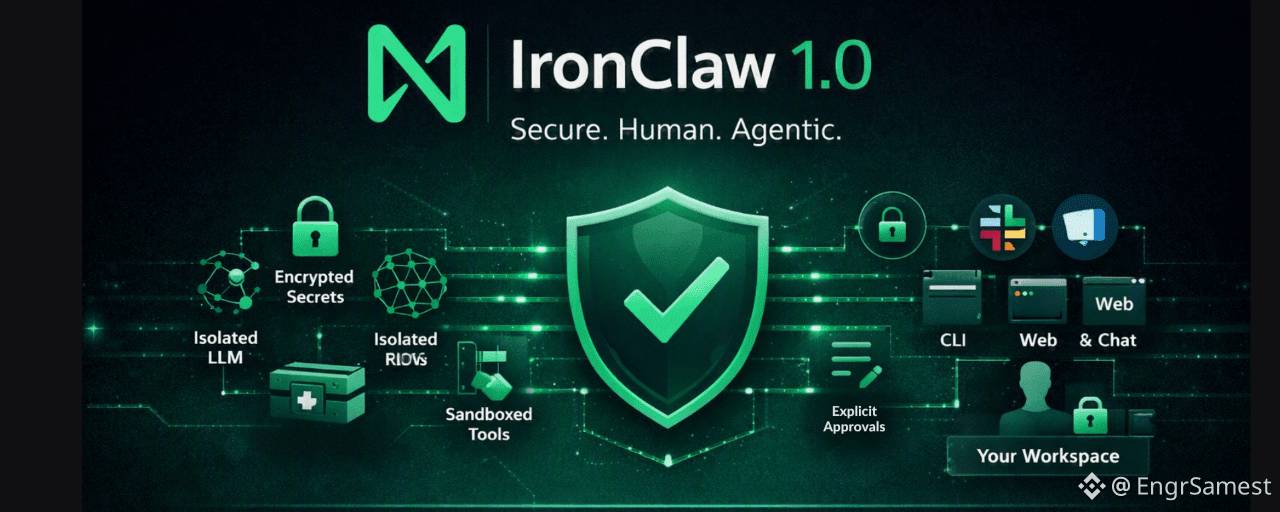
IronClaw 1.0: Uma Estrutura de Assistente Centrada no Ser HumanoO melhor assistente é aquele que você para de notar. Você define uma meta, muda de forma contínua do terminal para o Slack e nunca perde contexto ou refaz o trabalho por causa de uma interrupção. A maioria dos agentes de IA falha nesse teste cotidiano por um motivo estrutural: eles unem todo o raciocínio de funções, a execução, o armazenamento de segredos e o acesso à internet em um sistema único e emaranhado. Cada nova capacidade vira mais um ponto de falha ou um risco.
IronClaw 1.0, lançado por @NEAR_Protocol em 27 de julho de 2026, segue um caminho diferente. Ele separa a tomada de decisões da execução, com uma única camada de coordenação chamada guard entre elas. Esse ponto de verificação não é um mero recurso de marketing; é a arquitetura que faz um assistente sempre ativo parecer um colega confiável, e não um script frágil.
IronClaw 1.0: Uma Estrutura de Assistente Centrada no Ser Humano
O melhor assistente é aquele que você para de notar. Você define uma meta, muda de forma contínua do terminal para o Slack e nunca perde contexto ou refaz o trabalho por causa de uma interrupção. A maioria dos agentes de IA falha nesse teste cotidiano por um motivo estrutural: eles unem todo o raciocínio de funções, a execução, o armazenamento de segredos e o acesso à internet em um sistema único e emaranhado. Cada nova capacidade vira mais um ponto de falha ou um risco.
IronClaw 1.0, lançado por @NEAR Protocol em 27 de julho de 2026, segue um caminho diferente. Ele separa a tomada de decisões da execução, com uma única camada de coordenação chamada guard entre elas. Esse ponto de verificação não é um mero recurso de marketing; é a arquitetura que faz um assistente sempre ativo parecer um colega confiável, e não um script frágil.
IronClaw 1.0, lançado por @NEAR Protocol em 27 de julho de 2026, segue um caminho diferente. Ele separa a tomada de decisões da execução, com uma única camada de coordenação chamada guard entre elas. Esse ponto de verificação não é um mero recurso de marketing; é a arquitetura que faz um assistente sempre ativo parecer um colega confiável, e não um script frágil.
Vikky126:
This is a useful perspective on AI infrastructure. The intelligence of an agent matters, but so does the system responsible for controlling its actions, protecting credentials and maintaining user trust.
4
1
5
134

·
--
Artigo
IronClaw 1.0 e o Futuro da IA Possuída pelo Usuário: Por que a NEAR está Construindo Além do ModeloA inteligência artificial está migrando de sistemas que respondem perguntas para agentes que realmente conseguem executar tarefas. Mas dar à IA a capacidade de agir cria um desafio difícil: Como tornar agentes autônomos poderosos sem torná-los perigosos?
<c-127/> está abordando este problema sob a perspectiva de infraestrutura. Seu lançamento mais recente, #IronClaw 1.0, apresenta uma arquitetura projetada para separar a tomada de decisão de um agente de IA de sua capacidade de agir, criando uma base mais segura para uma IA autônoma.
IronClaw 1.0 e o Futuro da IA Possuída pelo Usuário: Por que a NEAR está Construindo Além do Modelo
A inteligência artificial está migrando de sistemas que respondem perguntas para agentes que realmente conseguem executar tarefas. Mas dar à IA a capacidade de agir cria um desafio difícil: Como tornar agentes autônomos poderosos sem torná-los perigosos?
<c-127/> está abordando este problema sob a perspectiva de infraestrutura. Seu lançamento mais recente, #IronClaw 1.0, apresenta uma arquitetura projetada para separar a tomada de decisão de um agente de IA de sua capacidade de agir, criando uma base mais segura para uma IA autônoma.
<c-127/> está abordando este problema sob a perspectiva de infraestrutura. Seu lançamento mais recente, #IronClaw 1.0, apresenta uma arquitetura projetada para separar a tomada de decisão de um agente de IA de sua capacidade de agir, criando uma base mais segura para uma IA autônoma.
Vikky126:
Persistent state is an underrated feature. An agent that can resume interrupted work instead of starting from scratch could significantly improve reliability for long-running, multi-step tasks.
4
1
6
106

·
--
Verificado
IronClaw 1.0: Agentes de IA Precisam de Mais do que Apenas InteligênciaAgentes de IA estão se tornando cada vez melhores em raciocinar. A diferença aqui não é apenas que raciocinar não é suficiente.
O verdadeiro desafio começa quando um agente precisa tomar alguma ação. Acessar uma ferramenta, navegar na web, gerenciar credenciais, retomar uma tarefa após uma interrupção ou alternar entre diferentes canais de comunicação sem perder o contexto.
Esse é o problema que o IronClaw 1.0 foi projetado para resolver.
✅ Uma Arquitetura Diferente para Agentes de IA
#ironclaw separa a parte de tomada de decisão da parte de execução da ação. Entre elas existe uma camada de coordenação chamada guarding. Essa separação é importante porque um agente de IA não deveria ter acesso ilimitado apenas porque consegue raciocinar sobre uma ação. Toda ação passa pela camada de guarding, criando um único ponto de verificação para permissões e segurança.
IronClaw 1.0: Agentes de IA Precisam de Mais do que Apenas Inteligência
Agentes de IA estão se tornando cada vez melhores em raciocinar. A diferença aqui não é apenas que raciocinar não é suficiente.
O verdadeiro desafio começa quando um agente precisa tomar alguma ação. Acessar uma ferramenta, navegar na web, gerenciar credenciais, retomar uma tarefa após uma interrupção ou alternar entre diferentes canais de comunicação sem perder o contexto.
Esse é o problema que o IronClaw 1.0 foi projetado para resolver.
✅ Uma Arquitetura Diferente para Agentes de IA
#ironclaw separa a parte de tomada de decisão da parte de execução da ação. Entre elas existe uma camada de coordenação chamada guarding. Essa separação é importante porque um agente de IA não deveria ter acesso ilimitado apenas porque consegue raciocinar sobre uma ação. Toda ação passa pela camada de guarding, criando um único ponto de verificação para permissões e segurança.
O verdadeiro desafio começa quando um agente precisa tomar alguma ação. Acessar uma ferramenta, navegar na web, gerenciar credenciais, retomar uma tarefa após uma interrupção ou alternar entre diferentes canais de comunicação sem perder o contexto.
Esse é o problema que o IronClaw 1.0 foi projetado para resolver.
✅ Uma Arquitetura Diferente para Agentes de IA
#ironclaw separa a parte de tomada de decisão da parte de execução da ação. Entre elas existe uma camada de coordenação chamada guarding. Essa separação é importante porque um agente de IA não deveria ter acesso ilimitado apenas porque consegue raciocinar sobre uma ação. Toda ação passa pela camada de guarding, criando um único ponto de verificação para permissões e segurança.
RWAemtx:
The key shift is from “Can the agent reason?” to “Can it act safely?”
IronClaw’s approach makes permissions, persistence, memory, and security part of the architecture itself.
As agents take on real-world tasks, that distinction could become one of the biggest factors separating useful agents from trustworthy ones.
7
8
2k

·
--
Artigo
Agentes de IA precisam de mais do que inteligênciaOs agentes de IA saíram da caixa de bate-papo e entraram nos corredores do ambiente de trabalho.
Eles não respondem apenas a perguntas. Eles classificam e-mails, agendam reuniões, fazem pesquisas, acessam arquivos e executam ações reais em ferramentas da empresa. Em resumo, estão evoluindo de um software com o qual conversamos para colegas digitais capazes de abrir portas em nosso nome.
Mas nunca entregaríamos a um funcionário todas as chaves da empresa e diríamos: “Eles parecem bem espertos. Espero que abram a porta certa.” Com agentes de IA, focar apenas na qualidade das decisões deles já não é suficiente.
Agentes de IA precisam de mais do que inteligência
Os agentes de IA saíram da caixa de bate-papo e entraram nos corredores do ambiente de trabalho.
Eles não respondem apenas a perguntas. Eles classificam e-mails, agendam reuniões, fazem pesquisas, acessam arquivos e executam ações reais em ferramentas da empresa. Em resumo, estão evoluindo de um software com o qual conversamos para colegas digitais capazes de abrir portas em nosso nome.
Mas nunca entregaríamos a um funcionário todas as chaves da empresa e diríamos: “Eles parecem bem espertos. Espero que abram a porta certa.” Com agentes de IA, focar apenas na qualidade das decisões deles já não é suficiente.
Eles não respondem apenas a perguntas. Eles classificam e-mails, agendam reuniões, fazem pesquisas, acessam arquivos e executam ações reais em ferramentas da empresa. Em resumo, estão evoluindo de um software com o qual conversamos para colegas digitais capazes de abrir portas em nosso nome.
Mas nunca entregaríamos a um funcionário todas as chaves da empresa e diríamos: “Eles parecem bem espertos. Espero que abram a porta certa.” Com agentes de IA, focar apenas na qualidade das decisões deles já não é suficiente.
RWAemtx:
The real bottleneck is safe execution.
Intelligence can make an agent smarter, but strong permission controls, privacy, memory, and accountability make it trustworthy enough to operate in the real world.
8
8
218

Artigo
IronClaw 1.0: Quando Agentes de IA Aprendem a Agir, o Controle Passa a Fazer Parte da InteligênciaOs agentes de IA estão entrando em uma fase diferente.
Agora, eles já não estão limitados a gerar texto ou responder perguntas. Eles podem pesquisar, gerenciar arquivos, interagir com sites, se comunicar entre plataformas e executar fluxos de trabalho de múltiplas etapas. Mas, à medida que os agentes se tornam capazes de agir em nosso nome, acho que uma questão se torna cada vez mais importante:
Como damos a uma IA autonomia suficiente para ser útil sem conceder a ela autoridade irrestrita?
É isso que torna o IronClaw 1.0, de #NEARAI , particularmente interessante para mim.
IronClaw 1.0: Quando Agentes de IA Aprendem a Agir, o Controle Passa a Fazer Parte da Inteligência
Os agentes de IA estão entrando em uma fase diferente.
Agora, eles já não estão limitados a gerar texto ou responder perguntas. Eles podem pesquisar, gerenciar arquivos, interagir com sites, se comunicar entre plataformas e executar fluxos de trabalho de múltiplas etapas. Mas, à medida que os agentes se tornam capazes de agir em nosso nome, acho que uma questão se torna cada vez mais importante:
Como damos a uma IA autonomia suficiente para ser útil sem conceder a ela autoridade irrestrita?
É isso que torna o IronClaw 1.0, de #NEARAI , particularmente interessante para mim.
Agora, eles já não estão limitados a gerar texto ou responder perguntas. Eles podem pesquisar, gerenciar arquivos, interagir com sites, se comunicar entre plataformas e executar fluxos de trabalho de múltiplas etapas. Mas, à medida que os agentes se tornam capazes de agir em nosso nome, acho que uma questão se torna cada vez mais importante:
Como damos a uma IA autonomia suficiente para ser útil sem conceder a ela autoridade irrestrita?
É isso que torna o IronClaw 1.0, de #NEARAI , particularmente interessante para mim.
Vikky126:
Persistent state is an underrated feature. An agent that can resume interrupted work instead of starting from scratch could significantly improve reliability for long-running, multi-step tasks.
4
1
7
84

·
--

Artigo
Análise Profunda do NEAR IronClaw 1.0 & NEAR AI StakingA evolução dos assistentes de inteligência artificial historicamente atingiu um gargalo arquitetural muito claro: um modelo monolítico conectado diretamente a cada uma de suas capacidades. Quando raciocinar, executar ações, lidar com credenciais sensíveis e acessar a rede acontecem no exato mesmo ambiente, surgem vulnerabilidades críticas e pontos únicos de falha, nos quais qualquer fluxo pode colapsar completamente em segundos.
@NEAR_Protocol encara diretamente esse desafio estrutural com o lançamento de #IronClaw 1.0, uma arquitetura avançada que separa de forma limpa a tomada de decisão em alto nível da execução por meio de uma camada de coordenação segura conhecida como guard.
Análise Profunda do NEAR IronClaw 1.0 & NEAR AI Staking
A evolução dos assistentes de inteligência artificial historicamente atingiu um gargalo arquitetural muito claro: um modelo monolítico conectado diretamente a cada uma de suas capacidades. Quando raciocinar, executar ações, lidar com credenciais sensíveis e acessar a rede acontecem no exato mesmo ambiente, surgem vulnerabilidades críticas e pontos únicos de falha, nos quais qualquer fluxo pode colapsar completamente em segundos.
@NEAR Protocol encara diretamente esse desafio estrutural com o lançamento de #IronClaw 1.0, uma arquitetura avançada que separa de forma limpa a tomada de decisão em alto nível da execução por meio de uma camada de coordenação segura conhecida como guard.
@NEAR Protocol encara diretamente esse desafio estrutural com o lançamento de #IronClaw 1.0, uma arquitetura avançada que separa de forma limpa a tomada de decisão em alto nível da execução por meio de uma camada de coordenação segura conhecida como guard.
Vikky126:
Persistent state is an underrated feature. An agent that can resume interrupted work instead of starting from scratch could significantly improve reliability for long-running, multi-step tasks.
6
1
8
234
Inicia sessão para explorar mais conteúdos
Junta-te a utilizadores de criptomoedas de todo o mundo na Binance Square
⚡️ Obtém informações úteis e recentes sobre criptomoedas.
💬 Com a confiança da maior exchange de criptomoedas do mundo.
👍 Descobre perspetivas reais de criadores verificados.
E-mail/Número de telefone
Tópicos em Tendência
1
#BTCTops$80K
5,984 visualizações
88 a discutir
2
#USWeeklyInitialJoblessClaimsRiseTo206000
23,612 visualizações
594 a discutir
3
#NvidiaToAcquireHuggingFaceFor$12.9B
463 visualizações
30 a discutir
4
#SnowflakeSurges24%OnEarningsBeat
2,328 visualizações
156 a discutir
5
#USISMServicesRisesTo55.4InAugust
1,806 visualizações
106 a discutir
6
#SECNewCryptoRulesAimToBringFirmsBackToUS
9,235 visualizações
286 a discutir
7
#USGainsControlOfVenezuelanOilFields
14,553 visualizações
377 a discutir
8
#CFTCScrutinizesPredictionMarketAffiliates
16,691 visualizações
360 a discutir
9
#EtherXRPETFInflowStreaksEnd
26,090 visualizações
499 a discutir
10
#PredictionMarketsPutCLARITYAct2026OddsAt15%
22,913 visualizações
509 a discutir