
When I first started diving deeper into Web3 over the years, I constantly noticed something strange. Everyone talks about decentralization like it is already solved, but when you zoom in on the tech stack, storage is almost always the weak point. People brag about trustless value transfer and fancy consensus models, yet their actual data is sitting on centralized platforms or semi decentralized networks that still have single points of control. That always felt like a contradiction to me. So when I encountered the Walrus WAL project, the idea immediately caught my attention because they are trying to fix the part almost everyone ignores.
The main mindset of Walrus is simple but important. If you cannot control your own data the same way you control your own crypto wallet, then you are not really decentralized. And honestly, I agree with that. Their entire approach is built around splitting files into encrypted pieces and spreading them across independent nodes. No single node ever holds a full file, and no one knows what they are storing. That alone solves a bunch of security and censorship problems that plague current systems.
The team chose $SUI for a reason. Sui works with digital objects rather than the old account based model. That gives the network better parallel processing and makes data operations faster. Walrus taps into this by attaching stored data to objects with verifiable states. The cool part is that many operations do not need global consensus every time, which is something that slows older chains down. This blend of storage layer and blockchain execution layer is something I have not seen many other projects attempt. Most storage systems float around outside the chain and depend on awkward bridges or off chain references.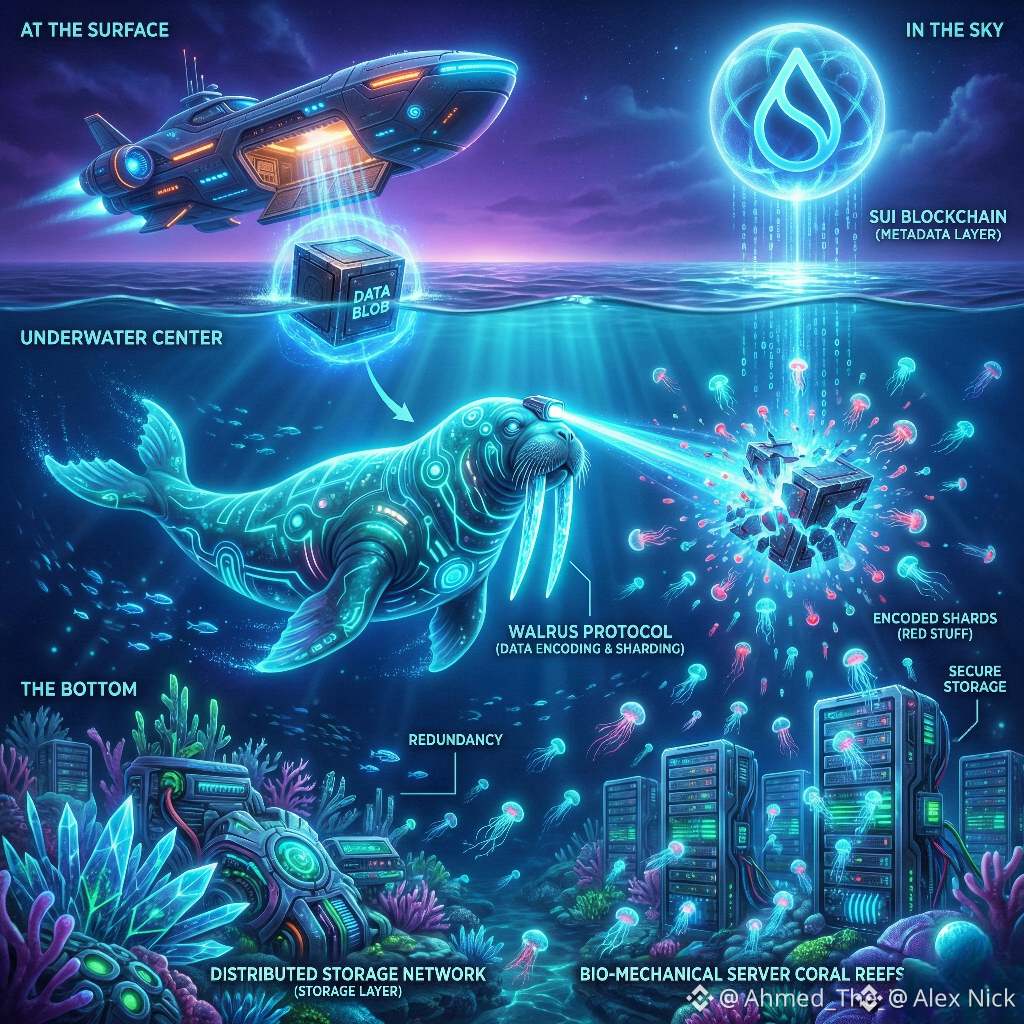
From a technical perspective, Walrus uses erasure coding instead of full replication. Instead of storing endless copies of the same file everywhere, the system only needs a certain number of fragments to rebuild the original. This cuts storage costs dramatically while still making the system robust if some nodes disappear. They also have verification systems to ensure nodes behave properly and actually provide data when called. To me, this makes sense because you get the reliability of redundancy without wasting resources.
One thing I personally find compelling is how Walrus treats privacy. It is not an add on or an optional feature. It is the default. Everything is encrypted and nodes cannot figure out the content or purpose. They are just storage workers, not data inspectors. This keeps the network trustless by design. The downside is that it limits built in search functions. If you want advanced indexing or filtering, you have to build those layers on top. But honestly, I would rather have privacy come first and convenience added later instead of the other way around.
The WAL token is the glue that makes the ecosystem operate smoothly. It is how storage is priced, how node operators get paid, and how misbehavior is punished. Basically, WAL is what keeps the system balanced without needing a central party to approve or reject anything. The challenge here is economic. If demand for storage grows, everything works well. If demand does not grow fast enough, token value can fluctuate in ways that make participation harder. Token based incentive models always rely on supply and demand finding their balance.
What makes Walrus important to me is not just what it does right now but what it makes possible in the future. Modern decentralized apps, especially ones handling large datasets or sensitive user information, cannot rely on centralized storage and still call themselves Web3. Without a proper data layer, all the talk about digital freedom ends up being marketing. Walrus gives a blueprint for how storage can actually become part of the decentralized core instead of a bolted on afterthought.
This does not mean the project is perfect. Complexity is high, onboarding is not easy for beginners, and adoption will take time. But I see it as a foundational piece rather than a finished product. It opens a path for developers to build new types of applications that combine computation, privacy, and storage in one unified environment. That is something the ecosystem desperately needs.
If you look at Web3 as a whole, Walrus is not just patching gaps. It is attempting to rebuild the concept of decentralized storage from the ground up. And in my opinion, that alone makes it worth keeping on the radar because it is attacking the root problem rather than just polishing the surface.

