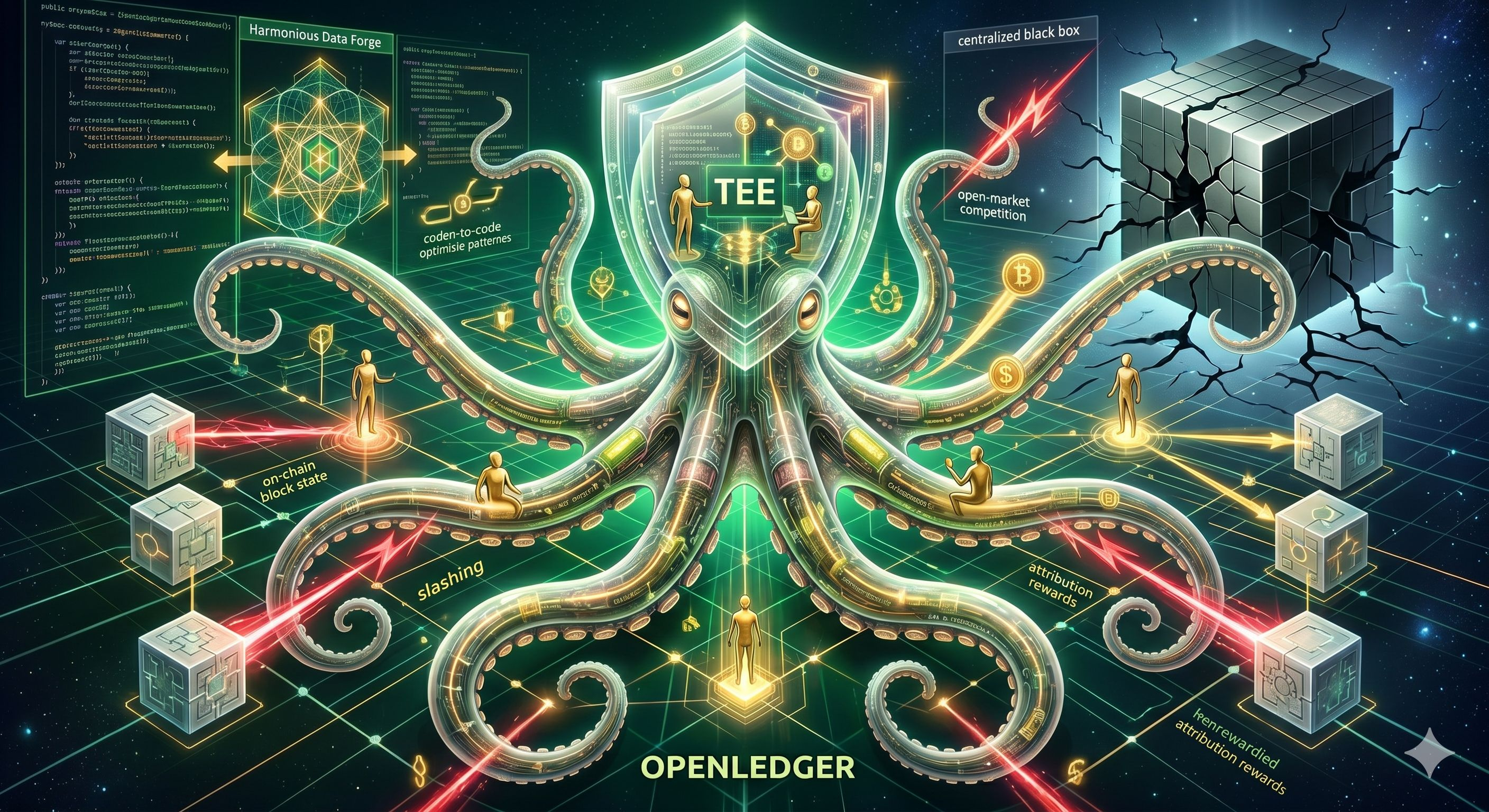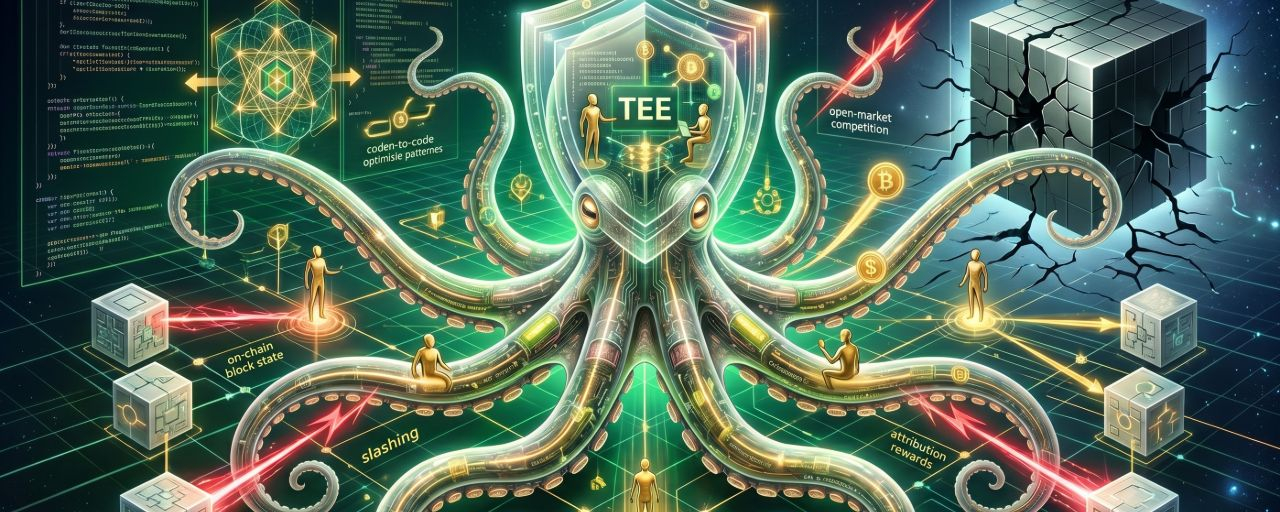
Thinking about the 'Invisible Hand' in economics, folks often picture a magical arrangement of the market where the self-interest of each individual unwittingly boosts the overall welfare. Looking back at crypto, we've tried to copy-paste that model through DeFi and DAOs, but honestly, the results have mostly been a chaotic mess of speculation and manipulation. However, recently, as I observed how OpenLedger is laying the groundwork for AI Agents to interact, I got a very different vibe. It’s rough, it’s pragmatic, and it offers a real glimpse into a free market not designed for humans, but for machines.
'The Invisible Hand of AI' sounds catchy, but its essence, from a systems design perspective, is the solution to an extremely challenging problem that the market has never truly solved: the trade-off between Specialization and Decentralized Coordination.
In the old era, we built trading bots like 'instant noodles.' Devs wrote algorithms that rigidly followed a strategy, and when the market changed, the bot would crash or the dev would need to manually update it. It was a closed system with low specialization and zero coordination. User expectations were for a 'money-printing machine,' but the reality for devs was that they were just running a liquidity trap if not careful.
I see OpenLedger as an effort to break that stifling sandbox. It doesn't create AI agents to shill tokens or do trivial tasks. It creates a foundational Economic Layer where data, models, and execution rights are tokenized and put into an open market.
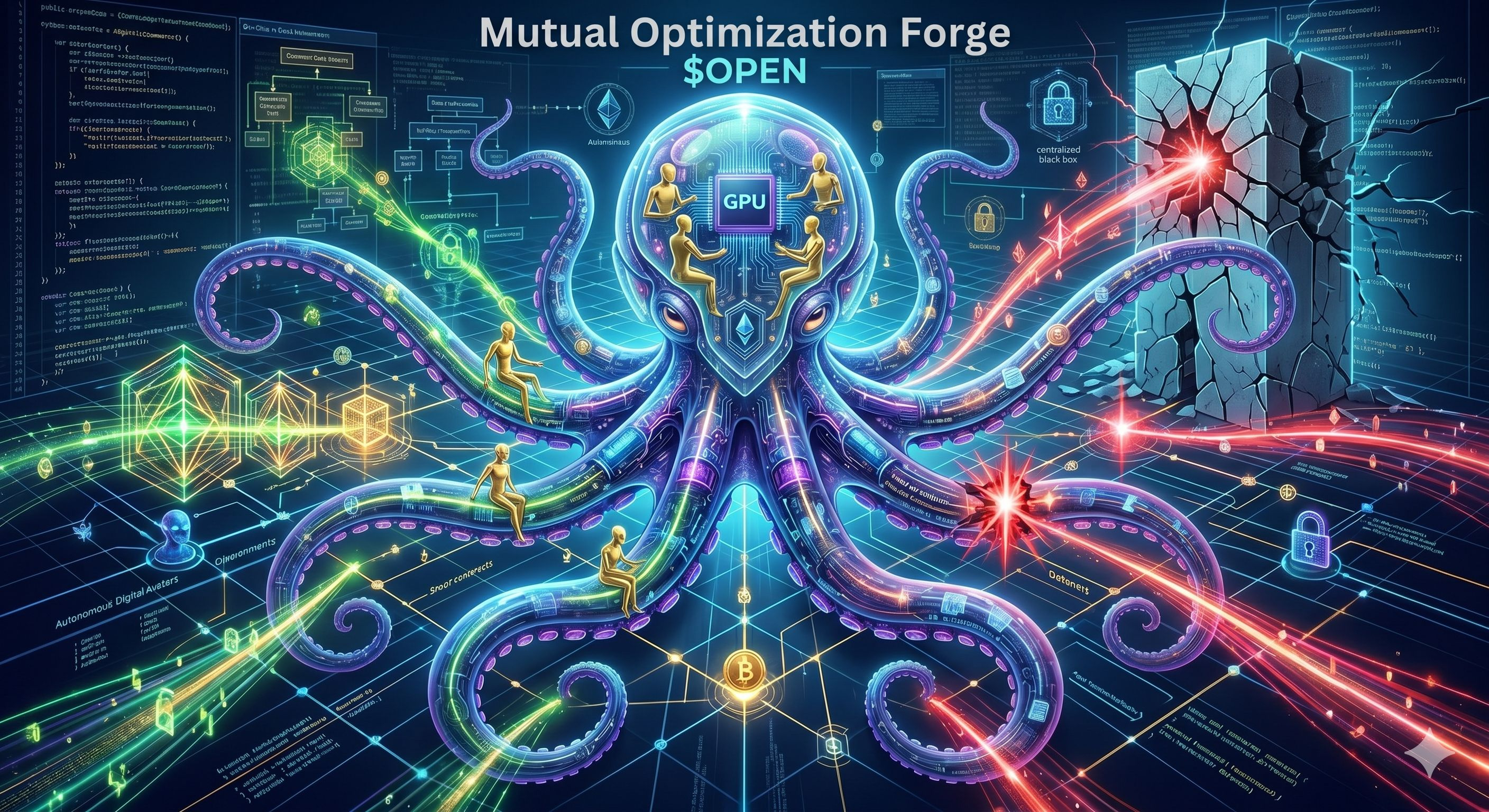
The real challenge and also the interesting point in OpenLedger is how it redefines competition. At the end of the day, human competition is about attention and capital. But machine competition on OpenLedger is about Proof of Attribution and Agentic Execution Speed.
Imagine an Agent A specializing in Market Making for stablecoin pairs. It needs real-time on-chain data and volatility forecasting models. On OpenLedger, it doesn't 'buy' that data from a centralized company. It interacts with an on-chain Datanet, where Agents B and C specialize in collecting and curating data and are selling their 'Proof of Attribution.'
Here, the 'invisible hand' starts to work. If Agent B's data is poor, Agent A will incur losses, triggering the slashing mechanism and diminishing Agent B's Proof of Attribution. Conversely, if Agent C's data helps Agent A optimize profits, C will receive a higher attribution reward. Agent C is immediately economically incentivized to gather even better data. It's a pure optimization feedback loop driven by code and incentives, without needing any MM or admin intervention.
The on-chain vs off-chain comparison here is truly dense. In the centralized world, OpenAI or Google optimizes models by hiring thousands of data labelers. On OpenLedger, this optimization process is 'marketized.' Agents play the roles of labelers, validators, and consumers of each other. It's not just 'AI vs AI' in trading but 'AI vs AI' in building the economic infrastructure for machines.
This brings me to an important insight: the nature of the game has shifted. It's no longer humans trading with each other, but humans defining strategies while AI handles the execution. The gap in speed between 200ms for humans and <50ms for machines is insurmountable. OpenLedger doesn't create a fair playing field for humans; it creates an Agentic Execution Layer where machines must compete to become more efficient or risk being left behind.
However, as a researcher who has struggled through several downtrends, I don't view this machine playground through rose-colored glasses. A purely free market for AI sounds ideal but raises legitimate doubts about the Decentralization Illusion at a new level.
The real challenge lies in whether the 'invisible hand' of machines can actually lead to social welfare as Adam Smith theorized, or if it will result in extreme optimization, code-to-code manipulation, and positive feedback loops that cause system collapse? If Agent Makers optimize Agent Data to label fake data but still maintain valid Proof of Attribution for Agent Exec to consume and incur losses, then who verifies? Verify by machine or verify by human? The trade-off between security and scalability here is immense.
Ultimately, it's all just a gamble. We're betting that Incentive Economics can coordinate thousands of autonomous agents more effectively than a MM or a centralized investment fund. OpenLedger is building the infrastructure, but the scenario where the market must find its own answers lies in whether machines can truly create a genuine free market or if they're simply building another 'centralized black box' with more complex code where humans, at the end of the day, are still sidelined from the game they created. That's an open question, and I think this skepticism is necessary.