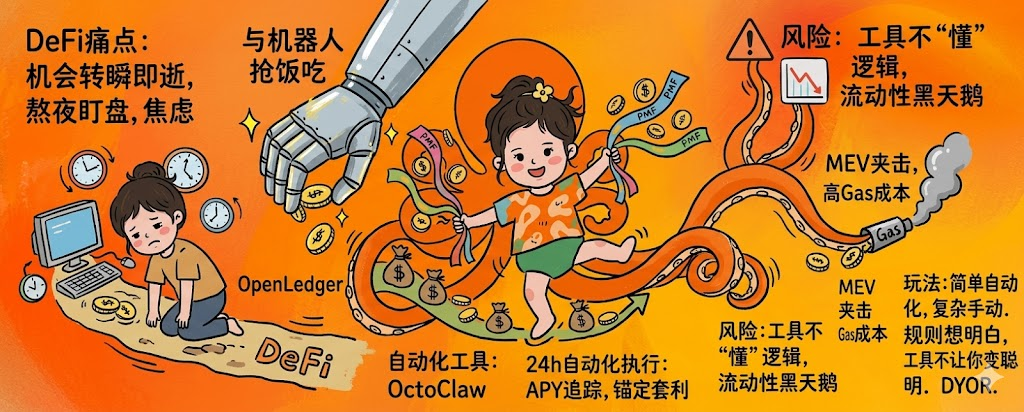
Anyone who plays in DeFi knows the feeling—seeing an opportunity but your hands just can't keep up. The OctoClaw from @OpenLedger made me rethink this, because I'm one of those folks who gets totally wrecked by the on-chain pace.
Let me share a true story. Last year, there was a liquidation opportunity on a certain chain with a clear price difference. Someone in my friend group sent out a heads-up early. I was having dinner at the time, saw the message, dropped my chopsticks, booted up my computer, unlocked my wallet, switched networks, checked Gas, signed, confirmed. By the time I was ready, the opportunity had already been scooped up. All in about three minutes. What does three minutes mean in DeFi? You think you're trading, but really you're just racing against a bunch of bots for crumbs. No matter how fast you are, you can't outrun their scripts.
I've been thinking about this ever since—what are regular folks really after in DeFi? The strategies aren’t hard; just look at some seasoned pros' shares or join a few reliable groups, and you won't stray too far off course. The real challenge is execution—what do you do when opportunities pop up while you’re asleep? What happens if there’s a sudden crash on-chain while you’re in a meeting? What if that arbitrage window opens and closes while you’re out without your laptop? Nobody is there to help you solve these problems, so you end up burning the midnight oil, staring at the charts, and turning into a constantly anxious person.
I actually tried OctoClaw recently. My most direct feeling wasn’t about its intelligence but rather how it took the "I have to keep watch" burden off my shoulders. You set the rules—like automatically entering when a pool's APY exceeds a certain amount, automatically exiting when it drops below a threshold, or executing arbitrage when a stablecoin drifts from its peg by a certain amount—and it keeps an eye on things, 24/7 without blinking. When an opportunity arises, its response time from recognition to execution is basically in seconds. Watching it complete a cross-chain arbitrage on its own for the first time felt strange, like having an assistant who never tires, and who works faster than you.
But I have to say, excitement aside, I can’t shake off a few questions I have.
First, does it really "understand" DeFi? The rules are set by me, but on-chain situations can be bizarre, and when a black swan event hits, any strategy can flip on a dime. I encountered this once during testing when a pool's liquidity suddenly dried up; OctoClaw followed the rules and entered, only to find the depth couldn’t support it, resulting in scary slippage. This isn’t the tool’s fault; it’s the inherent risk of DeFi. But once you hand over execution rights, that risk gets magnified—previously, when you moved slowly, you’d at least pause for a second and think, "something’s off." Now it’s fast, too fast for you to get that second.
The second factor is gas and costs. High-frequency strategies sound great, but every single operation burns gas, and records need to be kept on-chain. I pulled data for a week and found that running high-frequency with small capital simply doesn’t make sense; after costs, it turns into a loss. OctoClaw is better suited for two types of people: either those with significant capital, where gas costs can be diluted; or those with mid to low-frequency strategies, like arbitrage or rebalancing that happens every few hours. If you’re hoping to get rich overnight with it, I advise you to calm down. #OpenLedger
The third point, which makes me most skeptical, is how reliable the solutions provided by the models are. OctoClaw doesn’t make decisions directly; it hands over your strategy logic to the underlying model for execution. I tested the same arbitrage logic with different models, and the execution paths varied greatly. One open-source model provided me with a sequence that, upon closer inspection, was susceptible to MEV bots—not malicious, but just didn't consider that layer. So when using this tool, you must be aware: it amplifies your judgment, not replaces it. If your strategy has flaws, it will execute those flaws quickly and thoroughly.
So why am I still using it? Because it addresses real pain points.
In the DeFi game, time isn’t money; time is everything. The window of opportunity is getting shorter and shorter, and the players' response times are getting faster. Ordinary folks are increasingly struggling with manual operations. You either exit completely or find a tool to handle the execution, leaving the mental work for strategy and risk management. OctoClaw isn’t the only choice, but it does on-chain automation relatively well—it can automatically monitor, execute, and keep records on-chain for accountability. When you have all three, it’s already better than most similar tools.
I'm currently playing it cool. First, I’m using a small amount of capital to run some simple strategies, like tracking the APY of stablecoin pools and rebalancing within certain fixed time windows. These are low-risk, clear-cut tasks, so I let OctoClaw handle them. For the complex stuff that requires reading market sentiment and involves large sums, I prefer to do it manually. It’s not about not trusting the tool; it’s knowing my limits—automate the simple things and keep the complex decisions for myself. That’s the healthy way to play.
As for whether the value of OPEN tokens can keep pace with the actual usage of OctoClaw, I currently have no conclusions. It depends on whether the growth of paying users is fast enough, whether the on-chain call volume is genuine or just incentive farming, and when institutional clients actually come in. Until we have data on these three aspects, I consider the price fluctuations of $OPEN to be just noise.
Let me say something that many people don’t want to hear. No matter how great the tool is, it won’t save someone who hasn’t even thought through the basic strategies. OctoClaw can speed up your execution, but it won’t make you smarter. It watches the chain while you’re asleep, but only if you’ve figured out the rules while you’re awake. If your rules are wrong, it will just make you go wrong faster.
DYOR, do your homework first before worrying about tools.