Key Takeaways
A network effect occurs when a product or service becomes more valuable as additional users join, creating a positive feedback loop that can drive exponential growth in cryptocurrency and technology networks.
There are two main types: direct network effects (more users = more value for all users) and indirect network effects (additional users attract complementary products, developers, and infrastructure).
Network effects help explain why certain blockchain protocols achieve dominant market positions, even when technologically similar alternatives exist.
Negative network effects also exist: when adding users creates congestion or higher costs, discouraging participation and potentially limiting growth.
Introduction
How do blockchain protocols become market leaders? While technical quality matters, network effects often play a decisive role. A network effect is an economic phenomenon where a product or service gains additional value as more people adopt it.
This concept is fundamental to understanding why certain cryptocurrency networks attract the majority of users, developers, and capital, while comparable alternatives struggle to gain traction. In some cases, technologically inferior projects capture the bulk of market share simply because they were available at the right time and built momentum first.
What Is a Network Effect?
A network effect describes an economic dynamic where each new participant adds value to the overall network. When a network effect is present, joining the network becomes increasingly attractive over time because the service is more useful with more nodes or users connected.
One classic example is the telephone. In its early days, few people owned telephones, limiting the network's value. As the technology matured and more people connected, the utility of the entire telephone network grew. This created a positive feedback loop: more users joining meant more value for everyone already connected, which attracted even more users.
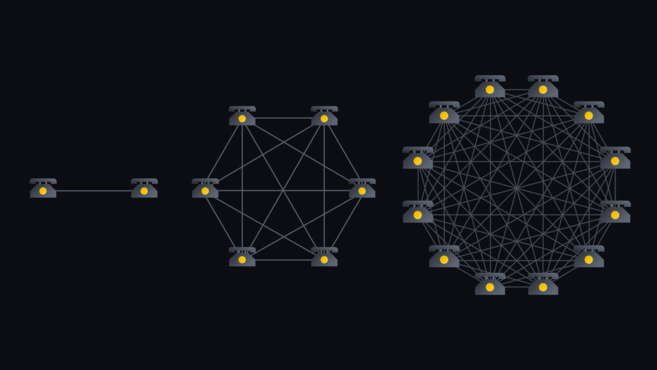
This same dynamic applies to modern technologies, digital platforms, and blockchain networks. Once a critical mass of users is reached, growth can accelerate exponentially, often described mathematically by Metcalfe's Law, which states that the value of a network is proportional to the square of the number of its connected users (n squared).
Types of Network Effects
There are two main categories of network effects:
Direct network effects.
These occur when increased usage directly adds value for all other participants. More users on a social platform means more connections to make; more traders on an exchange means better liquidity and tighter spreads. The telephone example illustrates direct network effects clearly.
Indirect network effects.
These refer to complementary benefits that emerge as a network grows. For example, a blockchain with strong adoption attracts more developers, who build better tools and applications, which in turn attracts more users. The network's value increases not from user-to-user connections alone, but from the ecosystem of products, services, and infrastructure that grows around it.
Many successful blockchain networks benefit from both types simultaneously: direct effects from liquidity and user activity, and indirect effects from developer ecosystems, tooling, and third-party integrations.
Network Effect Examples
Network effects are present across many industries and product categories:
Social media: Users join platforms where their social connections are already active. Once a platform reaches critical mass, switching costs become high because migrating an entire social graph is impractical.
Marketplaces: More sellers attract more buyers, and more buyers attract more sellers. This two-sided network effect creates powerful competitive moats.
Open-source software: More contributors improve code quality, documentation, and community support, which attracts more users and developers in a reinforcing cycle.
Payment networks: The more merchants accept a payment method, the more useful it becomes for consumers, and the more consumers use it, the more merchants want to accept it.
Even non-commercial projects like Wikipedia demonstrate network effects: more contributors create more comprehensive content, attracting more readers and further contributors.
Network Effects and Cryptocurrencies
Network effects are arguably the most important competitive dynamic in Bitcoin and the broader crypto ecosystem.
Bitcoin demonstrates powerful network effects through several reinforcing mechanisms. Miners secure the network and benefit from deep liquidity when converting rewards to fiat. More miners mean stronger security, which attracts more users and capital, which incentivizes more miners. Even if an alternative proof-of-work network offered higher block rewards, miners face significant switching costs because that alternative may lack sufficient liquidity or ecosystem support.
Beyond Bitcoin, network effects drive competition in DeFi through smart contract composability. When multiple protocols can seamlessly interact on the same chain, developers can build products that combine existing services, creating value greater than the sum of individual parts. This composability creates a powerful indirect network effect: each new protocol adds utility to all other connected protocols.
Metcalfe's Law in crypto valuation
Metcalfe's Law also has applications in crypto valuation models. Researchers use daily active addresses as a proxy for network participants, calculating an implied "fair value" based on network activity.
For Bitcoin, these models combine active address growth with scarcity dynamics (the halving cycle) to project network value. For Ethereum, Metcalfe-based models incorporate on-chain activity including DeFi transactions, L2 settlement volume, and fee revenue. While useful as broad valuation frameworks, these models are approximations and should be interpreted alongside other fundamental metrics.
Network Effects in a Multi-Chain World
The traditional "winner-take-all" thesis in crypto has evolved. In recent years, network effects increasingly operate across multiple layers rather than within a single blockchain:
Base settlement layers: Provide security, credibility, and final settlement. Network effects here come from validator participation, staked capital, and institutional trust.
Execution layers (L2s): Layer 2 scaling solutions now process over 60% of ecosystem transaction volume, building their own application-specific network effects while inheriting base-layer security.
Application layers: Specific communities, user experiences, and data create local network effects within individual protocols and platforms.
Cross-chain infrastructure: Interoperability protocols, bridges, and intent-based systems reduce lock-in by making liquidity and users portable across chains.
This layered structure means that the strongest crypto network effects in recent years come from liquidity density, developer ecosystems, cross-chain accessibility, and user distribution, rather than a single chain dominating all activity.
Negative Network Effects
Not all growth is beneficial. Negative network effects occur when additional users subtract value from the network. This concept is particularly relevant to Ethereum and other blockchains with limited throughput.
When network demand exceeds capacity, transaction fees can rise sharply. During periods of heavy congestion, gas fees increase because users compete to have their transactions included in the next block. If costs become prohibitive, some users stop participating entirely, reducing the network's effective utility.
Blockchain developers address negative network effects through various scaling approaches: Layer 2 rollups offload execution from the main chain (Ethereum L2s now handle the majority of daily transactions); protocol upgrades increase base-layer capacity; and fee market redesigns create more predictable cost structures. The EIP-1559 fee mechanism (live since 2021) and proto-danksharding via EIP-4844 (live since 2024) are Ethereum examples of addressing negative network effects through protocol design.
FAQ
What is the difference between direct and indirect network effects?
Direct network effects occur when each new user directly increases value for all existing users (such as more participants on a messaging platform). Indirect network effects arise when growth attracts complementary products, developers, or infrastructure that enhance the overall ecosystem, even for users who don't directly interact with each new participant.
How do network effects apply to Bitcoin?
Bitcoin benefits from multiple reinforcing network effects: more users increase liquidity and merchant acceptance; more miners strengthen security; more developers improve tooling and infrastructure; and broader institutional adoption increases credibility and accessibility. These effects compound over time, making it increasingly difficult for alternative store-of-value networks to compete.
Can a blockchain with strong network effects be overtaken?
While possible, it is difficult. Established networks have advantages in liquidity, developer talent, institutional trust, and infrastructure. However, new paradigms (such as fundamentally different architectures) or significant failures in established networks can create windows for disruption. Multi-chain interoperability also reduces the zero-sum nature of blockchain competition.
What is Metcalfe's Law and how does it relate to crypto?
Metcalfe's Law states that a network's value is proportional to the square of its connected users. In crypto, analysts apply this by using daily active addresses as a proxy for users and comparing implied network value against actual market capitalization. When market cap falls significantly below the Metcalfe-implied value, some consider the network undervalued, though such models are approximations rather than precise predictions.
Do Layer 2 networks create their own network effects?
Yes. Layer 2 networks can build local network effects through application-specific communities, lower transaction costs that attract users, and unique features or developer tooling. However, they also inherit security and credibility from their base layer. The strength of L2 network effects depends on how effectively they attract exclusive applications and users while maintaining interoperability with the broader ecosystem.
Closing Thoughts
Network effects are among the most powerful competitive dynamics in the cryptocurrency ecosystem. They explain why early movers with broad adoption can maintain dominant positions even when technically comparable alternatives emerge. For blockchain networks, network effects manifest through user activity, developer participation, liquidity depth, and institutional adoption..
Further Reading
Disclaimer: This content is presented to you on an "as is" basis for general information and educational purposes only, without representation or warranty of any kind. It should not be construed as financial, legal, or other professional advice, nor is it intended to recommend the purchase of any specific product or service. You should seek your own advice from appropriate professional advisors. Where the content is contributed by a third-party contributor, please note that those views expressed belong to the third-party contributor, and do not necessarily reflect those of Binance Academy. Digital asset prices can be volatile. The value of your investment may go down or up and you may not get back the amount invested. You are solely responsible for your investment decisions and Binance Academy is not liable for any losses you may incur. For more information, see our Terms of Use, Risk Warning and Binance Academy Terms.