
@Dusk In mid-April 2025, Dusk Network said it had onboarded with 21X as a trade participant, with deeper integration planned, including 21X integrating Dusk’s DuskEVM chain. On the surface, that can look like yet another “blockchain partners with exchange” headline. The reason it has stuck with people is that it’s a very specific kind of partnership: one that aims straight at regulated securities trading, where privacy, compliance, and operational discipline aren’t optional extras. They’re the whole point.
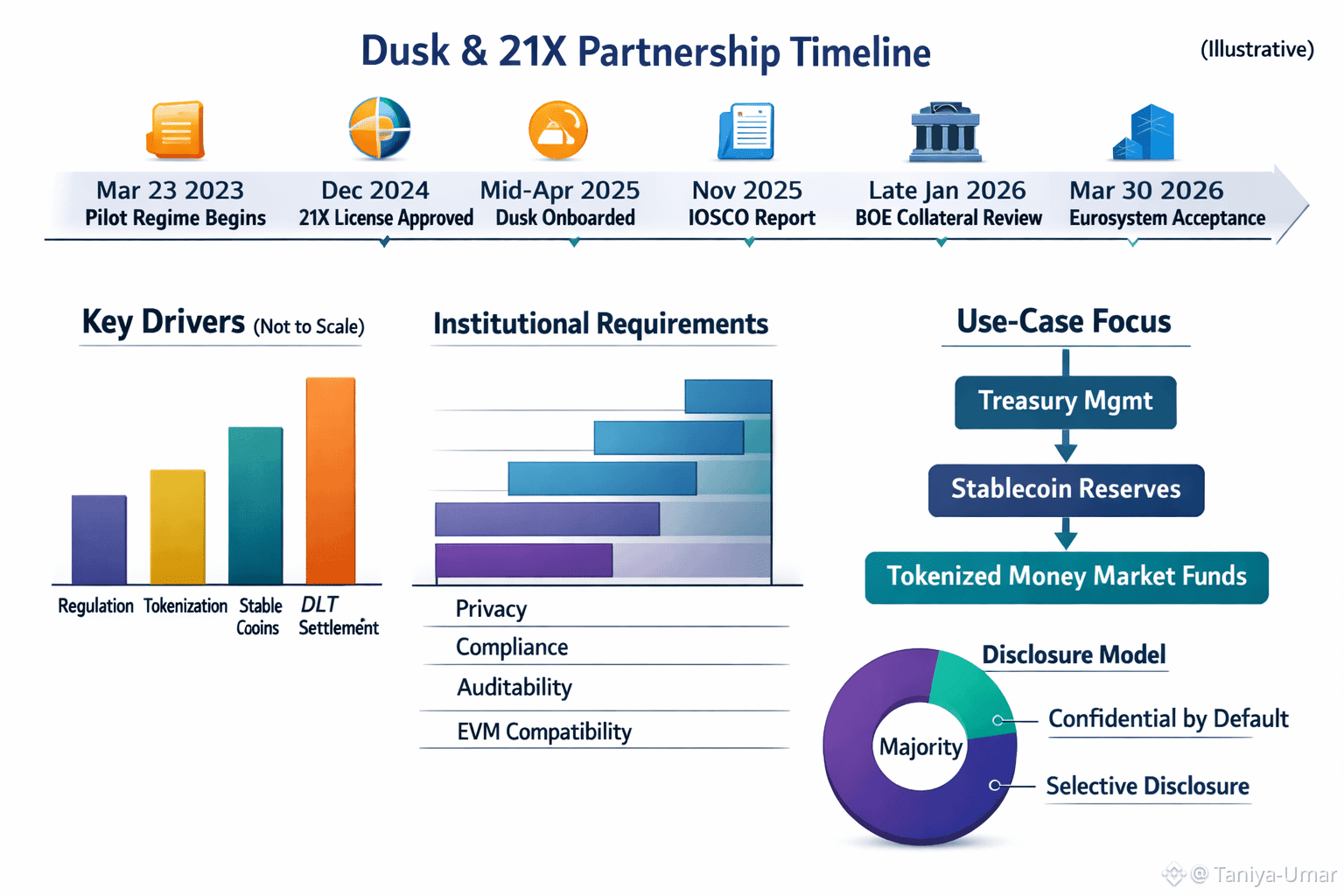
To understand why Dusk matters here, it helps to start with what it claims to be building. In its own documentation, Dusk describes itself as “the privacy blockchain for regulated finance,” with the idea that institutions should be able to meet real regulatory requirements on-chain while users don’t have to expose every balance and transfer to the public. That framing is different from the older “privacy coin” era, where privacy was often treated like a shield from oversight. Dusk is pitching something closer to how real financial markets actually work: most activity is confidential by default, but disclosure can happen when it’s required.
That might sound like a nuance, but it’s a big one. If you’ve spent any time watching how institutions behave, you know how protective they are of positions, strategies, and counterparties. Even when everyone involved is fully regulated, they don’t want their competitors reading their playbook in real time. A chain that’s designed for regulated issuance and trading has to make room for that reality. Dusk’s “confidential smart contracts” pitch leans into selective disclosure—keeping sensitive details private while still allowing compliance checks and auditability when needed. In other words, it’s trying to give markets the privacy they already expect, without breaking the accountability regulators require.
This is where 21X becomes a meaningful counterpart. 21X received a license in December 2024 under the EU’s DLT Pilot Regime to operate a DLT trading and settlement system (DLT TSS). The Pilot Regime has applied since March 23, 2023, and it creates a legal framework for trading and settlement of transactions in crypto-assets that qualify as financial instruments, including the combined “DLT TSS” model. That combined model is not just jargon. It’s an attempt to tighten the link between a trade and its completion—fewer handoffs, fewer moving parts, and fewer places for delay or confusion to creep in.
The Dusk–21X collaboration is also telling because it starts in a place that’s practical and slightly unglamorous: treasury management. The initial focus described by 21X and reported in industry coverage involves stablecoin treasury investment in tokenized money market funds, essentially putting reserve assets to work in a way that fits institutional norms. This is exactly the kind of use case where Dusk’s “regulated finance first” posture is meant to shine. If you’re talking reserves, you’re really talking trust: what’s backing the stablecoin, how quickly those assets can be cashed out, and how it behaves when things get tense. And trust needs two modes. Most days, you want privacy—so you’re not exposing operational details or inviting manipulation. But when the right people need proof—regulators, auditors, serious counterparties—you need disclosure that’s clear, credible, and easy to verify.
And the timing isn’t accidental. Tokenized money market funds have become one of the clearest bridges between traditional finance and crypto markets. Banque de France noted in 2025 that tokenized money market funds keep the same legal nature and return as traditional funds; the novelty is in how the units are recorded and transferred using DLT. That same Banque de France piece also pointed to the rapid growth of this niche—precisely because it satisfies a simple demand: a conservative, cash-like instrument that can move with the speed and programmability of modern digital rails.
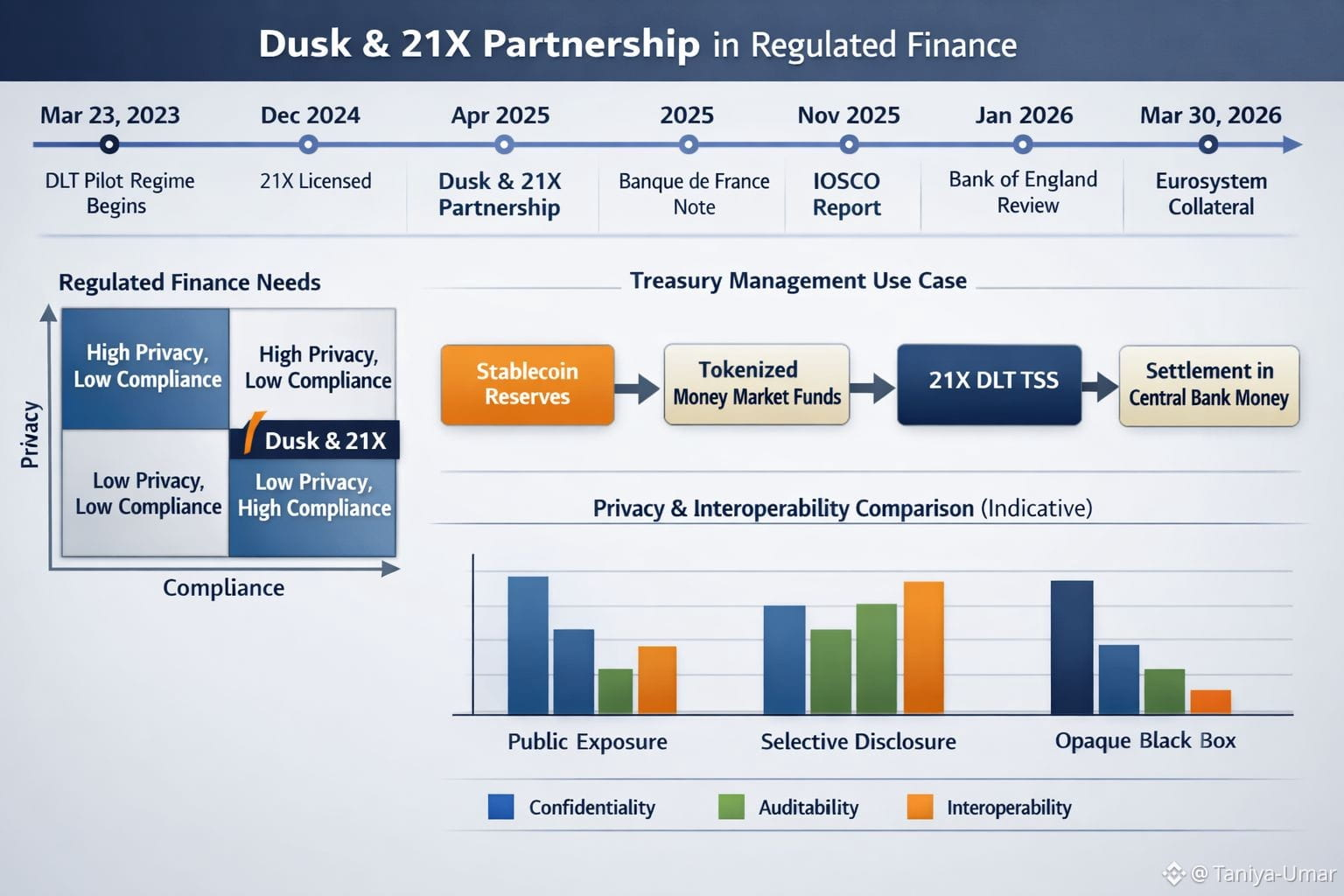
Regulators have been watching this intersection closely. IOSCO, in a November 2025 report, pointed to early signs of linkages between tokenized markets and crypto markets, including the increasing use of tokenized money market funds as stablecoin reserve assets or collateral. That’s not a “future” issue anymore; it’s a live design problem. If stablecoin reserves and tokenized funds are becoming part of the same plumbing, the infrastructure choices—what chain, what venue, what disclosure model—stop being philosophical debates and start being risk management.
This is also why Dusk’s potential deeper integration matters more than the initial onboarding. If 21X actually integrates DuskEVM, it’s a sign that regulated venues are looking for execution environments that can plug into the broader EVM world while still supporting privacy and compliance patterns that public chains weren’t originally built around. I don’t think the average reader needs to care about the technical architecture. The more human takeaway is simpler: Dusk is trying to be the “boring” foundation that regulated markets can live on—one that doesn’t force participants to choose between full public exposure and opaque black boxes.
Zooming out, the broader policy backdrop makes this feel a lot more “real” in early 2026 than it did a couple cycles ago. The European Central Bank has already signed off on a plan to let DLT trades settle in central bank money—which is a pretty loud signal that the official sector is taking the settlement question seriously. And then in late January 2026, reports said the Bank of England is looking at accepting a wider range of tokenised assets as collateral, alongside moves in the Eurosystem to start accepting certain DLT-issued assets as collateral from 30 March 2026. When central banks start talking about collateral eligibility and settlement rails, the conversation shifts. It’s no longer just about whether tokenization is “interesting.” It becomes about whether it can be safely integrated into the machinery that already holds the system together.
None of this guarantees adoption. Liquidity is earned, not announced, and regulated trading venues don’t change overnight. But if Dusk succeeds at anything, it will be by staying focused on the constraint that most blockchain projects try to wave away: regulated finance runs on confidentiality with accountability, not one or the other. In that sense, the Dusk–21X partnership is less about a flashy leap and more about a steady test of whether that balance can exist on-chain in a way that real institutions will trust.
