
@Vanarchain If we’re being honest, “Web3 gaming onboarding” has often been the polite name for the exit ramp. A game can hook you with visuals and a strong premise, and then—right at the start—it asks you to do a bunch of unfamiliar chores: install a wallet, protect a seed phrase, figure out gas, approve transactions you can’t easily interpret. That’s a lot to demand before someone has even had fun. The more encouraging trend is seeing teams accept that this isn’t “user education.” It’s product design, and it needs to feel as effortless as the game itself. They’re also doing it under real pressure: DappRadar’s 2025 reports described activity sliding quarter over quarter and hundreds of gaming dapps going inactive, which has a way of stripping the romance out of “we’ll fix onboarding later.”
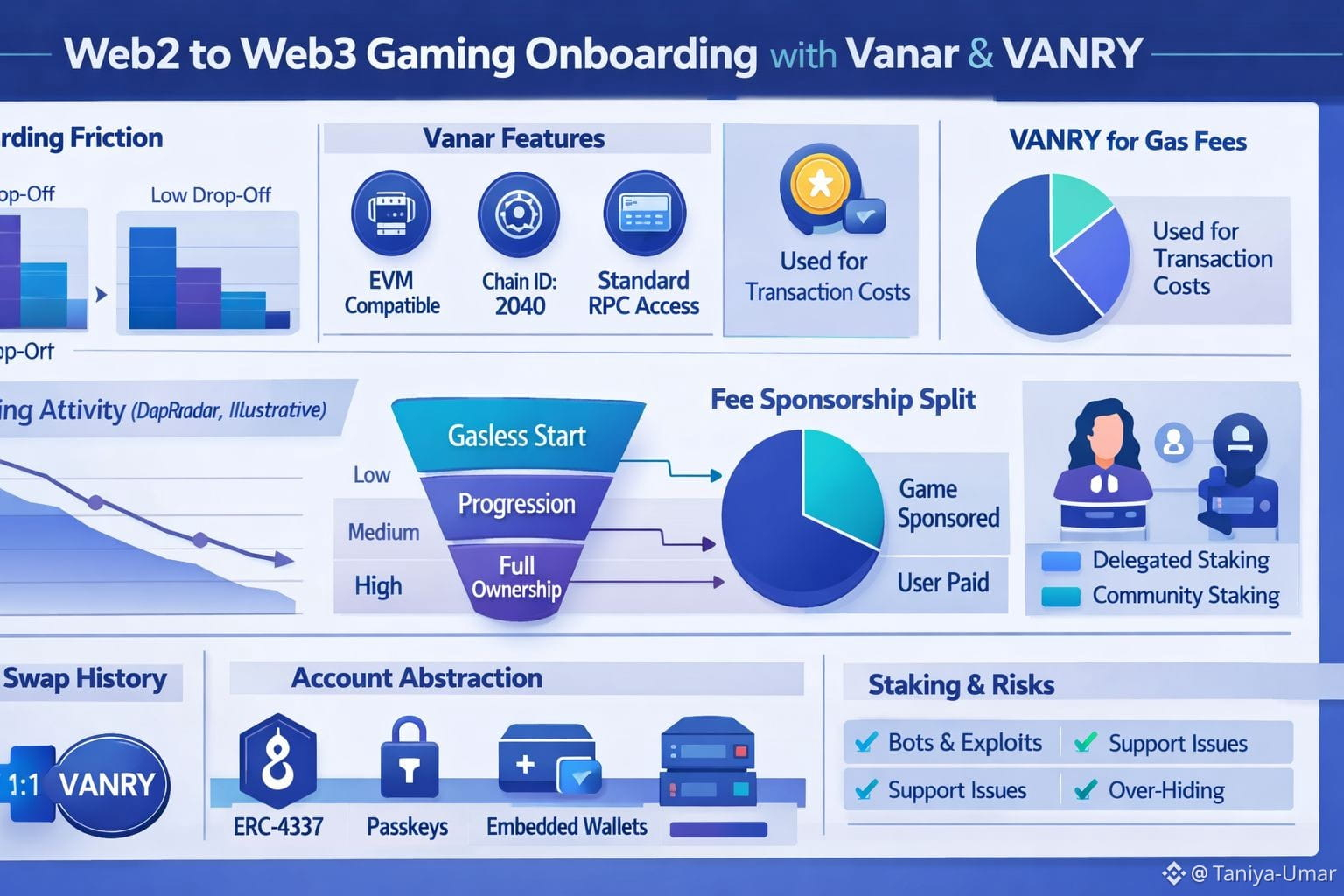
That’s the context where Vanar becomes interesting, because its positioning is not just “another chain,” but an attempt to package a blockchain as infrastructure that can sit quietly behind a game UI and behave predictably. Vanar positions itself as more than a basic blockchain. It presents an AI-native Layer 1 plus supporting components for things like storage and smart logic—useful context for developers, but not something most players will ever think about. What studios actually care about is the simpler part: it’s EVM-compatible, it has a standard chain ID (2040), and it connects through standard RPC endpoints. That means developers can build with the Ethereum tools they already know, and players don’t get pushed into strange new wallet steps.
That EVM compatibility matters because it’s the quiet enabler of a “Web2 feel.” If a player already has MetaMask, Coinbase Wallet, Brave Wallet, or a WalletConnect-compatible app, Vanar doesn’t require a new mental model—just adding a network like any other custom RPC. And if they don’t have a wallet at all, that same compatibility is what lets studios embed a wallet experience inside the game using the broader EVM wallet ecosystem, without locking themselves into a one-off solution. The point isn’t that players should care about chain IDs; it’s that developers can reduce friction by leaning on what already exists.
This is where the VANRY token should be treated as more than a background detail. On Vanar Mainnet, VANRY is explicitly the native currency symbol and the unit used to pay transaction fees. That makes it central to onboarding design, because “how do we handle fees?” is one of the first questions that breaks the player experience. The most player-friendly pattern is to sponsor fees early on—let people learn the game without buying anything—then introduce VANRY only when it’s genuinely useful, like when a player chooses to withdraw value, trade externally, or take full self-custody. In other words, VANRY becomes the “adult mode” of the economy, not the entrance exam.
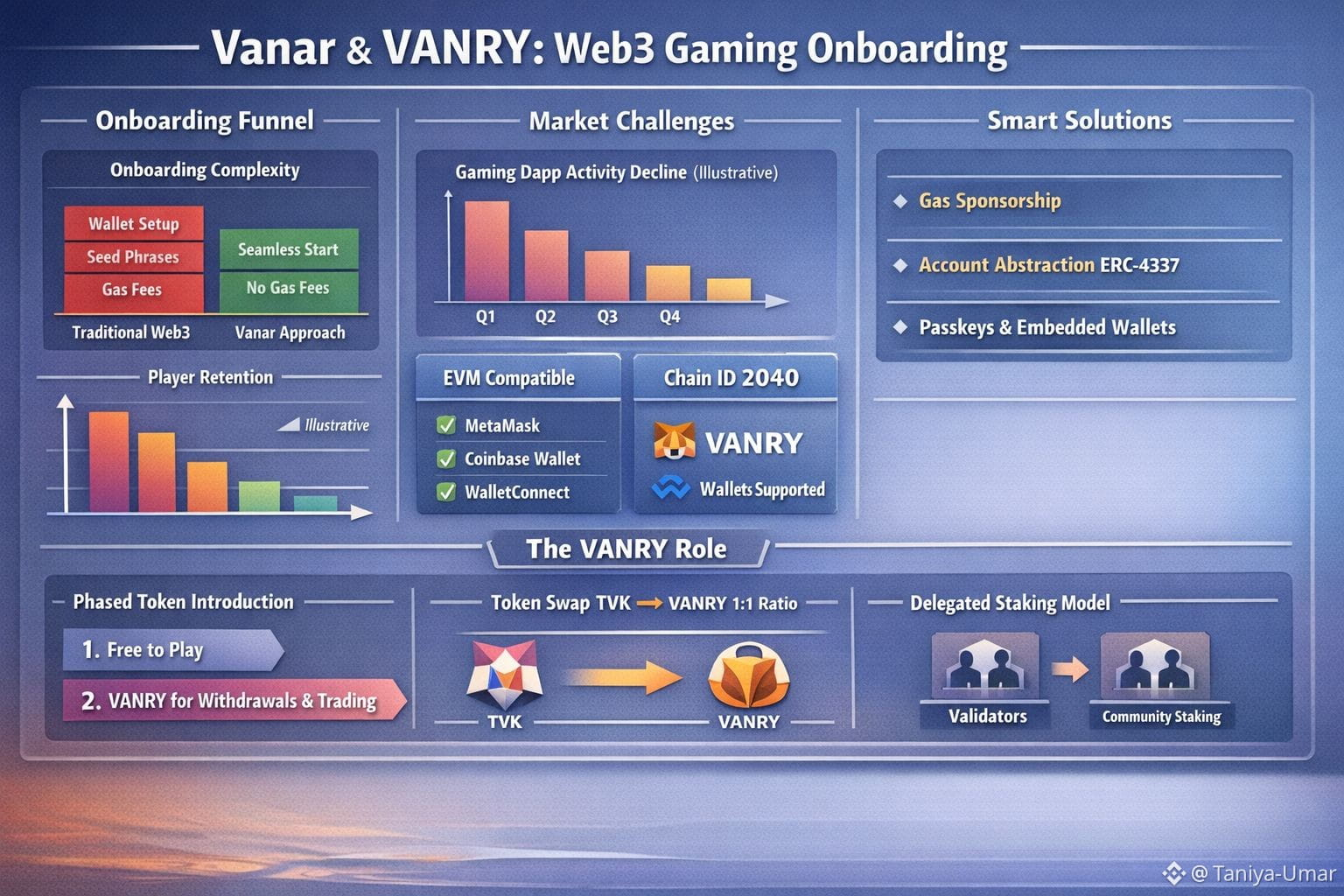
VANRY’s history also affects how comfortable teams feel building on it. The rebrand and token swap from Virtua’s TVK to VANRY was done at a 1:1 ratio and supported by major exchanges that publicly confirmed completion of the swap and the opening of deposits and withdrawals. That sort of operational follow-through doesn’t guarantee long-term success, but it does reduce a very real onboarding poison: the sense that a game’s economy is built on shifting sand. Players may not read announcements, yet they pick up on instability fast—missing tokens, confusing tickers, inconsistent wallet displays—and that uncertainty kills retention.
Account abstraction is the other big reason onboarding is trending now, because it gives studios a believable way to make wallets feel less like tools and more like accounts. ERC-4337 is widely described as the approach that enables smart accounts and features such as gas sponsorship, transaction batching, and flexible authentication, which is exactly the toolkit gaming teams need when they want gameplay to stay uninterrupted. Pair that with passkeys and embedded wallets—both of which are becoming mainstream topics in wallet infrastructure—and suddenly the dreaded seed phrase can stop being the first interaction a new player has with your game.
When you map that back onto Vanar and VANRY, a clearer onboarding concept appears: keep the first session “gasless” from the player’s perspective, while the game (or publisher) handles VANRY behind the scenes as needed to move state on-chain. Then, as a player’s attachment to the game deepens, introduce VANRY as the optional bridge to ownership: the token that pays for withdrawals, marketplace actions, or higher-trust permissions. Done well, the token stops feeling like a toll and starts feeling like a key you only need when you decide to open certain doors.
Staking and network security can even become part of that longer-term relationship, but only if it’s framed carefully. Vanar documents a delegated staking approach where users delegate VANRY to validators, and it also describes a model where validators are selected by the foundation while the community stakes to them. That’s not “onboarding” in the first-hour sense, but it is part of the credibility loop for players who do care about permanence: if items and balances are meant to matter, the network that records them needs a security story that’s understandable without a glossary.
None of this magically fixes the hardest problems. Gas sponsorship can attract bots. Embedded wallets can turn account recovery into a support nightmare if you don’t design it with care. And hiding blockchain too well can backfire if players later realize they never understood what they owned or what risks they took. The standard for a Web2-to-Web3 bridge isn’t “fast and cheap” anymore; it’s whether the system makes calm, safe choices easy by default. Vanar’s relevance here is that it’s trying to be the kind of EVM environment games can plug into without reinventing everything, and VANRY’s relevance is that it’s the economic lever you can introduce gradually, at the exact moment a player is ready for ownership to mean something.
