
If you only glance at the headlines from last night, it’s easy to get fooled.
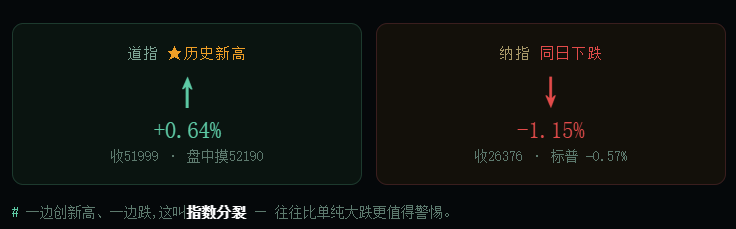
The Dow reached a new all-time high.
That's right, the Dow just surged 328 points, closing at 51999, and even hit a historical high of 52190 during the session.
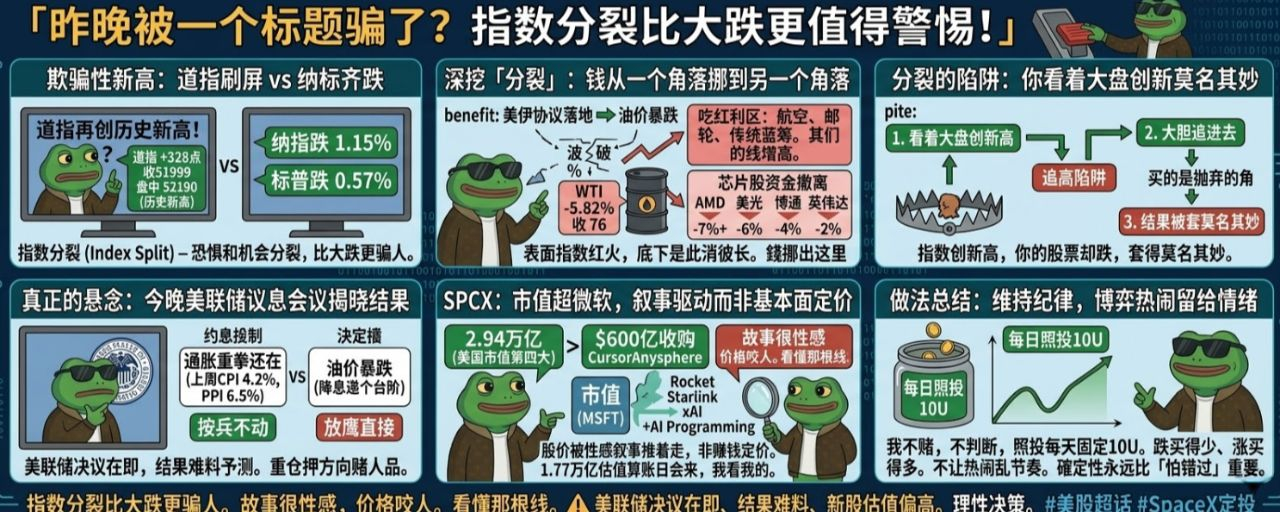
But if you take a closer look, you'll notice something's off: on the same day, the Nasdaq dropped by 1.15%, and the S&P fell by 0.57%. While one index is hitting new highs, the others are in the red. This is called index divergence, and it often warrants more caution than just a straightforward drop.
[Why is 'divergence' more concerning than a 'big drop'?]
Let's clarify what exactly went down last night.
After the US-Iran deal went through, oil prices continued to plummet (WTI down 5.82%, falling below 80 to 76), benefiting cyclicals like airlines, cruise lines, and traditional blue chips, pushing the Dow to new heights.
At the same time, money is being pulled out of the chip stocks that went crazy over the past few months—AMD dropped over 7% in one day, Micron fell 6%, Broadcom is down 4%, and even NVIDIA dropped over 2%.
So the new highs in the Dow aren’t great for the whole market; it’s just money shifting from one corner to another. The surface indices look hot, but underneath it's a structural tug-of-war. The most misleading part of this market is: you see the big board hitting new highs and think, 'the bull market is still on,' so you dive in, only to find you bought into the side that funds have abandoned (like chip stocks). The index rises while your picks drop, and you’re left scratching your head.
[And the real suspense will be revealed tonight: the Federal Reserve]
Yesterday, everyone was actually holding their breath for one thing—the Federal Reserve's meeting, and today the results will come out.
This is the real reason the market has been hesitant to make moves these past couple of days. Remember those two heavy punches of inflation last week (CPI 4.2%, PPI 6.5%)? With inflation still high, will the Federal Reserve stand pat or go hawkish to determine the next direction of funds? The plummeting oil prices seem to have provided a platform for rate cuts, but inflation data is still pressing down.
So this interest rate decision is harder to guess than any before. Before the results come out, whoever is heavily positioned in one direction is essentially gambling.
[SPCX: Market cap exceeds Microsoft, still riding on storytelling]
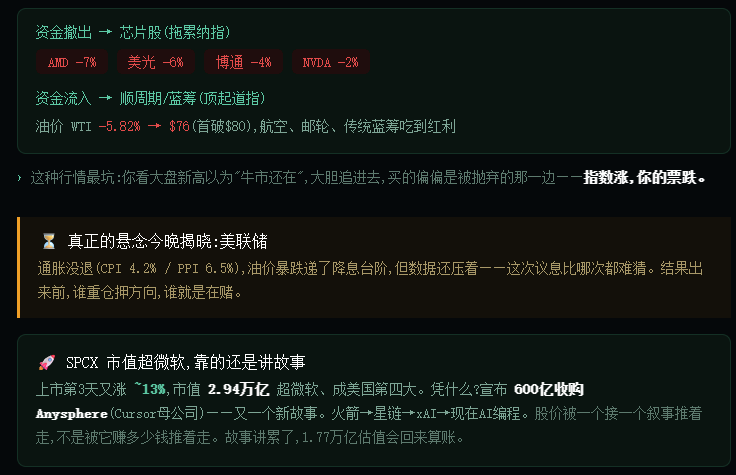
Let’s talk about the hottest stock in the room. SPCX rose about 13% yesterday, its market cap surged to $2.94 trillion, surpassing Microsoft and becoming the fourth largest company in the U.S.—just its third trading day since going public.
Why is it rising again? Because SpaceX announced it will spend $60 billion to acquire Anysphere, the company behind AI programming (that’s Cursor). Look, another new story—starting from rockets, Starlink, xAI, and now adding AI programming. A few days ago, I mentioned that SPCX is 'driven by sentiment and mechanisms, not fundamental pricing.' Yesterday's $60 billion acquisition made that crystal clear: its stock price is pushed by one narrative after another, not by how much it’s making today.
The story can be very sexy, and its market cap can exceed Microsoft's. But I still say: when the day comes that the narrative runs dry and the buying pressure from the indices is exhausted, that $1.77 trillion valuation will come back to settle the score with you. It can rise on its own; I’ll watch my own.
Tonight is the Fed meeting; let’s not drop the ball.
⚠️ Risk Warning: Investing carries risks. The current market indices are split, and sectors are rotating fiercely. The Fed's decision is imminent, and the outcome is uncertain; new stock valuations are high. The above is purely my personal observation and my own approach, and does not constitute any investment advice. Please make rational decisions based on your own risk tolerance #美股超话 .