
I think the layout of @OpenLedger on Datanets isn't really about the "decentralized data storage" narrative that's been beaten to death. The real breakthrough, in my opinion, is that it successfully transforms data from the proprietary assets of tech giants into a public infrastructure that can be co-built, governed, and profit-shared by the community. To put it simply, what Datanets is doing is rewriting the twenty-year-old unspoken rule of the traditional internet, which is "platform monopolizes data and users contribute for free," into a rigid on-chain protocol of "those who contribute benefit, and those who govern make decisions."
The essence of data monopoly is the inequality in production relations.
We can clearly feel that the core contradiction of the internet over the past twenty years has not changed: users generate data every day, platforms harvest the value of that data, and creators receive nothing. Google trains ad models with your search history, Meta uses your social graph to optimize recommendation algorithms, and OpenAI iterates GPT using your conversational data—these trillion-dollar data assets nominally belong to you, but in reality, you have no rights to dispose of them.
More critically, this monopoly is rapidly solidifying as we enter the AI era. Traditional tech giants, leveraging their first-mover advantage, have built extremely high data moats. New AI companies either have to pay exorbitant prices for data licensing or risk operating in gray areas. Data has become the most covert entry barrier in the AI industry, and the height of that barrier is dictated by a handful of giants.
I see OpenLedger's Datanets directly targeting this structural ailment.
Datanets’ solution: transforming data contribution into a verifiable, priceable, and distributable economic activity.
OpenLedger didn't try to 'overthrow' the giants; instead, it chose a more pragmatic path—using community co-construction to reclaim a data commons outside the monopolistic walls of the giants.
The core mechanism is clear: anyone can contribute data through Datanets, whether it's text, images, code, or knowledge bases in specific fields. When this data is put on-chain, it will be tagged with immutable source labels, clearly recording the contributor's identity, data type, quality rating, and usage authorization. When AI developers or institutions need to access this data, they must pay fees according to on-chain pricing, and the earnings will be automatically distributed to data contributors and network validators according to pre-set smart contracts.
What does this mean? It means data has finally transformed from 'free raw materials for platforms' into 'circulating assets for the community.' Contributors have finally gained pricing rights and revenue rights over their own data, while AI developers now have access to datasets that are clearly sourced, authorized, and legally usable for commercial purposes.
I think the most impressive aspect of this mechanism is that it directly resolves the legal conundrum of 'data rights' that has been debated for over a decade using code. It doesn't wait for legislative bodies to slowly discuss, nor does it rely on the giants to have a conscience; it enforces compliance through smart contracts. Compliance is not something to be persuaded; it is locked down on-chain.
Community co-construction is not just a slogan; it's a rigid design embedded in the token economy.
Many people may find the term 'community co-construction' vague, but Datanets has fully tokenized this logic.
Data contributors need to stake OPEN to ensure data quality; low-quality data will result in the forfeiture of their stake. Validators need to lock tokens to participate in data review, and their review actions directly impact their earnings. Data users need to consume OPEN to access datasets—the more frequently they use it, the higher the network's value. More crucially, the Datanets protocol will extract a certain percentage as fees for repurchasing and burning OPEN—this means that the network's usage translates directly into token scarcity.
I saw a statistic: since Datanets launched its testnet, the number of datasets contributed by the community has grown from 0 to over 120,000 in three months, covering high-value fields such as healthcare, law, finance, and scientific literature. The on-chain call frequency of these datasets has already surpassed 8 million times, while the cumulative earnings distribution for contributors has exceeded 2.4 million OPEN.
What do these numbers indicate? They show that when data contributions can actually earn money, the community's creativity far exceeds that of any company's procurement department. A tech giant may spend a billion dollars building a data labeling team, which could be outmatched by a well-designed incentive mechanism in an open community.
From data commons to the bottom-level reconstruction of the AI value chain.
The true ambition of Datanets, I believe, goes beyond being merely a 'decentralized data market.'
When the data contributed by the community is abundant, high-quality, and covers a wide range of areas, Datanets is effectively becoming the 'public data layer' of the AI era. On top of this public data layer, a whole value chain can develop for model training, fine-tuning, inference, and application deployment. Each step relies on Datanets’ data, consumes OPEN, and adheres to the on-chain authorization and distribution rules.
This is the complete picture of OpenLedger: Datanets solves the data sourcing problem, on-chain attribution addresses copyright compliance, verifiable execution resolves accountability issues, and the token economy tackles incentive problems. These four modules interlock to form a full-stack AI value chain from data to application. Each node in this value chain weakens the data monopoly of tech giants and redistributes value back to community participants.
Why can only OpenLedger do this?
Here, I want to elaborate a bit more. There are many projects in the data market space, but why does Datanets have the opportunity to truly break through?
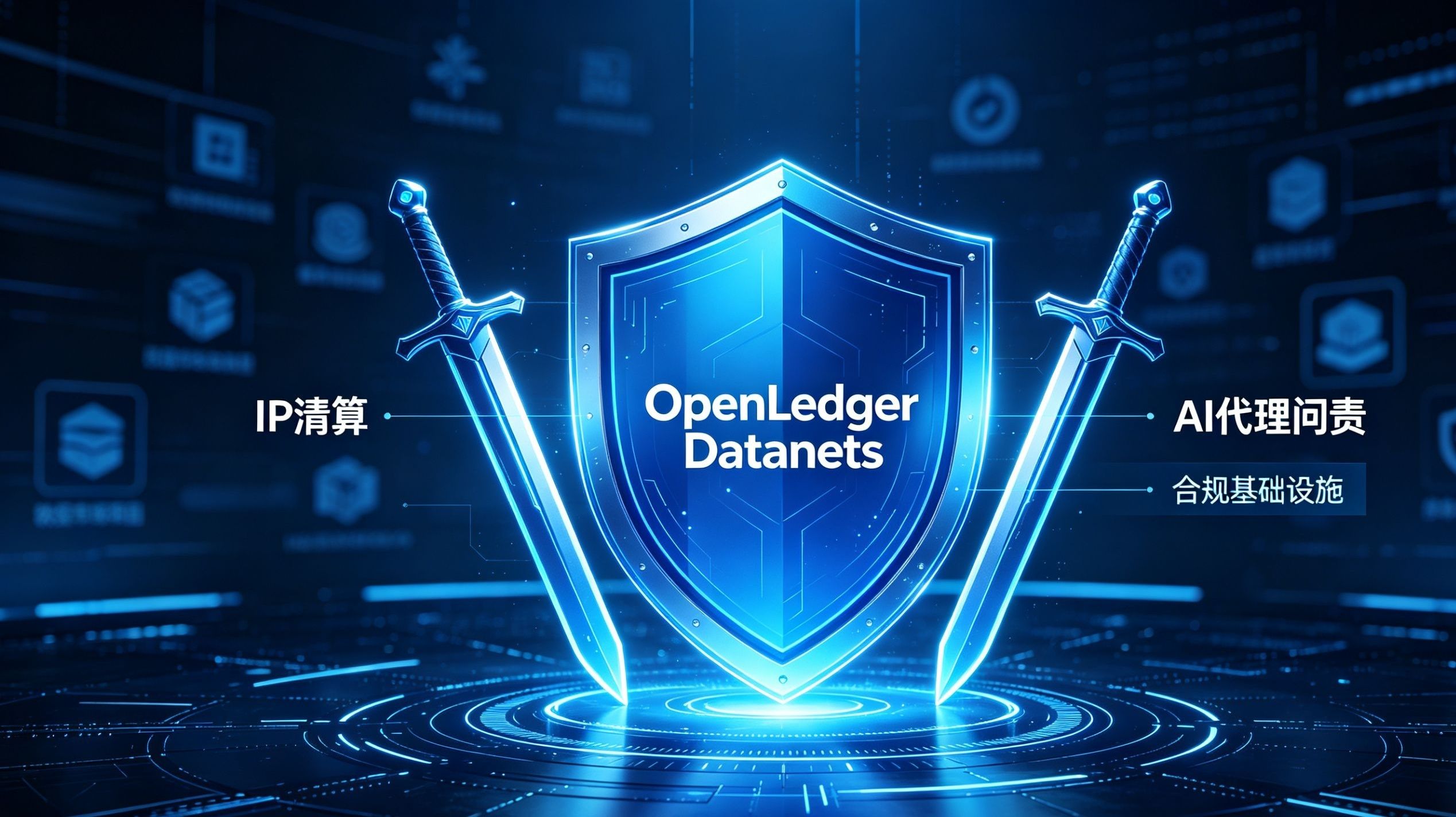
First, simply having a data market isn't enough; there must be a compliance framework. OpenLedger's previous collaborations with Story Protocol and TheoriqAI have already proven its execution capabilities in IP clearing and AI agent accountability. Datanets is not an isolated data pool; it's a data source embedded within the entire compliance infrastructure.
Secondly, just having community enthusiasm isn't enough; there must be an economic closed loop. The staking, consumption, and burning mechanisms of OPEN ensure that data contribution is not a one-off cash grab but a sustainable positive cycle. The more active the network, the scarcer the tokens; the scarcer the tokens, the stronger the earnings expectations for early contributors, which in turn makes the network more active.
Thirdly, having idealism isn't enough; there must be a real demand. The copyright lawsuits and data compliance pressures facing AI companies are real, urgent, and burning cash every day. Datanets doesn't offer a 'more ethical choice'; it provides a 'cheaper, safer, and more legal solution.' When compliance costs get high enough, rational players will naturally gravitate towards Datanets.
Written in conclusion
I believe the signal that OpenLedger conveys through Datanets is very clear: the power of data in the AI era should not be decided by the boards of a few tech giants, but should be jointly governed by the community contributing the data.
When data contributions can be verified, priced, and profitably distributed, the old paradigm of 'users as products' comes to an end. When the data commons co-built by the community is sufficiently solid, the data moats of tech giants will transform from insurmountable high walls to bypassable landscapes.
Datanets is not challenging the giants; rather, it's rebuilding a fairer production relationship in areas that the giants can't reach. When this production relationship is operational, the foundation of OPEN naturally becomes not just that of a project token, but of a public data infrastructure for the AI era.
The more pressing the compliance need, the more active the community, and the richer the data, the stronger the scarcity of OPEN will become. This is not a prediction; it's the reality unfolding on-chain.