
#SolanaGovernanceVoteToDoubleDeflationRate
Solana Opens First Governance Vote as Validators Debate Their Own Economics
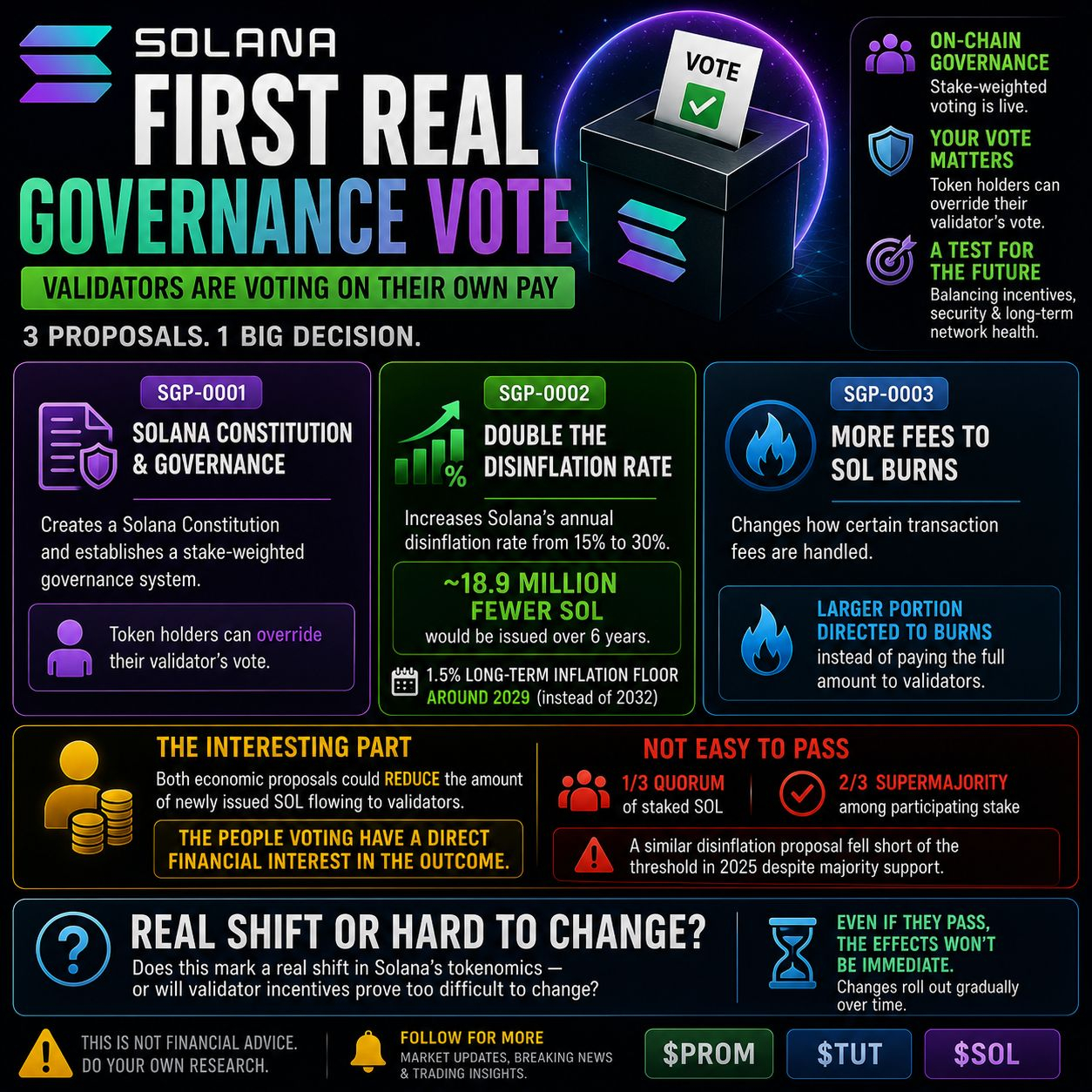
Solana has opened its first formal on-chain governance votes, putting the network's governance structure and token economics directly in the spotlight.
Three proposals are being considered, covering everything from how Solana governance works to inflation and transaction fees.
🗳️ Three Proposals, One Major Governance Test
SGP-0001 would establish a new Solana Constitution and formalize a stake-weighted governance system. Under the proposal, individual token holders could also override their validator's vote.
The other two proposals focus more directly on SOL's economics.
SGP-0002 proposes increasing Solana's annual disinflation rate from 15% to 30%. If approved, the network could potentially reach its 1.5% long-term inflation floor around 2029, rather than 2032.
The proposal estimates that roughly 18.9 million fewer SOL would be issued over six years.
Meanwhile, SGP-0003 would change how certain transaction fees are distributed, directing a larger portion toward SOL burns instead of paying the full amount to validators.
💰 Why Validator Incentives Matter
This is where the vote becomes particularly interesting.
Both economic proposals could reduce the amount of newly issued SOL flowing to validators.
That means some of the participants voting on the proposals have a direct financial interest in the outcome.
The debate isn't simply about making SOL less inflationary. Validators also have to consider whether changes to their rewards could affect the economics of operating the network and, ultimately, network security.
📊 A Tough Voting Threshold
The proposals face meaningful requirements before they can pass.
They need at least one-third quorum of staked SOL and a two-thirds supermajority among participating stake.
That threshold matters.
A similar disinflation proposal failed to reach the required threshold in 2025 despite receiving majority support.
So even if there is broad support for changing Solana's token economics, getting enough staked SOL behind the proposals could still prove difficult.
🔥 What Could It Mean for SOL?
If the proposals pass, the effects on SOL's supply and fee dynamics would develop over time rather than appearing immediately.
A faster reduction in inflation could mean fewer newly issued tokens, while greater use of transaction fees for burns could create additional changes to SOL's supply dynamics.
But the trade-off is important: reducing validator rewards could create new questions around network incentives and security.
👀 The Bigger Question
Solana's first formal governance vote is about more than tokenomics.
It's a test of whether the network can balance validator economics, token-holder interests and long-term network security through a formal governance process.
The outcome could influence how Solana approaches future economic changes.
Will Solana's validators and token holders support a less inflationary SOL — or will validator incentives make these reforms too difficult to pass?