
## TL;DR
If you are working out how to buy bitcoin in the United Kingdom, the short version is this: pick an exchange that is registered with the Financial Conduct Authority, pass identity verification, fund the account in GBP by bank transfer, buy $BTC, then decide whether the coins stay on the exchange or move to a wallet you control. The whole process usually takes under an hour of actual effort, and most of the friction UK beginners hit is not technical — it is banking friction, FCA cooling-off rules, and tax record-keeping nobody warned them about.
The rest of this guide covers each of those in order, with the traps that cost people money.
## How to buy bitcoin in the United Kingdom, step by step
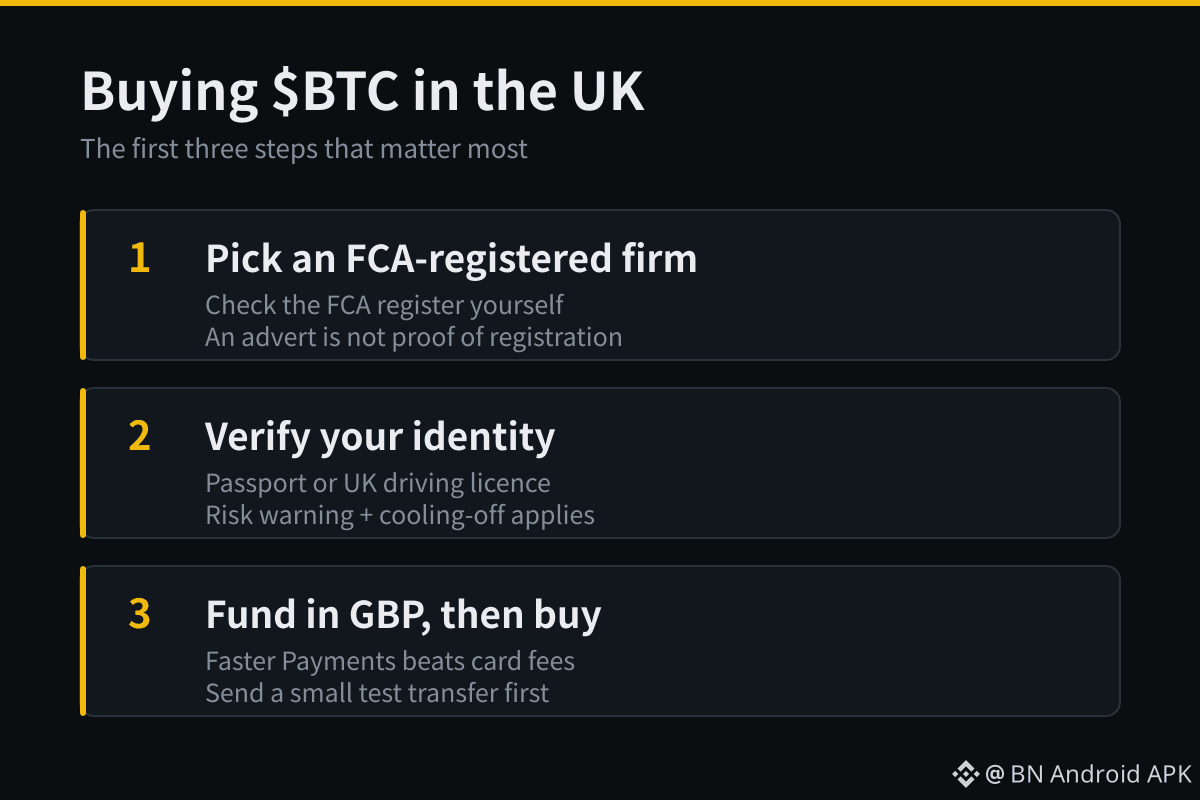
**1. Choose a registered exchange.** The FCA maintains a public register of cryptoasset firms permitted to operate in the UK. Check the register yourself rather than trusting an advert. A firm that is not on it may still take your money, but you have far less recourse when something goes wrong.
**2. Complete verification (KYC).** You will need a photo ID — passport or UK driving licence — plus a selfie check, and often a proof of address such as a bank statement or council tax letter. Use your legal name exactly as it appears on the document. Mismatches are the single most common reason verification stalls.
**3. Clear the FCA financial promotions steps.** UK residents opening a crypto account for the first time are shown a mandatory risk warning, asked to self-categorise as a restricted, high-net-worth or sophisticated investor, and put through an appropriateness assessment. First-time investors also face a cooling-off period before the first transaction can complete. This is not the exchange being awkward — it is UK regulation, and it applies across the market.
**4. Deposit GBP.** Bank transfer via Faster Payments is normally the cheapest route. Card deposits are instant but carry higher fees, and many UK banks treat them as cash advances.
**5. Place the order.** A market order fills immediately at whatever the book offers. A limit order fills only at your chosen price or better. For a first purchase of a liquid asset like bitcoin, either works; limit orders simply give you control over the fill.
**6. Decide on custody.** Leaving coins on the exchange is convenient. Moving them to a wallet you hold the keys to removes counterparty risk but hands you full responsibility. More on that below.
## Buying bitcoin in the UK with GBP: payment rails and bank friction
Faster Payments is the default. Transfers usually land within minutes, fees are low, and the amounts you can move are set by your bank rather than the exchange.
The catch is that several UK banks apply their own restrictions to crypto-related payments — monthly caps, blocks on card purchases, or holds on first-time transfers to a new payee. This varies by institution and changes over time, so check your own bank's current policy before assuming a large transfer will go through.
Two practical habits help:
- Send a small test transfer first. Confirm it arrives and is credited to the right account before sending the full amount.
- Use a bank account in your own name that matches your verified exchange account. Third-party deposits are routinely rejected and can trigger a compliance review.
A further UK-specific point: the Travel Rule applies to crypto transfers here. When you withdraw to an external wallet, you may be asked who owns the receiving address and, for transfers to another exchange, the recipient's details. Answer accurately. Guessing to get past the form is how withdrawals get frozen.
## Installing the app: Android and iPhone region traps
On Android, the Google Play version is the straightforward option for UK users. Some regions rely on a direct APK download instead, but if Play Store works for you, use it — updates are automatic and you avoid sideloading risk entirely.
On iPhone, one detail matters more than people expect: **the App Store region determines which app you get**.
- **Do not use a US App Store account.** The US store carries Binance.US, which is a separately operated platform. It does not share accounts with the global exchange, the asset listings differ, and a global-platform login simply will not work there. People discover this after depositing.
- **Do not use a mainland China account.** The app was delisted from the China region App Store, so you will not find it there at all.
For a UK resident, a UK Apple ID is the normal and correct answer. The two warnings above matter mainly if you hold a legacy overseas Apple ID or someone tells you to "just switch regions" — advice that is wrong far more often than it is right. If you do need a non-UK store, Taiwan or Hong Kong regions are the commonly used ones; both avoid the two traps above.
## Where to keep your $BTC after buying
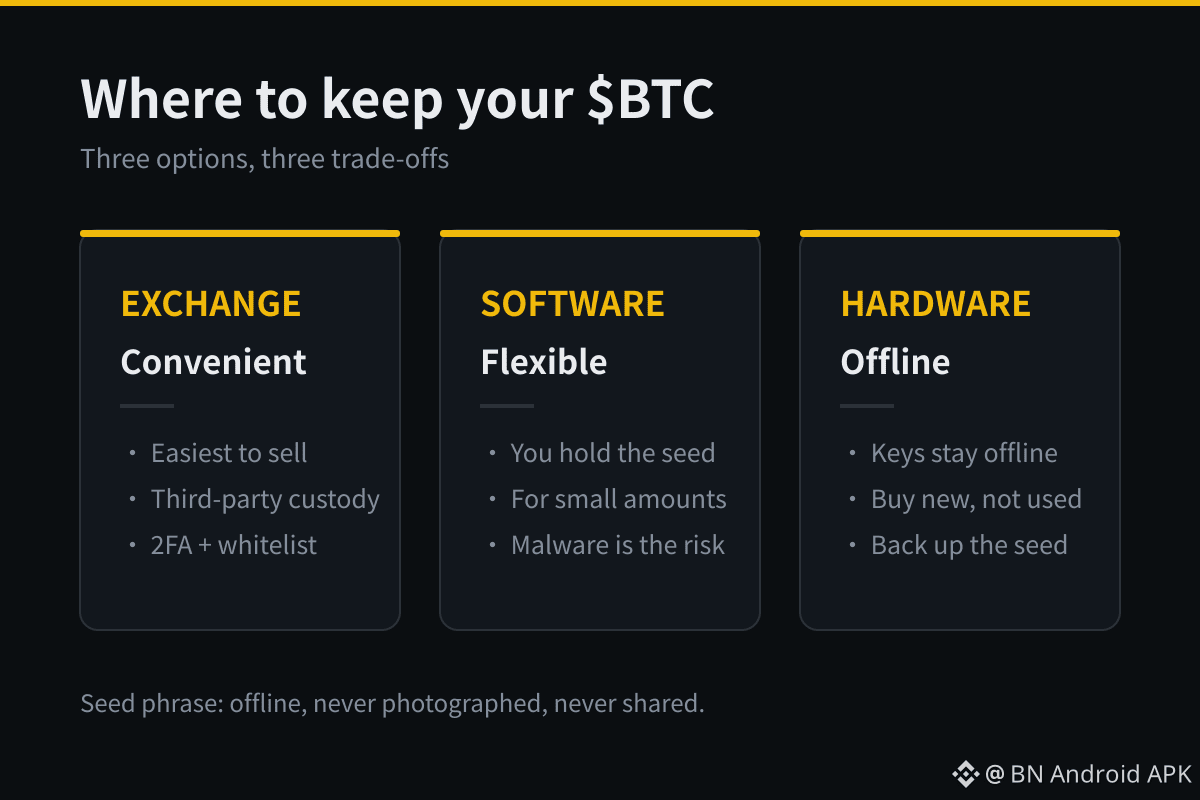
Three realistic options, each with a different trade-off.
**Exchange account.** Easiest to use, easiest to sell from, and the exchange handles key management. You are trusting a third party with custody, so treat two-factor authentication, a unique password and withdrawal address whitelisting as mandatory rather than optional.
**Software wallet.** A mobile or desktop wallet where you hold the seed phrase. Good for smaller amounts you want to move around, including over the Lightning Network for fast, low-cost $BTC payments. Vulnerable to malware on the host device.
**Hardware wallet.** A dedicated device such as a Ledger or Trezor that keeps keys offline. The standard choice for holdings you do not plan to touch for a long time. Buy direct from the manufacturer, never second-hand, and set up the seed phrase yourself.
Whatever you choose, the seed phrase rule is absolute: written down, stored offline, never photographed, never typed into a website, never shared with "support". No legitimate exchange or wallet provider will ever ask for it.
## Tax: what HMRC expects from UK bitcoin buyers
HMRC treats cryptoassets as property, not currency. For most individuals this means Capital Gains Tax applies when you dispose of bitcoin — and "disposal" is broader than people assume.
Disposals include:
- Selling $BTC for GBP
- Swapping $BTC for another cryptoasset such as $ETH or $BNB
- Spending bitcoin on goods or services
- Gifting it to anyone other than a spouse or civil partner
Simply buying and holding is not a disposal. Moving coins between your own wallets is not a disposal either.
There is an annual exempt amount below which gains are not taxed, and the figure has been revised several times in recent years — look up the current allowance on GOV.UK rather than relying on an old blog post. Gains above it are reported through Self Assessment.
Separately, crypto received as income — mining rewards, staking rewards, payment for work — is generally treated as income rather than capital gains at the point of receipt.
The practical advice: export your transaction history from the exchange regularly and keep it. Reconstructing three years of trades from memory is miserable, and the record-keeping burden sits with you, not the platform. If your activity is anything beyond occasional buying, speak to an accountant who has actually handled crypto clients.
## Mistakes that cost UK beginners money
**Chasing green candles.** The most expensive habit in the market is buying because the number went up this week. If you want exposure without timing pressure, regular fixed-size purchases spread over months remove the decision entirely.
**Skipping the test withdrawal.** Send a small amount to a new wallet address first, confirm it arrives, then send the rest. Bitcoin transactions cannot be reversed.
**Ignoring the network you are withdrawing on.** Sending an asset on the wrong network is a common way to lose funds permanently. Match the network on both ends before confirming.
**Falling for recovery and giveaway scams.** Anyone promising to recover lost crypto for an upfront fee is running a scam. So is any "double your deposit" offer. Report suspicious approaches to Action Fraud.
**Investing money you need.** Bitcoin is volatile and can fall sharply and stay there. Nothing in this guide changes that; position size is the only real defence.
## FAQ
**Is it legal to buy bitcoin in the United Kingdom?**
Yes. Buying, holding and selling bitcoin is legal for UK residents. What is regulated is how firms market and provide those services — hence the FCA registration requirement and the financial promotions rules you encounter at signup.
**What is the minimum amount I can buy?**
Most exchanges set minimums in the region of a few pounds' worth. You do not need to buy a whole bitcoin; it divides to eight decimal places, and the smallest unit is called a satoshi.
**Can I buy bitcoin in the UK with a debit card?**
Usually yes, though fees are higher than bank transfer and some UK banks block or limit crypto card payments. Credit cards are widely blocked and are a poor idea regardless, since you would be borrowing to buy a volatile asset.
**How long does UK verification take?**
Often minutes when documents are clear and well-lit. It stretches to days when the name or address does not match, so get that right the first time.
**Do I pay tax if I just hold?**
No. Tax events occur on disposal — selling, swapping, spending or gifting. Holding through a price rise creates no liability until you dispose.
**Should I keep bitcoin on the exchange or in my own wallet?**
Small, actively traded amounts on the exchange with strong security settings is reasonable. Larger long-term holdings belong in self-custody, ideally on a hardware wallet, provided you are confident about backing up and storing the seed phrase.
---
Get started: https://www.binance.com/en/join?ref=BNAPP
#Bitcoin #UKCrypto #CryptoForBeginners #BinanceSquare #CryptoTax