
Whenever I explore a new protocol, I rarely begin by looking at the token or the headline features.
I usually open the documentation first because that's where I can tell whether a project has been designed thoughtfully or simply marketed well.
While reading through @NewtonProtocol 's payment architecture, I noticed something interesting.
The documentation didn't just explain what each component does it explained why every step exists and how each one connects to the next.
That made the entire process much easier to follow.
Instead of jumping directly to the payment itself, I started at the beginning of the workflow.
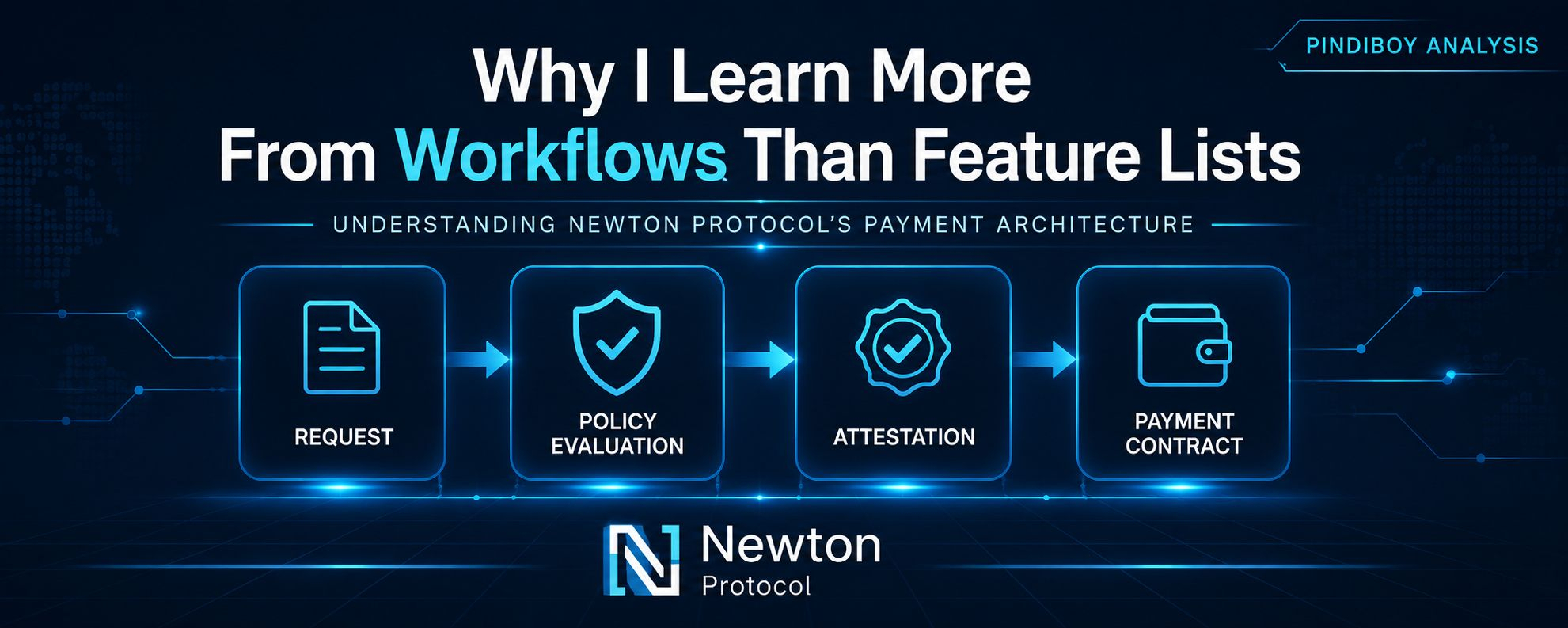
A request enters the system, policies are evaluated, an attestation is produced, and only then does the payment contract determine whether the transaction should move forward.
Seeing those steps in sequence made the architecture feel logical instead of complicated.
One detail that stood out to me was the explanation that there isn't an off-chain server sitting in the critical execution path.
I paused for a moment, looked back at the diagram, and traced the flow again.
Suddenly that design choice made much more sense because I could see exactly where every decision was happening.
That's one of the reasons I enjoy reading technical documentation.
A well-designed architecture page encourages you to slow down, revisit the diagram, and test your own understanding instead of simply accepting a list of features.
I found myself reading a paragraph, studying the workflow, then returning to the text with a completely different perspective.
Every time I repeated that process, another small detail became clear.
This is also why I spend more time on architecture documents than announcement posts.
Announcements tell me what's new, but architecture shows me how the entire protocol is expected to function when all the pieces work together.
Reading this architecture also made me more interested in the direction of Newton Mainnet Beta.
It's one thing to announce a network, but it's much more valuable when the documentation clearly explains how requests, policy evaluation, attestations, and payment execution work together.
That transparency makes it easier to understand what the protocol is actually building.
By the time I finished this section of @NewtonProtocol 's documentation, I wasn't focused on a single feature anymore.
I was thinking about how the complete payment workflow had been designed from start to finish.
For me, that's what good documentation should achieve it doesn't just explain a protocol, it helps you understand how everything fits together.
