
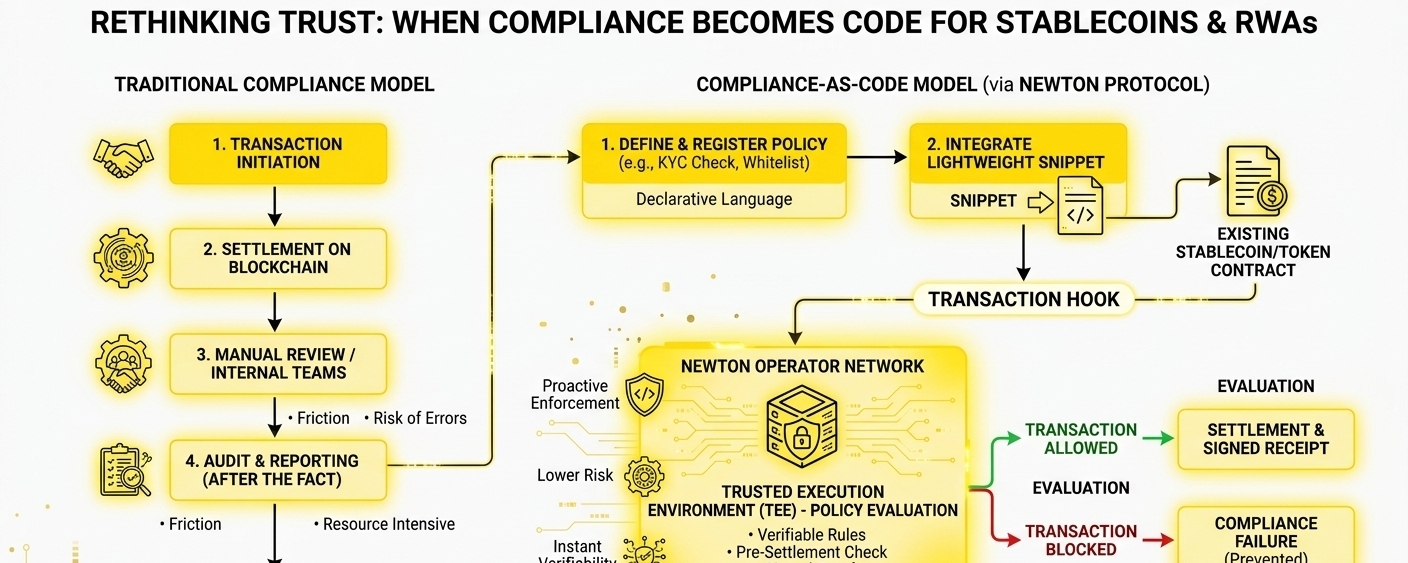

I was reading through how Newton Protocol frames its stablecoin and RWA use case a few days ago, and one phrase kept catching my attention more than the rest of the technical material around it: compliance-as-code. It sounds almost too clean when you first hear it, like a slogan more than a description, but the more I sat with what it actually implies, the more I started questioning how a stablecoin issuer's day-to-day operations would even change if this became the default way of doing things. Right now, most issuers rely on internal compliance teams, manual transaction reviews, and periodic audits that happen after the fact. Newton is proposing something structurally different, where the rule itself lives inside the smart contract and gets checked before a transfer ever settles, not after someone notices a problem.
What I find genuinely interesting is how narrow the actual integration seems to be from a technical standpoint. From what I've read, an issuer defines a policy, something like only allowing transfers to addresses that have passed KYC verification, registers it, and then adds what's described as a lightweight snippet to the existing contract. No rewrite of the core logic, no migration of the token itself, just a hook that routes the transaction through Newton's operator network for evaluation inside a trusted execution environment before it's allowed to proceed. It makes me think about how much of the friction in bringing regulated assets onchain has never really been about the blockchain technology itself, but about proving to regulators and auditors that the rules were actually followed, consistently, on every single transaction, not just the ones someone happened to review. A signed, verifiable receipt for every check does seem like it addresses that specific pain point directly, though I keep wondering how many issuers are actually structured internally to trust an automated system with that responsibility yet.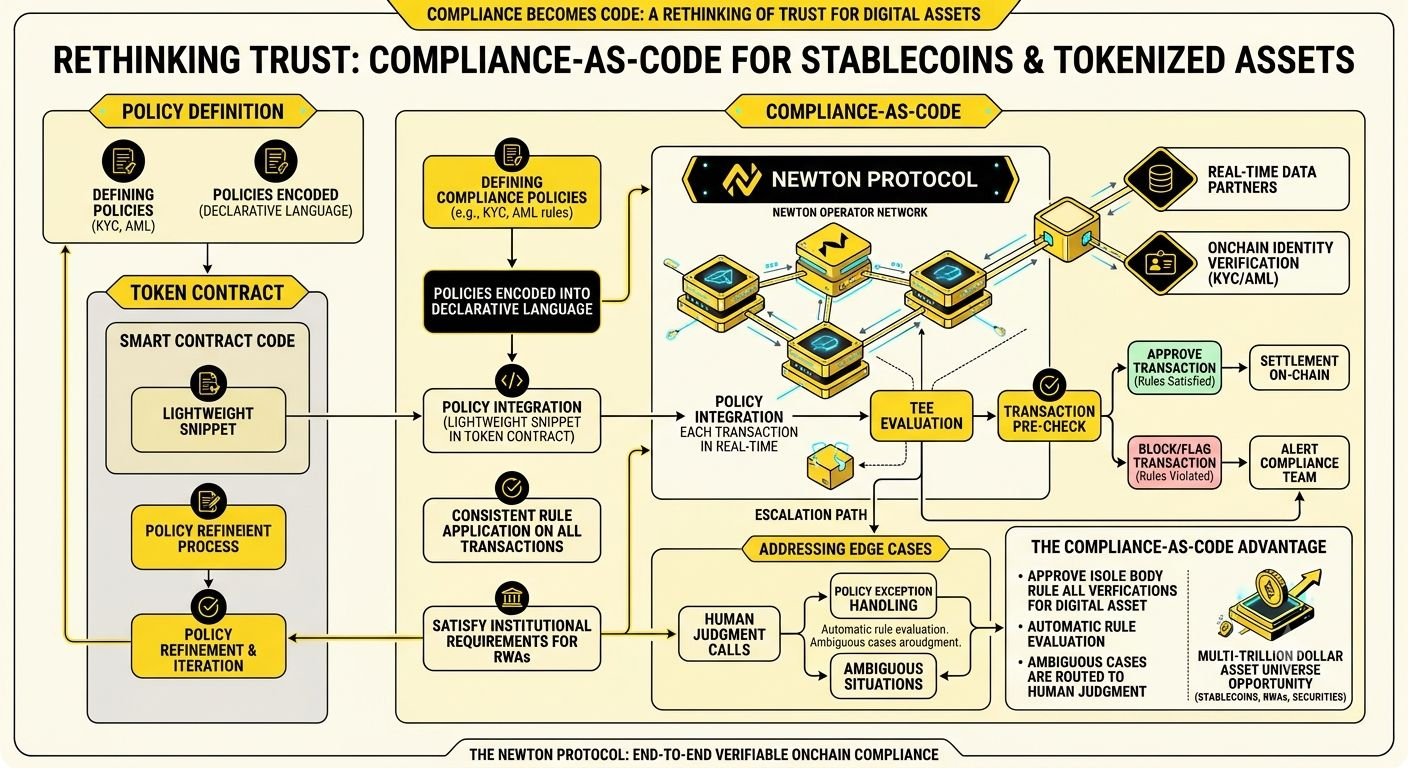
The part I haven't fully resolved in my thinking is what happens at the edges, the cases that don't fit neatly into a pre-written rule. Compliance in traditional finance often involves judgment calls, escalations, human review of ambiguous situations, exceptions that get made for legitimate business reasons. If a policy is written in a declarative language and evaluated automatically, where does that judgment go? Is it pushed upstream into how the policy gets written in the first place, meaning issuers need to anticipate every edge case in advance, or does Newton allow for some kind of override path when a transaction gets flagged incorrectly? I'm not completely sure, and it seems like the kind of question that only gets properly tested once real institutional volume starts flowing through these policies rather than staying in pilot or beta conditions. There's also the matter of who actually writes these policies well. A poorly constructed rule set could either block legitimate activity unnecessarily or, worse, create a false sense of security while missing the actual regulatory intent behind it.
Looking at where this sits within the mainnet beta rollout, it feels like Newton is trying to solve a problem that sits upstream of most of crypto's current conversation, less about trading or yield and more about whether the infrastructure underneath stablecoins and tokenized real-world assets can actually satisfy the institutions that are supposedly waiting to bring serious capital onchain. The market opportunity being described, spanning stablecoins, RWAs, and the broader multi-trillion dollar asset universe, is enormous on paper, but enormous addressable markets have a way of staying theoretical until the actual friction points get solved one issuer at a time. What seems interesting is that this isn't a hypothetical framework anymore, it's live, with real data partners and real policy infrastructure running today, yet I keep coming back to the question of adoption speed. Institutions tend to move cautiously with new compliance infrastructure precisely because the cost of getting it wrong is so asymmetric. Whether compliance-as-code becomes the standard or just one option among several older, slower methods is something I don't think anyone can honestly claim to know yet — anyway, time will tell🚀
#Binance1B$inStocks #USADP98KMiss #BitcoinFell20.5%InJuneTo$58526 #SKHynix2xLongETFFallsOver30%