
i used to think openledger was just another polished ai narrative wrapped in blockchain language because honestly that’s what most of these projects feel like at first now. every cycle creates its own vocabulary. first it was defi. then gamefi. then modular infrastructure. now suddenly everything wants to become “ai-powered.”
so when i first came across openledger, i reduced it immediately.
another protocol trying to tokenize intelligence.
another system promising decentralized ai.
another market chasing the next emotional narrative.
that was my assumption.
simple.
comfortable.
easy to dismiss.
but lately i’ve been noticing something i can’t really ignore anymore.
the longer i sit with the project, the less it feels obsessed with ai itself.
and the more it feels obsessed with something deeper underneath it.
ownership.
not ownership in the emotional sense people usually talk about online.
i mean operational ownership.
economic ownership.
the kind that decides who actually captures value once machines begin generating intelligence at scale.
and maybe that sounds abstract at first, but i think that’s because most people still imagine ai as a tool instead of an economy.
that’s the shift i keep coming back to.
because once ai stops being “software” and starts becoming an active economic participant — creating outputs, making decisions, interacting with systems, executing tasks autonomously — the entire structure underneath the internet starts changing quietly.
and i think openledger understands that more than people realize.
recently, while watching the project evolve, i started seeing the architecture differently. the launch of its mainnet, the expansion around payable ai, the push toward datanets and attribution systems, the focus on monetizing models and agents instead of just training them — none of it feels accidental anymore.
it feels coordinated around one uncomfortable realization:
ai is creating value using contributions it still struggles to economically recognize.
that tension sits underneath almost the entire industry right now.
artists feed the datasets.
users generate behavioral data.
developers refine systems.
communities create distribution.
contributors shape intelligence indirectly every single day.
but once the model produces something valuable, attribution disappears into the machine.
that disappearance became normalized so fast that people barely question it anymore.
and maybe that’s the real thing openledger is trying to challenge.
not ai itself.
the invisibility surrounding value creation inside ai systems.
i keep thinking about that because it changes how i interpret the project completely.
suddenly the blockchain part stops feeling speculative.
it starts feeling necessary.
because if future intelligence becomes autonomous, composable, and financially active, then systems will eventually need memory.
not human memory.
economic memory.
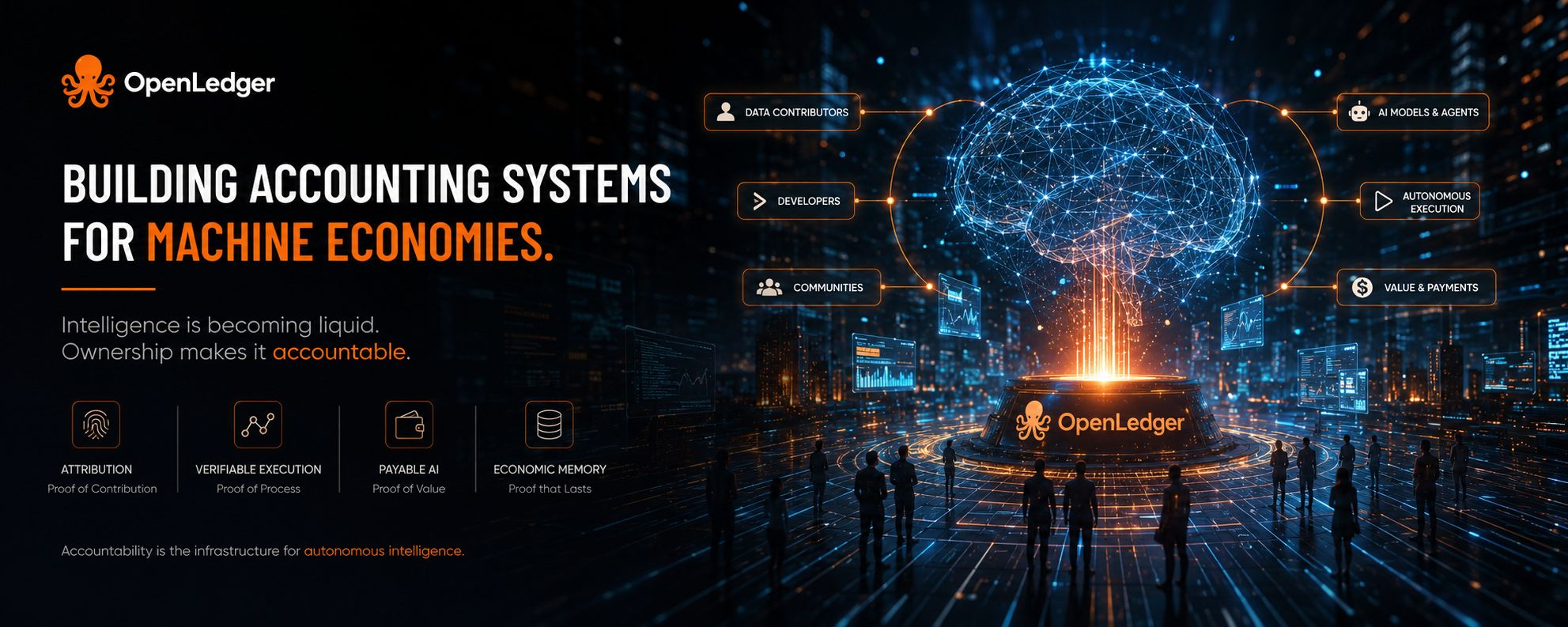
proof of where intelligence came from.
proof of who contributed.
proof of what influenced the output.
proof of who deserves compensation.
and that changes everything for me.
because most projects talk about scaling intelligence.
openledger seems more interested in scaling accountability around intelligence.
those are not the same thing.
the deeper i went into the recent developments around the ecosystem, the more i noticed how much attention they’re putting toward agent infrastructure, attribution layers, verifiable execution, and payment routing. even the language surrounding the project has started shifting away from simple “ai marketplace” narratives toward ideas around trustworthy ai economies.
that wording matters.
because trust is becoming the hidden crisis of the entire ai era.
people still think the biggest future problem is whether ai becomes powerful enough.
i’m starting to think the bigger issue might be whether anyone can verify where intelligence originated once systems become too complex to interpret.
especially when autonomous agents start operating financially.
especially when they begin influencing markets.
especially when machine-generated outputs become indistinguishable from human labor economically.
that future suddenly makes projects like openledger feel less theoretical to me.
almost defensive.
like infrastructure being built before the real pressure arrives.
and i think that’s why i can’t fully categorize it as just another crypto project anymore.
because beneath the token speculation and market volatility, there’s a much larger philosophical question forming underneath the entire system:
what happens when intelligence itself becomes liquid?
not information.
not assets.
intelligence.
what happens when models, agents, reasoning systems, and autonomous workflows become tradable economic participants inside digital markets?
who gets paid?
who gets erased?
who controls attribution?
who controls memory?
and maybe that’s the point where openledger started becoming genuinely interesting to me.
because i realized the project isn’t really trying to financialize ai hype.
it’s trying to build accounting systems for machine economies.
that realization hit me slowly.
almost uncomfortably.
because once you see it that way, the implications become much bigger than crypto narratives.
it starts touching labor.
creativity.
ownership.
governance.
power distribution.
machine autonomy.
all at once.
and honestly, i still don’t know if the market fully understands what it’s looking at yet.
sometimes i think people are still trading the surface while the deeper architecture quietly develops underneath them.
but maybe that’s how foundational systems always begin.
quietly.
misunderstood.
buried underneath speculation before eventually becoming infrastructure people depend on without thinking.
personally, i think openledger becomes important if the world truly moves toward autonomous ai economies the way people predict.
because eventually intelligence won’t just need scale.
it’ll need accountability.
and right now, very few systems are even attempting to solve that problem seriously.
openledger at least seems aware that the problem exists.
and the longer i think about that, the harder it becomes for me to see the project as “just another ai coin” anymore.