
The Account Abstraction team at the Ethereum Foundation has unveiled a series of goals for the Ethereum Interop Layer (EIL), aiming to enable the entire rollup ecosystem to “operate as a single chain” from the user's perspective.
“What if every L2 network worked like one unified Ethereum? No more worrying about bridges, no more remembering chain names, and no more fragmented assets or balances,” the research team wrote in their blog announcement on Tuesday. “That is the vision of the Ethereum Interop Layer: giving Ethereum the ‘feel’ of a unified chain — while preserving decentralization and minimizing trust assumptions that we deeply value.”
Although Ethereum has significantly improved throughput and reduced costs through Layer-2 (L2) solutions, this fragmentation introduces new challenges: technical burdens when interacting with multiple chains, more complex operations, increased trust assumptions, and security risks at bridges. According to Chainalysis, users lost over $2 billion in 2022 alone due to cross-chain bridge hacks, most of which involved L2 bridges.
Currently, the cross-L2 environment functions similarly to centralized exchanges, “as it depends on bridge operators, relayers, solvers, and opaque off-chain infrastructure,” according to Ethereum researcher Yoav Weiss.
EIL aims to do for Ethereum what HTTP did for the internet
Built on top of the ERC-4337 standard — the foundation of smart wallets — the Ethereum Interop Layer (EIL) enables users to execute cross-chain actions with a single transaction from their wallet, while hiding all underlying complexity.
“Users interact directly on all chains; trustless liquidity providers supply capital but never interact with users or see their transactions,” Weiss explained.
The article compares EIL to the role of the HTTP protocol during the early internet era — where wallets can function like browsers and the entire network becomes seamless, instead of fragmented into isolated blockchain “islands.”
According to the Ethereum Foundation’s Account Abstraction team, this wallet-centric cross-chain roadmap brings several major benefits: a more intuitive user experience, seamless compatibility with new rollups, default multi-chain support for dapps and wallets, reduced workload for developers, and a trust-minimized operating environment.
The announcement comes amid the Ethereum Devconnect conference in Buenos Aires, Argentina.
Ethereum price forecast: ETH attempts to hold recovery above the $3,100 support level
After forming a bottom just below $2,950, ETH price is attempting to maintain its rebound around the key $3,100 support zone. If bulls successfully defend this level, the coin may bounce back to retest the $3,470 resistance, opening the door for a deeper recovery.
Conversely, losing the $3,100 level may trigger a fresh decline, pulling ETH back toward the $2,850 zone. In a more bearish scenario, price could slide down to the strong support at $2,380.
Technical indicators are currently sending mixed signals: the RSI remains below neutral territory but is edging higher, while the Stochastic Oscillator has bounced from the oversold zone. This suggests that bearish pressure is gradually easing, giving bulls some short-term hope.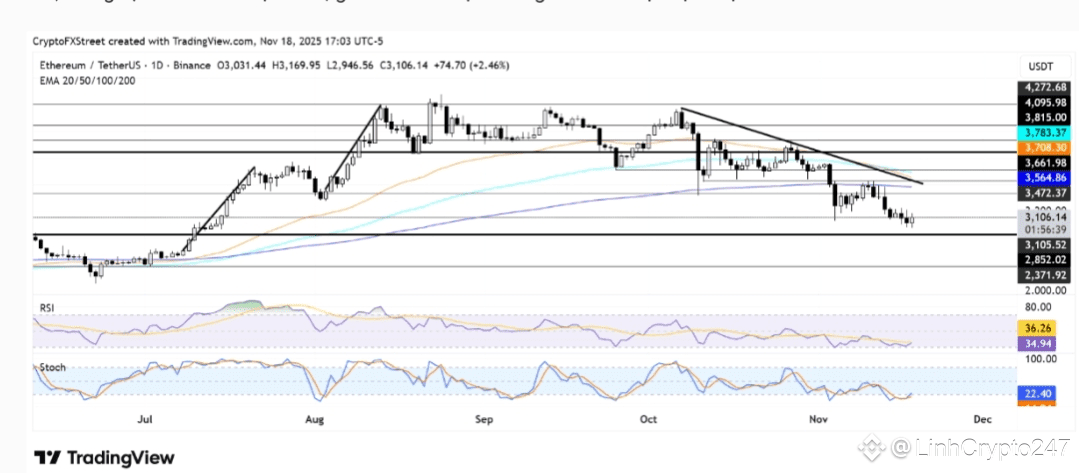
#Ethereum #ETH #EthereumNews
