
 5 Trading Habits That Slowly Kill Traders
Most traders are not losing because they cannot read charts.
They lose because of small habits that keep repeating again and again until the account finally breaks.
You can understand support and resistance.
You can know market structure.
You can spot clean entries.
But none of that matters if your habits are weak.
Trading is less about finding the perfect setup and more about controlling the bad decisions that quietly destroy progress.
Here are five habits every trader needs to fix before they become expensive mistakes.
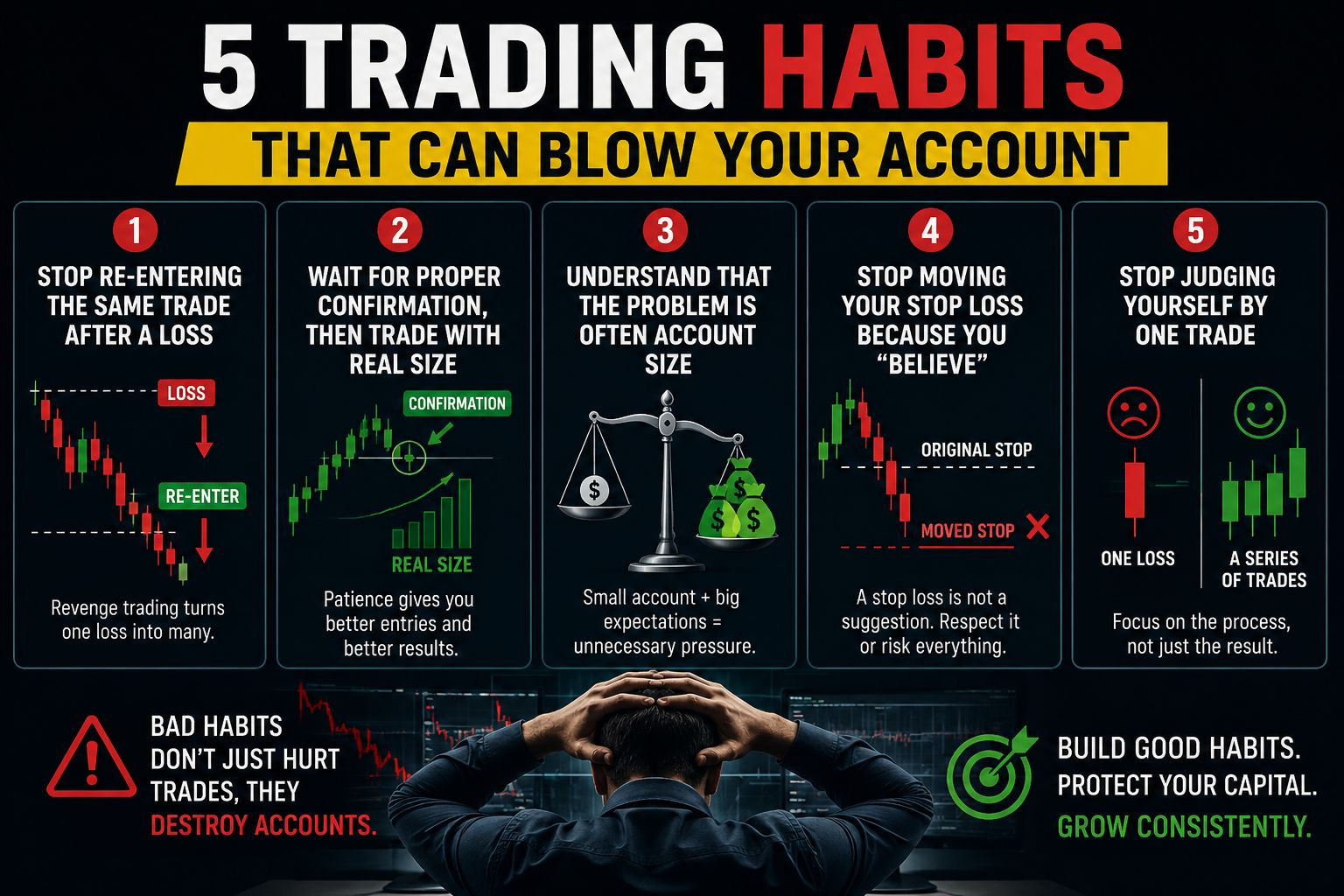
1. Taking the Same Trade Again Right After Losing
This is one of the biggest account killers.
You enter a trade.
It fails.
Stop loss gets hit.
Instead of moving on, you convince yourself the setup is still valid.
“Maybe I entered too early.”
“Maybe this level is better.”
“Now it looks cleaner.”
So you enter again.
Most of the time, this is not confidence.
It is emotion.
After a loss, traders want quick recovery. The mind starts chasing the money back instead of waiting for quality opportunities.
A failed trade already gave you information. The market showed that your idea was either wrong, too early, or simply not ready yet.
Jumping back into the same setup without fresh confirmation usually turns one mistake into several.
Good traders know when to leave a setup alone.
If you plan to re-enter, there should be a completely new reason behind it:
- a proper structure shift,
- strong rejection,
- confirmed retest,
- or clear momentum change.
Not just hope.
2. Entering Before the Market Confirms the Move
A lot of traders rush into trades because they want tighter stops and bigger profits.
Sounds smart at first.
But early entries often create unnecessary losses.
Price has not confirmed the move yet, but traders still jump in because they are afraid of missing the opportunity.
Then the trade fails.
Then they try again.
Then frustration begins.
The problem is not always the setup.
The problem is timing.
Strong traders wait for confirmation before risking money.
That does not mean waiting forever.
It means waiting for the market to actually show strength.
If you trade breakouts, wait for the breakout and retest.
If you trade support and resistance, wait for real reaction.
If you trade trends, wait for the pullback to hold.
If you trade liquidity sweeps, wait for rejection after the sweep.
Patience saves more accounts than prediction.
3. Expecting Huge Results From a Small Account
This is something many traders never admit.
Sometimes the issue is not skill.
It is expectation.
Small accounts create pressure.
When the balance is low, traders start forcing trades because they want fast growth. They risk too much, overtrade, and chase unrealistic returns.
They want a small account to produce big-account results.
That pressure destroys discipline.
A small account should be treated differently. The focus should be consistency, not speed.
Trying to turn a tiny balance into massive profit within days usually ends the same way:
the account disappears.
Real growth in trading takes time.
Build the process first.
The account growth comes later.
4. Moving Stop Losses Because You “Still Believe”
A stop loss is there for protection.
It marks the point where the trade idea no longer makes sense.
But many traders move their stop the moment price gets close.
Why?
Because accepting the loss feels uncomfortable.
So they widen the stop hoping price reverses.
Sometimes it works once, and that creates an even worse habit.
Moving stops without a real reason destroys risk management completely.
If your stop was placed below structure or above invalidation, respect it.
A stopped-out trade is part of trading.
A blown account is not.
Good traders accept small losses quickly.
Undisciplined traders keep moving risk until the damage becomes serious.
5. Making Every Trade Emotional
One winning trade does not make you amazing.
One losing trade does not make you terrible.
But many traders treat every result like it defines them personally.
That emotional attachment creates inconsistency.
Trading should be judged over a series of trades, not one moment.
Instead of asking:
“Did this trade win?”
Ask:
- Did I follow my plan?
- Did I respect risk?
- Did I avoid emotional decisions?
- Did I stay disciplined?
- Did I take quality setups only?
Losses are normal.
Wins are normal.
Both are simply part of the process.
The traders who survive long term are the ones who stop turning every trade into drama.
Final Thoughts
Trading will always involve losses.
No strategy wins every time.
The real goal is not avoiding losses completely.
The goal is avoiding unnecessary mistakes.
Most traders do not fail because they lack knowledge.
They fail because emotions slowly take control of their decisions.
Fix the habits.
Protect the account.
Stay consistent.
Because in trading, survival always comes before success.