
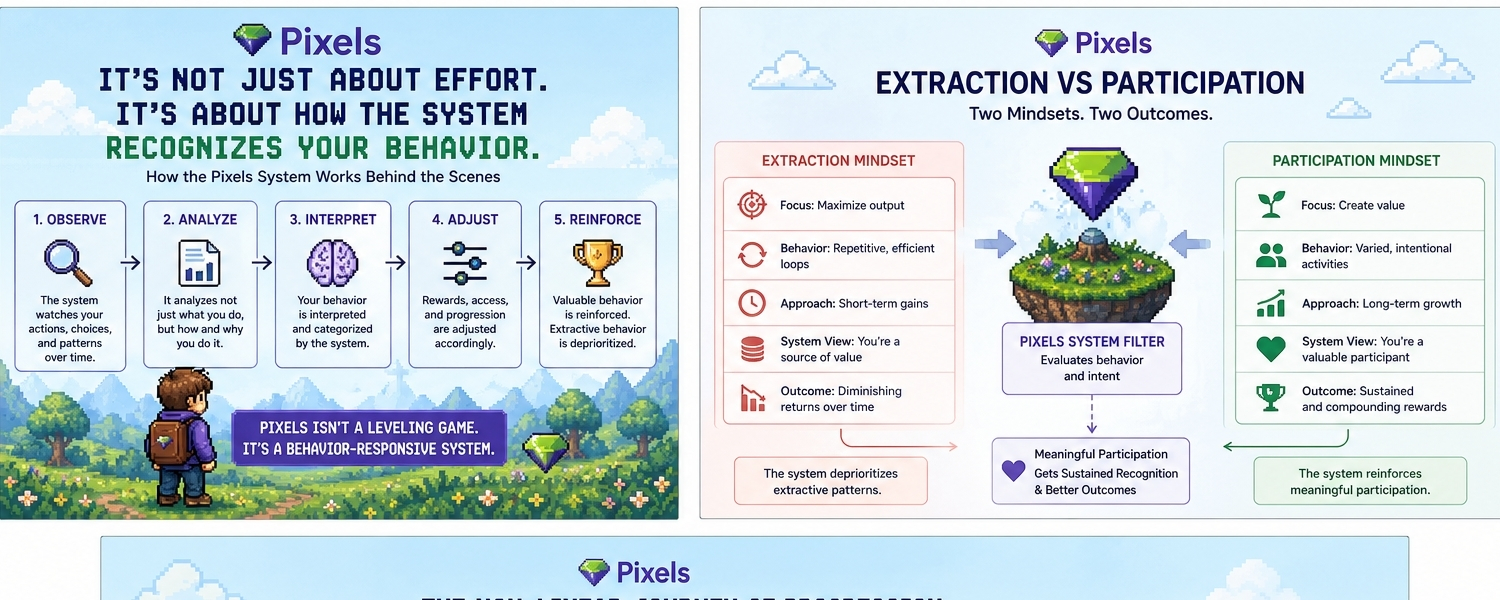
I remember logging off one night thinking I had executed everything properly. The loops were clean the timing was right and there were no obvious mistakes. Yet something felt slightly off. Not a clear loss more like the outcome did not align with the effort I put in. It was not failure. It was misalignment.
Naturally I assumed the issue was efficiency. That is the default mindset in most Web3 games if results do not match effort someone else is simply optimizing better. So I refined everything tighter cycles cleaner execution minimal waste. Over time it stopped feeling like gameplay and started resembling system maintenance. Repeatable predictable almost mechanical. For a while that explanation held.
But then I noticed something that did not fit that model.
There were players who were not grinding harder or optimizing more aggressively. In fact some seemed less structured. Yet their progression felt smoother as if they were not encountering the same invisible resistance. That is when it became clear efficiency alone was not the determining factor. If it were outcomes would scale more consistently.
That realization shifted how I interpret systems like $PIXEL .
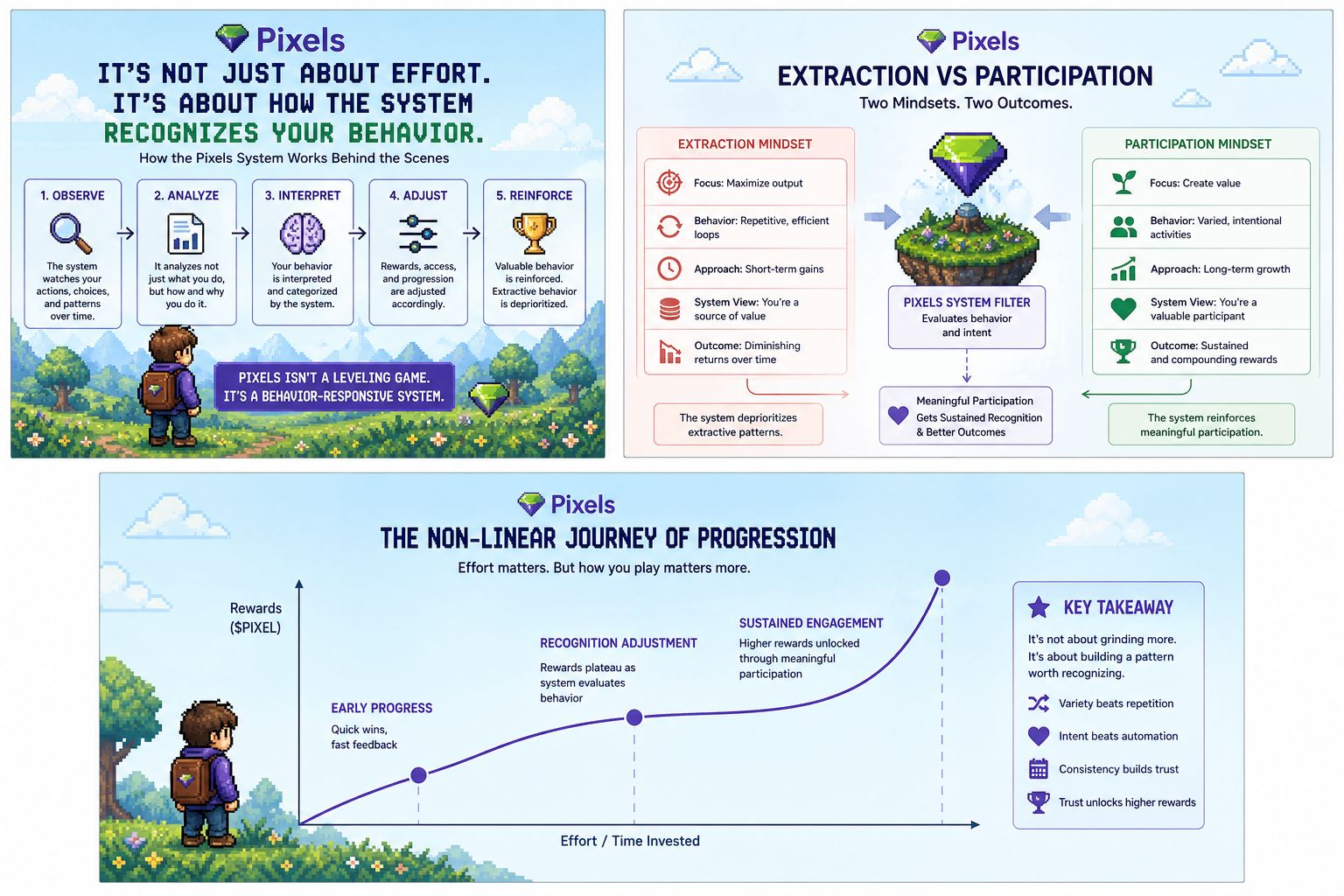
Most GameFi environments function as economic engines. They reward throughput the more cycles you complete the more value you extract. Players eventually adapt to this and stop playing in the traditional sense. They begin operating the system. Identity style or intent does not matter only output does.
Pixels appears to diverge from that model.
The longer I engaged with it the more it felt like the system was not neutral. Rewards did not scale linearly with effort. Sometimes returns compressed sometimes they held steady and occasionally they exceeded expectations. It did not feel random. It felt conditional like the system was interpreting behavior not just measuring activity.
That is where the underlying structure becomes more apparent.
Rewards are not simply distributed they are modulated. When behavior starts resembling pure extraction loops returns tend to flatten. When activity appears less replicable more embedded in actual gameplay rather than optimization patterns the system seems to respond differently. At the same time progression introduces friction. Crafting upgrades land maintenance all gradually pull value out of circulation. These are not always immediately profitable actions but they shape long term positioning. The system is not just rewarding it is also regulating.
This balance becomes more critical when viewed through the lens of the token itself.
With Pixel still in a post launch phase supply unlocking gradually and sentiment shifting alongside player behavior the economy remains sensitive. Not unstable but responsive. A purely linear reward structure would risk oversaturation. Instead behavior acts as a control layer filtering not just how much activity exists but what type of activity persists.
What stands out is how subtle this filtering is.
There is no explicit signal indicating a threshold has been crossed. But over time small behavioral differences compound. Two players can invest similar time and still diverge in outcomes not due to capital or effort but because the system categorizes them differently. It resembles adaptive systems seen elsewhere where feedback loops quietly reshape user experience without direct explanation.
That said this approach introduces its own risks.
Any system that interprets behavior can eventually be studied and once understood it can be imitated. If extractive players learn to mimic genuine engagement the signal degrades. There is also the possibility of false positives where consistent players are misread as repetitive or low value activity. The more adaptive the system becomes the more fragile its interpretation layer may be.
At a certain point the discussion moves beyond rewards entirely.
It becomes about retention.
Even the most sophisticated system fails if players do not return. Progression carries cost rewards vary and outcomes are not always predictable. The real test is whether the experience creates enough meaning for continued participation. Utility only matters if it brings players back the next day. Otherwise the system delays extraction rather than replacing it.
This shifts how the loop is perceived.
On the surface it remains familiar log in act progress. But underneath it evolves. The system observes responds and gradually adjusts how it treats different patterns of behavior. It is less about maximizing a single session and more about how actions accumulate over time. Outcomes are not immediate but they are not arbitrary either they are shaped.
I do not see #pixel purely as a game nor just as a token economy. It feels more like an evolving system attempting to determine which behaviors are worth sustaining and reinforcing those behaviors indirectly through outcomes rather than explicit rules.
Whether this model scales effectively is still uncertain.
Early participants influence the system just as much as the system influences them. Behavior incentives and timing intersect in ways design alone cannot fully control.
For now the concept feels ahead of its validation.
And perhaps that is intentional.
Because in this environment the objective is not simply to optimize for rewards it is to understand what the system is willing to preserve over time.