

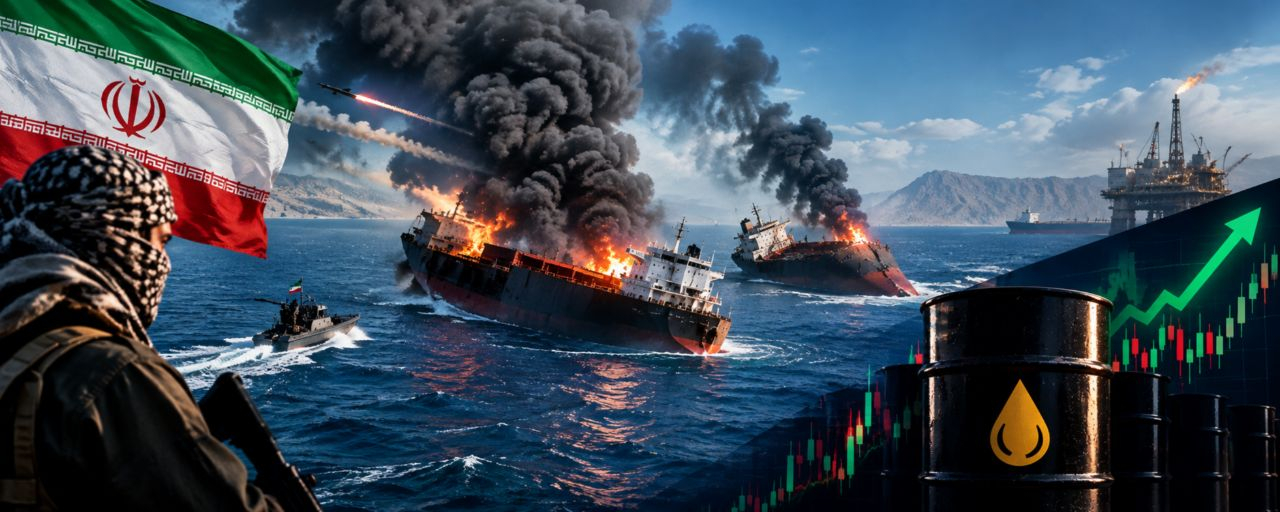

Two cargo ships managed by companies based in the United Arab Emirates have sunk near the Strait of Hormuz, extending a run of Iranian strikes on commercial shipping that shows no sign of slowing. The timing is hard to miss. The U.S. military has been guiding more Gulf crude through the strait while it holds Iranian exports down with a naval blockade and sanctions, and Iran has described its stepped-up strikes as a response to that pressure.
One was the GFS Pride, a Singapore-registered container ship. Singapore's Maritime and Port Authority said Wednesday that an unidentified projectile hit the vessel as it crossed the strait a day earlier, that fire broke out, and that it later sank. All 21 crew members got off safely. Nobody was injured. The authority did not mince words, calling such attacks "unprovoked, unjustifiable, and a breach of international law."
The other was the Cape Dao, a dry bulk carrier flagged in Antigua and Barbuda, and its story runs longer. A projectile struck it on Sept. 23. One crew member died, maritime sources said, and the rest were evacuated straight away. It sank close to the strait weeks later, International Maritime Organization data showed Wednesday. An analysis of that casualty data, reported by Reuters, counts the Pride and the Cape Dao as the second and third vessels to sink since the war began Feb. 28.
Mine or missile? The accounts do not match
Containers from the GFS Pride are now adrift, and Pakistani maritime authorities have warned that they are a hazard to navigation. A second Singapore-registered ship, the GFS Giselle, was also struck by an unidentified projectile. Hull damage, yes, but the vessel reached safe anchorage under its own power, and all 22 crew members were unharmed, the Singapore authority said.
Iran tells it differently. Through the state news agency Tasnim, its Revolutionary Guard claimed the Pride exploded and sank after hitting a naval mine. Singapore's authority reported a projectile strike instead. Marisks, a maritime security firm, said nothing independent confirms that a mine was involved.
More than 20 vessels, and the month is only half over
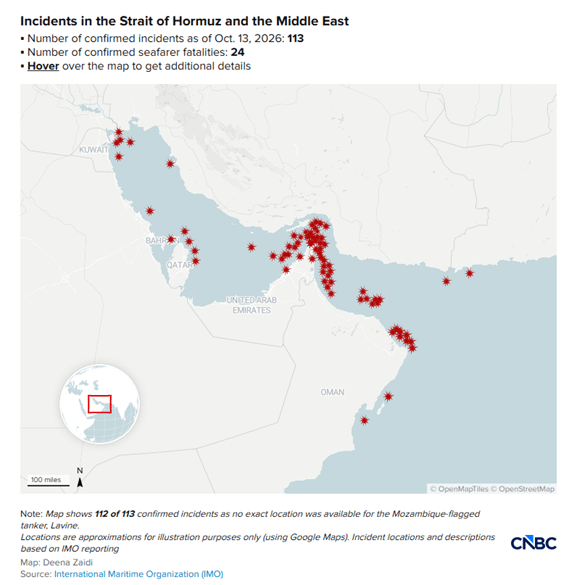
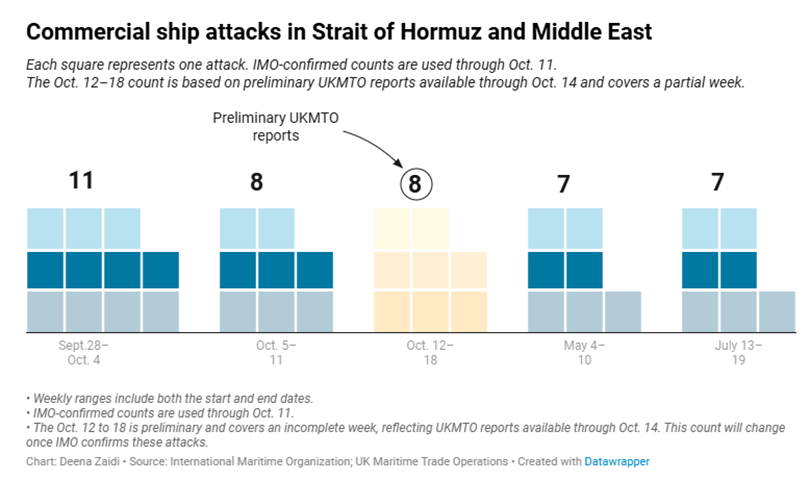
The tally keeps climbing. The UK Maritime Trade Operations Centre has recorded more than 20 vessels, mostly oil tankers, targeted this month across the Strait of Hormuz, the Persian Gulf and the Gulf of Oman. The IMO says the incidents have left two sailors missing and more than a dozen injured.
Marisk reads the mine story as part of something larger. It called Iran's claim "consistent with an ongoing psychological operations campaign," meant to rattle crews and owners and push commercial traffic away from Hormuz. The campaign has a concrete target: Iran wants to choke off a recovery in crude exports through the waterway.
Crude flows through Hormuz slip after a September rebound. Exports through the strait had recovered to prewar levels in September. Then the attacks intensified, and the recovery faded. Kpler data show crude shipments averaging 8.5 million barrels per day in the week to Oct. 12, nearly 40% below the prewar level. Total Middle Eastern shipments, which include pipeline exports to the Gulf of Oman and the Red Sea, reached 14 million barrels per day, almost 20% short of where they stood before the war. Day-to-day readings are jumpy. Only 3 million barrels crossed Hormuz on Monday. On the Friday before, the figure was 6 million.
Aramco's headquarters takes a hit
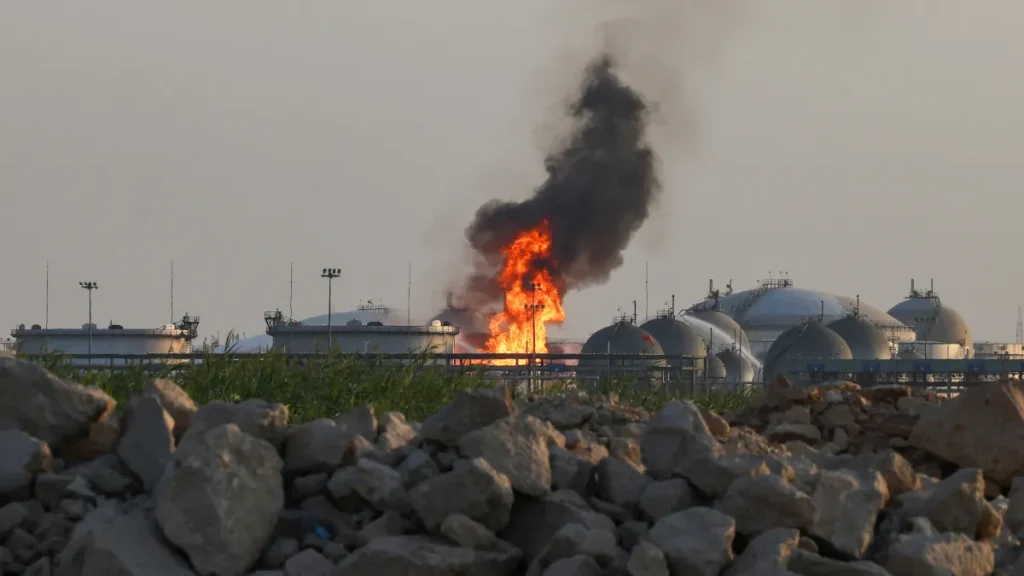
A second front was adding to the pressure on Gulf supply. Iran-backed Houthis in Yemen fired missiles and drones across Saudi Arabia, and on Tuesday night one strike damaged Saudi Aramco's headquarters in Dhahran. About three floors of a tower that houses key company functions were hit, and employees were told to work from home. A person familiar with the matter said oil production was not affected. Saudi authorities reported a fire but no casualties.
The barrage did not end there. On Wednesday, Riyadh, Dhahran, Kharj and other areas were targeted again, and the Saudi-led coalition said it had intercepted multiple projectiles. Fighting over the past week has killed at least 18 people and injured hundreds in the kingdom. The Saudi cabinet warned that the Houthis would "bear the consequences" of repeated attacks on airports and on civilian and economic sites.
Trump promises to remember
President Donald Trump answered on social media. He accused the Houthis of deliberately trying to push oil prices higher at Tehran's behest, with the Nov. 3 U.S. midterm elections in mind, though he offered no evidence of that motive. The threat that followed was veiled:
"I'll be there after the Elections, and I will never forget!"
He also looked back to last year's U.S. military campaign against the group. He had assumed, he said, that the Houthis learned their lesson then, before Washington stopped its strikes at their request.
Over the weekend, Trump said he was considering joining the Saudi-backed campaign. For now, Washington backs Riyadh with intelligence, targeting assistance and aerial refueling, and it has avoided direct military involvement.
The fighting threatens Crown Prince Mohammed bin Salman's economic transformation agenda. Flights at Riyadh's main airport have been halted. The capital's financial district has moved to remote work, and a run of major international events is close at hand. The biggest is the Future Investment Initiative, the kingdom's flagship investor conference, scheduled for Oct. 26 to 29. Citing diplomatic sources, AFP reported that organizers plan to offer virtual attendance alongside in-person seats.
Oil follows the headlines
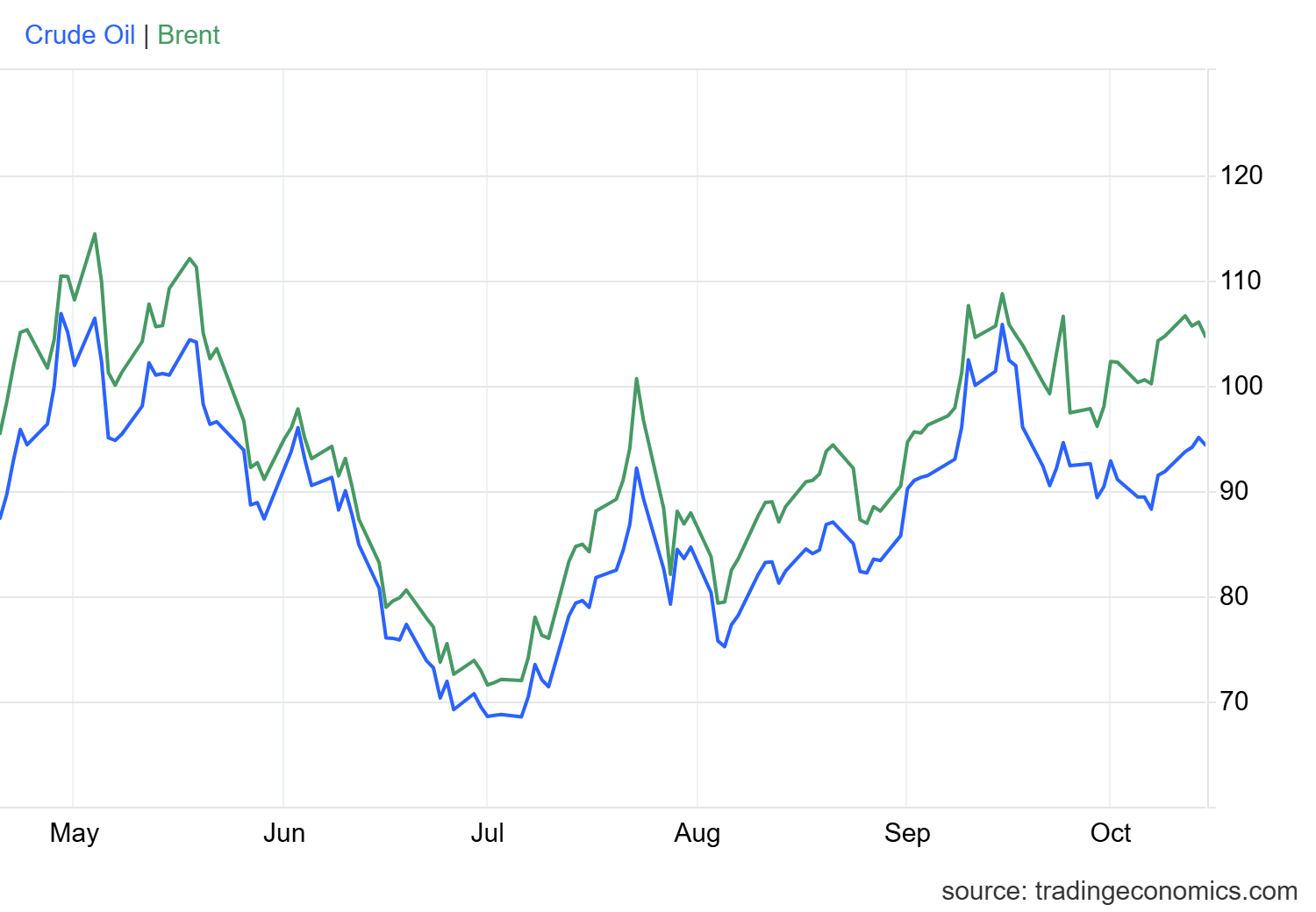
Crude traders took all of it as a supply problem. Hostilities intensified from Russia to the Middle East, threatening flows that had only recently recovered to near prewar levels. Brent settled Wednesday at $106.06 a barrel, up 37 cents. West Texas Intermediate closed at $95.09, a gain of 95 cents, or 1.01%.
Some of that gave way early Thursday. WTI fell $1.06, or 1.11%, to $94.03 a barrel, and Brent dropped $1.79, or 1.69%, to $104.27.
Kyiv's Starlink dispute
The Russian front produced its own friction with Washington. Ukrainian military officials said Elon Musk's SpaceX had curbed, without warning, the speed of Starlink terminals while they are in motion. Ukrainian President Volodymyr Zelenskyy called the restriction deliberate and blamed Musk's decision for deaths, saying people were dying because of it. He added that it was painful to watch Trump choose one side.
The cost, Zelenskyy argued, had already reached civilians. Ukrainian interceptors that depend on the satellite link could no longer knock down Russian drones as effectively. Musk wrote that limits on the military-grade Starshield service are set by the U.S. military and ultimately the president, and Axios reported that a senior U.S. official said the Trump administration had nothing to do with the restrictions. The dispute has deepened the rift between Washington and Kyiv.
Russia kept up its own assault in the meantime. Six people were killed and 13 wounded in a Russian drone attack on Lutsk, a western city close to the Polish border, Zelenskyy said on social media.
Two clocks, one strait
Nov. 3 is 19 days away. Trump has signaled that his answer to the Houthis comes after the vote, while Iran's strikes have already pulled Hormuz exports far below their September recovery. Which of those clocks the oil market ends up following is still an open question.