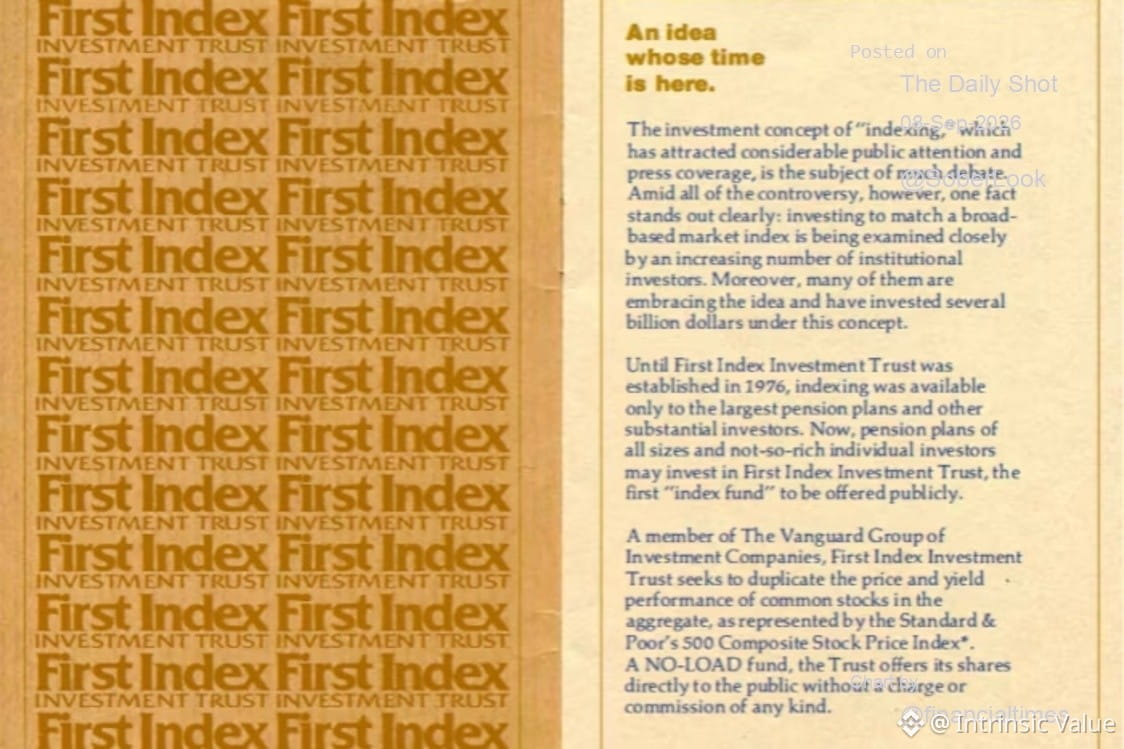
Fifty years since Vanguard launched the first index fund. What began as a low-cost alternative has fundamentally altered market structure.
Passive flows now dominate price discovery. When capital allocation is driven by market cap weighting rather than valuation or business quality, you get strange outcomes: overvalued names get more capital simply because they're already large. Momentum feeds on itself.
The irony: index funds were meant to democratize investing by tracking "the market." But when passive becomes the majority, it IS the market. Price and value decouple more easily. Fundamentals matter less in the short run.
This doesn't mean indexing is wrong—it's still the best choice for most retail investors. But it does mean markets behave differently now. Less mean reversion. More concentration risk. Fewer opportunities for active managers who actually analyze businesses.
We've traded fundamental-driven markets for flow-driven markets. The consequences are still unfolding.
Passive flows now dominate price discovery. When capital allocation is driven by market cap weighting rather than valuation or business quality, you get strange outcomes: overvalued names get more capital simply because they're already large. Momentum feeds on itself.
The irony: index funds were meant to democratize investing by tracking "the market." But when passive becomes the majority, it IS the market. Price and value decouple more easily. Fundamentals matter less in the short run.
This doesn't mean indexing is wrong—it's still the best choice for most retail investors. But it does mean markets behave differently now. Less mean reversion. More concentration risk. Fewer opportunities for active managers who actually analyze businesses.
We've traded fundamental-driven markets for flow-driven markets. The consequences are still unfolding.