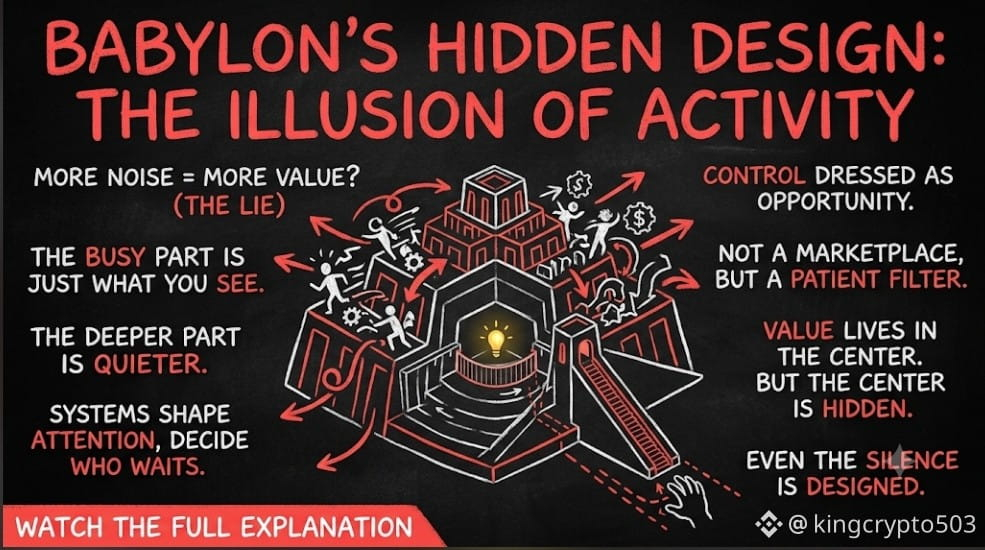
I used to think systems like Babylon were mostly about movement, like more activity meant more freedom, more noise meant more value. But that never really seems to hold up for long. The busy part is usually just the part you can see. The deeper part is quieter.
At first it looks simple enough. People come in, things happen, numbers rise and fall, and everyone reads that as proof that the system is alive. But then you spend a little longer inside it and you start noticing what stays still. What gets slowed down. What is gently made harder to touch. Strange, really. The visible flow is never the whole story.
Maybe that is the point. Maybe the system is not trying to reward speed at all. Maybe it is trying to shape attention, to decide who waits, who watches, who gets to move first. Or maybe that is just how control looks when it is dressed up as opportunity.
Not everything that feels open is open.
Not everything that feels active is creating value.
Babylon, or any place built like it, starts to feel less like a marketplace and more like a filter. A soft one. A patient one. It lets enough happen to keep people leaning in, but not enough to make the center obvious. And the center is usually where the value lives.
I think that is what I missed before. It was never only about what was happening. It was about what had to be limited for the whole thing to make sense. And once you see that, even the silence starts to look designed.
@BabylonLabs_io #baby $BABY
At first it looks simple enough. People come in, things happen, numbers rise and fall, and everyone reads that as proof that the system is alive. But then you spend a little longer inside it and you start noticing what stays still. What gets slowed down. What is gently made harder to touch. Strange, really. The visible flow is never the whole story.
Maybe that is the point. Maybe the system is not trying to reward speed at all. Maybe it is trying to shape attention, to decide who waits, who watches, who gets to move first. Or maybe that is just how control looks when it is dressed up as opportunity.
Not everything that feels open is open.
Not everything that feels active is creating value.
Babylon, or any place built like it, starts to feel less like a marketplace and more like a filter. A soft one. A patient one. It lets enough happen to keep people leaning in, but not enough to make the center obvious. And the center is usually where the value lives.
I think that is what I missed before. It was never only about what was happening. It was about what had to be limited for the whole thing to make sense. And once you see that, even the silence starts to look designed.
@BabylonLabs_io #baby $BABY