
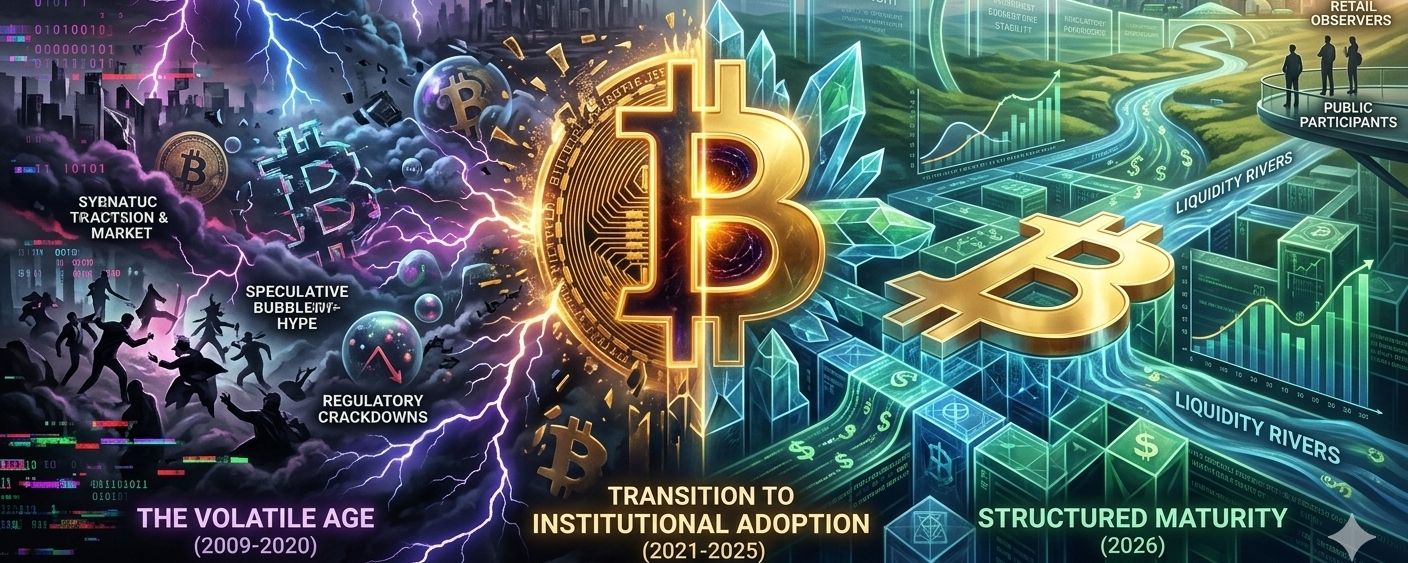
Bitcoin has long been defined by extremes. Rapid price surges, sudden crashes, and waves of hype shaped its identity for more than a decade. For many, it represented opportunity but also unpredictability. In 2026, that identity is beginning to shift. The market is no longer driven purely by emotion or speculation. Instead, it is gradually evolving into something more controlled, more structured, and more aligned with the broader financial system.
In its earlier phases, Bitcoin moved in dramatic cycles. Bull runs were fast and often fueled by retail enthusiasm, while corrections were sharp and unforgiving. These movements were difficult to interpret because they were driven largely by sentiment. Today, the behavior of the market is different. Price still moves, but those movements are increasingly influenced by deeper forces such as liquidity conditions, capital flows, and macroeconomic trends. The result is not the absence of volatility, but a transition toward more measured and gradual shifts.
A major factor behind this change is the growing presence of institutional investors. Large financial players have moved beyond observation and are now actively participating in the market. Their approach differs significantly from that of retail investors. Instead of reacting quickly to hype or fear, institutions tend to build positions over time, guided by strategy and long-term outlook. This introduces a level of stability that did not previously exist. The market becomes less reactive to short-term noise and more responsive to capital allocation decisions.
At the same time, Bitcoin has become increasingly connected to the global macroeconomic environment. It no longer operates in isolation. Interest rates, inflation expectations, and global liquidity now play a central role in shaping its direction. When financial conditions tighten, Bitcoin tends to slow down. When liquidity expands, it gains strength. This alignment with traditional economic forces is a sign that Bitcoin is being taken seriously as a financial asset, but it also means it is no longer immune to broader market pressures.
Another important development is the rise of regulation. Governments and financial institutions are no longer ignoring the crypto space. Instead, they are working to create frameworks that bring structure and oversight. This shift reduces uncertainty and builds confidence, particularly for large investors. However, it also changes the pace of growth. Regulation tends to limit extreme speculation, replacing it with a more sustainable but slower form of expansion.
Interestingly, while institutional activity is increasing, retail participation has become more cautious. Many individual investors who experienced previous cycles are now waiting for clearer signals before re-entering the market. This creates a quieter environment, where accumulation can take place without excessive attention. Such phases are often misunderstood as stagnation, but they can represent periods of underlying strength.
Volatility, which has always been a defining feature of Bitcoin, has not disappeared. What has changed is its nature. Instead of chaotic swings driven by emotion, price movements are becoming more connected to real-world events and financial conditions. This makes volatility more interpretable, even if it remains significant. The market still carries risk, but that risk is increasingly tied to understandable factors rather than unpredictable sentiment.
Bitcoin in 2026 exists in a state of transition. It is no longer the purely speculative asset it once was, but it has not yet fully matured into a stable financial instrument. This creates a unique phase where expectations must adjust. Large, explosive rallies may become less frequent, replaced by slower and more sustained growth. While this may seem less exciting on the surface, it reflects a deeper form of strength.
Controlled growth may not capture attention in the same way as rapid price surges, but it builds a stronger foundation. It allows for the development of support levels, encourages long-term participation, and reduces the likelihood of severe market shocks. Over time, this kind of growth can prove more durable and more meaningful.
The current state of Bitcoin reflects a balance between its past and its future. Elements of volatility and speculation still exist, but they are being reshaped by institutional involvement, macroeconomic influence, and regulatory development. The market is becoming less chaotic and more deliberate.
This shift requires a change in perspective. Success in this environment is less about reacting to sudden movements and more about understanding broader trends. It involves patience, awareness of global conditions, and recognition of how capital flows through the system.
Bitcoin $BTC has not lost its defining qualities. It remains innovative, dynamic, and capable of growth. But its character is evolving. The chaos that once defined it is giving way to structure, and in that transformation lies the foundation for its next phase.