I thought I was playing Pixels to grow something.
After a few days, it felt more like Pixels was growing something in me.
I started opening the game at the same time without thinking. Not because I had a plan, but because it felt unfinished if I didn’t. There was always something waiting. Crops ready to harvest. A small step left before the next upgrade. A loop that didn’t feel complete.
That feeling is not random.
Pixels is built around short cycles that never fully close. You plant crops that finish later. You craft items that lead into the next step. You log out, but the system quietly continues in the background.
So when you return, it doesn’t feel like starting again. It feels like continuing something you already began.
That design matters more than it looks.
Let’s take a simple daily loop. You log in, harvest crops, replant, maybe craft one or two items. None of these actions are big. But each one sets up the next session. What you plant now becomes tomorrow’s reason to return.
The system connects your sessions together.
That’s how the habit forms.
Not through big rewards, but through unfinished cycles.
What stood out to me is that progress in Pixels doesn’t come from pushing harder. It comes from showing up again. A player who logs in for 15 minutes every day can move more smoothly than someone who plays for hours but skips days.
Because the system rewards continuity.
Not intensity.
There’s a quiet shift that happens over time.
At the beginning, you choose to play.
Later, it feels like you should play.
That shift is where the real design shows up.
The game avoids clear stopping points. There’s no moment where everything feels complete. Something is always growing, crafting, or waiting. That creates a soft pressure to return.
Not forced, but persistent.
In Pixels, you don’t just play the game. The game keeps a place for you.
That’s why short sessions feel enough. You don’t need to grind for hours. You just need to maintain the loop.
From a system perspective, this is very efficient.
It spreads player activity across time. It keeps the world active without requiring long sessions. It stabilizes the economy because players return in a predictable rhythm.
Farming, crafting, and resource flow all depend on this consistency.
Habit becomes infrastructure.
But there’s a trade-off.
When you repeat the same loop every day, decisions become automatic. You stop thinking about what to do next. You already know. Harvest, replant, craft, repeat.
It feels smooth, but it also becomes mechanical.
The system reduces friction, but it also reduces reflection.
You’re not exploring anymore. You’re maintaining.
That’s where the experience can flatten over time.
Another thing I noticed is what happens when the routine breaks.
If you skip a day, the connection weakens. Not dramatically, but enough to feel different. Two or three missed sessions, and the urgency fades. The loop that once felt continuous now feels optional.
Coming back requires effort again.
So the system is very strong at keeping players once the habit is formed, but weaker at pulling them back once it breaks.
That creates a fragile balance.
It works best when players stay consistent. But consistency is not guaranteed.
Now imagine this at scale.
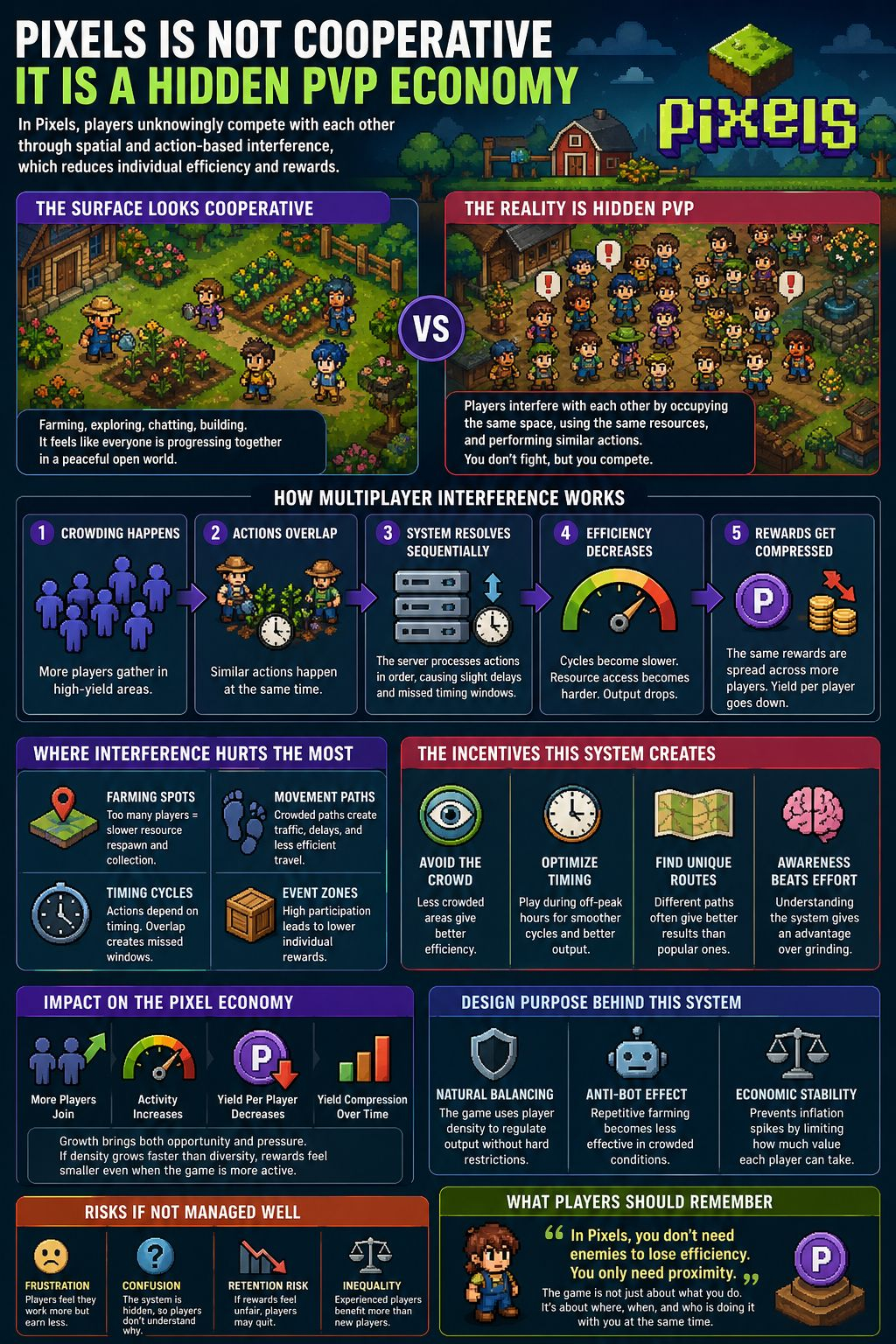
If most players maintain daily routines, the system feels stable. Activity flows evenly. Resources move smoothly. Everything feels alive.
If routines start breaking across many players, the rhythm changes. Activity becomes uneven. Some loops feel empty, others feel crowded.
The system doesn’t collapse, but it loses its smoothness.
That’s the hidden dependency.
Pixels doesn’t just need players.
It needs their habits.
There’s also a psychological layer to this.
The game doesn’t rely on big milestones to keep you engaged. It relies on small, repeated actions that feel easy to complete. That lowers resistance. It makes returning feel simple.
But over time, those small actions can start to feel predictable.
And when everything becomes predictable, meaning becomes harder to feel.
One thought stayed with me while playing.
In Pixels, progress is not something you chase. It’s something you maintain.
That explains both its strength and its weakness.
It’s easy to stay in.
But harder to feel growth.
To be fair, this design has clear advantages.
It fits into daily life. It avoids burnout. It creates a steady rhythm instead of intense bursts. It keeps the world active through consistency.
That’s not easy to design.
But it also changes what the game is about.
It becomes less about achieving something new and more about keeping something going.
And that difference matters over time.
Because players don’t just want to repeat actions.
They want moments that feel meaningful.
If everything becomes part of a routine, those moments become rare.
Pixels has built a system that runs on habit.
Not in an obvious way, but in a quiet, consistent way.
And once you notice it, it’s hard to unsee.
Because in the end, you’re not just farming crops.
You’re maintaining a pattern.
And that pattern is what keeps the whole system alive.