
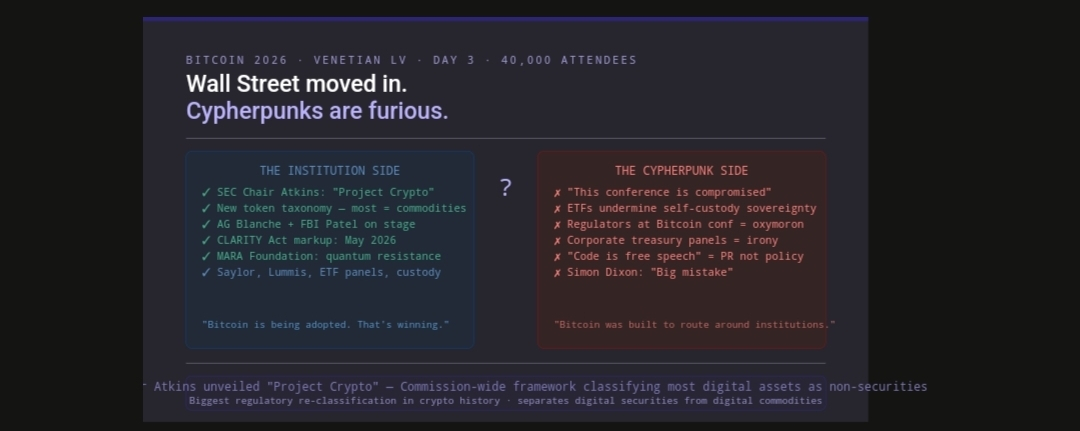
Forty thousand people showed up at The Venetian in Las Vegas for Bitcoin 2026. But the most important conversation at the conference isn't happening on the main stage. It's happening on the conference floor, in hotel lobbies, and on social media — and it's a fundamental disagreement about what Bitcoin is for.The Bitcoin 2026 Conference at The Venetian Resort exposed a widening tension that has been building since institutional adoption began reshaping who holds Bitcoin. While the event's speaker list reads like a roll call of institutional power, early Bitcoin adopters were voicing sharp criticism on the conference floor, arguing that an event built around regulator appearances, corporate treasury panels, and ETF product showcases has abandoned the counterculture ethos that built Bitcoin as a tool to route around exactly those institutions.
Simon Dixon, an inaugural conference speaker and early Bitcoin investor, put it directly: "Let's face it, this Bitcoin conference is compromised. Bitcoin is open source code. It's a big mistake not to understand the difference." His specific criticism was that marketing custody products, ETFs, and corporate treasury strategies to Bitcoiners promotes tools that undermine the individual sovereignty the protocol was built to deliver.
The institutional camp's position is equally coherent. When 40,000 people attend. When the Attorney General and FBI Director appear on stage to declare that code is free speech. When the SEC Chair uses the conference to announce the biggest regulatory re-classification in crypto history — that looks a lot like winning. LaikalabsLaikalabsAnd what SEC Chair Atkins announced is genuinely significant. Paul Atkins outlined a new regulatory framework that separates digital securities from digital commodities, with most digital assets classified under the latter category. He described it as "Project Crypto" — a Commission-wide initiative to modernize securities rules for digital assets and establish a new token taxonomy.
Lummis announced that the CLARITY Act markup will happen in May. MARA Holdings announced the MARA Foundation focused on quantum resistance and network stewardship. The quantum threat to Bitcoin's cryptography warranted its own dedicated conference panel, following BIP 361's release — a three-phase proposal to migrate Bitcoin toward quantum-resistant outputs.
Here's the honest tension at the heart of this debate. The cypherpunks are right that Bitcoin was built to route around institutions. They are also watching those institutions pour in capital, create regulatory frameworks, and advocate for Bitcoin in rooms that were previously closed to it. The institutions are right that adoption at scale requires regulatory clarity, institutional infrastructure, and mainstream distribution. They are also building systems that, by design, reintroduce intermediaries into a protocol that was explicitly designed to eliminate them. LaikalabsLaikalabsBoth things are simultaneously true. Bitcoin can be a tool of financial sovereignty AND an asset class held in BlackRock's ETF. The question isn't which version is "real Bitcoin." The question is whether the protocol's core properties — decentralization, fixed supply, no permission needed — survive as the institutions build their rails on top of it.That's the debate that matters. Not whether the conference sold out to Wall Street. But whether the protocol itself remains what it was designed to be, regardless of who holds it.
#Bitcoin2026 #Bitcoin #CryptoRegulation #SECCrypto #ProjectCrypto