
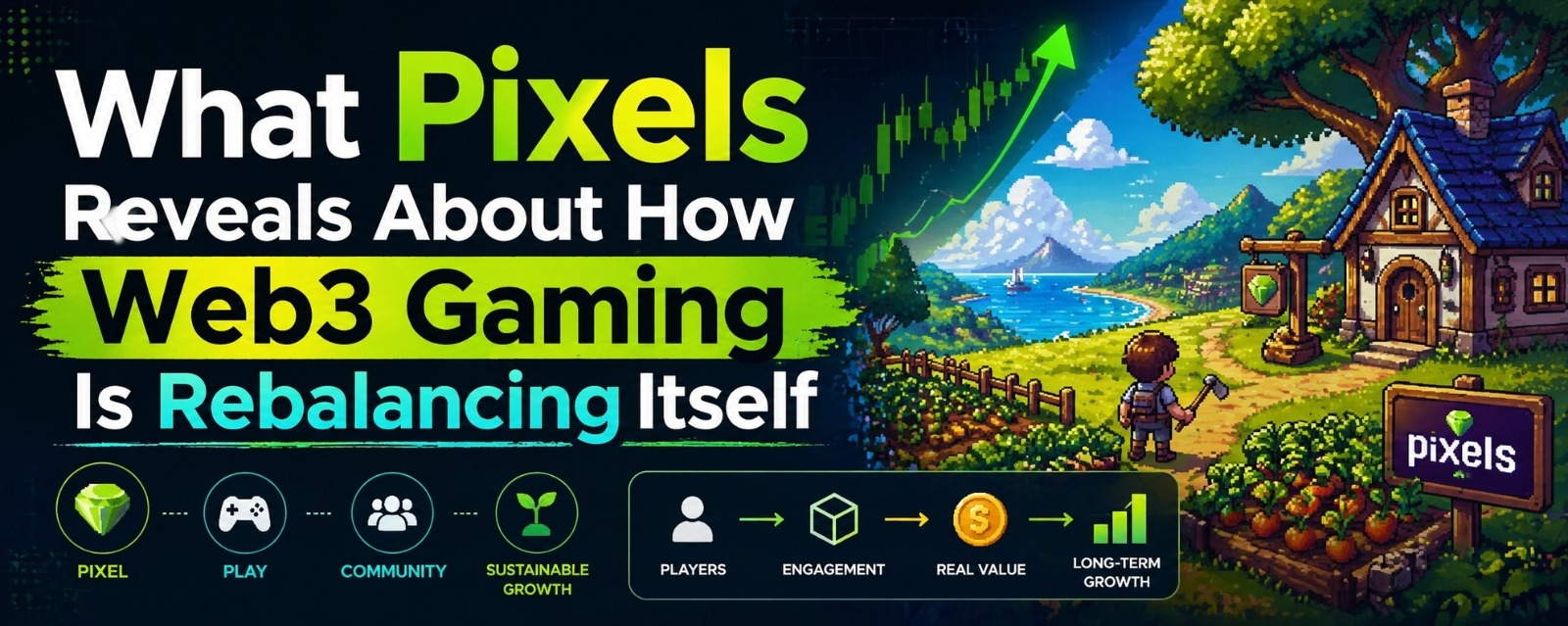
I’ve been watching the evolution of Web3 gaming closely over the past cycle, and what stands out to me about @Pixels is not what it promises, but what it quietly avoids trying to be. In a market that has already burned through multiple narratives around play-to-earn, hyper-financialized gameplay, and speculative user acquisition, Pixels feels like a project that emerged not to impress, but to adjust.
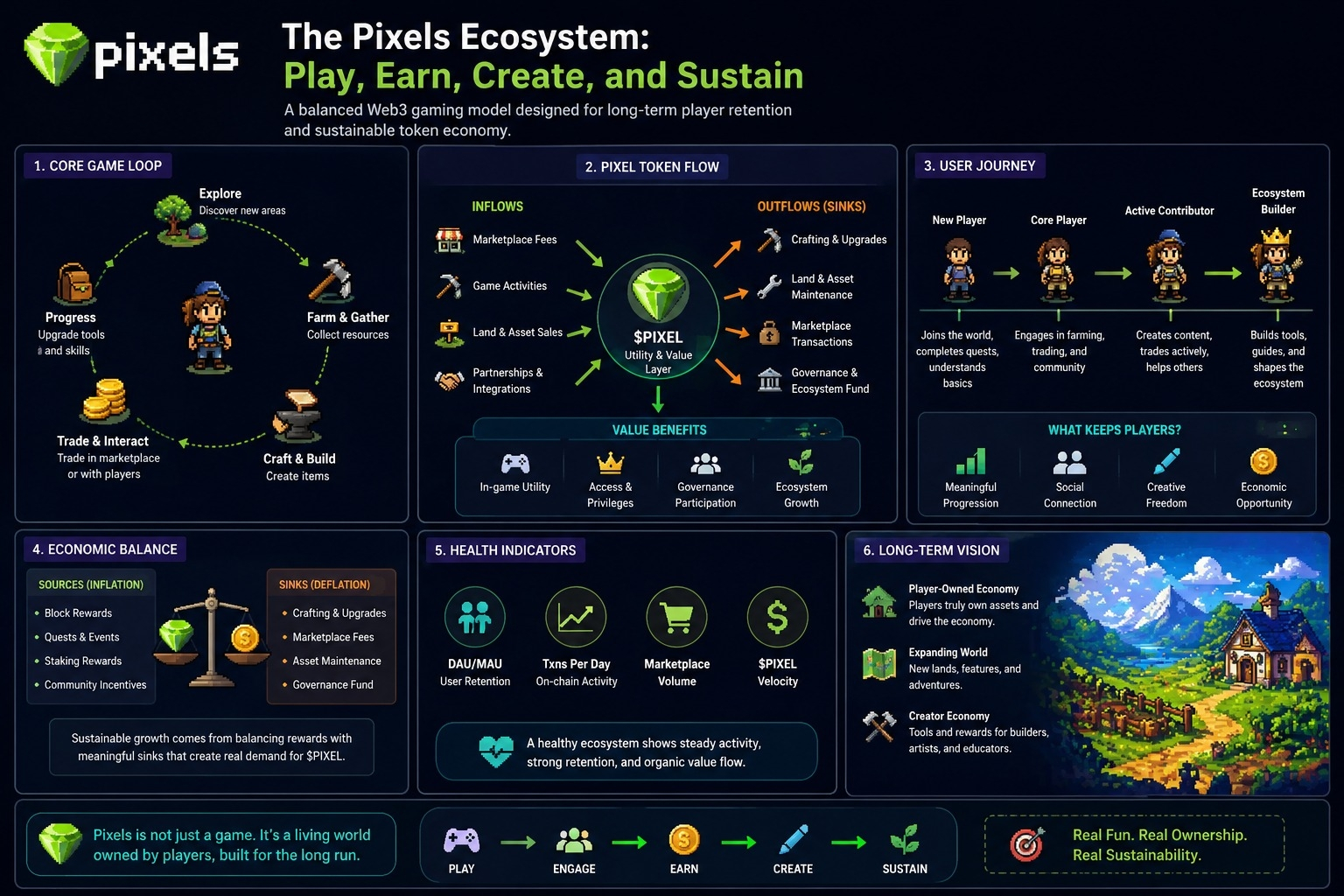
$PIXEL exists at a moment where the industry has already learned a painful lesson: users don’t stay for tokens, they stay for experience. That sounds obvious now, but it clearly wasn’t during the earlier wave of Web3 games where yield mechanics were treated as a substitute for engagement. What I notice with Pixels is that it doesn’t try to reverse that mistake loudly. Instead, it shifts the center of gravity back toward something simpler—farming, exploration, light social interaction—while letting the token layer sit more quietly in the background.
The problem it addresses isn’t just “how to reward users,” but how to retain them without forcing constant financial decision-making. Most players don’t want to think like traders every time they log in. They want progression, routine, and a sense of place. Pixels leans into that. The open-world farming loop isn’t innovative in a technical sense, but in this context, it becomes meaningful because it removes friction. It gives users a reason to return that isn’t purely tied to extraction.
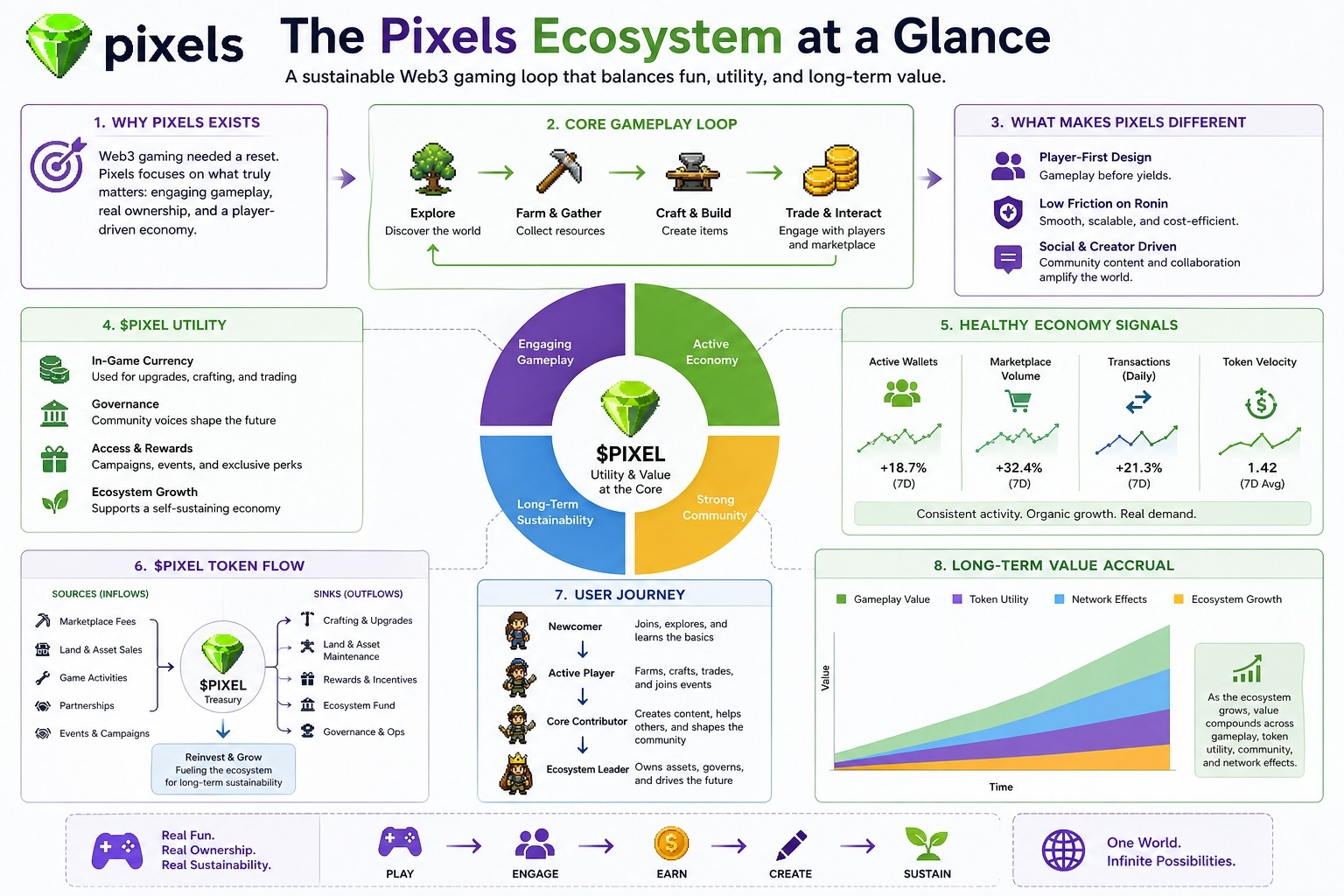
Underneath that simplicity, though, there’s still a deliberate structure. Being built on the Ronin network is not just a branding choice; it’s a practical one. Ronin has already proven it can handle a gaming-heavy user base with relatively low transaction friction. What this means in practice is that actions inside the game—crafting, trading, upgrading—don’t feel like “blockchain actions.” They feel like normal gameplay loops. That distinction matters more than most people think, because every extra step in a Web3 game is a point where a user decides to leave.
From a user interaction perspective, Pixels doesn’t demand upfront commitment. You can enter, explore, and gradually understand its systems without needing to immediately optimize for earnings. Over time, players who engage more deeply start interacting with the token layer, whether through asset ownership, resource generation, or marketplace dynamics. It’s a slower onboarding curve, and I think that’s intentional. It filters for users who are actually interested in the environment, not just the rewards.
But that approach comes with trade-offs. By downplaying aggressive earning mechanics, Pixels risks being overlooked by the very crowd that initially drove Web3 gaming growth—the yield seekers. There’s also a question of depth. Casual gameplay can attract users, but sustaining them requires evolving complexity. If the game loop remains too shallow, retention may plateau once the novelty fades. I’ve seen this pattern before in both Web2 and Web3 environments.
The PIXEL token itself reflects this balance. It’s not positioned as the sole reason to participate, but it still underpins the in-game economy. Its utility is tied to progression, upgrades, and participation in the broader ecosystem. What I pay attention to here is not just token distribution or emissions, but how often players are actually choosing to use it versus hold or sell it. If the in-game sinks are meaningful, you’ll see a different kind of price behavior—less driven by hype cycles and more by activity cycles.
When I look at on-chain or marketplace activity, I’m less interested in spikes and more in consistency. A steady flow of small transactions often tells a more honest story than a few large speculative moves. If Pixels is working the way it seems to intend, its economic signals should resemble a living system rather than a pump-and-exit pattern. That’s harder to achieve, and slower to show results, but ultimately more durable.
Recent developments around creator campaigns and social engagement layers suggest another direction the project is exploring. It’s not just about playing the game anymore, but about creating content around it. This is where things get interesting. If users begin to see Pixels not only as a game but as a social layer or identity space, the retention model changes entirely. Engagement becomes multi-dimensional. People aren’t just logging in to farm; they’re logging in to participate.
In the broader market cycle, I see Pixels fitting into a phase where the industry is trying to rebuild trust. Not through grand innovation, but through reliability and subtle improvements. It’s less about being the next big narrative and more about being something that simply works, day after day. That might not attract immediate attention, but it tends to age better.
What I’m still uncertain about is whether this quieter approach can scale without eventually reintroducing the same pressures that broke earlier models. Growth often demands incentives, and incentives can distort behavior. The challenge for Pixels will be maintaining its balance as more users arrive and expectations shift.

For now, though, I see it as a reflection of where the market currently stands—less optimistic, more cautious, and slowly rediscovering that not everything needs to be financialized to have value. Whether that realization holds over time is something I’m still watching closely.