


CRYPTO PROJECTS:
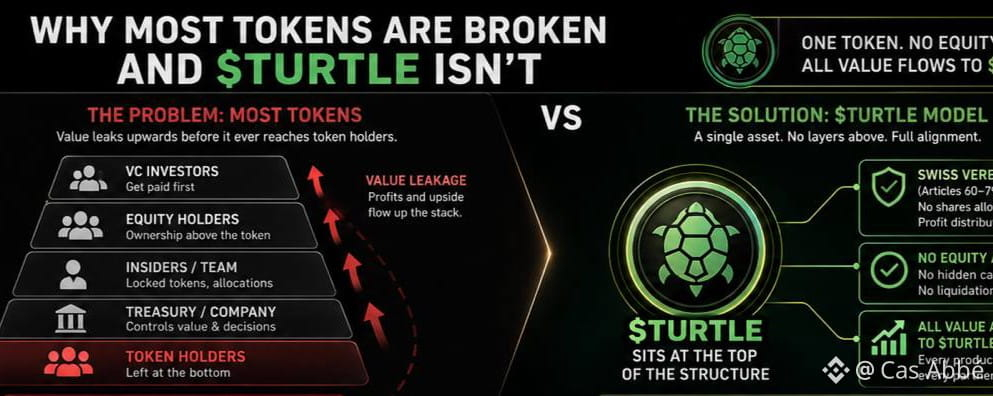
You’re told there’s value. You’re shown a token. But somewhere behind the curtain, there are early investors, private deals, hidden equity layers people who L sit above you in the line when money starts flowing.
And that’s the uncomfortable truth most newcomers don’t realize.
You’re often not buying the business. You’re buying access to whatever is left after everyone else has already taken their share. Now, here’s where Turtle starts to get interesting.
At its core, Turtle is trying to fix a very specific problem: how money moves inside crypto. In simple terms, liquidity just means available money capital that can be deployed somewhere to earn a return. Capital is scattered across chains, platforms, and deals, and it doesn’t flow efficiently.
Turtle positions itself as the plumbing system. It connects people who need money (new protocols, projects, opportunities) with people who have money (investors, liquidity providers), and it tries to do it in a structured, repeatable way. Not randomly. Not through hype. But through curated dealflow.
But the real story is how it’s structured
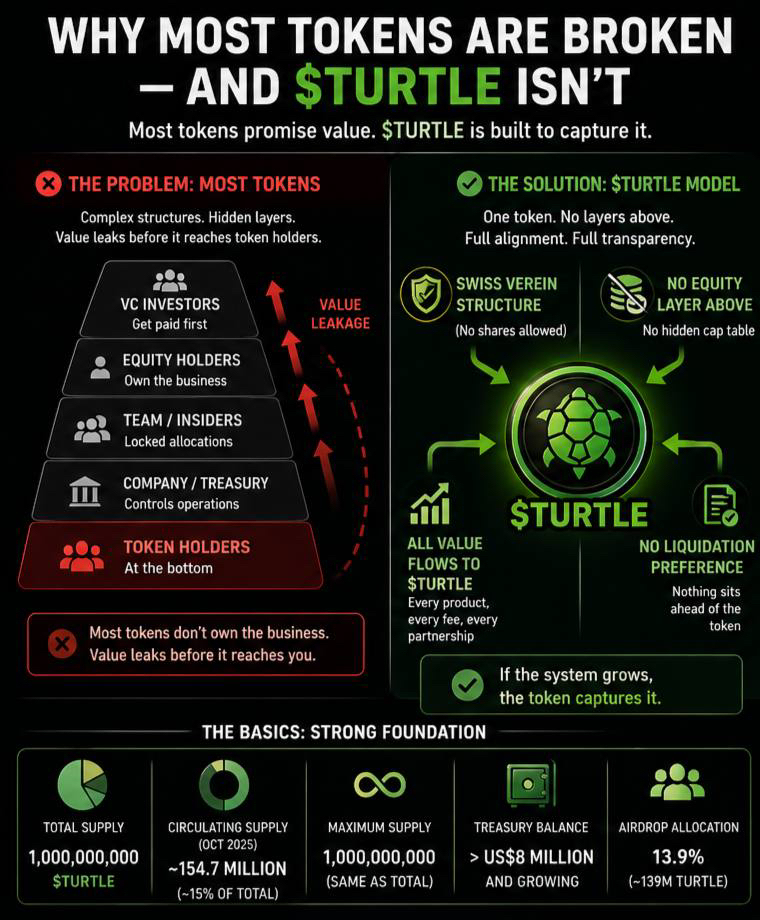
Most projects build a company first, then slap a token on top. That company has shareholders. Those shareholders have priority. And when value is created, it often flows upward before it ever touches the token. Turtle flips that.
It’s set up as a Swiss Verein. That sounds technical, but think of it like a members’ association rather than a traditional company. And here’s the key detail: under this structure, there is no share capital. No equity. No class of investors sitting above everyone else waiting to get paid first.
In plain terms, there’s no hidden boss layer above the token.
If this were a normal business, it would be like a restaurant where the customers and the system itself share the upside directly—without a group of silent owners taking a cut before anyone else sees anything.
You might be wondering why that matters.
It matters because it removes a very common conflict. In most crypto setups, the token and the company are not perfectly aligned. The company can succeed while the token stagnates. Here, that gap is intentionally closed. If Turtle grows, the token is the thing that reflects it. There’s nowhere else for the value to leak. That’s the theory but theory is cheap. So you look for proof.
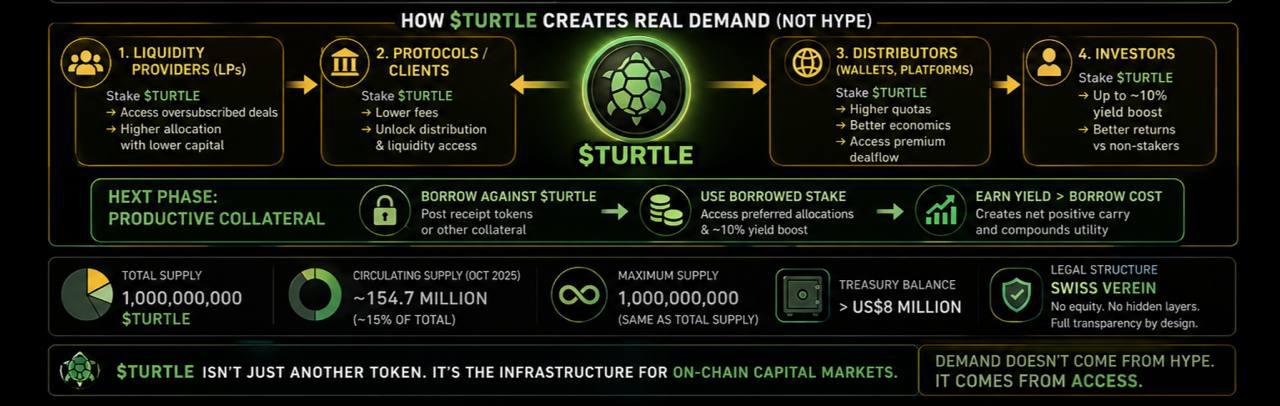
The first signal is the treasury. Turtle is sitting on more than $8 million. That’s not just a number. It’s oxygen. It tells you the project can survive, build, and iterate without constantly running back to the market to raise more money. In crypto, where many projects are one bad quarter away from disappearing, having a runway of years not months changes the conversation.
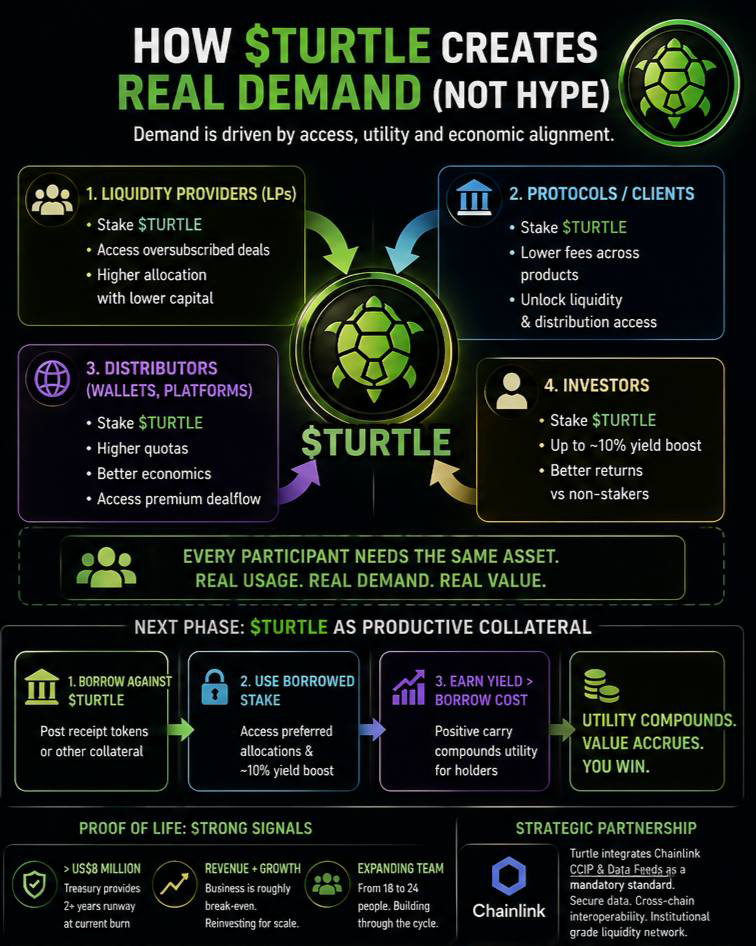
It suggests this isn’t a short-term experiment. Then there’s the business activity itself. Turtle isn’t just sitting idle. It’s already coordinating liquidity, running campaigns, and generating revenue that roughly balances its costs. That’s rare. Most projects live on promises. This one, at least, is trying to operate.
And then comes the part that ties it all together.
THE CHAINLINK PARTNERSHIP
Now, if you’re new to this, Chainlink is essentially the data layer of crypto. It provides reliable information like prices and cross-chain communication that other systems depend on. Without it, many DeFi applications are flying blind. Turtle making Chainlink’s infrastructure mandatory is not a branding move. It’s a signal about standards.
It’s saying: if you want to participate in this liquidity network, you need verified data, secure connections, and proper infrastructure. No shortcuts.
WHY DOES THAT EVEN MATTER
Because liquidity again, just money doesn’t move toward chaos. It moves toward trust. Institutional capital, in particular, won’t touch systems that feel fragile or opaque. By anchoring itself to something like Chainlink, Turtle is trying to position itself less like a speculative playground and more like financial plumbing you can rely on.
And this connects back to the token.
$TURTLE ROLE IS CLOSER TO A KEY
You stake it meaning you lock it up to access better opportunities. You use it to lower fees. You rely on it to get allocation in deals that might otherwise be out of reach. Over time, the idea is that it becomes productive collateral an asset you can borrow against and reuse, like putting down property to get a loan and then using that loan to generate more income.
If that works, demand will come from usage. That’s a big if, of course. And it would be irresponsible to pretend otherwise.
This model depends on one thing above all: consistent dealflow. If there aren’t good opportunities flowing through the system, the incentives weaken. Add to that the usual crypto risks smart contract bugs, market volatility, fragmented liquidity across chains and you have a setup that is promising, but not guaranteed.
Still, step back for a second.
WHAT TURTLE IS ACTUALLY DOING IS FORCING A QUESTION
What should a crypto project look like if it were designed properly from the start?
1- No hidden equity
2- No value leakage
3- A token that actually represents the system, not just sits beside it
4- Infrastructure partnerships that suggest seriousness
That’s the direction this points to
And whether Turtle itself becomes dominant or not, the structure it’s experimenting with looks cleaner, more honest and closer to how these systems were supposed to work in the first place. You don’t have to buy the token to appreciate that.
But once you understand it, you start seeing the rest of the market a little differently.