

I keep coming back to one question when I look at Web3 gaming: are players being rewarded because they create value inside the game, or are they being paid just to keep activity numbers alive?
That difference matters. A reward system can create noise for a while, but if the gameplay loop, ownership layer, spending logic, and community behavior are weak, the economy eventually feels like a faucet with no real sink.
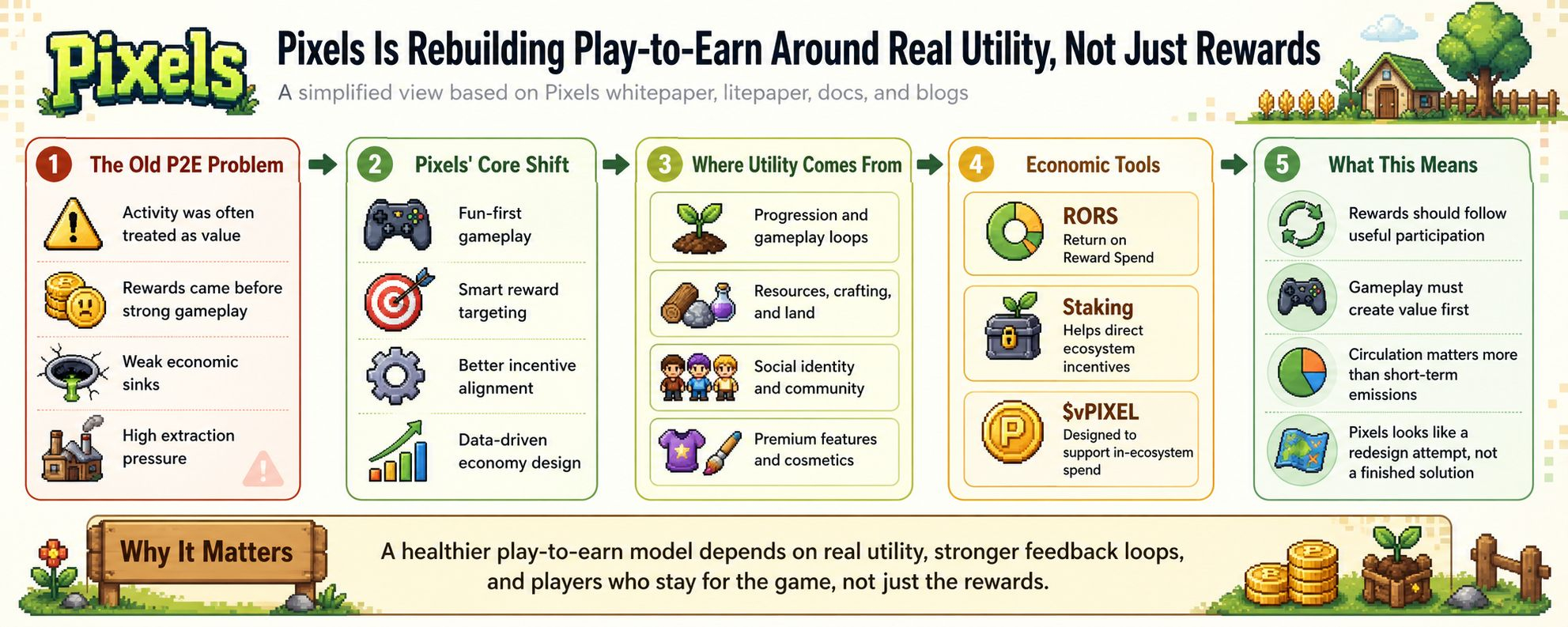
That is why Pixels feels worth studying. I do not see it only as a farming game with token rewards. I see it as an attempt to rebuild play-to-earn around a more practical idea: rewards should follow useful participation.
The project’s own materials point toward this direction through fun-first gameplay, targeted rewards, incentive alignment, staking, and a data-driven economic loop.
The older play-to-earn model had a clear weakness. It often treated activity as value. If users logged in, farmed, clicked, and extracted rewards, the system could look active even when the economic base was fragile.
But activity without retention is not enough. Rewards without entertainment turn a game into repetitive work. Pixels seems to understand that the game itself must provide value first, before the token layer can make sense.
This is the most important part for me. Pixels economic docs frame gameplay as the real source of value, not speculation alone.
The idea is that users should enjoy the experience enough that upgrades, skins, premium features, land, and social expression feel meaningful in a normal gaming sense. That sounds simple, but in Web3 gaming it is a serious correction. It moves the conversation away from “how much can I earn? and back toward “why would I play?
Utility in Pixels is not only about having a token. Utility is about whether an asset does something inside the world. Can it support progression, save time, improve identity, or make land, crafting, pets, and community activity more meaningful? These are healthier questions than short-term reward chasing because they connect value to the game experience itself.
The newer Pixels whitepaper gives rewards a more disciplined role. Instead of distributing incentives broadly and hoping growth follows, it talks about smart reward targeting, data analysis, and identifying player actions that support long-term value.
To me, that is one of the more mature parts of the design. It treats rewards less like free emissions and more like user-acquisition capital that must be measured.
The RORS idea, Return on Reward Spend, makes this clearer. In simple terms, it asks whether rewards given to players are generating enough value back into the ecosystem.
That is a better lens than celebrating daily activity alone. A game can have many users and still be economically weak if most activity is only extracting value. Pixels is trying to separate useful participation from empty activity.
The staking model adds another layer. Pixels describes $PIXEL as a governance and staking asset where players can support individual games and influence how ecosystem incentives are allocated.
That changes staking from passive yield into an economic signal. If games compete for stakers by improving retention, real in-game spend, and reward efficiency, the system becomes less about farming emissions and more about proving economic quality.
$vPIXEL also fits this direction because it is designed as a spend-only token backed by PIXEL The idea is to encourage more in-ecosystem use and reduce immediate extraction pressure. Whether this works perfectly will depend on execution, but the intention is clear: Pixels wants value to circulate inside the ecosystem instead of leaking out too quickly.
My personal view is that Pixels is trying to correct one of the biggest mistakes of early blockchain gaming: confusing earning with value creation. Earning is an output. Value creation is the process behind it. If players create content, deepen communities, trade useful assets, spend inside the ecosystem, or help improve retention, then rewards can become part of a healthier structure.
That is why I would not frame Pixels as a finished solution. I would frame it as a serious redesign attempt. The project has acknowledged issues like token inflation, sell pressure, and mis-targeted rewards, which makes the current direction more credible.
It is easier to take a system seriously when it admits where the old model was weak and then tries to rebuild incentives around measurable contribution.
The uncertainty is execution. Data-driven incentives need constant tuning. Staking needs real decision-making value. Rewards need to reach genuine players without overpaying extractive behavior. Gameplay needs to remain fun even when token incentives change.
Still, the direction feels important. Pixels is not only asking how players can earn from a game. It is asking how a game can reward players without damaging the economy that supports them.
If play-to-earn is going to mature, rewards cannot be the whole product. They need to follow real utility, real participation, and real economic feedback.
