
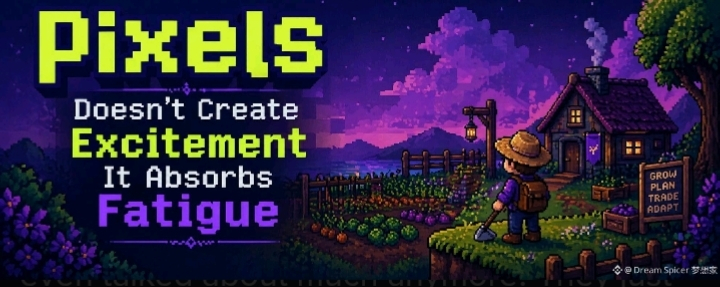
I spent a bit too long today just watching people grind inside Pixels. Not even playing at first, just watching loops. Farming, harvesting, selling, repeating. It looked simple, almost boring at surface. But the longer I sat with it, the less it felt like a game and more like a system quietly shaping behavior.Here’s the thesis I landed on: Pixels isn’t really competing as a game it’s functioning as a behavioral engine that trains users into on chain economic loops, and the token only makes sense if that conditioning actually sticks.
At surface level, Pixels sells the usual narrative: social, casual, open-world farming on Ronin. Low barrier, friendly visuals, easy onboarding. You plant crops, gather resources, craft items, maybe trade with others. Nothing here feels new if you’ve seen Web2 farming sims.But the visible layer is doing something specific. It removes intimidation.
No wallets thrown in your face immediately, no heavy DeFi framing. You’re just doing small, repeatable actions. Click, wait, collect. The kind of loop that doesn’t require thinking. That part is intentional, I think.Because underneath that, there’s a second layer that only becomes obvious after you watch player behavior for a while.
Everything meaningful in Pixels is tied to resource flow and time allocation. Energy systems, land usage, crafting chains, market interactions. You’re not just playing you’re optimizing. Even casual players slowly start asking: what’s the most efficient crop? What sells faster? Where should I spend time?That shift is the real product.
Pixels is training users to think in terms of on-chain productivity without ever explicitly teaching them DeFi. It’s not saying “yield farming,” but the behavior is almost identical. Input resources, wait, extract output, reinvest.I didn’t expect that part to feel so clear, but it does after a while.And then the third layer clicks the economy isn’t just decorative. It actually depends on these behaviors stabilizing.
If players don’t optimize, the system slows. If they don’t trade, markets thin out. If they don’t care about efficiency, the token layer becomes noise. So the game has to constantly nudge users into tighter loops without making it feel forced.That’s a hard balance.Because if it feels like work, people leave. If it feels meaningless, they also leave.
So Pixels sits in this narrow band where repetition has to feel “light” but still economically relevant. I’m not fully sure they’ve solved that yet, honestly. Some loops already feel a bit… mechanical in a way that might not hold long term.But when it works, it works quietly.
The practical implication here is more interesting than it looks. If Pixels succeeds, it creates a user base that is already conditioned to interact with tokenized systems not through speculation, but through habit.That matters more than another DeFi UI improvement.
Imagine a player who spent weeks optimizing crop cycles and selling outputs. Moving that user into a broader on chain economy is much easier than onboarding someone from scratch. They already understand time-value, resource allocation, and market timing even if they never call it that.That’s where the token starts to make sense.
PIXEL isn’t just there for rewards or governance dressing. It acts as the coordination layer between all these loops. It standardizes value across activities, gives players a reason to care about efficiency, and connects in-game actions to something transferable.Without the token, the system collapses back into a closed game economy. With it, the loops extend outward.But that also creates a dependency that’s hard to ignore.
The token only holds meaning if player behavior remains consistent and growing. If new users stop entering, or if existing players stop caring about optimization, the entire economic layer weakens. Not instantly, but gradually liquidity dries, incentives blur, attention moves elsewhere.This isn’t unique to Pixels, but here it feels more exposed because the whole system leans on repetition.
I keep thinking about one small moment I saw earlier. A player adjusted their entire farming layout just to shave off a bit of idle time between harvests. It wasn’t required. The game didn’t force it. But they did it anyway.That’s the signal.Not engagement. Not DAU. But voluntary optimization.
What I’m watching now is whether that behavior deepens or fades. If players start building more complex strategies, coordinating with others, treating the system like something worth mastering then the thesis holds. The behavioral engine is working.
If instead the loops flatten into passive clicking and short term reward chasing, then it probably breaks. Slowly at first, then all at once.Because in the end, Pixels doesn’t win by being fun alone.
It wins if people unknowingly become operators inside it.