

I look at @Pixels and see something most Web3 games miss entirely.
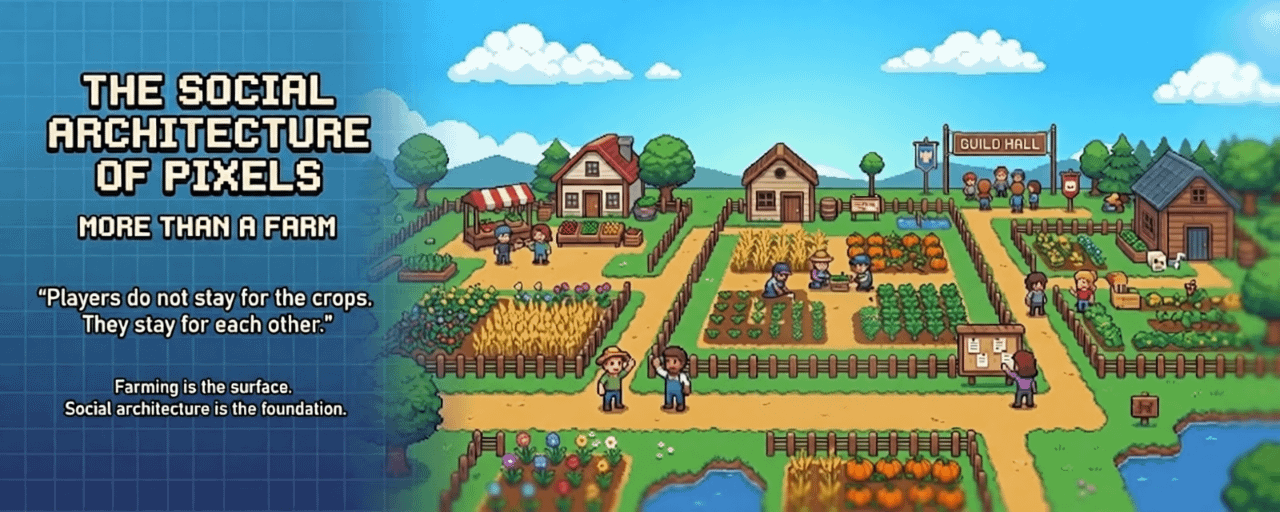
Farming is the surface. Social architecture is the foundation.
After fifteen days of observation, one truth stands out clearly. Players do not stay for the crops. They stay for each other. The soil produces. The market moves. The upgrades improve efficiency. But none of these create long-term loyalty. People create long-term loyalty.
Pixels understands this deeply. Every feature, every mechanic, every system points toward connection. Farms are visible, not hidden. Neighbors are present, not isolated. Trading requires real interaction. Visiting is encouraged, not blocked. Even the quiet act of walking through someone else's land builds silent bonds.
This is not accidental. This is design.
Many Web3 games focus on individual wealth. Single-player grinding. Isolated progress. Personal rewards. Pixels takes the opposite path. It builds communities first. Farms second. The gameplay supports the social layer. The social layer does not support the gameplay.
That reversal changes everything.
When a player feels connected to others, they do not leave when prices drop. They do not quit when upgrades slow down. They stay because the farm next door is still growing. They stay because someone waved back. They stay because trading feels like conversation, not competition.
Consider how visibility shapes behavior inside Pixels. A farm that sits alone in a private instance receives no visitors. No comments. No silent appreciation. That farm could be beautiful, but no one would know. Pixels eliminates this problem entirely. Every farm is potentially public. Every farmer is potentially visible. Every layout can inspire someone else.
This visibility creates natural accountability. Players who know others can see their farms tend to maintain them better. They organize resources more carefully. They design layouts more thoughtfully. Not because the game forces them. Because social presence creates gentle pressure.
Now look at the trading system. In many Web3 games, trading happens through anonymous marketplaces. Click a button. Complete a transaction. Never see the other person again. Pixels makes trading more human. Players meet. They negotiate. They remember who treated them fairly and who did not. Over time, trading partners become regular contacts. Regular contacts become friends. Friends become the reason to log in every day.
The visiting mechanic deserves special attention. Walking onto another player's farm in Pixels requires no permission. No loading screen. No formal request. Just movement. Simple, natural movement. This low friction changes everything. Players explore casually. They discover unexpected layouts. They steal ideas for their own farms. They leave feeling inspired, not threatened.
Pixels also handles competition differently than most Web3 games. No leaderboards that shame slow progress. No rankings that compare wealth directly. No public shaming of low activity. Instead, competition exists softly. A better farm inspires, not intimidates. A smarter layout teaches, not humiliates. A richer neighbor demonstrates possibility, not inequality.
The chat system in Pixels follows the same philosophy. Always available. Never forced. Players can ignore it completely or dive deep into conversation. The game does not punish either choice. This flexibility respects different play styles while keeping the door open for connection.
Guilds add another layer to the social architecture. Players with shared goals find each other naturally. Resource sharing becomes organized. Knowledge spreads faster. New players receive help without begging. Experienced players gain purpose without pressure. The guild system amplifies everything good about individual play while adding collective benefits impossible to achieve alone.
What makes all of this powerful is its subtlety. Pixels does not scream "BE SOCIAL." It does not force players into uncomfortable interactions. It does not reward empty friending or fake engagement. Instead, it builds a world where social behavior emerges naturally because the environment supports it.
A player who wants to farm alone can farm alone. No problem. A player who wants to build a community can build one. Also no problem. The game does not judge. The game does not punish. The game simply provides the space for both approaches to exist peacefully.
This social architecture creates resilience. When token prices fall in other Web3 games, communities collapse. Players blame each other. Trust disappears. Activity stops. In Pixels, social bonds survive market swings because the bonds were never about money. They were about shared space. Shared goals. Shared quiet moments on adjacent farms.
Pixels proves a simple truth that many Web3 projects have forgotten. Technology enables connection. Technology does not replace it. A blockchain can track ownership forever. But only people can make ownership feel meaningful.
The farms matter. The crops matter. The upgrades matter. But none of them matter as much as the player in the next field who waves hello.
That is the social architecture of Pixels. Quiet. Powerful. Easy to miss. Impossible to ignore once seen.
