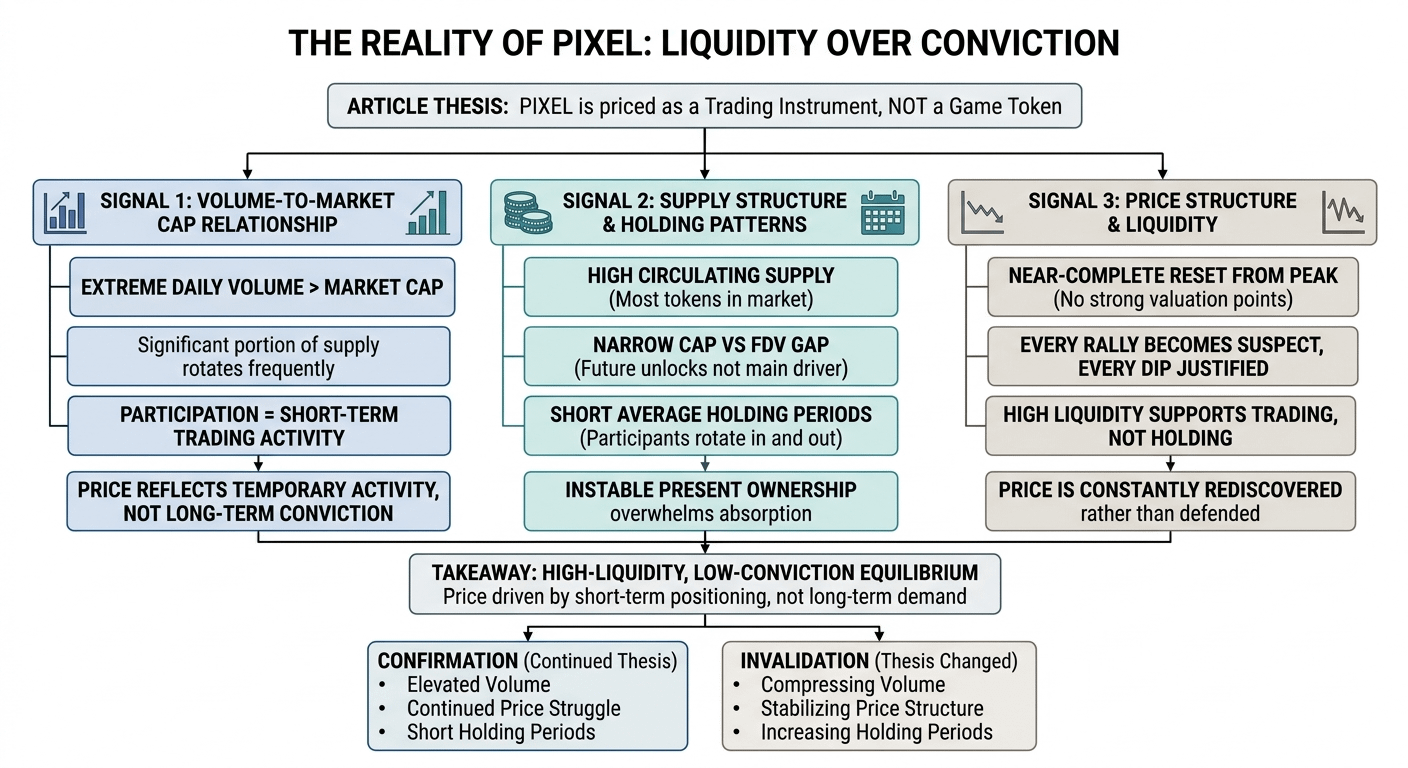
 Most people looking at PIXEL think they’re trading a game token. They’re not. What they’re actually trading is a liquidity structure with unstable ownership. Until you see that clearly, the price action will continue to look random and disconnected.
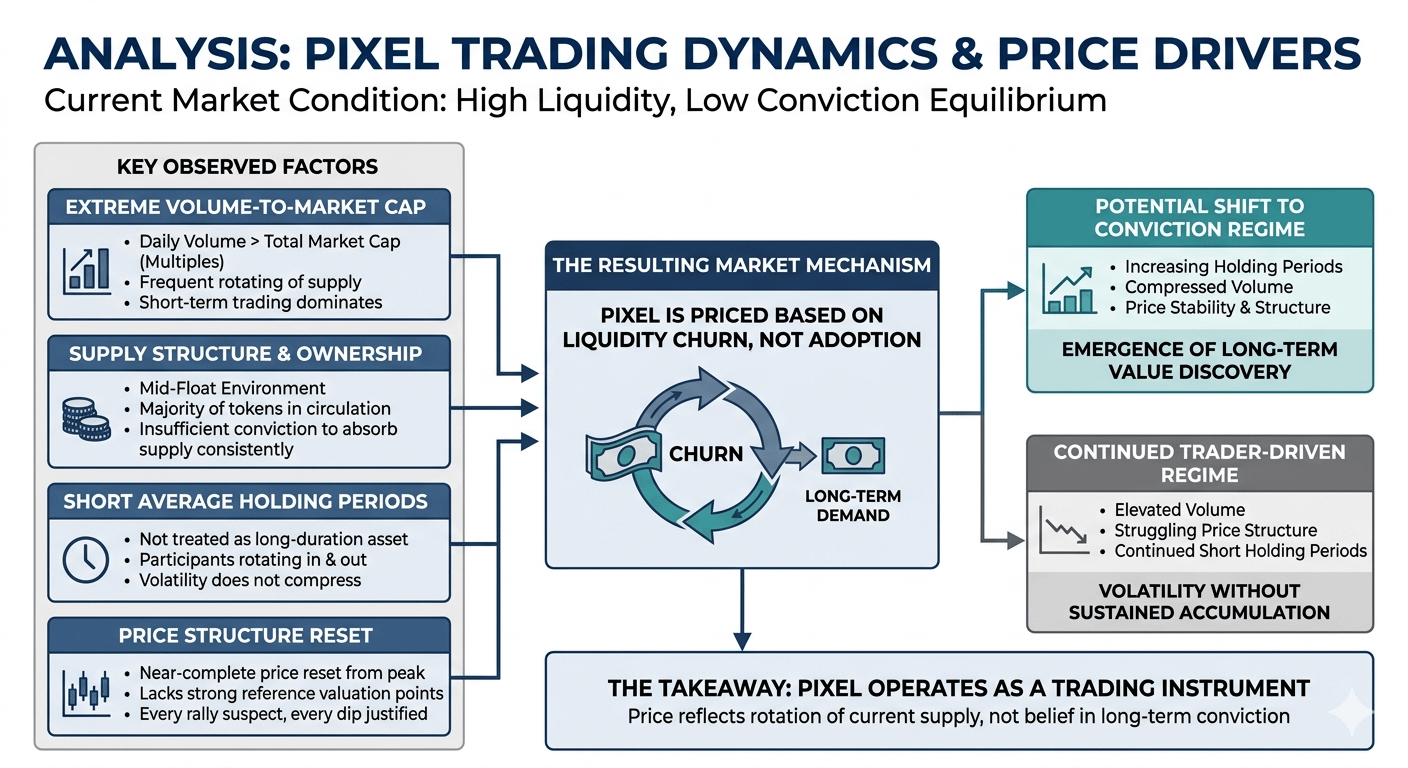
Thesis: PIXEL is not being priced based on long-term adoption. It is being priced based on short-term liquidity churn overwhelming a relatively small market cap. The result is a market where ownership is weak, turnover is extreme, and price discovery is unreliable.
The first signal is the volume-to-market cap relationship. Recent data shows daily trading volume reaching multiple times the total market cap, implying that a significant portion of the circulating supply can rotate within short timeframes. This matters because it indicates that participation is dominated by short-term trading activity rather than accumulation. When turnover is this high, price reflects activity, not conviction—and activity is temporary.
The second factor is supply structure. Circulating supply already represents a majority of the total supply, meaning most tokens are already in the market. This removes the typical “low float” narrative. Instead, it creates a mid-float environment where there is enough supply to sell but not enough conviction to absorb it consistently. Future emissions exist, but they are not the primary driver of current volatility. The instability is coming from how existing supply is behaving.
The third observation is the relatively narrow gap between market cap and fully diluted valuation. This suggests the market is not heavily discounting future inflation. In other words, price weakness cannot be fully explained by token unlock expectations. That shifts the focus back to participant behavior. The problem is not future supply—it is present ownership.
That becomes clearer when looking at holding patterns. Average holding periods remain relatively short for an asset tied to a long-term game economy. This indicates that participants are not treating the token as a long-duration asset. Instead, they are rotating in and out. If conviction were stronger, holding periods would extend, supply would tighten, and volatility would begin to compress. None of that is happening yet.
Price structure reinforces the same conclusion. The token has experienced a near-complete reset from its peak levels, eliminating any strong reference points for valuation. When an asset loses that level of price anchoring, every rally becomes suspect and every dip feels justified. Without a stable base of holders, price is constantly rediscovered rather than defended.
Liquidity conditions further amplify this dynamic. The token is widely accessible and actively traded, which increases participation. But without underlying conviction, increased access does not lead to stability—it leads to faster rotation. Liquidity supports trading, not holding, and that distinction is critical.
Taken together, PIXEL is operating in a high-liquidity, low-conviction equilibrium. There is enough volume to create movement, but not enough belief to sustain it. There is enough supply to enable trading, but not enough scarcity to force accumulation. As a result, price is driven more by short-term positioning than long-term demand.
There is a counterargument. High trading activity can signal strong interest, and the underlying ecosystem still has the potential to convert users into long-term participants. It is possible that current churn represents an early phase before more stable ownership emerges. However, this scenario depends on a behavioral shift that is not yet visible in the data.
To confirm the current thesis, volume would remain elevated while price continues to struggle forming consistent higher lows. Holding periods would stay short, and supply would continue rotating rather than consolidating. This would indicate that the asset remains trader-driven.
To invalidate it, the data would need to change meaningfully. Holding periods would need to increase, suggesting stronger conviction. Volume would likely compress while price stabilizes, indicating reduced churn. Most importantly, price would begin forming structure without relying on sudden spikes in activity.
The takeaway is straightforward. PIXEL is not being priced as a long-term asset yet. It is being priced as a trading instrument.
And until ownership behavior changes, every move in the market will reflect rotation—not conviction.
#CHIPPricePump #EthereumFoundationUnstakes$48.9MillionWorthofETH #ShootingIncidentAtWhiteHouseCorrespondentsDinner #pixel $PIXEL @Pixels