

I thought I understood what multi-game expansion meant in .
Honestly…. I did not
I kept framing it the same way everyone else does—more Games, more utility, more demand. Clean narrative, easy to sell, sounds Good on paper. But the more time I actually Spent inside over the past few days, the more that explanation started to feel… incomplete.
Like I was looking at the surface and missing the mechanism underneath.
Because this isn’t just expansion.
It’s a shift in how value moves.
And I don’t think most People fully see it yet.
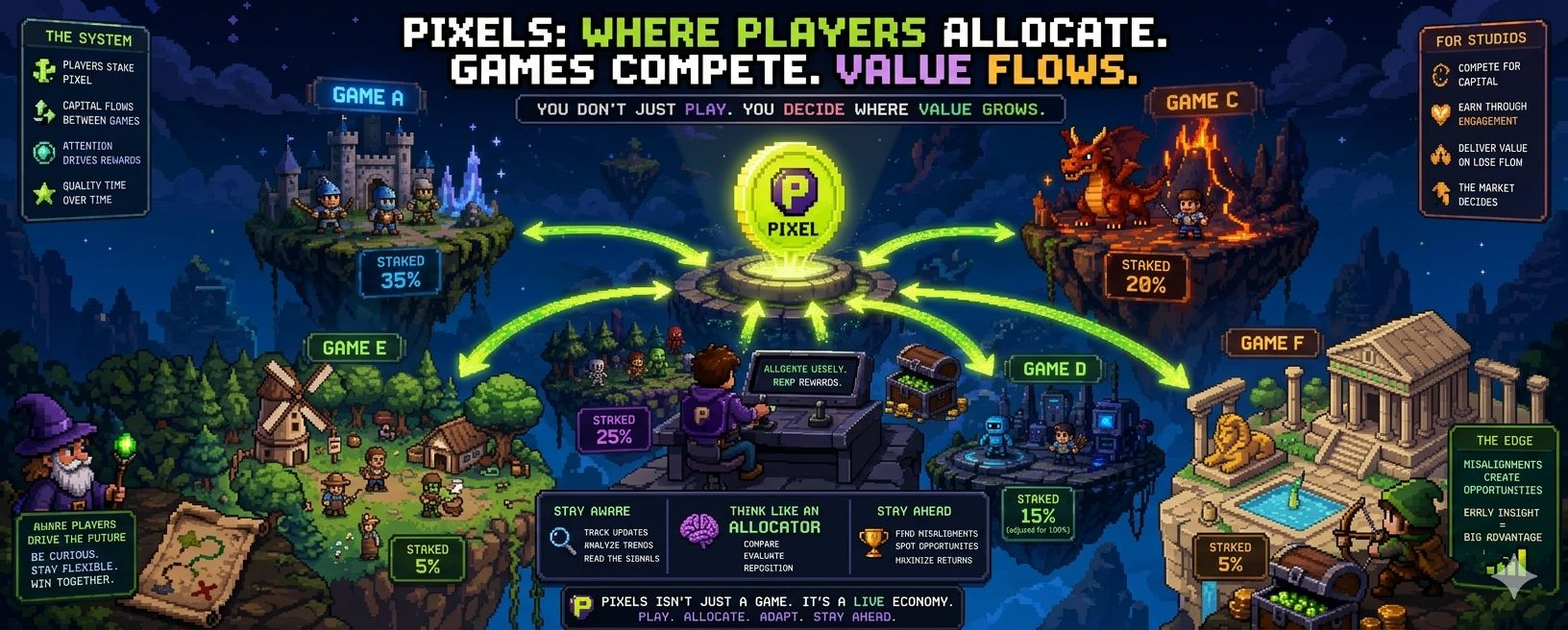
What Pixels is quietly building isn’t a bunch of games connected by a token. It’s a system where capital flows between games—and players are the ones directing it.
That part clicked for me yesterday while I was checking staking allocations and realized I wasn’t behaving like a “player” anymore.
I was making allocation decisions.
When I stake PIXEL into a Game now, I’m not just locking tokens and waiting. I’m basically saying, “I think value is here…. or it’s about to be here.”
That’s a very different mindset.
PIXEL stops feeling like a Currency at that point. It starts acting like a signal.
A live one.
Where people stake is where attention goes. And where attention goes… rewards follow. Simple feedback loop, but it’s powerful.
And once you notice that, the behavior it creates becomes hard to ignore.
In a single-game setup, staking is easy. You decide once, and you’re done. There’s nothing to compare against, so there’s no real pressure to rethink your position.
But here?
Now I’m constantly second-guessing myself (in a good way).
Like… Is this game actually growing, or just hyped for a moment? Are players sticking around, or just farming and leaving? Is another Game quietly improving while nobody’s watching?
That’s not passive staking anymore.
That’s portfolio thinking.
And I’ll be real most people aren’t doing that yet.
A lot of staking still feels… static. Set it, forget it, check back when rewards drop. I’ve done that too. Everyone has.
But in this System, that approach feels like leaving money and more importantly, Positioning on the table.
Because once multiple games are competing for the same pool of staked tokens, the system naturally rewards people who are paying attention.
Not the loudest. Not the earliest.
The most aware.
If you’re tracking updates, noticing retention shifts, seeing where players are actually spending time—not just where Twitter hype is you’re operating with context.
And context here is everything.
What really got me thinking deeper though is what this does to the studios.
Because this isn’t a normal Publishing model at all.
Studios aren’t just fighting for downloads anymore. They’re competing for capital allocation.
That’s a much harder GAME.
You can’t fake that with marketing. You can not Survive on short-term hype. If your game doesn’t hold attention, does not create real engagement, doesn’t give players a reason to come back…
It won’t attract staking.
And if it doesn’t attract staking, it loses rewards.
No committee. No manual selection. No one deciding winners.
The system just… filters.
And markets like this don’t lie for long.
Weak games get exposed eventually. Strong ones get reinforced.
Not because someone says so but because players move their capital.
And here’s the part I think people are still underestimating.
This creates actual opportunity for players—not just devs.
Because whenever capital is moving like this, inefficiencies show up.
Some games will be undervalued. Quietly improving, but ignored.
Others will be overvalued. Riding attention, but not delivering underneath.
That gap?
That’s where the edge is.
I’m starting to pay more attention to that than anything else. Not just APR numbers—but behavior.
Like earlier today, I caught myself looking at where players were actually Spending time versus where staking was Concentrated. Those two didn’t fully match… and that’s interesting.
I almost moved my stake into X yesterday because APR looked higher… then realized player activity there was actually dropping.
That’s the kind of misalignment you can position around.
And no, it’s not some big-brain strategy. It’s just… paying attention slightly earlier than others.
Which sounds simple, but barely anyone does it consistently.
That’s why I do not think the real barrier here is capital.
It’s awareness.
Anyone can stake.
But not everyone is Actually thinking about what they’re doing.
And that brings me to the question I keep coming back to:
Are PIXEL stakers actually behaving like participants in a live system?
Or are most still stuck in that old mindset—stake once, react later?
Because the difference between those two isn’t small.
It literally determines how powerful this entire model becomes.
If people stay passive, the system slows down. Signals get weaker. Capital moves late.
But if people stay active constantly reassessing, shifting, questioning then this becomes something way more efficient… and way more competitive.
And honestly, that’s the part that excites me the most.
Because at that point, Pixels isn’t just a game anymore.
It’s an environment where games compete for capital…
…and players, whether they realize it or not, are the ones allocating it.
And the ones who stay curious who keep adjusting instead of settling are always going to be a step ahead.