
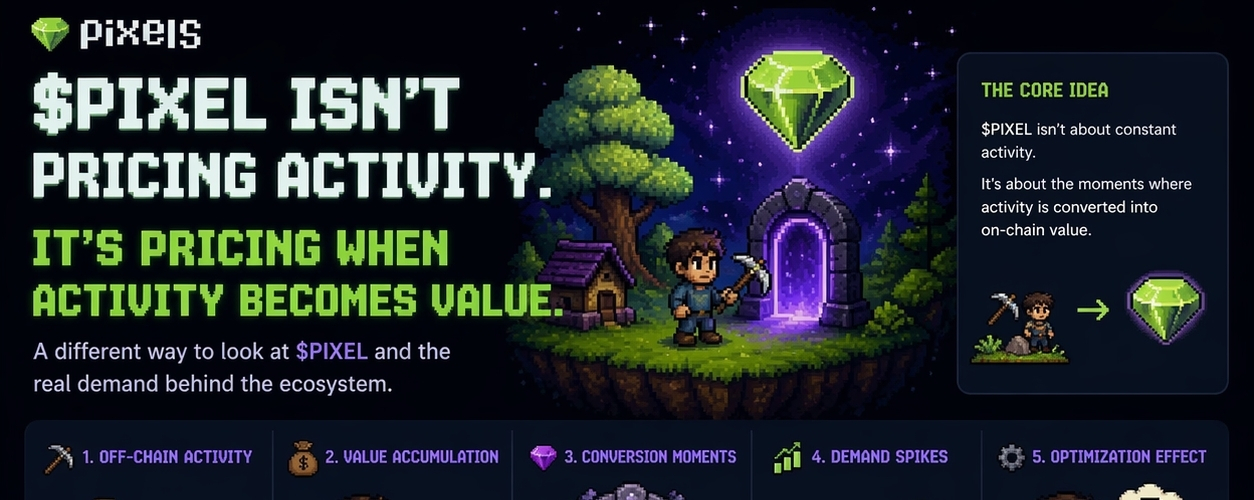
Within @Pixels els (https://www.binance.com/en/square/profile/pixels), most players focus on visible gameplay activity such as farming, crafting, and progression loops. However, this surface activity does not automatically translate into direct Pixel demand.
To understand the system properly, it is important to separate activity generation from value conversion.
Activity generation happens off-chain. Players continuously build resources, progress through cycles, and accumulate value within the game environment. But this stage remains outside the token economy, meaning no direct token interaction occurs yet.
The real economic shift happens at conversion points. These are system-defined moments where off-chain progress is transformed into on-chain outcomes such as upgrades, rewards, or ecosystem actions. At these points, $PIXEL becomes functionally required, creating real demand pressure.
This structure produces an episodic demand model. Instead of steady consumption, token usage clusters around specific conversion events driven by system design rather than constant gameplay activity.
At the same time, supply distribution typically remains continuous through incentives and emissions within the Stacked ecosystem. This creates a structural imbalance where long-term stability depends on whether conversion demand is strong enough to absorb ongoing supply flow.
From an analytical standpoint, the key metric is not engagement volume but conversion density. If the ecosystem consistently requires $PIXEL at meaningful progression stages, demand remains structurally supported. If conversion is weak or optional, high activity alone cannot sustain token pressure.
Ultimately, $PIXEL should be evaluated based on how effectively gameplay is translated into token-relevant economic events rather than how active the ecosystem appears.