
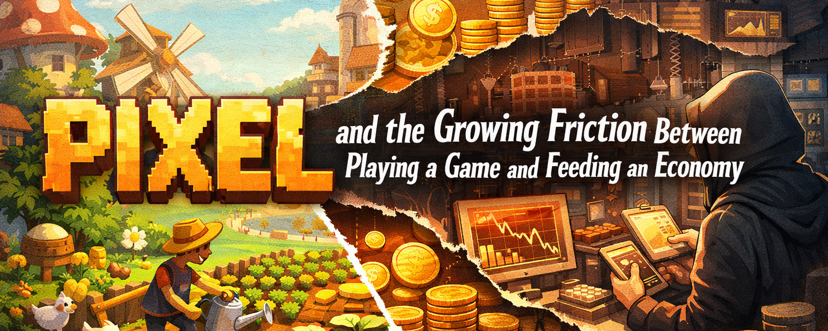


PIXEL is at that stage now where I stop caring about the pitch and start watching the strain.
That is usually when a project gets interesting. Not when it is still floating on optimism. Not when everyone is repeating the same clean story about ownership, community, or the future of gaming. I have seen too many of those cycles already. Same language. Same recycled confidence. Same noise dressed up as conviction. What matters now is simpler. Can this thing keep working once the mood turns, once the easy excitement burns off, once people start treating it like a system instead of a dream.
That is where PIXEL sits for me.
I do not look at it and see some grand answer to where gaming is headed. I see friction. I see a live economy trying to pretend it is still just a world to play in. And maybe that tension is the whole story. Because once a game starts carrying a token, and then staking, and then ecosystem logic, and then more layers of access and reward routing, it stops being just a game no matter how soft the art style is. The surface can stay friendly. Underneath, it is all distribution pressure, behavioral management, retention design, and the constant grind of trying to keep value from leaking faster than belief can replace it.
That is the part people skip.
They like to talk about players owning assets, about digital economies, about the idea that time spent in a game can finally mean something beyond entertainment. Fine. I get why that sounds attractive. But I have watched enough of these projects age badly to know that ownership inside a controlled system is never as clean as it sounds. A project can hand users tradable assets and still keep a tight grip on the rules that actually matter. Who gets rewarded. Who gets diluted. Who gets access first. Who is stuck paying to keep up. That is where the real economy is. Not in the slogans.
And PIXEL, at this point, feels less like a token attached to a game and more like a reward machine wrapped in a game world. I do not even mean that as an insult. It is just what happens when a project matures in this direction. Every update starts doing double duty. It has to look like content, feel like progression, and quietly serve the economy underneath. New systems are not just new systems. They are new filters. New gates. New ways of controlling scarcity. New ways of deciding who gets to produce efficiently and who gets pushed into the slower lane.
That is where I start paying attention.
Because this is usually the moment a project reveals what it really is. When the economy gets more complicated, not less. When participation starts feeling more structured. When users are not just wandering around or having fun, but adjusting themselves to whatever the model now rewards. At that point I stop asking whether the game is alive and start asking whether the economy is getting desperate.
Maybe desperate is too harsh. Maybe. But I have seen enough reward-driven systems to know how quickly they slide into recycling the same activity with slightly different packaging. More loops. More sinks. More reasons to stay active. More reasons to lock in. More reasons to believe one more update will make the structure feel stable. Sometimes it works for a while. Sometimes the whole thing starts feeling like labor with brighter colors.
That is the risk around PIXEL. Not that it has a token. Not even that it is trying to build a wider ecosystem. The risk is that the game ends up serving the economy so completely that players can feel the machinery in every corner of the experience. Once that happens, the magic goes fast. People stop seeing the world. They start seeing the model. They stop asking what is fun. They ask what pays, what drains, what gets nerfed next, what unlock is coming, who this update really benefits.
And once your players start thinking like that, you have a different kind of product on your hands.
I think PIXEL is already somewhere in that transition. You can feel it. It is no longer living off novelty. No serious person is looking at projects like this and getting dazzled just because there is a token attached to gameplay. That phase is over. The market is too tired for that now. Everyone has seen too much. Too many projects overpromised. Too many economies hollowed themselves out. Too many communities were really just temporary alignments around extraction. So now the standard is harsher. Good. It should be.
The real test, though, is not whether PIXEL can keep shipping. Lots of projects ship. Shipping is not the hard part anymore. The hard part is whether any of these new layers actually reduce the grind instead of just reorganizing it. Whether they create genuine reasons to stay inside the system beyond habit, sunk cost, or the hope that value might hold together for one more cycle. Whether players feel like participants or just inventory with wallets.
That is the line I keep coming back to. Because a lot of these projects talk about economy when what they really mean is managed behavior. They want activity, consistency, retention, spending, social proof, all of it, and they want to calibrate it as tightly as possible. PIXEL does not strike me as uniquely guilty there. If anything, it feels like a very clear example of where this whole category ended up after the first wave of fantasy wore off. Less idealism. More tuning. Less freedom than advertised. More dependence on keeping the loops alive.
I do not say that to dismiss it. Honestly, I find it more credible now than I would have if it were still speaking in that old, shiny language. At least pressure tells the truth. A weak market tells the truth. User fatigue tells the truth. Ongoing supply pressure tells the truth. That is when you learn whether a project has built something people actually want to live in, or whether it just found a clever way to subsidize attention for a while.
And PIXEL, to me, still feels unresolved. Still mid-test. Still caught between wanting to be a real game world and needing to behave like an economy under constant maintenance.
Maybe that is the future for this whole sector. Not fully games. Not fully markets. Just these strange, half-living systems where play, labor, and finance keep bleeding into each other until nobody can quite say where one ends and the next begins.
I keep looking at PIXEL and wondering how much more weight it can carry before the world starts feeling like pure accounting. Or maybe it already does, and people are just better at pretending otherwise.