

#staking
staking
2.2M vues
8,229 mentions
Populaire
Récents

·
--
"No action is required from stETH holders" is true, and it still costs something
MetaMask disclosed a security incident in part of its infrastructure on September 30 and is pulling affected validators, Lido's included
it doesn't hold withdrawal keys for client stake and sees no immediate threat to wallets
the bill is time
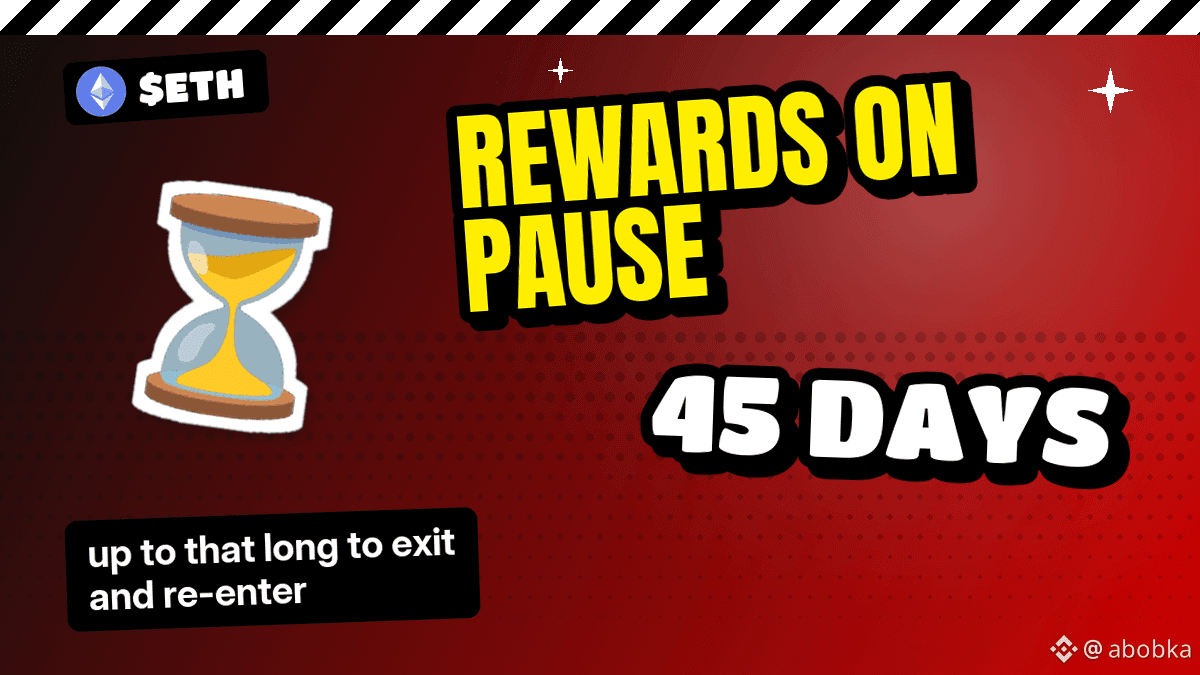
exit and re-entry could take up to about 45 days
no staking rewards on those validators while they wait, downtime penalties possible
the last affected ones finish exiting by the end of Oct. 7
still undisclosed: how it happened, how many validators, how much $ETH , whether any data was accessed
zero ETH in my bags right now. Lido ($LDO ) gets up to 45 days of explaining
stETH holders: is missing rewards on those validators enough to make you rotate?
#MetaMask #Lido #staking #Ethereum
"No action is required from stETH holders" is true, and it still costs something
MetaMask disclosed a security incident in part of its infrastructure on September 30 and is pulling affected validators, Lido's included
it doesn't hold withdrawal keys for client stake and sees no immediate threat to wallets
the bill is time
exit and re-entry could take up to about 45 days
no staking rewards on those validators while they wait, downtime penalties possible
the last affected ones finish exiting by the end of Oct. 7
still undisclosed: how it happened, how many validators, how much $ETH , whether any data was accessed
zero ETH in my bags right now. Lido ($LDO ) gets up to 45 days of explaining
stETH holders: is missing rewards on those validators enough to make you rotate?
#MetaMask #Lido #staking #Ethereum
MetaMask disclosed a security incident in part of its infrastructure on September 30 and is pulling affected validators, Lido's included
it doesn't hold withdrawal keys for client stake and sees no immediate threat to wallets
the bill is time
exit and re-entry could take up to about 45 days
no staking rewards on those validators while they wait, downtime penalties possible
the last affected ones finish exiting by the end of Oct. 7
still undisclosed: how it happened, how many validators, how much $ETH , whether any data was accessed
zero ETH in my bags right now. Lido ($LDO ) gets up to 45 days of explaining
stETH holders: is missing rewards on those validators enough to make you rotate?
#MetaMask #Lido #staking #Ethereum
120

·
--
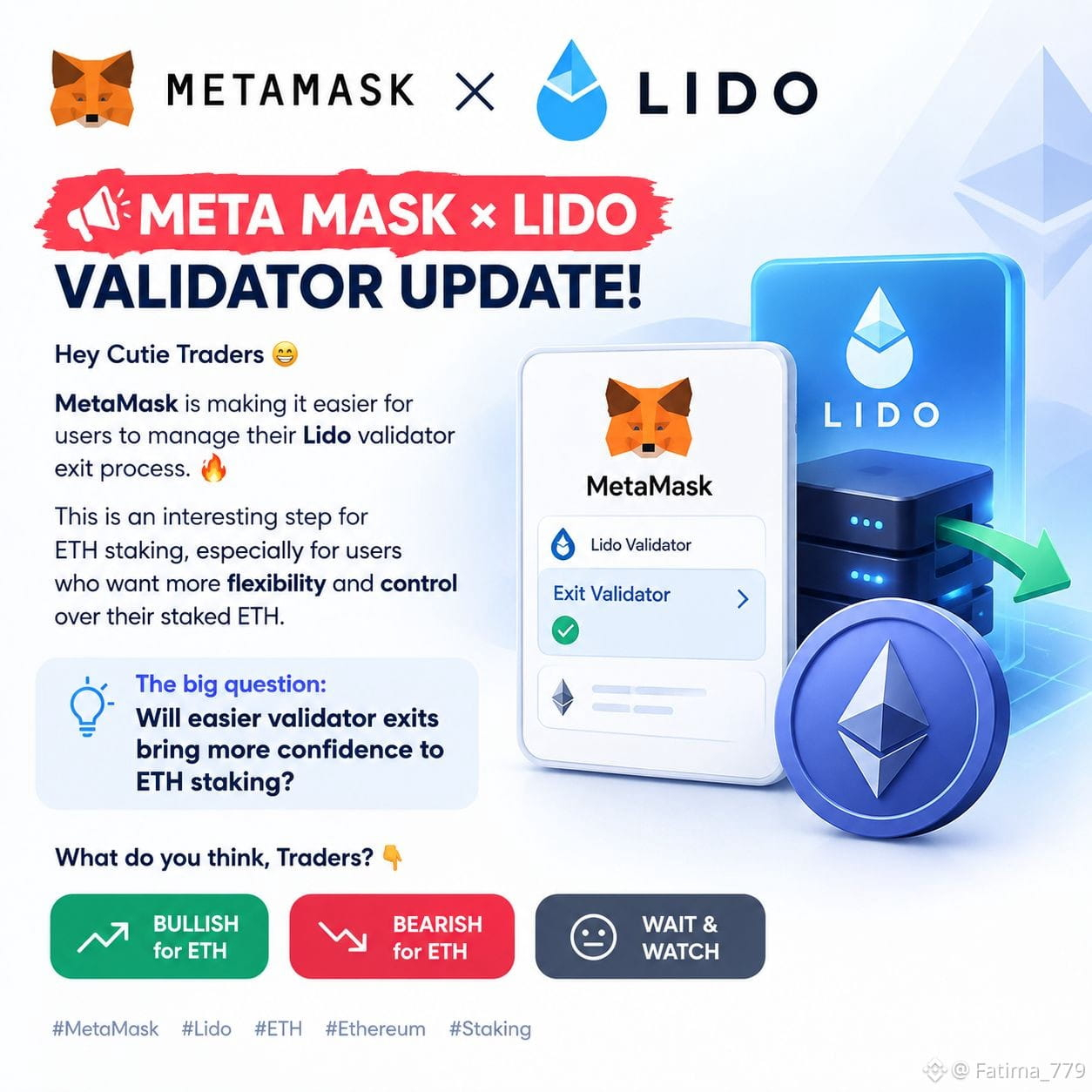
META MASK × LIDO VALIDATOR UPDATE! 👀
Hey Cutie Traders 😁
MetaMask is making it easier for users to manage their Lido validator exit process.
This is an interesting step for ETH staking, especially for users who want more flexibility and control over their staked ETH.
The big question:
Will easier validator exits bring more confidence to ETH staking?
What do you think, Traders? 👇
📈 BULLISH for ETH
📉 BEARISH for ETH
🤔 WAIT & WATCH
#MetaMask #Lido #MetaMaskExitsLidoValidatorsAfterSecurityIncident #Ethereum #Staking $MOVR
{future}(MOVRUSDT)
$NEAR
{future}(NEARUSDT)
$ETH
{future}(ETHUSDT)
META MASK × LIDO VALIDATOR UPDATE! 👀
Hey Cutie Traders 😁
MetaMask is making it easier for users to manage their Lido validator exit process.
This is an interesting step for ETH staking, especially for users who want more flexibility and control over their staked ETH.
The big question:
Will easier validator exits bring more confidence to ETH staking?
What do you think, Traders? 👇
📈 BULLISH for ETH
📉 BEARISH for ETH
🤔 WAIT & WATCH
#MetaMask #Lido #MetaMaskExitsLidoValidatorsAfterSecurityIncident #Ethereum #Staking $MOVR
$NEAR
$ETH
Hey Cutie Traders 😁
MetaMask is making it easier for users to manage their Lido validator exit process.
This is an interesting step for ETH staking, especially for users who want more flexibility and control over their staked ETH.
The big question:
Will easier validator exits bring more confidence to ETH staking?
What do you think, Traders? 👇
📈 BULLISH for ETH
📉 BEARISH for ETH
🤔 WAIT & WATCH
#MetaMask #Lido #MetaMaskExitsLidoValidatorsAfterSecurityIncident #Ethereum #Staking $MOVR
$NEAR
$ETH
1
312

🚨 METAMASK SHIFTS STAKING INFRASTRUCTURE AFTER SECURITY INCIDENT ON $ETH VALIDATORS! ⚠️
MetaMask just flagged an infrastructure breach, immediately pulling out from compromised validators on $ETH to shield user funds. No active wallet balances are under threat right now, but staking infrastructure flows are actively re-routing liquidity behind the scenes. 🏦
When major ecosystem players rotate out of validators, it creates subtle shifts in yield mechanics and network exit queues. Smart money is watching validator movements closely to see where this capital redeploys next. 🔍
💬 Do you keep your $ETH liquid during infrastructure hiccups or hold through the turbulence? 👇
⚠️ Not financial advice. Always manage your risk. 🛡️
🏷️ #ETH #Ethereum #Staking #Crypto
🛡️ 👁️
🚨 METAMASK SHIFTS STAKING INFRASTRUCTURE AFTER SECURITY INCIDENT ON $ETH VALIDATORS! ⚠️
MetaMask just flagged an infrastructure breach, immediately pulling out from compromised validators on $ETH to shield user funds. No active wallet balances are under threat right now, but staking infrastructure flows are actively re-routing liquidity behind the scenes. 🏦
When major ecosystem players rotate out of validators, it creates subtle shifts in yield mechanics and network exit queues. Smart money is watching validator movements closely to see where this capital redeploys next. 🔍
💬 Do you keep your $ETH liquid during infrastructure hiccups or hold through the turbulence? 👇
⚠️ Not financial advice. Always manage your risk. 🛡️
🏷️ #ETH #Ethereum #Staking #Crypto
🛡️ 👁️
MetaMask just flagged an infrastructure breach, immediately pulling out from compromised validators on $ETH to shield user funds. No active wallet balances are under threat right now, but staking infrastructure flows are actively re-routing liquidity behind the scenes. 🏦
When major ecosystem players rotate out of validators, it creates subtle shifts in yield mechanics and network exit queues. Smart money is watching validator movements closely to see where this capital redeploys next. 🔍
💬 Do you keep your $ETH liquid during infrastructure hiccups or hold through the turbulence? 👇
⚠️ Not financial advice. Always manage your risk. 🛡️
🏷️ #ETH #Ethereum #Staking #Crypto
🛡️ 👁️

19

·
--
Staking lets you earn rewards by locking up your crypto to help secure a blockchain network. Think of it like putting money in a high-yield savings account — but instead of a bank, you're supporting a decentralized network. Validators process transactions and create new blocks, and you delegate your tokens to them for a share of the rewards.
Popular options include Ethereum (ETH) on the Beacon Chain or via liquid staking protocols like Lido (3–5% APY), Solana (SOL) through validators or Marinade Finance (6–8% APY), and Quant (QNT) on supported platforms like Binance Earn or centralized exchanges (4–7% APY). These are conservative annual estimates — actual returns fluctuate with network activity and token price.
Risk warning: Slashing penalties can reduce your principal if validators misbehave or go offline, and locked tokens can't be sold during market drops.
Always research validator performance, unbonding periods, and platform security before committing funds. Diversify across chains and methods to manage exposure.
Are you staking any crypto right now? Drop your favourite coin below!
#CryptoTips #BeginnerCrypto #Staking #PassiveIncome
Staking lets you earn rewards by locking up your crypto to help secure a blockchain network. Think of it like putting money in a high-yield savings account — but instead of a bank, you're supporting a decentralized network. Validators process transactions and create new blocks, and you delegate your tokens to them for a share of the rewards.
Popular options include Ethereum (ETH) on the Beacon Chain or via liquid staking protocols like Lido (3–5% APY), Solana (SOL) through validators or Marinade Finance (6–8% APY), and Quant (QNT) on supported platforms like Binance Earn or centralized exchanges (4–7% APY). These are conservative annual estimates — actual returns fluctuate with network activity and token price.
Risk warning: Slashing penalties can reduce your principal if validators misbehave or go offline, and locked tokens can't be sold during market drops.
Always research validator performance, unbonding periods, and platform security before committing funds. Diversify across chains and methods to manage exposure.
Are you staking any crypto right now? Drop your favourite coin below!
#CryptoTips #BeginnerCrypto #Staking #PassiveIncome
Popular options include Ethereum (ETH) on the Beacon Chain or via liquid staking protocols like Lido (3–5% APY), Solana (SOL) through validators or Marinade Finance (6–8% APY), and Quant (QNT) on supported platforms like Binance Earn or centralized exchanges (4–7% APY). These are conservative annual estimates — actual returns fluctuate with network activity and token price.
Risk warning: Slashing penalties can reduce your principal if validators misbehave or go offline, and locked tokens can't be sold during market drops.
Always research validator performance, unbonding periods, and platform security before committing funds. Diversify across chains and methods to manage exposure.
Are you staking any crypto right now? Drop your favourite coin below!
#CryptoTips #BeginnerCrypto #Staking #PassiveIncome
384
·
--
- No markdown (so plain text, no formatting like **, *, etc.)
- 200-250 words.
- Explain staking in plain English.
- List 3 popular coins/platforms to stake on.
- Mention realistic APY ranges (conservative estimates).
- Include one risk warning.
- End with: "Are you staking any crypto right now? Drop your favourite coin below!"
- Final line: "#CryptoMarket #BinanceSquare #Staking #PassiveIncome"
- No extra commentary, no thinking, just the final post text.
- Must be 200-250 words inclusive. Let's target around 225 words.
We need to reference current trending coins if relevant: Quant. So mention Quant as maybe a trending coin.
We need to mention 3 popular coins/platforms to stake on. Could be Ethereum (ETH) via Lido, Binance Coin (BNB) on Binance Earn, Solana (SOL) via Marinade, or Polkadot, Cardano, etc. Also could mention Quant (QNT) staking? Quant maybe not staking but can be staked via some platforms? Might mention Quant as trending.
We need to mention realistic APY ranges conservative. Eg: ETH ~4-5%, BNB ~3-4%, SOL ~5-6%, ADA ~3-4%. Provide ranges.
Include one risk warning: e.g., slashing, smart contract risk, lock-up periods, market volatility.
End with the required line.
Final line with hashtags.
Word count: Need to count words.
We must not include markdown. So plain text.
We must not include any extra text like "Post:" etc.
Let's draft.
We'll aim for around 225 words.
Count words manually.
Draft:
"Staking lets you lock up a cryptocurrency to help secure a blockchain and earn rewards, similar to earning interest on a savings account. When you delegate your tokens to a validator or a staking pool, the network uses them to validate transactions and, in return, pays you a share of the newly minted coins or transaction fees. Popular options today include Ethereum staked through Lido (around 4‑5% APY), Binance Coin on Binance Earn (roughly 3‑4% AP
- No markdown (so plain text, no formatting like **, *, etc.)
- 200-250 words.
- Explain staking in plain English.
- List 3 popular coins/platforms to stake on.
- Mention realistic APY ranges (conservative estimates).
- Include one risk warning.
- End with: "Are you staking any crypto right now? Drop your favourite coin below!"
- Final line: "#CryptoMarket #BinanceSquare #Staking #PassiveIncome"
- No extra commentary, no thinking, just the final post text.
- Must be 200-250 words inclusive. Let's target around 225 words.
We need to reference current trending coins if relevant: Quant. So mention Quant as maybe a trending coin.
We need to mention 3 popular coins/platforms to stake on. Could be Ethereum (ETH) via Lido, Binance Coin (BNB) on Binance Earn, Solana (SOL) via Marinade, or Polkadot, Cardano, etc. Also could mention Quant (QNT) staking? Quant maybe not staking but can be staked via some platforms? Might mention Quant as trending.
We need to mention realistic APY ranges conservative. Eg: ETH ~4-5%, BNB ~3-4%, SOL ~5-6%, ADA ~3-4%. Provide ranges.
Include one risk warning: e.g., slashing, smart contract risk, lock-up periods, market volatility.
End with the required line.
Final line with hashtags.
Word count: Need to count words.
We must not include markdown. So plain text.
We must not include any extra text like "Post:" etc.
Let's draft.
We'll aim for around 225 words.
Count words manually.
Draft:
"Staking lets you lock up a cryptocurrency to help secure a blockchain and earn rewards, similar to earning interest on a savings account. When you delegate your tokens to a validator or a staking pool, the network uses them to validate transactions and, in return, pays you a share of the newly minted coins or transaction fees. Popular options today include Ethereum staked through Lido (around 4‑5% APY), Binance Coin on Binance Earn (roughly 3‑4% AP
- 200-250 words.
- Explain staking in plain English.
- List 3 popular coins/platforms to stake on.
- Mention realistic APY ranges (conservative estimates).
- Include one risk warning.
- End with: "Are you staking any crypto right now? Drop your favourite coin below!"
- Final line: "#CryptoMarket #BinanceSquare #Staking #PassiveIncome"
- No extra commentary, no thinking, just the final post text.
- Must be 200-250 words inclusive. Let's target around 225 words.
We need to reference current trending coins if relevant: Quant. So mention Quant as maybe a trending coin.
We need to mention 3 popular coins/platforms to stake on. Could be Ethereum (ETH) via Lido, Binance Coin (BNB) on Binance Earn, Solana (SOL) via Marinade, or Polkadot, Cardano, etc. Also could mention Quant (QNT) staking? Quant maybe not staking but can be staked via some platforms? Might mention Quant as trending.
We need to mention realistic APY ranges conservative. Eg: ETH ~4-5%, BNB ~3-4%, SOL ~5-6%, ADA ~3-4%. Provide ranges.
Include one risk warning: e.g., slashing, smart contract risk, lock-up periods, market volatility.
End with the required line.
Final line with hashtags.
Word count: Need to count words.
We must not include markdown. So plain text.
We must not include any extra text like "Post:" etc.
Let's draft.
We'll aim for around 225 words.
Count words manually.
Draft:
"Staking lets you lock up a cryptocurrency to help secure a blockchain and earn rewards, similar to earning interest on a savings account. When you delegate your tokens to a validator or a staking pool, the network uses them to validate transactions and, in return, pays you a share of the newly minted coins or transaction fees. Popular options today include Ethereum staked through Lido (around 4‑5% APY), Binance Coin on Binance Earn (roughly 3‑4% AP
18

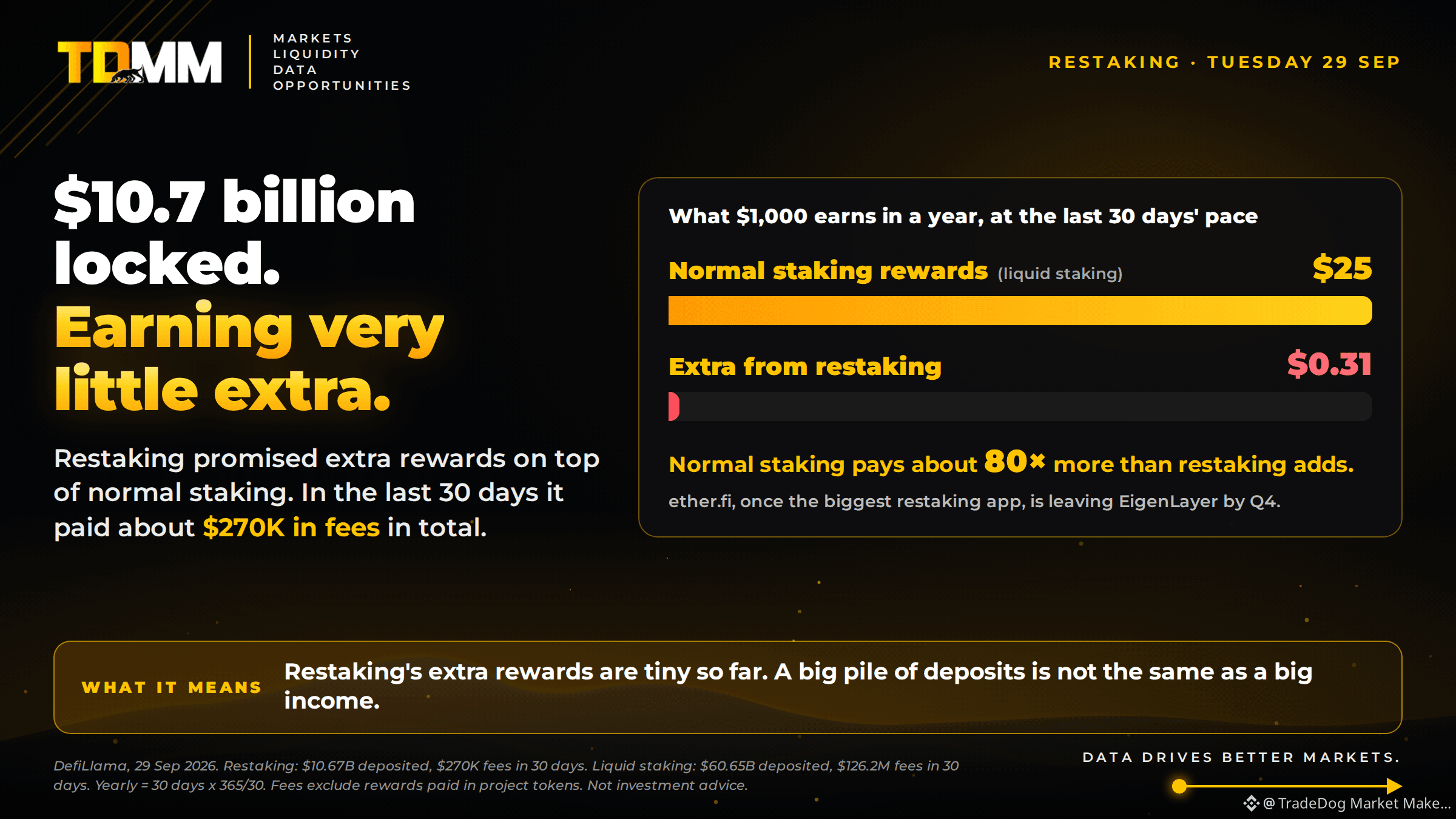
💸 $10.7B locked in restaking. Earning very little extra.
What $1,000 earns in a year (at the last 30 days' pace):
🟡 Normal staking rewards: ~$25
🔴 Extra from restaking: ~$0.31
➡️ Normal staking pays ~80× more than restaking adds
📊 The whole restaking sector paid ~$270K in fees in 30 days. $ETH restaking on EigenLayer alone holds ~$7.0B and earned ~$169K.
📰 Ether.fi, once the biggest restaking app, is fully exiting EigenLayer by Q4.
💡 Money parked is not money earned. Check what deposits actually produce.
What would make restaking pay again? 👇
#Restaking #ETH #DeFi #Staking
Data: DefiLlama, 29 Sep. Fees exclude rewards paid in project tokens. Not financial advice. DYOR.
💸 $10.7B locked in restaking. Earning very little extra.
What $1,000 earns in a year (at the last 30 days' pace):
🟡 Normal staking rewards: ~$25
🔴 Extra from restaking: ~$0.31
➡️ Normal staking pays ~80× more than restaking adds
📊 The whole restaking sector paid ~$270K in fees in 30 days. $ETH restaking on EigenLayer alone holds ~$7.0B and earned ~$169K.
📰 Ether.fi, once the biggest restaking app, is fully exiting EigenLayer by Q4.
💡 Money parked is not money earned. Check what deposits actually produce.
What would make restaking pay again? 👇
#Restaking #ETH #DeFi #Staking
Data: DefiLlama, 29 Sep. Fees exclude rewards paid in project tokens. Not financial advice. DYOR.
What $1,000 earns in a year (at the last 30 days' pace):
🟡 Normal staking rewards: ~$25
🔴 Extra from restaking: ~$0.31
➡️ Normal staking pays ~80× more than restaking adds
📊 The whole restaking sector paid ~$270K in fees in 30 days. $ETH restaking on EigenLayer alone holds ~$7.0B and earned ~$169K.
📰 Ether.fi, once the biggest restaking app, is fully exiting EigenLayer by Q4.
💡 Money parked is not money earned. Check what deposits actually produce.
What would make restaking pay again? 👇
#Restaking #ETH #DeFi #Staking
Data: DefiLlama, 29 Sep. Fees exclude rewards paid in project tokens. Not financial advice. DYOR.
3
231

·
--
🌟 Why Stake $CZR.US ?
Staking $CZR isn’t just about earning yield — it’s about tying rewards directly to ecosystem growth.
Potential benefits:
Competitive passive rewardsReduced circulating supply, which may support healthier token economicsBonus incentivesPriority access to upcoming launchpads and ecosystem opportunities
If adoption keeps expanding, staking could become one of the main ways holders participate in the growth of the CZR ecosystem.
Hold it, stake it, and let the ecosystem do the work. 👀
{stock_us}(CZR.US)
#staking #PassiveIncome #crypto #Launchpad #AnthropicIPOProspectusCouldValueItOver$2T
🌟 Why Stake $CZR.US ?
Staking $CZR isn’t just about earning yield — it’s about tying rewards directly to ecosystem growth.
Potential benefits:
Competitive passive rewardsReduced circulating supply, which may support healthier token economicsBonus incentivesPriority access to upcoming launchpads and ecosystem opportunities
If adoption keeps expanding, staking could become one of the main ways holders participate in the growth of the CZR ecosystem.
Hold it, stake it, and let the ecosystem do the work. 👀
#staking #PassiveIncome #crypto #Launchpad #AnthropicIPOProspectusCouldValueItOver$2T
Staking $CZR isn’t just about earning yield — it’s about tying rewards directly to ecosystem growth.
Potential benefits:
Competitive passive rewardsReduced circulating supply, which may support healthier token economicsBonus incentivesPriority access to upcoming launchpads and ecosystem opportunities
If adoption keeps expanding, staking could become one of the main ways holders participate in the growth of the CZR ecosystem.
Hold it, stake it, and let the ecosystem do the work. 👀
#staking #PassiveIncome #crypto #Launchpad #AnthropicIPOProspectusCouldValueItOver$2T
CZRUS-0,01%
11

·
--
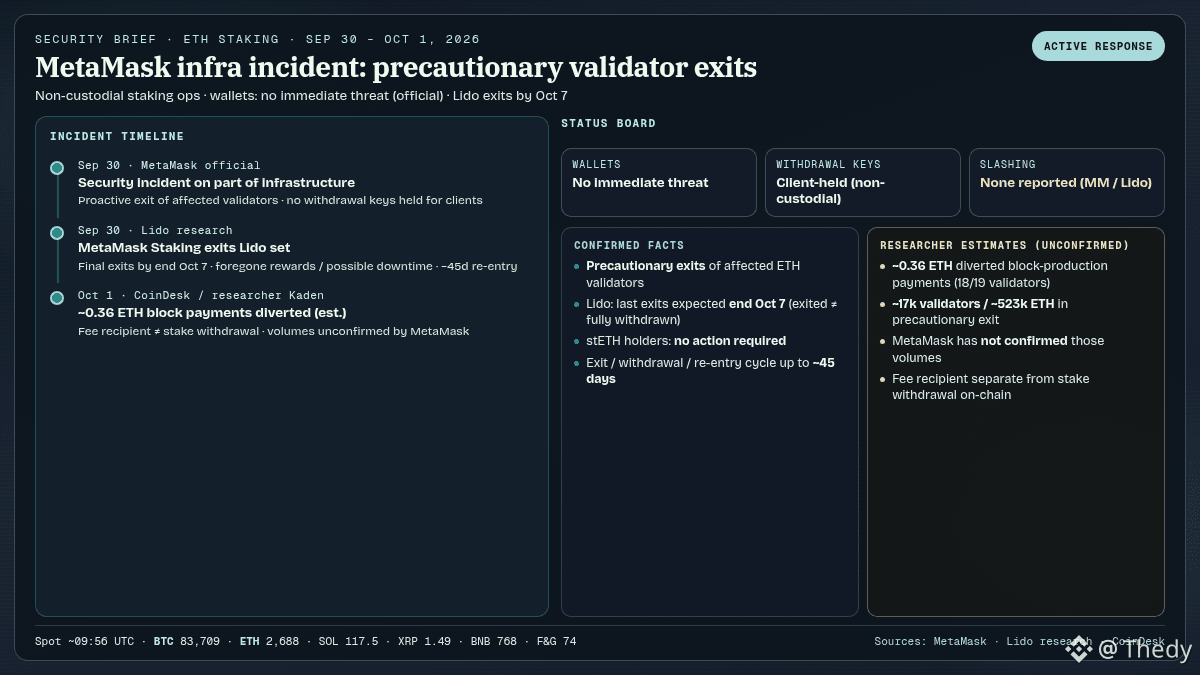
MetaMask sort préventivement ses validators Ethereum. Message officiel: pas de menace immédiate sur les wallets.
Le 30/09, MetaMask a confirmé un incident de sécurité sur une partie de son infrastructure. Mesure prise: exit des validators concernés dans le staking non-custodial. Point clé: MetaMask ne gère pas les withdrawal keys des clients.
Côté Lido (forum research, 30/09): MetaMask Staking (ex Consensys Staking) sort ses validators du set. Derniers exits attendus fin 7 octobre (exited, pas forcément fully withdrawn). Rewards manqués + éventuelles downtime penalties si offline trop tôt. Cycle exit / withdrawal / re-entry jusqu'à ~45 jours (entry queue). « No action is required from stETH holders ».
CoinDesk (01/10) cite le researcher Kaden: ~0,36 ETH de block-production payments détournés (18/19 validators MetaMask ayant earned). Estimation researcher, NON confirmée par MetaMask: ~17k validators / ~523k ETH en exit préventif. Fee recipient ≠ destination de withdrawal du stake (séparés on-chain). Pas de slashing rapporté par MetaMask/Lido au moment de l'article.
Spot (~09:57 UTC, Kraken/CoinGecko): $BTC ~83 709 · $ETH ~2 688 · SOL ~117,55 · XRP ~1,488 · BNB ~768. Fear & Greed 74 (Greed).
Scénarios à suivre:
1) Remédiation rapide, exits contenus, stETH inchangé côté holder
2) Investigation plus longue, rewards foregone plus visibles sur le set opérateur
3) Confusion marché si on lit « wallets hackés » alors que MetaMask dit explicitement no immediate threat
Vous suivez plutôt le signal staking (exits / queues) ou le message wallet sur $ETH ?
#Ethereum #Staking #MetaMask
MetaMask sort préventivement ses validators Ethereum. Message officiel: pas de menace immédiate sur les wallets.
Le 30/09, MetaMask a confirmé un incident de sécurité sur une partie de son infrastructure. Mesure prise: exit des validators concernés dans le staking non-custodial. Point clé: MetaMask ne gère pas les withdrawal keys des clients.
Côté Lido (forum research, 30/09): MetaMask Staking (ex Consensys Staking) sort ses validators du set. Derniers exits attendus fin 7 octobre (exited, pas forcément fully withdrawn). Rewards manqués + éventuelles downtime penalties si offline trop tôt. Cycle exit / withdrawal / re-entry jusqu'à ~45 jours (entry queue). « No action is required from stETH holders ».
CoinDesk (01/10) cite le researcher Kaden: ~0,36 ETH de block-production payments détournés (18/19 validators MetaMask ayant earned). Estimation researcher, NON confirmée par MetaMask: ~17k validators / ~523k ETH en exit préventif. Fee recipient ≠ destination de withdrawal du stake (séparés on-chain). Pas de slashing rapporté par MetaMask/Lido au moment de l'article.
Spot (~09:57 UTC, Kraken/CoinGecko): $BTC ~83 709 · $ETH ~2 688 · SOL ~117,55 · XRP ~1,488 · BNB ~768. Fear & Greed 74 (Greed).
Scénarios à suivre:
1) Remédiation rapide, exits contenus, stETH inchangé côté holder
2) Investigation plus longue, rewards foregone plus visibles sur le set opérateur
3) Confusion marché si on lit « wallets hackés » alors que MetaMask dit explicitement no immediate threat
Vous suivez plutôt le signal staking (exits / queues) ou le message wallet sur $ETH ?
#Ethereum #Staking #MetaMask
Le 30/09, MetaMask a confirmé un incident de sécurité sur une partie de son infrastructure. Mesure prise: exit des validators concernés dans le staking non-custodial. Point clé: MetaMask ne gère pas les withdrawal keys des clients.
Côté Lido (forum research, 30/09): MetaMask Staking (ex Consensys Staking) sort ses validators du set. Derniers exits attendus fin 7 octobre (exited, pas forcément fully withdrawn). Rewards manqués + éventuelles downtime penalties si offline trop tôt. Cycle exit / withdrawal / re-entry jusqu'à ~45 jours (entry queue). « No action is required from stETH holders ».
CoinDesk (01/10) cite le researcher Kaden: ~0,36 ETH de block-production payments détournés (18/19 validators MetaMask ayant earned). Estimation researcher, NON confirmée par MetaMask: ~17k validators / ~523k ETH en exit préventif. Fee recipient ≠ destination de withdrawal du stake (séparés on-chain). Pas de slashing rapporté par MetaMask/Lido au moment de l'article.
Spot (~09:57 UTC, Kraken/CoinGecko): $BTC ~83 709 · $ETH ~2 688 · SOL ~117,55 · XRP ~1,488 · BNB ~768. Fear & Greed 74 (Greed).
Scénarios à suivre:
1) Remédiation rapide, exits contenus, stETH inchangé côté holder
2) Investigation plus longue, rewards foregone plus visibles sur le set opérateur
3) Confusion marché si on lit « wallets hackés » alors que MetaMask dit explicitement no immediate threat
Vous suivez plutôt le signal staking (exits / queues) ou le message wallet sur $ETH ?
#Ethereum #Staking #MetaMask
1
99

🔥 Dividends aren't exclusive to stocks; crypto can hand you comparable yields right now.
📈 STRC’s April VWAP of $99.76 locked a steady 11.5% dividend and delivered its first monthly gain in nine — a rare #Dividends #Equities signal that investors are craving reliable cash flow.
💡 While traditional payouts rise, the crypto cycle is humming: #Staking on Solana now yields ~6% APY, BNB offers ~5% on Binance Earn, and #DeFi protocols on BSC are pulling in $71K+ in the Hermès narrative, all while BTC sits at $84,612 with a bullish MACD crossover and $8.01 B open interest, indicating institutional confidence.
🚀 Practical move: allocate a modest slice of your portfolio to high‑yield on‑chain assets—e.g., stake SOL (RSI 60.5, bullish) or lock BNB (MACD bullish, $51 M volume) and monitor funding rates (+0.0029% for BTC, +0.0037% for ETH) to gauge long‑short pressure before rebalancing.
❓ How are you balancing traditional dividend stocks like STRC with crypto yield strategies—leaning heavier on cash flow, or shifting toward on‑chain income?
🔥 Dividends aren't exclusive to stocks; crypto can hand you comparable yields right now.
📈 STRC’s April VWAP of $99.76 locked a steady 11.5% dividend and delivered its first monthly gain in nine — a rare #Dividends #Equities signal that investors are craving reliable cash flow.
💡 While traditional payouts rise, the crypto cycle is humming: #Staking on Solana now yields ~6% APY, BNB offers ~5% on Binance Earn, and #DeFi protocols on BSC are pulling in $71K+ in the Hermès narrative, all while BTC sits at $84,612 with a bullish MACD crossover and $8.01 B open interest, indicating institutional confidence.
🚀 Practical move: allocate a modest slice of your portfolio to high‑yield on‑chain assets—e.g., stake SOL (RSI 60.5, bullish) or lock BNB (MACD bullish, $51 M volume) and monitor funding rates (+0.0029% for BTC, +0.0037% for ETH) to gauge long‑short pressure before rebalancing.
❓ How are you balancing traditional dividend stocks like STRC with crypto yield strategies—leaning heavier on cash flow, or shifting toward on‑chain income?
📈 STRC’s April VWAP of $99.76 locked a steady 11.5% dividend and delivered its first monthly gain in nine — a rare #Dividends #Equities signal that investors are craving reliable cash flow.
💡 While traditional payouts rise, the crypto cycle is humming: #Staking on Solana now yields ~6% APY, BNB offers ~5% on Binance Earn, and #DeFi protocols on BSC are pulling in $71K+ in the Hermès narrative, all while BTC sits at $84,612 with a bullish MACD crossover and $8.01 B open interest, indicating institutional confidence.
🚀 Practical move: allocate a modest slice of your portfolio to high‑yield on‑chain assets—e.g., stake SOL (RSI 60.5, bullish) or lock BNB (MACD bullish, $51 M volume) and monitor funding rates (+0.0029% for BTC, +0.0037% for ETH) to gauge long‑short pressure before rebalancing.
❓ How are you balancing traditional dividend stocks like STRC with crypto yield strategies—leaning heavier on cash flow, or shifting toward on‑chain income?
12
·
--
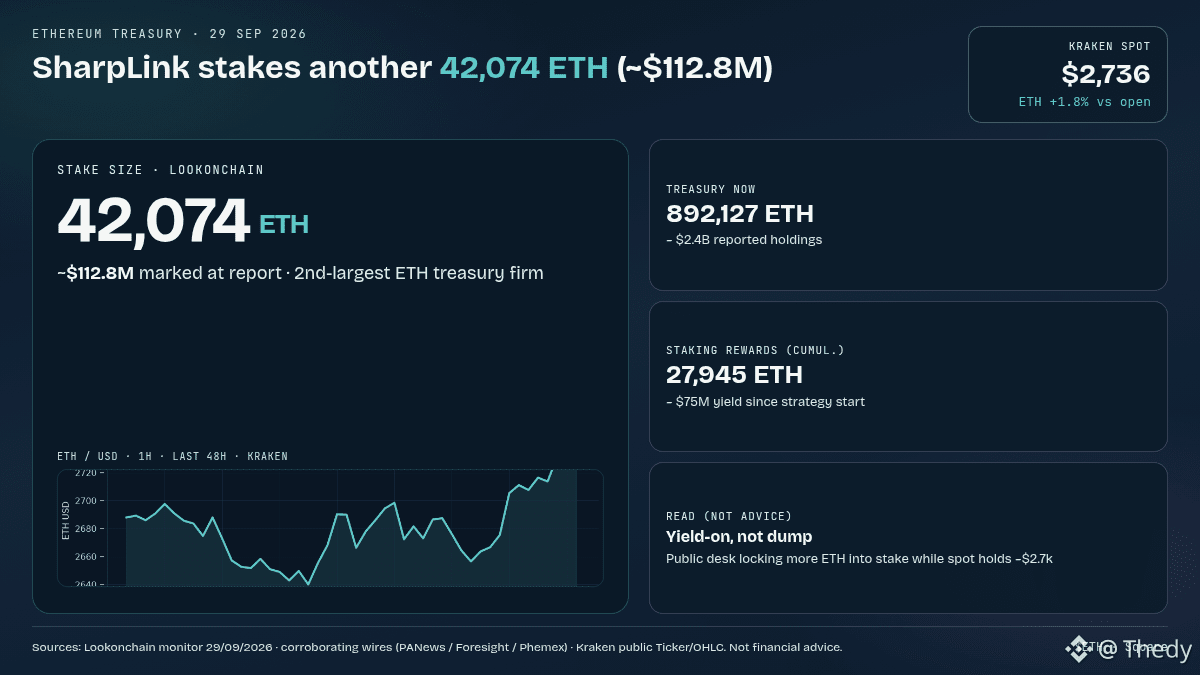
SharpLink verrouille encore 42 074 $ETH. Environ 112,8 M$ qui passent en staking, pas en vente.
Faits (Lookonchain, 29/09 ; fils PANews / Foresight / Phemex) :
• +42 074 ETH stakés aujourd’hui, valorisés ~112,8 M$ au moment du rapport.
• Trésorerie SharpLink : 892 127 ETH (~2,4 Md$). Deuxième plus grosse trésorerie ETH publique selon le moniteur.
• Récompenses de staking cumulées : 27 945 ETH (~75 M$) depuis le lancement de la stratégie.
• Spot Kraken (~13:00 UTC, 29/09) : ETH ≈ 2 736 $ (+1,8 % vs open), $BTC ≈ 84 284 $, $SOL ≈ 120,9 $. Fear & Greed 73 (Greed).
Lecture (interprétation, pas un conseil) :
Un desk coté continue d’activer le rendement natif d’ETH plutôt que de réduire. Ce n’est pas un flux ETF, ni un buy spot frais : c’est du yield-on sur un stock déjà détenu. Utile à croiser avec des ETF ETH encore en petit vert (SoSoValue / médias 28/09), mais le signal SharpLink reste un geste de trésorerie, pas une preuve de demande externe.
Scénarios :
• A : nouveaux batches de staking + ETH qui tient au-dessus de ~2 650–2 700 $ → le narratif « trésorerie productive » reste porté.
• B : unwind ou ventes visibles après le stake, ou cassure sous ~2 600 $ sans nouveaux flux → le geste se lit comme cosmétique, pas comme un re-rating.
Vous suivez plutôt les trésoreries ETH type SharpLink, ou uniquement les flux ETF ?
$ETH $BTC $SOL
#Ethereum #Crypto #Staking
SharpLink verrouille encore 42 074 $ETH . Environ 112,8 M$ qui passent en staking, pas en vente.
Faits (Lookonchain, 29/09 ; fils PANews / Foresight / Phemex) :
• +42 074 ETH stakés aujourd’hui, valorisés ~112,8 M$ au moment du rapport.
• Trésorerie SharpLink : 892 127 ETH (~2,4 Md$). Deuxième plus grosse trésorerie ETH publique selon le moniteur.
• Récompenses de staking cumulées : 27 945 ETH (~75 M$) depuis le lancement de la stratégie.
• Spot Kraken (~13:00 UTC, 29/09) : ETH ≈ 2 736 $ (+1,8 % vs open), $BTC ≈ 84 284 $, $SOL ≈ 120,9 $. Fear & Greed 73 (Greed).
Lecture (interprétation, pas un conseil) :
Un desk coté continue d’activer le rendement natif d’ETH plutôt que de réduire. Ce n’est pas un flux ETF, ni un buy spot frais : c’est du yield-on sur un stock déjà détenu. Utile à croiser avec des ETF ETH encore en petit vert (SoSoValue / médias 28/09), mais le signal SharpLink reste un geste de trésorerie, pas une preuve de demande externe.
Scénarios :
• A : nouveaux batches de staking + ETH qui tient au-dessus de ~2 650–2 700 $ → le narratif « trésorerie productive » reste porté.
• B : unwind ou ventes visibles après le stake, ou cassure sous ~2 600 $ sans nouveaux flux → le geste se lit comme cosmétique, pas comme un re-rating.
Vous suivez plutôt les trésoreries ETH type SharpLink, ou uniquement les flux ETF ?
$ETH $BTC $SOL
#Ethereum #Crypto #Staking
Faits (Lookonchain, 29/09 ; fils PANews / Foresight / Phemex) :
• +42 074 ETH stakés aujourd’hui, valorisés ~112,8 M$ au moment du rapport.
• Trésorerie SharpLink : 892 127 ETH (~2,4 Md$). Deuxième plus grosse trésorerie ETH publique selon le moniteur.
• Récompenses de staking cumulées : 27 945 ETH (~75 M$) depuis le lancement de la stratégie.
• Spot Kraken (~13:00 UTC, 29/09) : ETH ≈ 2 736 $ (+1,8 % vs open), $BTC ≈ 84 284 $, $SOL ≈ 120,9 $. Fear & Greed 73 (Greed).
Lecture (interprétation, pas un conseil) :
Un desk coté continue d’activer le rendement natif d’ETH plutôt que de réduire. Ce n’est pas un flux ETF, ni un buy spot frais : c’est du yield-on sur un stock déjà détenu. Utile à croiser avec des ETF ETH encore en petit vert (SoSoValue / médias 28/09), mais le signal SharpLink reste un geste de trésorerie, pas une preuve de demande externe.
Scénarios :
• A : nouveaux batches de staking + ETH qui tient au-dessus de ~2 650–2 700 $ → le narratif « trésorerie productive » reste porté.
• B : unwind ou ventes visibles après le stake, ou cassure sous ~2 600 $ sans nouveaux flux → le geste se lit comme cosmétique, pas comme un re-rating.
Vous suivez plutôt les trésoreries ETH type SharpLink, ou uniquement les flux ETF ?
$ETH $BTC $SOL
#Ethereum #Crypto #Staking
1
429

The SEC is taking a closer look at liquid staking tokens, highlighting a crucial detail many traders overlook: exit liquidity. While assets like cbETH and stETH offer great yield opportunities, your ability to convert them back to native ETH depends heavily on platform-specific withdrawal queues and terms. Regulatory scrutiny on these mechanics could shift how the market perceives staking risk. Always factor in potential unstaking delays before locking up your capital in DeFi protocols. $ETH #Ethereum #Staking #CryptoRegulation
The SEC is taking a closer look at liquid staking tokens, highlighting a crucial detail many traders overlook: exit liquidity. While assets like cbETH and stETH offer great yield opportunities, your ability to convert them back to native ETH depends heavily on platform-specific withdrawal queues and terms. Regulatory scrutiny on these mechanics could shift how the market perceives staking risk. Always factor in potential unstaking delays before locking up your capital in DeFi protocols. $ETH #Ethereum #Staking #CryptoRegulation
1
36

💰 Passive Income from Lazy Funds with Binance Earn!
Want to earn without trading or holding coins? You can use the Binance Earn feature of Binance.
🔹 Simple Earn (Flexible): You can withdraw funds at any time.
🔹 Locked Staking: Get higher APY/returns by locking for a fixed period.
Get regular returns by stacking instead of lazily leaving crypto in the wallet! 💸$USDC $BNB $ETH
#BinanceEarn #PassiveIncome #staking #CryptoEarnings
💰 Passive Income from Lazy Funds with Binance Earn!
Want to earn without trading or holding coins? You can use the Binance Earn feature of Binance.
🔹 Simple Earn (Flexible): You can withdraw funds at any time.
🔹 Locked Staking: Get higher APY/returns by locking for a fixed period.
Get regular returns by stacking instead of lazily leaving crypto in the wallet! 💸$USDC $BNB $ETH
#BinanceEarn #PassiveIncome #staking #CryptoEarnings
Want to earn without trading or holding coins? You can use the Binance Earn feature of Binance.
🔹 Simple Earn (Flexible): You can withdraw funds at any time.
🔹 Locked Staking: Get higher APY/returns by locking for a fixed period.
Get regular returns by stacking instead of lazily leaving crypto in the wallet! 💸$USDC $BNB $ETH
#BinanceEarn #PassiveIncome #staking #CryptoEarnings
59

·
--
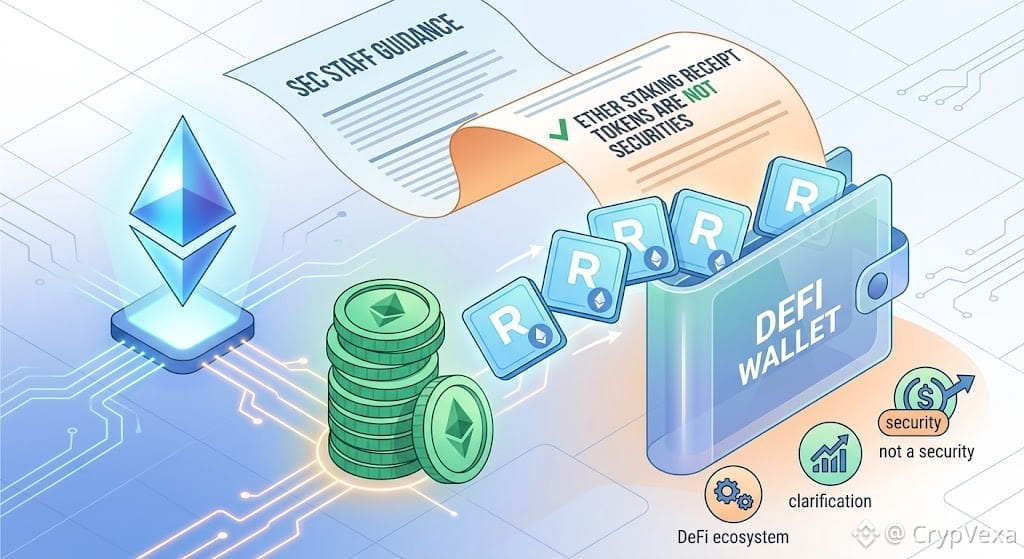
⚡ SEC Staff Clarifies Ethereum Staking Receipt Tokens
🇺🇸 SEC staff guidance says a staking receipt token representing a non-security crypto asset such as ETH is not itself a security, when it functions purely as a receipt under the described conditions.
🪙 The receipt simply represents ownership of the underlying staked asset. It does not create a separate right to rewards or additional financial benefits.
⚠️ Important: This is staff guidance, not a new SEC rule. The SEC says the FAQs are nonbinding and do not have legal force.
🌐 The clarification could provide more regulatory certainty for Ethereum staking and liquid-staking infrastructure.
👀 Could clearer staking rules accelerate institutional participation in Ethereum?
#Ethereum #ETH #Staking #CryptoRegulation
⚡ SEC Staff Clarifies Ethereum Staking Receipt Tokens
🇺🇸 SEC staff guidance says a staking receipt token representing a non-security crypto asset such as ETH is not itself a security, when it functions purely as a receipt under the described conditions.
🪙 The receipt simply represents ownership of the underlying staked asset. It does not create a separate right to rewards or additional financial benefits.
⚠️ Important: This is staff guidance, not a new SEC rule. The SEC says the FAQs are nonbinding and do not have legal force.
🌐 The clarification could provide more regulatory certainty for Ethereum staking and liquid-staking infrastructure.
👀 Could clearer staking rules accelerate institutional participation in Ethereum?
#Ethereum #ETH #Staking #CryptoRegulation
🇺🇸 SEC staff guidance says a staking receipt token representing a non-security crypto asset such as ETH is not itself a security, when it functions purely as a receipt under the described conditions.
🪙 The receipt simply represents ownership of the underlying staked asset. It does not create a separate right to rewards or additional financial benefits.
⚠️ Important: This is staff guidance, not a new SEC rule. The SEC says the FAQs are nonbinding and do not have legal force.
🌐 The clarification could provide more regulatory certainty for Ethereum staking and liquid-staking infrastructure.
👀 Could clearer staking rules accelerate institutional participation in Ethereum?
#Ethereum #ETH #Staking #CryptoRegulation
1
94

·
--
Every proof-of-stake network has a quiet problem that never shows up in price charts: staking concentration.
Ask who actually validates $ETH and the answer gets uncomfortable fast. A large share of staked supply routes through a handful of liquid staking protocols and institutional staking services — not thousands of independent home validators. $SOL advertises one of the largest validator sets in crypto, yet stake weight clusters heavily among a small group of professional operators running data-center infrastructure. $BNB is even more explicit about it: a deliberately small validator committee that trades decentralization for speed and cost.
None of this makes these chains broken. But it changes what you're actually underwriting when you hold them.
The honest metric isn't validator count — it's how many independent entities would need to coordinate to censor or halt the chain. On paper, most majors look impressively decentralized. In practice, that number is far smaller than the marketing suggests.
Concentration creates correlated failure modes: a single staking provider under regulatory pressure, a slashing bug propagating through a shared client, unstaking queues flooding the moment confidence dips. None are hypotheticals — each has already happened somewhere in crypto.
The signal to watch isn't a headline, it's flows: where unstaking requests concentrate during stress, and whether governance actually disperses stake when one operator dominates.
Decentralization is a process, not a launch announcement.
$ETH $SOL $BNB
#Staking #Layer1 #DeFi #Crypto #PoS
Every proof-of-stake network has a quiet problem that never shows up in price charts: staking concentration.
Ask who actually validates $ETH and the answer gets uncomfortable fast. A large share of staked supply routes through a handful of liquid staking protocols and institutional staking services — not thousands of independent home validators. $SOL advertises one of the largest validator sets in crypto, yet stake weight clusters heavily among a small group of professional operators running data-center infrastructure. $BNB is even more explicit about it: a deliberately small validator committee that trades decentralization for speed and cost.
None of this makes these chains broken. But it changes what you're actually underwriting when you hold them.
The honest metric isn't validator count — it's how many independent entities would need to coordinate to censor or halt the chain. On paper, most majors look impressively decentralized. In practice, that number is far smaller than the marketing suggests.
Concentration creates correlated failure modes: a single staking provider under regulatory pressure, a slashing bug propagating through a shared client, unstaking queues flooding the moment confidence dips. None are hypotheticals — each has already happened somewhere in crypto.
The signal to watch isn't a headline, it's flows: where unstaking requests concentrate during stress, and whether governance actually disperses stake when one operator dominates.
Decentralization is a process, not a launch announcement.
$ETH $SOL $BNB
#Staking #Layer1 #DeFi #Crypto #PoS
Ask who actually validates $ETH and the answer gets uncomfortable fast. A large share of staked supply routes through a handful of liquid staking protocols and institutional staking services — not thousands of independent home validators. $SOL advertises one of the largest validator sets in crypto, yet stake weight clusters heavily among a small group of professional operators running data-center infrastructure. $BNB is even more explicit about it: a deliberately small validator committee that trades decentralization for speed and cost.
None of this makes these chains broken. But it changes what you're actually underwriting when you hold them.
The honest metric isn't validator count — it's how many independent entities would need to coordinate to censor or halt the chain. On paper, most majors look impressively decentralized. In practice, that number is far smaller than the marketing suggests.
Concentration creates correlated failure modes: a single staking provider under regulatory pressure, a slashing bug propagating through a shared client, unstaking queues flooding the moment confidence dips. None are hypotheticals — each has already happened somewhere in crypto.
The signal to watch isn't a headline, it's flows: where unstaking requests concentrate during stress, and whether governance actually disperses stake when one operator dominates.
Decentralization is a process, not a launch announcement.
$ETH $SOL $BNB
#Staking #Layer1 #DeFi #Crypto #PoS
163

·
--
SEC这波操作太迷了!质押ETH的风险被放大,特别是退出机制。Coinbase和Lido的取款规则决定了你啥时候能拿回ETH。质押收益虽香,但退出通道也得看清啊!#staking #DeFi $ETH $stETH
SEC's latest move is wild! Staked ETH exit risks are now in the spotlight. Coinbase's terms and Lido's withdrawal queue dictate when you actually get your ETH back. Staking yields are tempting, but make sure you understand the exit path! #staking #DeFi $ETH $stETH
SEC这波操作太迷了!质押ETH的风险被放大,特别是退出机制。Coinbase和Lido的取款规则决定了你啥时候能拿回ETH。质押收益虽香,但退出通道也得看清啊!#staking #DeFi $ETH $stETH
SEC's latest move is wild! Staked ETH exit risks are now in the spotlight. Coinbase's terms and Lido's withdrawal queue dictate when you actually get your ETH back. Staking yields are tempting, but make sure you understand the exit path! #staking #DeFi $ETH $stETH
SEC's latest move is wild! Staked ETH exit risks are now in the spotlight. Coinbase's terms and Lido's withdrawal queue dictate when you actually get your ETH back. Staking yields are tempting, but make sure you understand the exit path! #staking #DeFi $ETH $stETH
296

·
--
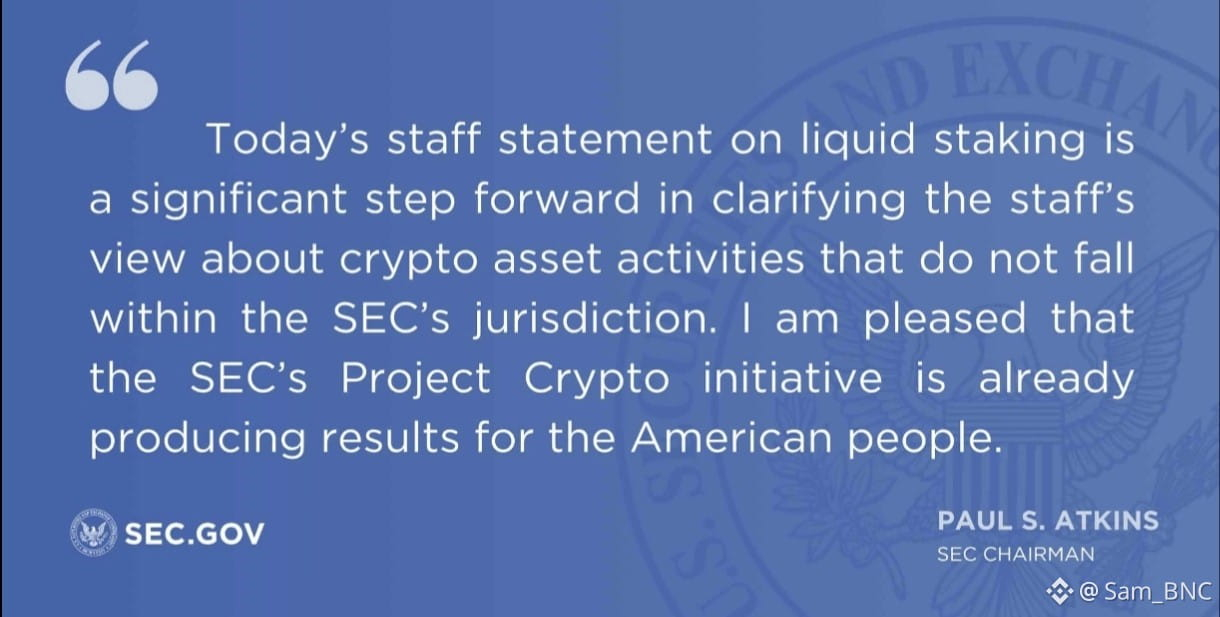
🚨 SEC JUST CLARIFIED LIQUID STAKING!
SEC staff says certain staking receipt tokens may be treated as digital tools rather than securities, depending on how they work.
{future}(ETHUSDT)
Could this impact the staking sector? 👀
#Ethereum #ETH #Crypto #Staking #BinanceSquare
🚨 SEC JUST CLARIFIED LIQUID STAKING!
SEC staff says certain staking receipt tokens may be treated as digital tools rather than securities, depending on how they work.
Could this impact the staking sector? 👀
#Ethereum #ETH #Crypto #Staking #BinanceSquare
SEC staff says certain staking receipt tokens may be treated as digital tools rather than securities, depending on how they work.
Could this impact the staking sector? 👀
#Ethereum #ETH #Crypto #Staking #BinanceSquare
1
46

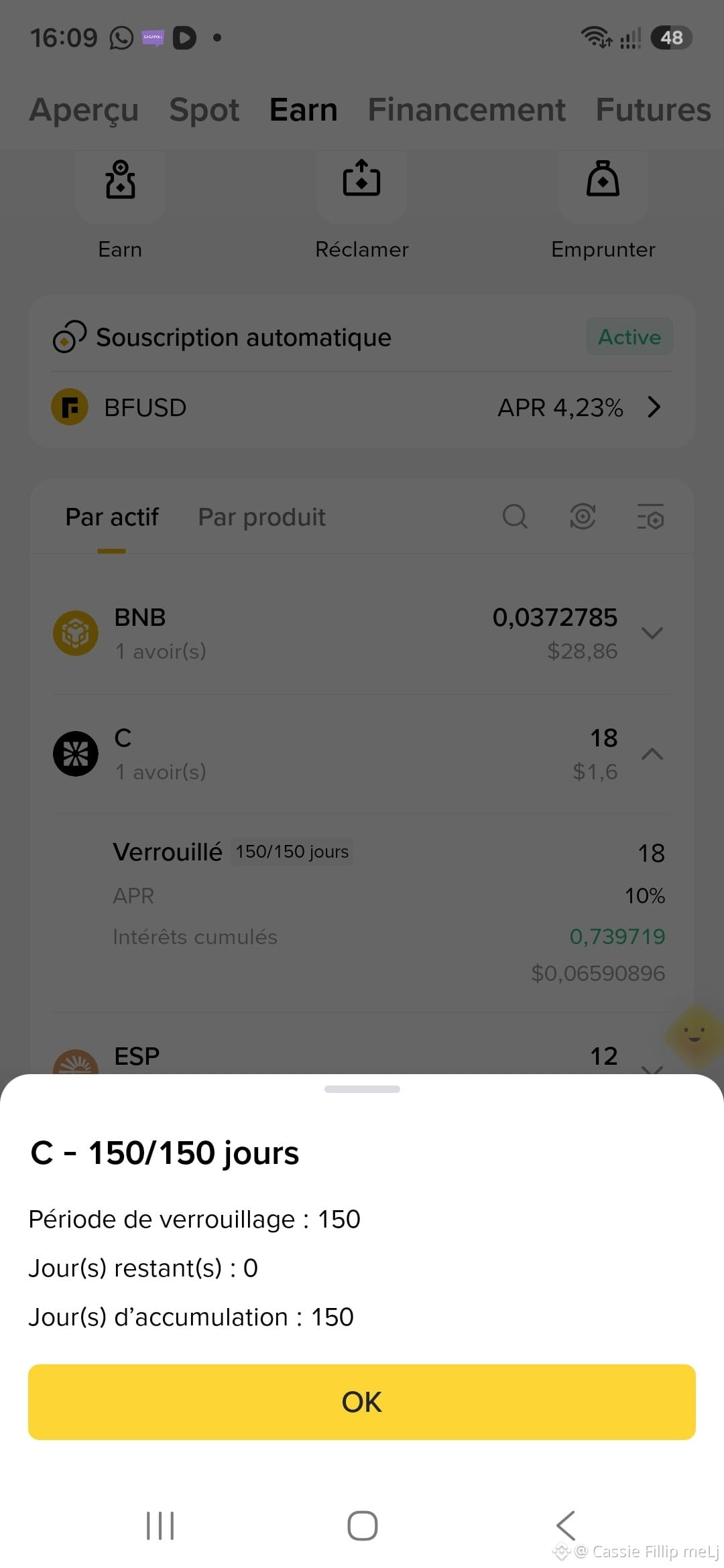
1. La patience du staker : Quand le compteur affiche 150/150 ⏳💡
Titre : Earn Locked : Pourquoi vos jetons ne sont pas débloqués à la seconde près ?
Contenu :
Avez-vous déjà vu votre produit Binance Earn afficher 150/150 jours sans pour autant retrouver vos jetons immédiatement sur votre portefeuille Spot ? C'est une interrogation très fréquente chez les traders !
📌 Le fonctionnement du processus de rachat :
La fin du contrat (\text{J}+150) : Le système arrête de calculer de nouveaux intérêts.
Le traitement automatique : Le déverrouillage nécessite un délai de traitement batch (souvent entre 00:00 et 08:00 UTC).
La libération du capital : Le principal ainsi que le cumul des intérêts générés basculent vers le portefeuille Spot dans les 24h à 48h.
En crypto, la patience ne s'applique pas seulement à l'attente du Bull Run, mais aussi au fonctionnement technique de la blockchain et des smart contracts.
#BinanceEarn #SimpleEarn #CryptoTrading #Staking #BinanceSquare
1. La patience du staker : Quand le compteur affiche 150/150 ⏳💡
Titre : Earn Locked : Pourquoi vos jetons ne sont pas débloqués à la seconde près ?
Contenu :
Avez-vous déjà vu votre produit Binance Earn afficher 150/150 jours sans pour autant retrouver vos jetons immédiatement sur votre portefeuille Spot ? C'est une interrogation très fréquente chez les traders !
📌 Le fonctionnement du processus de rachat :
La fin du contrat (\text{J}+150) : Le système arrête de calculer de nouveaux intérêts.
Le traitement automatique : Le déverrouillage nécessite un délai de traitement batch (souvent entre 00:00 et 08:00 UTC).
La libération du capital : Le principal ainsi que le cumul des intérêts générés basculent vers le portefeuille Spot dans les 24h à 48h.
En crypto, la patience ne s'applique pas seulement à l'attente du Bull Run, mais aussi au fonctionnement technique de la blockchain et des smart contracts.
#BinanceEarn #SimpleEarn #CryptoTrading #Staking #BinanceSquare
Titre : Earn Locked : Pourquoi vos jetons ne sont pas débloqués à la seconde près ?
Contenu :
Avez-vous déjà vu votre produit Binance Earn afficher 150/150 jours sans pour autant retrouver vos jetons immédiatement sur votre portefeuille Spot ? C'est une interrogation très fréquente chez les traders !
📌 Le fonctionnement du processus de rachat :
La fin du contrat (\text{J}+150) : Le système arrête de calculer de nouveaux intérêts.
Le traitement automatique : Le déverrouillage nécessite un délai de traitement batch (souvent entre 00:00 et 08:00 UTC).
La libération du capital : Le principal ainsi que le cumul des intérêts générés basculent vers le portefeuille Spot dans les 24h à 48h.
En crypto, la patience ne s'applique pas seulement à l'attente du Bull Run, mais aussi au fonctionnement technique de la blockchain et des smart contracts.
#BinanceEarn #SimpleEarn #CryptoTrading #Staking #BinanceSquare
109

·
--

Article
🚀 ¿QUÉ ES EL STAKING EN BINANCE Y CÓMO GANAR CRIPTOS MIENTRAS DURMIES? 🛌💰Si has visto la palabra Staking en la app de Binance y te suena a chino mandarín, ¡tranquilo! A todos nos pasó al principio. No necesitas ser un programador ni un experto en blockchain para entenderlo.
Te lo explico en cristiano y sin rodeos:
💡 ¿Qué es el Staking en palabras sencillas?
Imagínate que la red de una cripto (como Solana o Ethereum) necesita "guardias de seguridad" para verificar que las transacciones sean reales. En lugar de usar computadoras gigantes consumiendo luz, la red usa las criptomonedas de la comunidad para mantenerse firme y segura.
Cuando haces Staking, tú le "prestas" tus monedas a la red para ayudar a respaldarla. Y a cambio de tu ayuda... ¡la red te premia pagándote recompensas diarias o semanales! 🎁
Binance se encarga de todo el enredo técnico por ti. Tú solo pones tus monedas a trabajar y cobras tus rendimientos.
⚙️ Los 2 tipos de Staking que vas a encontrar:
🔒 1. Staking Bloqueado:
Dejas tus monedas guardadas por un tiempo fijo (ej. 30, 60 o 90 días). A cambio de dejar las monedas "inmóviles", te suelen ofrecer una tasa de ganancia (APR) más alta. Eso sí, no las puedes retirar a la ligera de un momento a otro.
💧 2. Staking Flexible o Líquido:
Te da mucha más libertad. Puedes retirar tu dinero cuando quieras o te entregan un token equivalente para que sigas moviendo tu capital mientras sigues generando recompensas.
🛑 ¡OJO! No confundas Staking con Ahorrar USDT
Guardar dólares digitales (USDT) en Earn es como un plazo fijo tradicional (el rendimiento viene de préstamos). El Staking es exclusivo de monedas como SOL, ETH o ADA y las ganancias nacen de la propia red blockchain.
⚠️ 3 Cosas que debes saber antes de hacer Staking:
1️⃣ El precio de la moneda se mueve: Vas a ganar más monedas, pero si el precio de esa cripto cae en el mercado, el valor de tu portafolio también baja.
2️⃣ Las tasas no son fijas para siempre: El porcentaje de ganancia (APR/APY) se va ajustando según la cantidad de gente participando en la red.
3️⃣ Revisa los días de retiro: Si decides retirar tu Staking Bloqueado antes de tiempo, suele haber un periodo de espera de varios días para que los fondos vuelvan a tu Billetera Spot.
💡 Mi consejo: Si tienes monedas a largo plazo que no piensas vender mañana mismo, ponlas en Staking para que no se queden congeladas sin producir nada.
👇 PREGUNTA PARA LA COMUNIDAD:
¿Qué moneda tienes actualmente haciendo Staking en Binance Earn? ¡Te leo en los comentarios!
❤️ ¡Dale LIKE, GUARDA esta guía básica y REPOSTEA para que tus amigos aprendan a poner sus criptos a trabajar!
$SOL $BTC #staking
{spot}(SOLUSDT)
🚀 ¿QUÉ ES EL STAKING EN BINANCE Y CÓMO GANAR CRIPTOS MIENTRAS DURMIES? 🛌💰
Si has visto la palabra Staking en la app de Binance y te suena a chino mandarín, ¡tranquilo! A todos nos pasó al principio. No necesitas ser un programador ni un experto en blockchain para entenderlo.
Te lo explico en cristiano y sin rodeos:
💡 ¿Qué es el Staking en palabras sencillas?
Imagínate que la red de una cripto (como Solana o Ethereum) necesita "guardias de seguridad" para verificar que las transacciones sean reales. En lugar de usar computadoras gigantes consumiendo luz, la red usa las criptomonedas de la comunidad para mantenerse firme y segura.
Cuando haces Staking, tú le "prestas" tus monedas a la red para ayudar a respaldarla. Y a cambio de tu ayuda... ¡la red te premia pagándote recompensas diarias o semanales! 🎁
Binance se encarga de todo el enredo técnico por ti. Tú solo pones tus monedas a trabajar y cobras tus rendimientos.
⚙️ Los 2 tipos de Staking que vas a encontrar:
🔒 1. Staking Bloqueado:
Dejas tus monedas guardadas por un tiempo fijo (ej. 30, 60 o 90 días). A cambio de dejar las monedas "inmóviles", te suelen ofrecer una tasa de ganancia (APR) más alta. Eso sí, no las puedes retirar a la ligera de un momento a otro.
💧 2. Staking Flexible o Líquido:
Te da mucha más libertad. Puedes retirar tu dinero cuando quieras o te entregan un token equivalente para que sigas moviendo tu capital mientras sigues generando recompensas.
🛑 ¡OJO! No confundas Staking con Ahorrar USDT
Guardar dólares digitales (USDT) en Earn es como un plazo fijo tradicional (el rendimiento viene de préstamos). El Staking es exclusivo de monedas como SOL, ETH o ADA y las ganancias nacen de la propia red blockchain.
⚠️ 3 Cosas que debes saber antes de hacer Staking:
1️⃣ El precio de la moneda se mueve: Vas a ganar más monedas, pero si el precio de esa cripto cae en el mercado, el valor de tu portafolio también baja.
2️⃣ Las tasas no son fijas para siempre: El porcentaje de ganancia (APR/APY) se va ajustando según la cantidad de gente participando en la red.
3️⃣ Revisa los días de retiro: Si decides retirar tu Staking Bloqueado antes de tiempo, suele haber un periodo de espera de varios días para que los fondos vuelvan a tu Billetera Spot.
💡 Mi consejo: Si tienes monedas a largo plazo que no piensas vender mañana mismo, ponlas en Staking para que no se queden congeladas sin producir nada.
👇 PREGUNTA PARA LA COMUNIDAD:
¿Qué moneda tienes actualmente haciendo Staking en Binance Earn? ¡Te leo en los comentarios!
❤️ ¡Dale LIKE, GUARDA esta guía básica y REPOSTEA para que tus amigos aprendan a poner sus criptos a trabajar!
$SOL $BTC #staking
Te lo explico en cristiano y sin rodeos:
💡 ¿Qué es el Staking en palabras sencillas?
Imagínate que la red de una cripto (como Solana o Ethereum) necesita "guardias de seguridad" para verificar que las transacciones sean reales. En lugar de usar computadoras gigantes consumiendo luz, la red usa las criptomonedas de la comunidad para mantenerse firme y segura.
Cuando haces Staking, tú le "prestas" tus monedas a la red para ayudar a respaldarla. Y a cambio de tu ayuda... ¡la red te premia pagándote recompensas diarias o semanales! 🎁
Binance se encarga de todo el enredo técnico por ti. Tú solo pones tus monedas a trabajar y cobras tus rendimientos.
⚙️ Los 2 tipos de Staking que vas a encontrar:
🔒 1. Staking Bloqueado:
Dejas tus monedas guardadas por un tiempo fijo (ej. 30, 60 o 90 días). A cambio de dejar las monedas "inmóviles", te suelen ofrecer una tasa de ganancia (APR) más alta. Eso sí, no las puedes retirar a la ligera de un momento a otro.
💧 2. Staking Flexible o Líquido:
Te da mucha más libertad. Puedes retirar tu dinero cuando quieras o te entregan un token equivalente para que sigas moviendo tu capital mientras sigues generando recompensas.
🛑 ¡OJO! No confundas Staking con Ahorrar USDT
Guardar dólares digitales (USDT) en Earn es como un plazo fijo tradicional (el rendimiento viene de préstamos). El Staking es exclusivo de monedas como SOL, ETH o ADA y las ganancias nacen de la propia red blockchain.
⚠️ 3 Cosas que debes saber antes de hacer Staking:
1️⃣ El precio de la moneda se mueve: Vas a ganar más monedas, pero si el precio de esa cripto cae en el mercado, el valor de tu portafolio también baja.
2️⃣ Las tasas no son fijas para siempre: El porcentaje de ganancia (APR/APY) se va ajustando según la cantidad de gente participando en la red.
3️⃣ Revisa los días de retiro: Si decides retirar tu Staking Bloqueado antes de tiempo, suele haber un periodo de espera de varios días para que los fondos vuelvan a tu Billetera Spot.
💡 Mi consejo: Si tienes monedas a largo plazo que no piensas vender mañana mismo, ponlas en Staking para que no se queden congeladas sin producir nada.
👇 PREGUNTA PARA LA COMUNIDAD:
¿Qué moneda tienes actualmente haciendo Staking en Binance Earn? ¡Te leo en los comentarios!
❤️ ¡Dale LIKE, GUARDA esta guía básica y REPOSTEA para que tus amigos aprendan a poner sus criptos a trabajar!
$SOL $BTC #staking
2
3
91
·
--
Staking yield is the most misunderstood number in crypto.
When a chain advertises 8% staking APY, most people read it as income. Read it as inflation first. Nominal staking yield is mostly new token issuance — a transfer from non-stakers to stakers. If everyone stakes, everyone gets diluted in lockstep, and that "yield" simply buys back the share of your own inflation.
The honest number is real yield: what the chain actually earns. A chain paying 8% while inflating 6% hands you roughly 2% of true economic yield. A chain paying 3% with heavy fee burn and real user demand can quietly pay more.
This reframes the Layer 1 comparison. $ETH's fee-burn design separates the books: issuance is payroll for security, fees are revenue, and the burn refunds part of the inflation back to every holder. $SOL's high nominal yield is a deliberate adoption subsidy — transparent, but funded by non-stakers. $DOT ties its inflation to participation, paying those who show up and pruning those who don't.
The rule of thumb: yield paid from outside the system (fees, MEV, real demand) is income. Yield paid from inside the system (fresh issuance) is a refund on money already taken from you.
Before chasing any APY, ask one question: who is actually paying for this yield?
#Staking #Tokenomics #Layer1 #Yield #Crypto
Staking yield is the most misunderstood number in crypto.
When a chain advertises 8% staking APY, most people read it as income. Read it as inflation first. Nominal staking yield is mostly new token issuance — a transfer from non-stakers to stakers. If everyone stakes, everyone gets diluted in lockstep, and that "yield" simply buys back the share of your own inflation.
The honest number is real yield: what the chain actually earns. A chain paying 8% while inflating 6% hands you roughly 2% of true economic yield. A chain paying 3% with heavy fee burn and real user demand can quietly pay more.
This reframes the Layer 1 comparison. $ETH 's fee-burn design separates the books: issuance is payroll for security, fees are revenue, and the burn refunds part of the inflation back to every holder. $SOL 's high nominal yield is a deliberate adoption subsidy — transparent, but funded by non-stakers. $DOT ties its inflation to participation, paying those who show up and pruning those who don't.
The rule of thumb: yield paid from outside the system (fees, MEV, real demand) is income. Yield paid from inside the system (fresh issuance) is a refund on money already taken from you.
Before chasing any APY, ask one question: who is actually paying for this yield?
#Staking #Tokenomics #Layer1 #Yield #Crypto
When a chain advertises 8% staking APY, most people read it as income. Read it as inflation first. Nominal staking yield is mostly new token issuance — a transfer from non-stakers to stakers. If everyone stakes, everyone gets diluted in lockstep, and that "yield" simply buys back the share of your own inflation.
The honest number is real yield: what the chain actually earns. A chain paying 8% while inflating 6% hands you roughly 2% of true economic yield. A chain paying 3% with heavy fee burn and real user demand can quietly pay more.
This reframes the Layer 1 comparison. $ETH 's fee-burn design separates the books: issuance is payroll for security, fees are revenue, and the burn refunds part of the inflation back to every holder. $SOL 's high nominal yield is a deliberate adoption subsidy — transparent, but funded by non-stakers. $DOT ties its inflation to participation, paying those who show up and pruning those who don't.
The rule of thumb: yield paid from outside the system (fees, MEV, real demand) is income. Yield paid from inside the system (fresh issuance) is a refund on money already taken from you.
Before chasing any APY, ask one question: who is actually paying for this yield?
#Staking #Tokenomics #Layer1 #Yield #Crypto
282
·
--
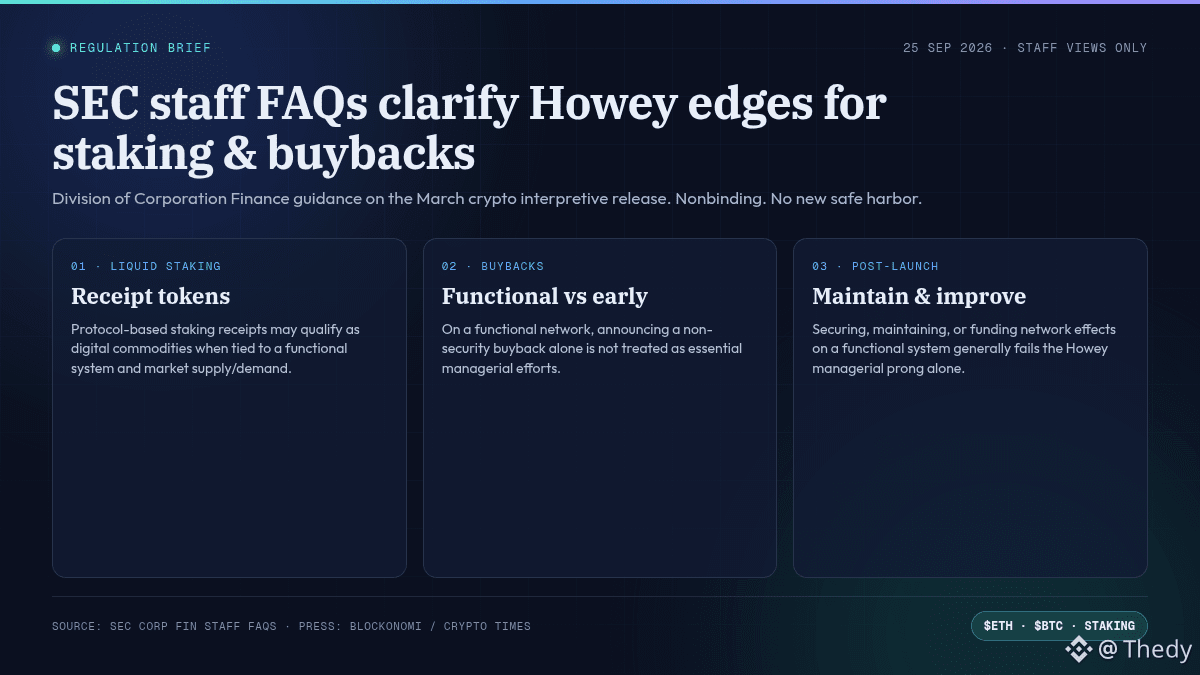
La SEC ne change pas la loi. Elle précise où Howey s’arrête pour le staking et les buybacks.
Faits (staff Corp Fin, FAQs datées du 25/09, vues staff uniquement, sans force juridique) :
• Receipts de liquid staking liés à un système crypto déjà fonctionnel peuvent, selon les circonstances décrites, être traités comme des digital commodities (valeur liée au fonctionnement programmatique + offre/demande).
• Annoncer un buyback d’un token non-security sur un réseau déjà fonctionnel n’est pas, à lui seul, vu comme une promesse d’« essential managerial efforts ».
• Sécuriser, maintenir, améliorer un système fonctionnel, ou financer des effets de réseau, ne suffit en général pas à remplir le volet « efforts managériaux » de Howey.
• Le document ne crée pas de safe harbor. Il interprète le cadre de mars 2026. Presse de confirmation : Blockonomi, The Crypto Times.
Contexte marché (Kraken, ~00:45 UTC 26/09) : BTC ≈ 83 870 $, ETH ≈ 2 685 $, SOL ≈ 121,5 $, XRP ≈ 1,56 $. Pas de break violent pendant que le fil réglementaire avance.
Interprétation (pas un conseil) :
Moins d’ambiguïté sur les réseaux déjà live, plus de discipline sur le marketing de yield/buybacks avant la fonctionnalité. Pour $ETH et le liquid staking, le détail « receipt = outil / commodity selon l’émetteur » mérite d’être lu ligne par ligne, pas résumé en un tweet.
Scénarios :
• A : projets qui cadrent clairement utility vs promesse de rendement → friction réglementaire perçue en baisse, sans changement de prix immédiat.
• B : projets encore pré-fonctionnels qui vendent le buyback comme « yield » → le signal Howey reste actif, le risque de reclassement aussi.
Vous lisez plutôt le volet staking receipts, ou le volet buybacks ?
$ETH $BTC
#Crypto #Staking
La SEC ne change pas la loi. Elle précise où Howey s’arrête pour le staking et les buybacks.
Faits (staff Corp Fin, FAQs datées du 25/09, vues staff uniquement, sans force juridique) :
• Receipts de liquid staking liés à un système crypto déjà fonctionnel peuvent, selon les circonstances décrites, être traités comme des digital commodities (valeur liée au fonctionnement programmatique + offre/demande).
• Annoncer un buyback d’un token non-security sur un réseau déjà fonctionnel n’est pas, à lui seul, vu comme une promesse d’« essential managerial efforts ».
• Sécuriser, maintenir, améliorer un système fonctionnel, ou financer des effets de réseau, ne suffit en général pas à remplir le volet « efforts managériaux » de Howey.
• Le document ne crée pas de safe harbor. Il interprète le cadre de mars 2026. Presse de confirmation : Blockonomi, The Crypto Times.
Contexte marché (Kraken, ~00:45 UTC 26/09) : BTC ≈ 83 870 $, ETH ≈ 2 685 $, SOL ≈ 121,5 $, XRP ≈ 1,56 $. Pas de break violent pendant que le fil réglementaire avance.
Interprétation (pas un conseil) :
Moins d’ambiguïté sur les réseaux déjà live, plus de discipline sur le marketing de yield/buybacks avant la fonctionnalité. Pour $ETH et le liquid staking, le détail « receipt = outil / commodity selon l’émetteur » mérite d’être lu ligne par ligne, pas résumé en un tweet.
Scénarios :
• A : projets qui cadrent clairement utility vs promesse de rendement → friction réglementaire perçue en baisse, sans changement de prix immédiat.
• B : projets encore pré-fonctionnels qui vendent le buyback comme « yield » → le signal Howey reste actif, le risque de reclassement aussi.
Vous lisez plutôt le volet staking receipts, ou le volet buybacks ?
$ETH $BTC
#Crypto #Staking
Faits (staff Corp Fin, FAQs datées du 25/09, vues staff uniquement, sans force juridique) :
• Receipts de liquid staking liés à un système crypto déjà fonctionnel peuvent, selon les circonstances décrites, être traités comme des digital commodities (valeur liée au fonctionnement programmatique + offre/demande).
• Annoncer un buyback d’un token non-security sur un réseau déjà fonctionnel n’est pas, à lui seul, vu comme une promesse d’« essential managerial efforts ».
• Sécuriser, maintenir, améliorer un système fonctionnel, ou financer des effets de réseau, ne suffit en général pas à remplir le volet « efforts managériaux » de Howey.
• Le document ne crée pas de safe harbor. Il interprète le cadre de mars 2026. Presse de confirmation : Blockonomi, The Crypto Times.
Contexte marché (Kraken, ~00:45 UTC 26/09) : BTC ≈ 83 870 $, ETH ≈ 2 685 $, SOL ≈ 121,5 $, XRP ≈ 1,56 $. Pas de break violent pendant que le fil réglementaire avance.
Interprétation (pas un conseil) :
Moins d’ambiguïté sur les réseaux déjà live, plus de discipline sur le marketing de yield/buybacks avant la fonctionnalité. Pour $ETH et le liquid staking, le détail « receipt = outil / commodity selon l’émetteur » mérite d’être lu ligne par ligne, pas résumé en un tweet.
Scénarios :
• A : projets qui cadrent clairement utility vs promesse de rendement → friction réglementaire perçue en baisse, sans changement de prix immédiat.
• B : projets encore pré-fonctionnels qui vendent le buyback comme « yield » → le signal Howey reste actif, le risque de reclassement aussi.
Vous lisez plutôt le volet staking receipts, ou le volet buybacks ?
$ETH $BTC
#Crypto #Staking
210
Connectez-vous pour découvrir plus de contenu
Rejoignez la communauté mondiale des adeptes de cryptomonnaies sur Binance Square
⚡️ Suviez les dernières informations importantes sur les cryptomonnaies.
💬 Jugé digne de confiance par la plus grande plateforme d’échange de cryptomonnaies au monde.
👍 Découvrez les connaissances que partagent les créateurs vérifiés.
Adresse e-mail/Nº de téléphone
Sujets d’actualité
1
#EtherGains70.9%InQ3
20 vues
29 mentions
2
#US10YearYieldNears5.3%
18,008 vues
270 mentions
3
#DollarIndexHitsHighestSinceMay2025
2 vues
13 mentions
4
#USWeeklyJoblessClaimsFallTo197000
1,009 vues
77 mentions
5
#BitcoinETFsTake$6.34BillionInQ3
714 vues
36 mentions
6
#KoreaProposesTokenizingStocksAndBonds
27,764 vues
445 mentions
7
#MetaMaskExitsLidoValidatorsAfterSecurityIncident
101,904 vues
1,161 mentions
8
#MicronBeatsEarningsLiftsGuidance
57,678 vues
887 mentions
9
#CFTCSubmitsTwoEventContractRulesToWhiteHouse
40,036 vues
704 mentions
10
#BitcoinClears$85200
42,419 vues
371 mentions