

#orocryptotrends
orocryptotrends
1.2M vues
914 mentions
Populaire
Récents

Détention de 1.5 USDT en $XAUT
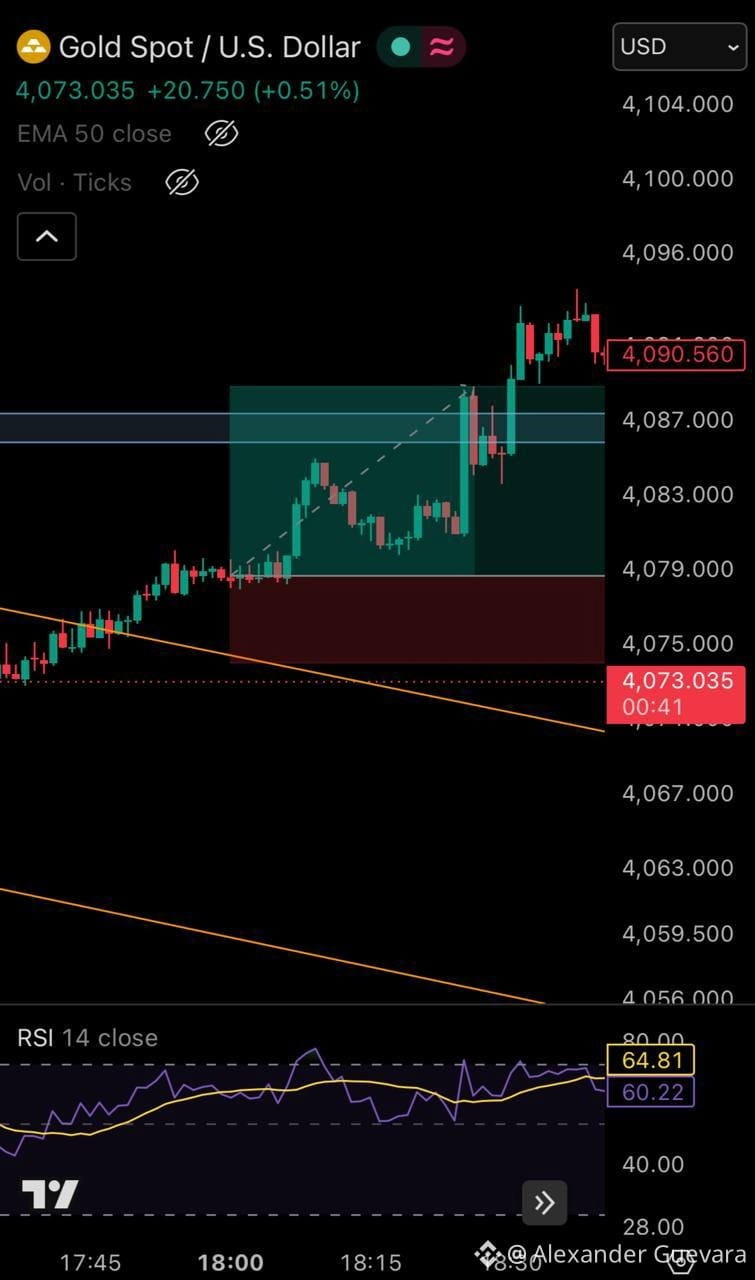
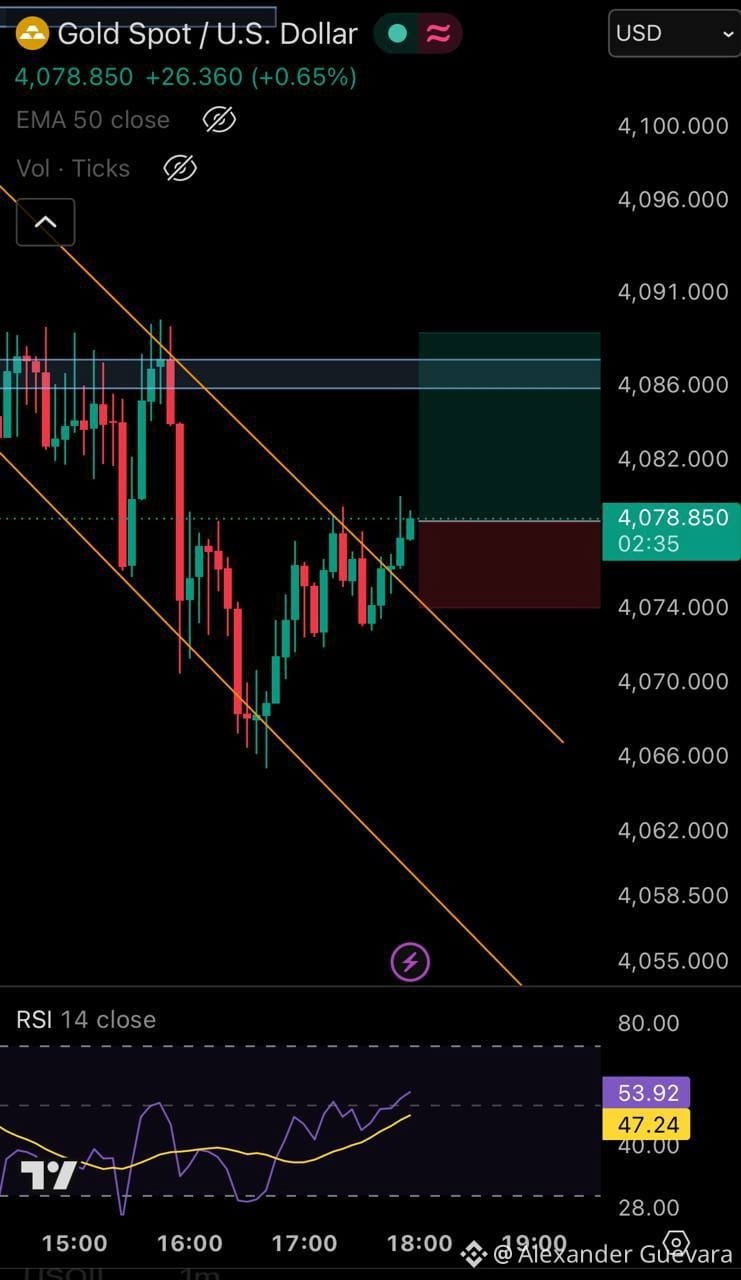
🐳:🚨 NUEVA ORDEN – ORO COMPRA 📈
• Entry: 4078.00
• SL: 4070.00
• TP: 4090.00
✅ OPERACIÓN CERRADA - ORO ✅
• Precio de entrada: 4078
• Nivel de toma de ganancias: 4090
📊 Beneficio obtenido: +120 PIPS
#orocryptotrends #GOLD #XAU #oro #TrendingTopic $XAU $XAUT $PAXG
🐳:🚨 NUEVA ORDEN – ORO COMPRA 📈
• Entry: 4078.00
• SL: 4070.00
• TP: 4090.00
✅ OPERACIÓN CERRADA - ORO ✅
• Precio de entrada: 4078
• Nivel de toma de ganancias: 4090
📊 Beneficio obtenido: +120 PIPS
#orocryptotrends #GOLD #XAU #oro #TrendingTopic $XAU $XAUT $PAXG
• Entry: 4078.00
• SL: 4070.00
• TP: 4090.00
✅ OPERACIÓN CERRADA - ORO ✅
• Precio de entrada: 4078
• Nivel de toma de ganancias: 4090
📊 Beneficio obtenido: +120 PIPS
#orocryptotrends #GOLD #XAU #oro #TrendingTopic $XAU $XAUT $PAXG
3
110

·
--
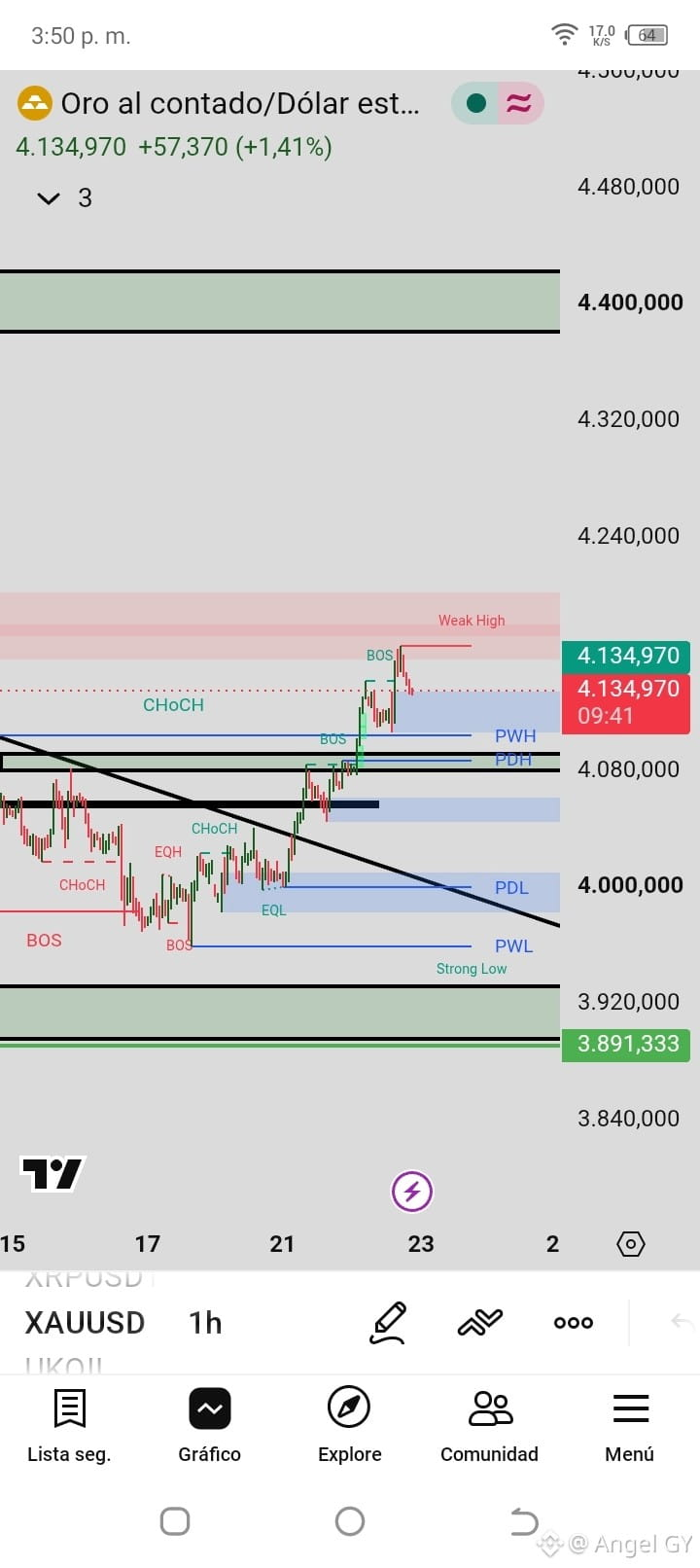
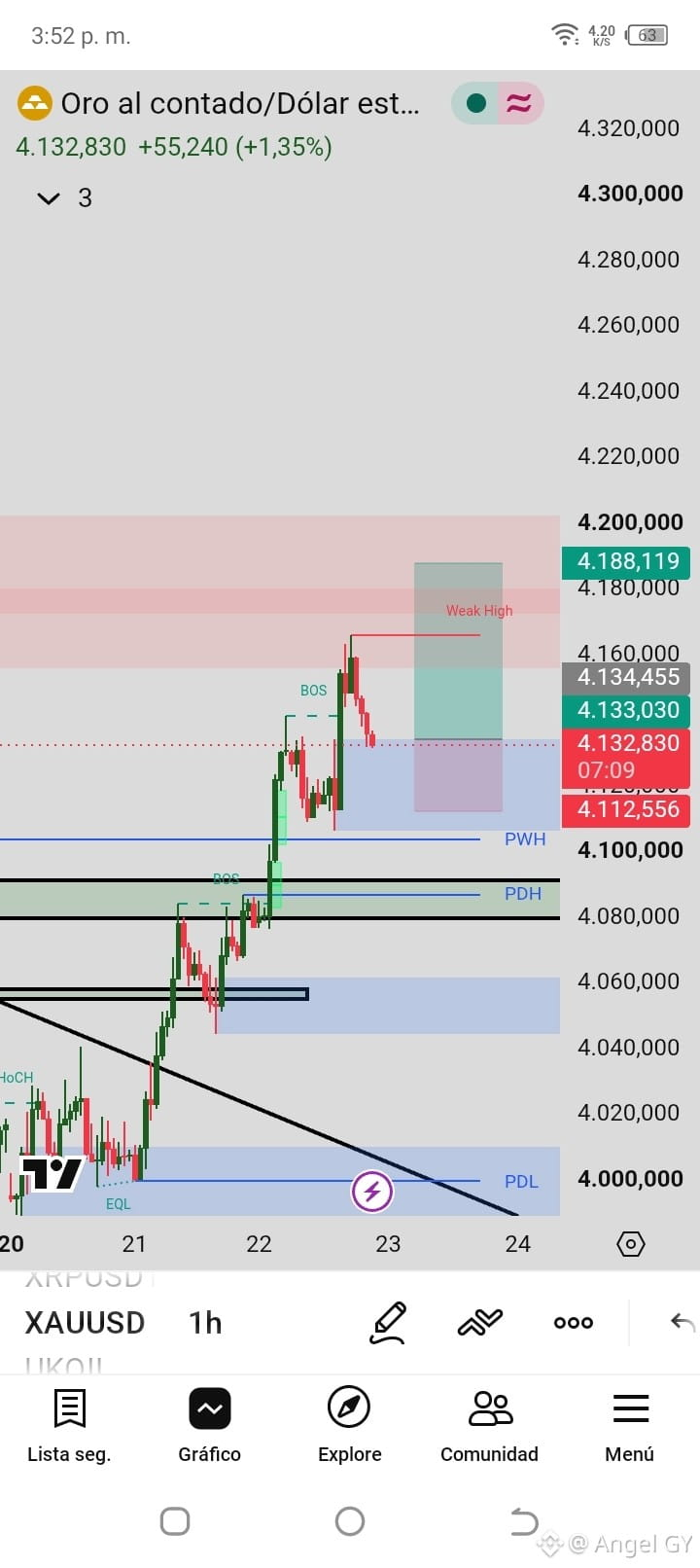
#orocryptotrends como ven está operación en el oro 🤔
#orocryptotrends como ven está operación en el oro 🤔
1
351


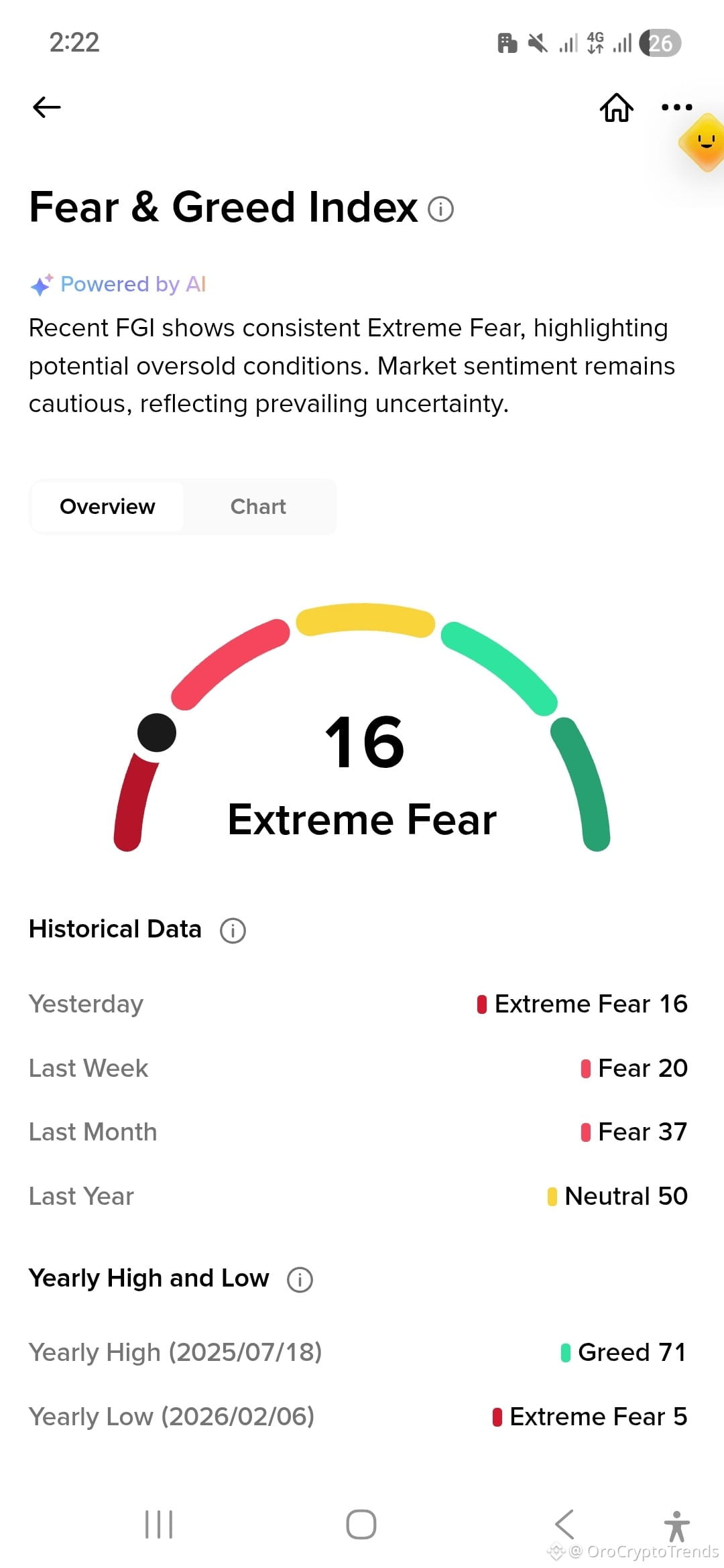
Fear & Greed at 16 and it's been sitting here for two days now. I keep checking it like the number is going to move if I look hard enough.
The thing that actually got me was the trend. Last week it was 20. Month ago it was 37. A year ago this market was neutral at 50. So this isn't some sudden shock that sent sentiment off a cliff. It's been a slow bleed downward for months. And now we're at 16 and apparently that's just… where we are.
The yearly low was 5 back in February. So we bounced off that and the best we could manage by late June is 16. I don't know, that doesn't feel like a market quietly healing. It feels like a market that stopped panicking but didn't actually start recovering.
Total market cap is just over $2T on $94B volume. For context — and I'm going from memory here so I might be slightly off — we've had days where that volume was closer to $150–200B on a market this size. $94B feels quiet. Almost too quiet for a bottom.
And then AGLD is up 79% today. Which, okay. That's wild. But one token going vertical while everything else drifts sideways isn't a signal I know what to do with. It's more like the market reminding you it can still be random.
BTC at $60K feels steady on the surface. The FGI says something different underneath.
Still trying to figure out if 16 is close enough to 5 to matter, or if we just stopped falling for now.
Which mode fits today's post? Or want me to pull specific elements from two of them and blend?
$BTC #BTC #orocryptotrends #Write2Earn
Fear & Greed at 16 and it's been sitting here for two days now. I keep checking it like the number is going to move if I look hard enough.
The thing that actually got me was the trend. Last week it was 20. Month ago it was 37. A year ago this market was neutral at 50. So this isn't some sudden shock that sent sentiment off a cliff. It's been a slow bleed downward for months. And now we're at 16 and apparently that's just… where we are.
The yearly low was 5 back in February. So we bounced off that and the best we could manage by late June is 16. I don't know, that doesn't feel like a market quietly healing. It feels like a market that stopped panicking but didn't actually start recovering.
Total market cap is just over $2T on $94B volume. For context — and I'm going from memory here so I might be slightly off — we've had days where that volume was closer to $150–200B on a market this size. $94B feels quiet. Almost too quiet for a bottom.
And then AGLD is up 79% today. Which, okay. That's wild. But one token going vertical while everything else drifts sideways isn't a signal I know what to do with. It's more like the market reminding you it can still be random.
BTC at $60K feels steady on the surface. The FGI says something different underneath.
Still trying to figure out if 16 is close enough to 5 to matter, or if we just stopped falling for now.
Which mode fits today's post? Or want me to pull specific elements from two of them and blend?
$BTC #BTC #orocryptotrends #Write2Earn
The thing that actually got me was the trend. Last week it was 20. Month ago it was 37. A year ago this market was neutral at 50. So this isn't some sudden shock that sent sentiment off a cliff. It's been a slow bleed downward for months. And now we're at 16 and apparently that's just… where we are.
The yearly low was 5 back in February. So we bounced off that and the best we could manage by late June is 16. I don't know, that doesn't feel like a market quietly healing. It feels like a market that stopped panicking but didn't actually start recovering.
Total market cap is just over $2T on $94B volume. For context — and I'm going from memory here so I might be slightly off — we've had days where that volume was closer to $150–200B on a market this size. $94B feels quiet. Almost too quiet for a bottom.
And then AGLD is up 79% today. Which, okay. That's wild. But one token going vertical while everything else drifts sideways isn't a signal I know what to do with. It's more like the market reminding you it can still be random.
BTC at $60K feels steady on the surface. The FGI says something different underneath.
Still trying to figure out if 16 is close enough to 5 to matter, or if we just stopped falling for now.
Which mode fits today's post? Or want me to pull specific elements from two of them and blend?
$BTC #BTC #orocryptotrends #Write2Earn
1
543

·
--
📉 Las Razones de la Caída del Oro 🥇🏅
🎯 El precio del oro ha sufrido un fuerte desplome en las últimas jornadas. Tras haber alcanzado un máximo histórico por encima de los $5,600 USD por onza en enero, el metal precioso cotiza actualmente en torno a los $4,315 - $4,440 USD.
#orocryptotrends
El detonante principal de los últimos días fue la publicación del informe de nóminas no agrícolas en Estados Unidos. El "Efecto Shock" del Reporte de Empleo en EE. UU. fue el detonante de la caída del oro.
📡 El dato: La economía estadounidense sumó 172,000 empleos, destruyendo por completo las previsiones de los analistas, quienes estimaban apenas 85,000.
Un mercado laboral tan fuerte demuestra que la economía no se está enfriando, lo que elimina cualquier presión para que la Reserva Federal (Fed) baje las tasas de interés a corto plazo.
La fortaleza del empleo cambió drásticamente el sentimiento de Wall Street. Los inversores ahora estiman un 98% de probabilidad de que las tasas se mantengan elevadas o incluso suban hacia finales de año.
Como el #oro es un activo físico que no genera dividendos ni rendimientos (intereses), mantenerlo guardado se vuelve muy costoso (cost of carry) cuando los bonos del Tesoro de EE. UU. están ofreciendo rendimientos superiores al 4.5% y 5% con un riesgo casi nulo. El dinero institucional simplemente se está mudando del oro a los bonos del gobierno.
$PAXG
{spot}(PAXGUSDT)
📉 Las Razones de la Caída del Oro 🥇🏅
🎯 El precio del oro ha sufrido un fuerte desplome en las últimas jornadas. Tras haber alcanzado un máximo histórico por encima de los $5,600 USD por onza en enero, el metal precioso cotiza actualmente en torno a los $4,315 - $4,440 USD.
#orocryptotrends
El detonante principal de los últimos días fue la publicación del informe de nóminas no agrícolas en Estados Unidos. El "Efecto Shock" del Reporte de Empleo en EE. UU. fue el detonante de la caída del oro.
📡 El dato: La economía estadounidense sumó 172,000 empleos, destruyendo por completo las previsiones de los analistas, quienes estimaban apenas 85,000.
Un mercado laboral tan fuerte demuestra que la economía no se está enfriando, lo que elimina cualquier presión para que la Reserva Federal (Fed) baje las tasas de interés a corto plazo.
La fortaleza del empleo cambió drásticamente el sentimiento de Wall Street. Los inversores ahora estiman un 98% de probabilidad de que las tasas se mantengan elevadas o incluso suban hacia finales de año.
Como el #oro es un activo físico que no genera dividendos ni rendimientos (intereses), mantenerlo guardado se vuelve muy costoso (cost of carry) cuando los bonos del Tesoro de EE. UU. están ofreciendo rendimientos superiores al 4.5% y 5% con un riesgo casi nulo. El dinero institucional simplemente se está mudando del oro a los bonos del gobierno.
$PAXG
🎯 El precio del oro ha sufrido un fuerte desplome en las últimas jornadas. Tras haber alcanzado un máximo histórico por encima de los $5,600 USD por onza en enero, el metal precioso cotiza actualmente en torno a los $4,315 - $4,440 USD.
#orocryptotrends
El detonante principal de los últimos días fue la publicación del informe de nóminas no agrícolas en Estados Unidos. El "Efecto Shock" del Reporte de Empleo en EE. UU. fue el detonante de la caída del oro.
📡 El dato: La economía estadounidense sumó 172,000 empleos, destruyendo por completo las previsiones de los analistas, quienes estimaban apenas 85,000.
Un mercado laboral tan fuerte demuestra que la economía no se está enfriando, lo que elimina cualquier presión para que la Reserva Federal (Fed) baje las tasas de interés a corto plazo.
La fortaleza del empleo cambió drásticamente el sentimiento de Wall Street. Los inversores ahora estiman un 98% de probabilidad de que las tasas se mantengan elevadas o incluso suban hacia finales de año.
Como el #oro es un activo físico que no genera dividendos ni rendimientos (intereses), mantenerlo guardado se vuelve muy costoso (cost of carry) cuando los bonos del Tesoro de EE. UU. están ofreciendo rendimientos superiores al 4.5% y 5% con un riesgo casi nulo. El dinero institucional simplemente se está mudando del oro a los bonos del gobierno.
$PAXG

2
230
$BTC #BTC #orocryptotrends
I keep seeing people treat this ETH and BTC bounce like it’s some kind of clean recovery signal.
Honestly, I think that’s the wrong read.
Yes, short-term price action looks stable.
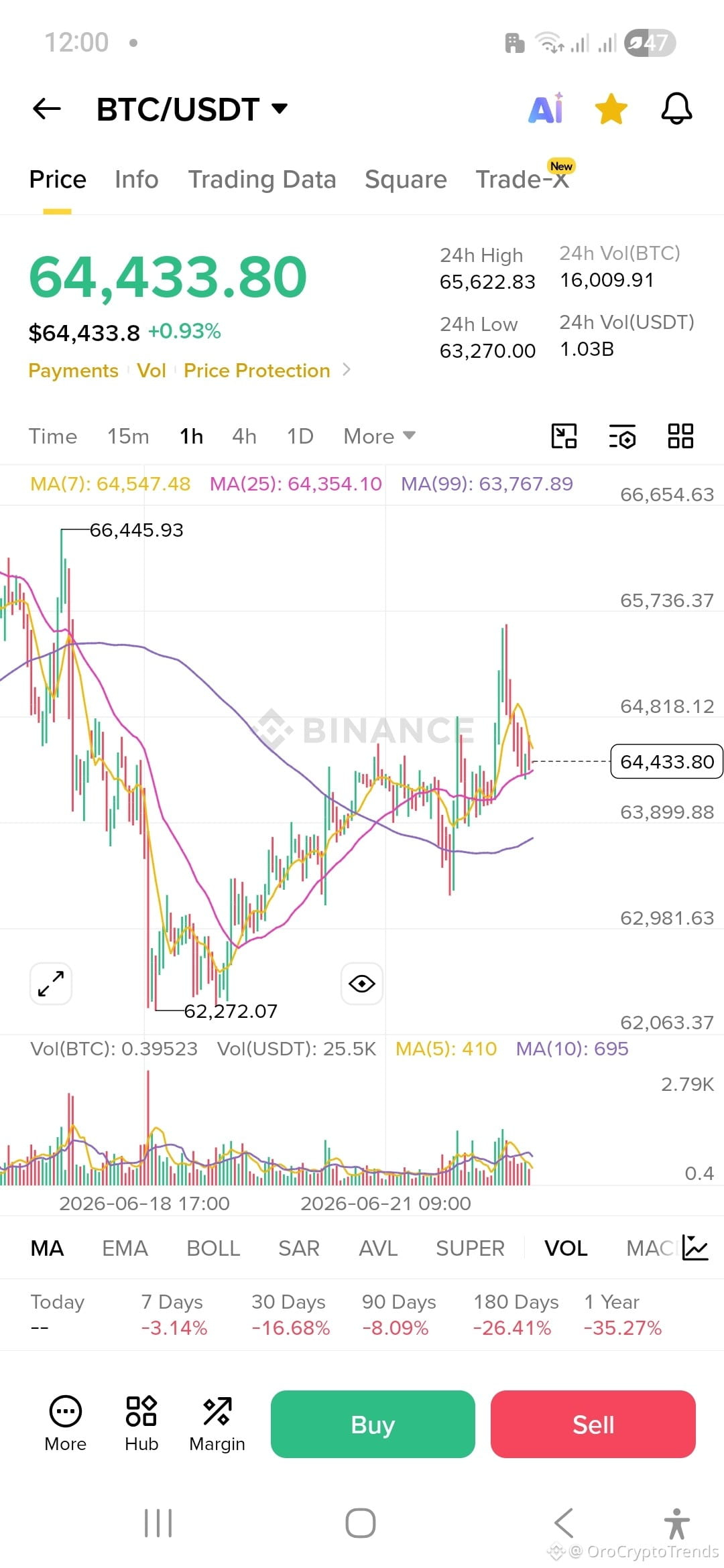
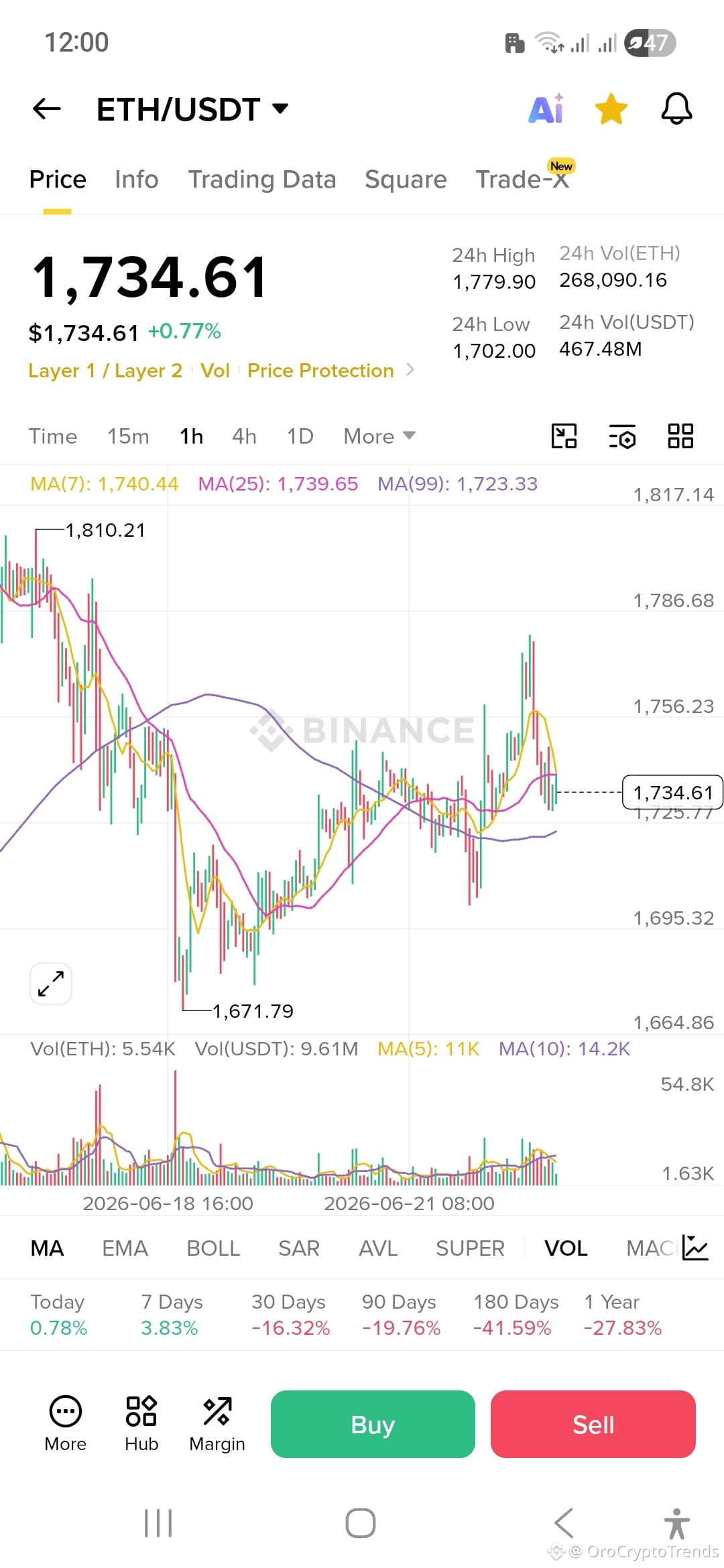
Ethereum is sitting around $1,700+, and Bitcoin is holding mid-$64K with a modest intraday push. But zoom out and the structure is still uncomfortable.
ETH is down ~40% over 180 days. BTC is still negative on the year. That’s not “healthy consolidation” in any meaningful sense—it’s a slow bleed with intermittent relief rallies.
Most people are calling this accumulation. I don’t fully buy that. Because accumulation usually shows expansion in participation. Here, volume is doing the opposite—compressed, reactive, almost defensive.
What stands out to me is the moving average clustering on the 1H chart. Price is basically orbiting MA(7), MA(25), MA(99) with no real displacement. That’s not strength. That’s indecision. And indecision in a downtrend often resolves the wrong way more often than people admit.
Here’s the contradiction nobody wants to say out loud: this “stability” might actually be distribution in disguise. Sideways price, declining higher-timeframe performance, and fading momentum over 90–180 days… that’s not bullish until proven otherwise.
Still, markets don’t move in straight lines. A squeeze can form from exactly this kind of compression. But that doesn’t make it constructive.
Am I wrong, or is this just being overhyped?
#Write2Earn
$BTC #BTC #orocryptotrends
I keep seeing people treat this ETH and BTC bounce like it’s some kind of clean recovery signal.
Honestly, I think that’s the wrong read.
Yes, short-term price action looks stable.
Ethereum is sitting around $1,700+, and Bitcoin is holding mid-$64K with a modest intraday push. But zoom out and the structure is still uncomfortable.
ETH is down ~40% over 180 days. BTC is still negative on the year. That’s not “healthy consolidation” in any meaningful sense—it’s a slow bleed with intermittent relief rallies.
Most people are calling this accumulation. I don’t fully buy that. Because accumulation usually shows expansion in participation. Here, volume is doing the opposite—compressed, reactive, almost defensive.
What stands out to me is the moving average clustering on the 1H chart. Price is basically orbiting MA(7), MA(25), MA(99) with no real displacement. That’s not strength. That’s indecision. And indecision in a downtrend often resolves the wrong way more often than people admit.
Here’s the contradiction nobody wants to say out loud: this “stability” might actually be distribution in disguise. Sideways price, declining higher-timeframe performance, and fading momentum over 90–180 days… that’s not bullish until proven otherwise.
Still, markets don’t move in straight lines. A squeeze can form from exactly this kind of compression. But that doesn’t make it constructive.
Am I wrong, or is this just being overhyped?
#Write2Earn
I keep seeing people treat this ETH and BTC bounce like it’s some kind of clean recovery signal.
Honestly, I think that’s the wrong read.
Yes, short-term price action looks stable.
Ethereum is sitting around $1,700+, and Bitcoin is holding mid-$64K with a modest intraday push. But zoom out and the structure is still uncomfortable.
ETH is down ~40% over 180 days. BTC is still negative on the year. That’s not “healthy consolidation” in any meaningful sense—it’s a slow bleed with intermittent relief rallies.
Most people are calling this accumulation. I don’t fully buy that. Because accumulation usually shows expansion in participation. Here, volume is doing the opposite—compressed, reactive, almost defensive.
What stands out to me is the moving average clustering on the 1H chart. Price is basically orbiting MA(7), MA(25), MA(99) with no real displacement. That’s not strength. That’s indecision. And indecision in a downtrend often resolves the wrong way more often than people admit.
Here’s the contradiction nobody wants to say out loud: this “stability” might actually be distribution in disguise. Sideways price, declining higher-timeframe performance, and fading momentum over 90–180 days… that’s not bullish until proven otherwise.
Still, markets don’t move in straight lines. A squeeze can form from exactly this kind of compression. But that doesn’t make it constructive.
Am I wrong, or is this just being overhyped?
#Write2Earn
1
787

·
--
الترند القادم اغنم الفرصه معانا 🚀🔥
🔥 $DODO | #DODOUSDT — بداية تحرك صعودي واعد! 🚀
• الاتجاه: Long (صعودي في مرحلة التأسيس) 🟢
• منطقة الدخول الحالية: 0.01860 - 0.01880
• وقف الخسارة المقترح: 0.01820
🎯 الأهداف:
1️⃣ 0.01910
2️⃣ 0.01950
3️⃣ 0.02000
📊 التحليل السريع:
العملة تعطي إشارات "استيقاظ"! مع حجم تداول وصل إلى 27.4 ألف USDT في دقيقة واحدة وسيطرة المشترين بنسبة 62%، يبدو أن هناك محاولة لكسر حالة الركود التي كانت تعيشها. الصعود بنسبة 1.6% في دقيقة واحدة يعتبر انطلاقة جيدة ومحفزة لبقية الجلسة، خاصة مع استقرار العملة فوق مستويات الدعم الحالية.
$NIL
{future}(NILUSDT)
$CC
{future}(CCUSDT)
#meme板块关注热点 #Web3 #YGG💰智能多空策略 #orocryptotrends
الترند القادم اغنم الفرصه معانا 🚀🔥
🔥 $DODO | #DODOUSDT — بداية تحرك صعودي واعد! 🚀
• الاتجاه: Long (صعودي في مرحلة التأسيس) 🟢
• منطقة الدخول الحالية: 0.01860 - 0.01880
• وقف الخسارة المقترح: 0.01820
🎯 الأهداف:
1️⃣ 0.01910
2️⃣ 0.01950
3️⃣ 0.02000
📊 التحليل السريع:
العملة تعطي إشارات "استيقاظ"! مع حجم تداول وصل إلى 27.4 ألف USDT في دقيقة واحدة وسيطرة المشترين بنسبة 62%، يبدو أن هناك محاولة لكسر حالة الركود التي كانت تعيشها. الصعود بنسبة 1.6% في دقيقة واحدة يعتبر انطلاقة جيدة ومحفزة لبقية الجلسة، خاصة مع استقرار العملة فوق مستويات الدعم الحالية.
$NIL
$CC
#meme板块关注热点 #Web3 #YGG💰智能多空策略 #orocryptotrends
🔥 $DODO | #DODOUSDT — بداية تحرك صعودي واعد! 🚀
• الاتجاه: Long (صعودي في مرحلة التأسيس) 🟢
• منطقة الدخول الحالية: 0.01860 - 0.01880
• وقف الخسارة المقترح: 0.01820
🎯 الأهداف:
1️⃣ 0.01910
2️⃣ 0.01950
3️⃣ 0.02000
📊 التحليل السريع:
العملة تعطي إشارات "استيقاظ"! مع حجم تداول وصل إلى 27.4 ألف USDT في دقيقة واحدة وسيطرة المشترين بنسبة 62%، يبدو أن هناك محاولة لكسر حالة الركود التي كانت تعيشها. الصعود بنسبة 1.6% في دقيقة واحدة يعتبر انطلاقة جيدة ومحفزة لبقية الجلسة، خاصة مع استقرار العملة فوق مستويات الدعم الحالية.
$NIL
$CC
#meme板块关注热点 #Web3 #YGG💰智能多空策略 #orocryptotrends
1
60
Partiellement vrai
$BANK
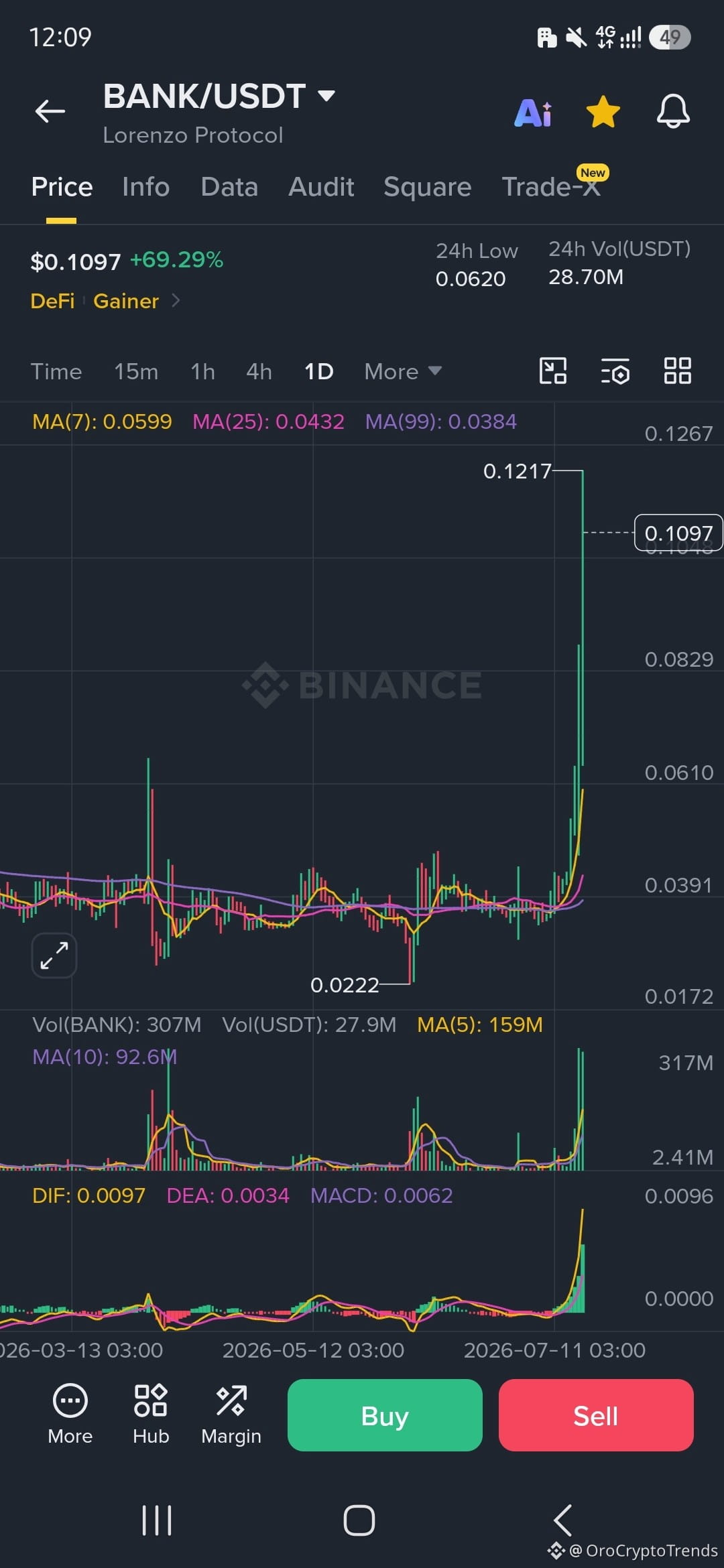
BANK's 70% candle is not the story. The real story is whether the market discovered a new value, or simply created a new temporary belief.
BANK is not just experiencing a pump; it is entering a market debate. The breakout shows that investors are willing to reprice the asset, but the next phase will decide whether this was genuine valuation discovery or only a liquidity-driven excitement cycle.
#Write2Earn #orocryptotrends
$BANK
BANK's 70% candle is not the story. The real story is whether the market discovered a new value, or simply created a new temporary belief.
BANK is not just experiencing a pump; it is entering a market debate. The breakout shows that investors are willing to reprice the asset, but the next phase will decide whether this was genuine valuation discovery or only a liquidity-driven excitement cycle.
#Write2Earn #orocryptotrends
BANK's 70% candle is not the story. The real story is whether the market discovered a new value, or simply created a new temporary belief.
BANK is not just experiencing a pump; it is entering a market debate. The breakout shows that investors are willing to reprice the asset, but the next phase will decide whether this was genuine valuation discovery or only a liquidity-driven excitement cycle.
#Write2Earn #orocryptotrends
2
1k
Crypto Market Sell-Off: Why Are Some Altcoins Still Rising?
While the broader crypto market faces intense selling pressure, a few altcoins — including Aster (ASTER), Monero (XMR), and Giggle Fund (GIGGLE) — continue to show resilience, defying the bearish sentiment dominating most of the market.
Altcoin Divergence: Strength in a Weak Market
Despite Bitcoin extending losses by another 2%, a handful of altcoins are moving in the opposite direction. This divergence highlights that even during broad sell-offs, selective narratives, on-chain catalysts, and token-specific developments can drive isolated uptrends.
Aster (ASTER) has rebounded over 13% in 24 hours, recovering from its oversold zone near $0.82. The move comes after CZ’s recent $2 million ASTER purchase, fueling renewed investor confidence. A sustained break above the $1.25 resistance zone could set the stage for another rally toward $1.50–$1.60.
Monero (XMR) also climbed nearly 5%, testing the $345–$350 resistance range — the upper limit of its descending triangle structure. If this breakout holds, XMR could aim for $430 based on its measured move pattern.
Meanwhile, Giggle Fund (GIGGLE) stole the spotlight with a massive 128% jump, following Binance’s announcement to donate 50% of GIGGLE trading fees to its educational arm, Giggle Academy. The news injected strong momentum, with traders watching the $140 resistance as a potential breakout zone.
What It Means for Traders
These isolated gains amid a market downturn suggest that fundamental catalysts and liquidity events still matter, even when macro conditions weigh heavily on sentiment. Traders are rotating into tokens with strong community backing, clear narratives, or institutional attention — a reminder that alpha still exists in micro trends.
Insight:
While most of the crypto market cools off, watching how select tokens defy gravity can reveal where the next wave of capital rotation may flow once broader sentiment improves.
#Altcoins #CryptoMarket #MarketAnalysis #BinanceNews #orocryptotrends
Disclaimer: Not Financial Advice.
Crypto Market Sell-Off: Why Are Some Altcoins Still Rising?
While the broader crypto market faces intense selling pressure, a few altcoins — including Aster (ASTER), Monero (XMR), and Giggle Fund (GIGGLE) — continue to show resilience, defying the bearish sentiment dominating most of the market.
Altcoin Divergence: Strength in a Weak Market
Despite Bitcoin extending losses by another 2%, a handful of altcoins are moving in the opposite direction. This divergence highlights that even during broad sell-offs, selective narratives, on-chain catalysts, and token-specific developments can drive isolated uptrends.
Aster (ASTER) has rebounded over 13% in 24 hours, recovering from its oversold zone near $0.82. The move comes after CZ’s recent $2 million ASTER purchase, fueling renewed investor confidence. A sustained break above the $1.25 resistance zone could set the stage for another rally toward $1.50–$1.60.
Monero (XMR) also climbed nearly 5%, testing the $345–$350 resistance range — the upper limit of its descending triangle structure. If this breakout holds, XMR could aim for $430 based on its measured move pattern.
Meanwhile, Giggle Fund (GIGGLE) stole the spotlight with a massive 128% jump, following Binance’s announcement to donate 50% of GIGGLE trading fees to its educational arm, Giggle Academy. The news injected strong momentum, with traders watching the $140 resistance as a potential breakout zone.
What It Means for Traders
These isolated gains amid a market downturn suggest that fundamental catalysts and liquidity events still matter, even when macro conditions weigh heavily on sentiment. Traders are rotating into tokens with strong community backing, clear narratives, or institutional attention — a reminder that alpha still exists in micro trends.
Insight:
While most of the crypto market cools off, watching how select tokens defy gravity can reveal where the next wave of capital rotation may flow once broader sentiment improves.
#Altcoins #CryptoMarket #MarketAnalysis #BinanceNews #orocryptotrends
Disclaimer: Not Financial Advice.
While the broader crypto market faces intense selling pressure, a few altcoins — including Aster (ASTER), Monero (XMR), and Giggle Fund (GIGGLE) — continue to show resilience, defying the bearish sentiment dominating most of the market.
Altcoin Divergence: Strength in a Weak Market
Despite Bitcoin extending losses by another 2%, a handful of altcoins are moving in the opposite direction. This divergence highlights that even during broad sell-offs, selective narratives, on-chain catalysts, and token-specific developments can drive isolated uptrends.
Aster (ASTER) has rebounded over 13% in 24 hours, recovering from its oversold zone near $0.82. The move comes after CZ’s recent $2 million ASTER purchase, fueling renewed investor confidence. A sustained break above the $1.25 resistance zone could set the stage for another rally toward $1.50–$1.60.
Monero (XMR) also climbed nearly 5%, testing the $345–$350 resistance range — the upper limit of its descending triangle structure. If this breakout holds, XMR could aim for $430 based on its measured move pattern.
Meanwhile, Giggle Fund (GIGGLE) stole the spotlight with a massive 128% jump, following Binance’s announcement to donate 50% of GIGGLE trading fees to its educational arm, Giggle Academy. The news injected strong momentum, with traders watching the $140 resistance as a potential breakout zone.
What It Means for Traders
These isolated gains amid a market downturn suggest that fundamental catalysts and liquidity events still matter, even when macro conditions weigh heavily on sentiment. Traders are rotating into tokens with strong community backing, clear narratives, or institutional attention — a reminder that alpha still exists in micro trends.
Insight:
While most of the crypto market cools off, watching how select tokens defy gravity can reveal where the next wave of capital rotation may flow once broader sentiment improves.
#Altcoins #CryptoMarket #MarketAnalysis #BinanceNews #orocryptotrends
Disclaimer: Not Financial Advice.

5
267
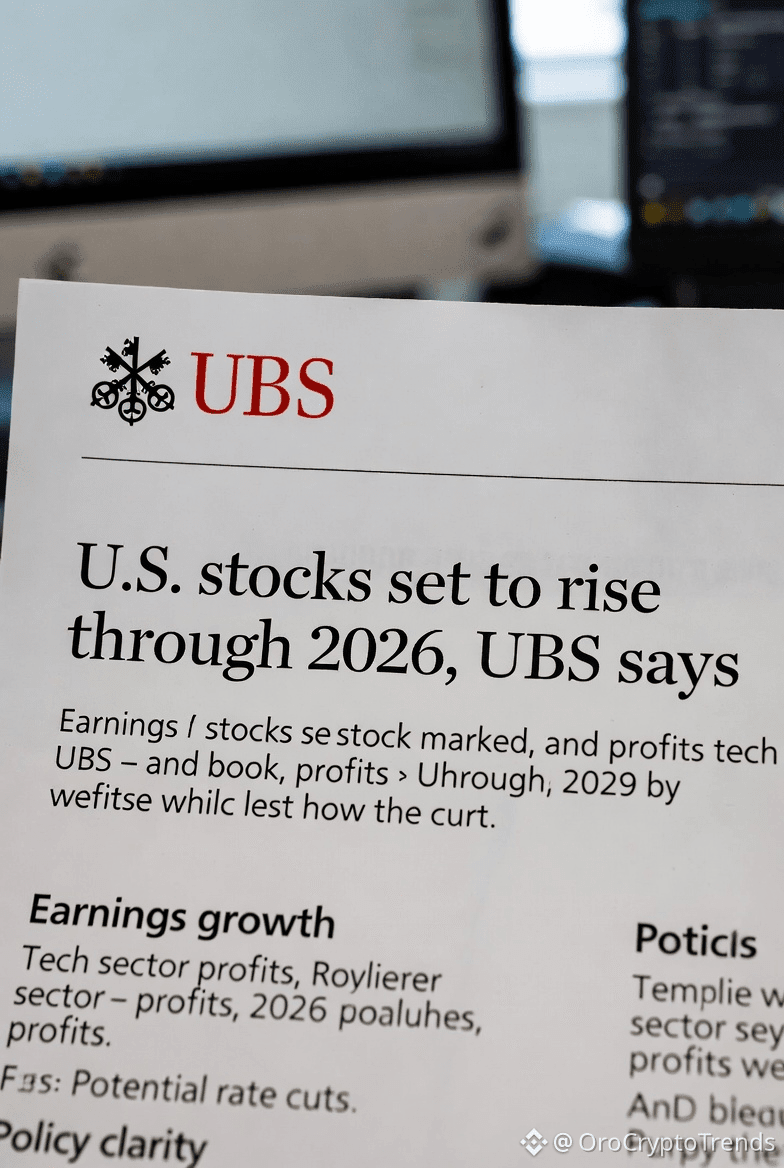
UBS thinks U.S. stocks will keep rising until 2026 because of real market factors, not just speculation.
Here's what UBS says is driving the growth:
* S&P 500 earnings are predicted to grow by about 10%.
* Tech companies are making big profits.
* The Federal Reserve might cut rates.
* Things are getting clearer with policy and tariffs, which lowers risk.
UBS believes the S\&P 500 could get close to 7,700 because of this, and stock prices will stay fair.
What this means for investors:
This market rise is based on company earnings, not following trends.
Do you think earnings growth is the main thing moving the market in 2025–2026?
Write your opinion down below.
#BinanceSquare #USStocks #SP500 #orocryptotrends #Write2Earn
UBS thinks U.S. stocks will keep rising until 2026 because of real market factors, not just speculation.
Here's what UBS says is driving the growth:
* S&P 500 earnings are predicted to grow by about 10%.
* Tech companies are making big profits.
* The Federal Reserve might cut rates.
* Things are getting clearer with policy and tariffs, which lowers risk.
UBS believes the S\&P 500 could get close to 7,700 because of this, and stock prices will stay fair.
What this means for investors:
This market rise is based on company earnings, not following trends.
Do you think earnings growth is the main thing moving the market in 2025–2026?
Write your opinion down below.
#BinanceSquare #USStocks #SP500 #orocryptotrends #Write2Earn
Here's what UBS says is driving the growth:
* S&P 500 earnings are predicted to grow by about 10%.
* Tech companies are making big profits.
* The Federal Reserve might cut rates.
* Things are getting clearer with policy and tariffs, which lowers risk.
UBS believes the S\&P 500 could get close to 7,700 because of this, and stock prices will stay fair.
What this means for investors:
This market rise is based on company earnings, not following trends.
Do you think earnings growth is the main thing moving the market in 2025–2026?
Write your opinion down below.
#BinanceSquare #USStocks #SP500 #orocryptotrends #Write2Earn
1
1
7
730
🤖 Automated Trading Expansion: BNB, ETH, SOL Trading Bot Services Activated
1️⃣ Market Move Fact:
Binance has significantly expanded its Trading Bots offerings. Effective 2025-12-16 08:00 (UTC), new Trading Bot services will be activated for several major assets:
* Spot Grid and Spot DCA (Dollar-Cost Averaging) services are now enabled for: BNB, ETH, and SOL (paired with USD1).
* Spot Algo Orders are also enabled for DOGE/USD1, SUI/USD1, and XRP/USD1 alongside the three above.
2️⃣ Data Snapshot (Current Estimate):
* Asset: BNB
* Current Price: \approx 846.66 USDT (based on recent market data)
* Key Level Broken: N/A (Alert is based on platform service expansion, not price movement)
* Timeframe: N/A (Service Announcement)
* Percentage Change (BNB/USDT 24H): \approx -3.54\%
3️⃣ Indication & Analysis:
The immediate expansion of Spot Grid and DCA services to major assets like BNB, ETH, and SOL indicates a strategic move by Binance to increase automation and liquidity across these core pairs. This enables users to employ more sophisticated, long-term, and passive trading strategies, potentially drawing in more systematic volume and helping to stabilize price action through programmed buy/sell orders around key ranges.
4️⃣ Next Key Level to Watch:
The introduction of Grid and DCA bots for BNB is significant. We may see increased bot-driven activity stabilizing the range between its recent high (\approx 870 USDT) and the next major psychological support at 800 USDT.
5️⃣ Action:
This development lowers the barrier to algorithmic trading for major assets. Consider how this expanded toolset fits into your personal trading strategy.
#TrumpTariffs #orocryptotrends #Write2Earn
🤖 Automated Trading Expansion: BNB, ETH, SOL Trading Bot Services Activated
1️⃣ Market Move Fact:
Binance has significantly expanded its Trading Bots offerings. Effective 2025-12-16 08:00 (UTC), new Trading Bot services will be activated for several major assets:
* Spot Grid and Spot DCA (Dollar-Cost Averaging) services are now enabled for: BNB, ETH, and SOL (paired with USD1).
* Spot Algo Orders are also enabled for DOGE/USD1, SUI/USD1, and XRP/USD1 alongside the three above.
2️⃣ Data Snapshot (Current Estimate):
* Asset: BNB
* Current Price: \approx 846.66 USDT (based on recent market data)
* Key Level Broken: N/A (Alert is based on platform service expansion, not price movement)
* Timeframe: N/A (Service Announcement)
* Percentage Change (BNB/USDT 24H): \approx -3.54\%
3️⃣ Indication & Analysis:
The immediate expansion of Spot Grid and DCA services to major assets like BNB, ETH, and SOL indicates a strategic move by Binance to increase automation and liquidity across these core pairs. This enables users to employ more sophisticated, long-term, and passive trading strategies, potentially drawing in more systematic volume and helping to stabilize price action through programmed buy/sell orders around key ranges.
4️⃣ Next Key Level to Watch:
The introduction of Grid and DCA bots for BNB is significant. We may see increased bot-driven activity stabilizing the range between its recent high (\approx 870 USDT) and the next major psychological support at 800 USDT.
5️⃣ Action:
This development lowers the barrier to algorithmic trading for major assets. Consider how this expanded toolset fits into your personal trading strategy.
#TrumpTariffs #orocryptotrends #Write2Earn
1️⃣ Market Move Fact:
Binance has significantly expanded its Trading Bots offerings. Effective 2025-12-16 08:00 (UTC), new Trading Bot services will be activated for several major assets:
* Spot Grid and Spot DCA (Dollar-Cost Averaging) services are now enabled for: BNB, ETH, and SOL (paired with USD1).
* Spot Algo Orders are also enabled for DOGE/USD1, SUI/USD1, and XRP/USD1 alongside the three above.
2️⃣ Data Snapshot (Current Estimate):
* Asset: BNB
* Current Price: \approx 846.66 USDT (based on recent market data)
* Key Level Broken: N/A (Alert is based on platform service expansion, not price movement)
* Timeframe: N/A (Service Announcement)
* Percentage Change (BNB/USDT 24H): \approx -3.54\%
3️⃣ Indication & Analysis:
The immediate expansion of Spot Grid and DCA services to major assets like BNB, ETH, and SOL indicates a strategic move by Binance to increase automation and liquidity across these core pairs. This enables users to employ more sophisticated, long-term, and passive trading strategies, potentially drawing in more systematic volume and helping to stabilize price action through programmed buy/sell orders around key ranges.
4️⃣ Next Key Level to Watch:
The introduction of Grid and DCA bots for BNB is significant. We may see increased bot-driven activity stabilizing the range between its recent high (\approx 870 USDT) and the next major psychological support at 800 USDT.
5️⃣ Action:
This development lowers the barrier to algorithmic trading for major assets. Consider how this expanded toolset fits into your personal trading strategy.
#TrumpTariffs #orocryptotrends #Write2Earn
7
180

·
--
Buenas tardes mis Troyanos me pareció importante mostrarles la siguiente comparación .
Oro Vs Bitcoin
El oro y el Bitcoin son activos de refugio y reserva de valor con escasez limitada, pero difieren drásticamente en madurez y volatilidad. El oro ofrece estabilidad histórica (5,000 años) y protección contra la inflación, mientras que el Bitcoin ofrece alta rentabilidad potencial, descentralización y portabilidad, pero con una volatilidad extrema y riesgo especulativo.
*Comparación Detallada:
-Naturaleza: El oro es un activo físico tangible; el Bitcoin es oro digital descentralizado.
-Volatilidad: La volatilidad anualizada del oro es baja (12%-15%), mientras que la del Bitcoin es muy alta (60%-80% o más).
-Historial: El oro es un refugio confiable de larga trayectoria, mientras que Bitcoin tiene menos de dos décadas.
-Almacenamiento y Transferencia: El oro físico es costoso de almacenar y difícil de transportar; Bitcoin se almacena digitalmente y se transfiere al instante globalmente.
-Escasez: Ambos son escasos: el oro por su abundancia limitada en la corteza terrestre, y Bitcoin por su límite de 21 millones de unidades.
¿Cuál elegir?
-Oro: Mejor para preservar patrimonio a largo plazo y reducir riesgo (inversor conservador).
-Bitcoin: Mejor para buscar altos rendimientos, diversificación tecnológica y coberturas ante crisis globales (inversor arriesgado).
A mediados de abril de 2026, el oro mostraba fuerza con un aumento del 46% anual, mientras que Bitcoin experimentaba correcciones tras alcanzar máximos.
Los leos en los comentarios
$BTC
{spot}(BTCUSDT)
#orocryptotrends #BTC☀
Buenas tardes mis Troyanos me pareció importante mostrarles la siguiente comparación .
Oro Vs Bitcoin
El oro y el Bitcoin son activos de refugio y reserva de valor con escasez limitada, pero difieren drásticamente en madurez y volatilidad. El oro ofrece estabilidad histórica (5,000 años) y protección contra la inflación, mientras que el Bitcoin ofrece alta rentabilidad potencial, descentralización y portabilidad, pero con una volatilidad extrema y riesgo especulativo.
*Comparación Detallada:
-Naturaleza: El oro es un activo físico tangible; el Bitcoin es oro digital descentralizado.
-Volatilidad: La volatilidad anualizada del oro es baja (12%-15%), mientras que la del Bitcoin es muy alta (60%-80% o más).
-Historial: El oro es un refugio confiable de larga trayectoria, mientras que Bitcoin tiene menos de dos décadas.
-Almacenamiento y Transferencia: El oro físico es costoso de almacenar y difícil de transportar; Bitcoin se almacena digitalmente y se transfiere al instante globalmente.
-Escasez: Ambos son escasos: el oro por su abundancia limitada en la corteza terrestre, y Bitcoin por su límite de 21 millones de unidades.
¿Cuál elegir?
-Oro: Mejor para preservar patrimonio a largo plazo y reducir riesgo (inversor conservador).
-Bitcoin: Mejor para buscar altos rendimientos, diversificación tecnológica y coberturas ante crisis globales (inversor arriesgado).
A mediados de abril de 2026, el oro mostraba fuerza con un aumento del 46% anual, mientras que Bitcoin experimentaba correcciones tras alcanzar máximos.
Los leos en los comentarios
$BTC
#orocryptotrends #BTC☀
Oro Vs Bitcoin
El oro y el Bitcoin son activos de refugio y reserva de valor con escasez limitada, pero difieren drásticamente en madurez y volatilidad. El oro ofrece estabilidad histórica (5,000 años) y protección contra la inflación, mientras que el Bitcoin ofrece alta rentabilidad potencial, descentralización y portabilidad, pero con una volatilidad extrema y riesgo especulativo.
*Comparación Detallada:
-Naturaleza: El oro es un activo físico tangible; el Bitcoin es oro digital descentralizado.
-Volatilidad: La volatilidad anualizada del oro es baja (12%-15%), mientras que la del Bitcoin es muy alta (60%-80% o más).
-Historial: El oro es un refugio confiable de larga trayectoria, mientras que Bitcoin tiene menos de dos décadas.
-Almacenamiento y Transferencia: El oro físico es costoso de almacenar y difícil de transportar; Bitcoin se almacena digitalmente y se transfiere al instante globalmente.
-Escasez: Ambos son escasos: el oro por su abundancia limitada en la corteza terrestre, y Bitcoin por su límite de 21 millones de unidades.
¿Cuál elegir?
-Oro: Mejor para preservar patrimonio a largo plazo y reducir riesgo (inversor conservador).
-Bitcoin: Mejor para buscar altos rendimientos, diversificación tecnológica y coberturas ante crisis globales (inversor arriesgado).
A mediados de abril de 2026, el oro mostraba fuerza con un aumento del 46% anual, mientras que Bitcoin experimentaba correcciones tras alcanzar máximos.
Los leos en los comentarios
$BTC
#orocryptotrends #BTC☀
426

·
--
$ORCA — low supply sounds good… but it’s not the edge 👀
~75M total supply gets attention fast.
But supply alone doesn’t move markets — demand does.
📊 What actually matters:
• Real usage (DEX volume, ecosystem activity)
• Liquidity depth (can size enter/exit smoothly?)
• Narrative + momentum (is attention building?)
🧠 Reality check:
Low supply ≠ guaranteed pump
High supply ≠ guaranteed weakness
We’ve seen both scenarios play out.
⚠️ About “quick profits”:
Fast gains usually come with:
• Higher volatility
• Lower margin for error
• Easier traps for late entries
📌 Smarter approach:
• Follow volume + structure, not just tokenomics
• Wait for breakout → hold → continuation
• Define risk before chasing momentum
💡 Bottom line:
Supply can attract attention…
but sustained demand is what drives price higher.
#orocryptotrends CA #Crypto #Trading #Altcoins #MarketStructure #RiskManagement
$ORCA — low supply sounds good… but it’s not the edge 👀
~75M total supply gets attention fast.
But supply alone doesn’t move markets — demand does.
📊 What actually matters:
• Real usage (DEX volume, ecosystem activity)
• Liquidity depth (can size enter/exit smoothly?)
• Narrative + momentum (is attention building?)
🧠 Reality check:
Low supply ≠ guaranteed pump
High supply ≠ guaranteed weakness
We’ve seen both scenarios play out.
⚠️ About “quick profits”:
Fast gains usually come with:
• Higher volatility
• Lower margin for error
• Easier traps for late entries
📌 Smarter approach:
• Follow volume + structure, not just tokenomics
• Wait for breakout → hold → continuation
• Define risk before chasing momentum
💡 Bottom line:
Supply can attract attention…
but sustained demand is what drives price higher.
#orocryptotrends CA #Crypto #Trading #Altcoins #MarketStructure #RiskManagement
~75M total supply gets attention fast.
But supply alone doesn’t move markets — demand does.
📊 What actually matters:
• Real usage (DEX volume, ecosystem activity)
• Liquidity depth (can size enter/exit smoothly?)
• Narrative + momentum (is attention building?)
🧠 Reality check:
Low supply ≠ guaranteed pump
High supply ≠ guaranteed weakness
We’ve seen both scenarios play out.
⚠️ About “quick profits”:
Fast gains usually come with:
• Higher volatility
• Lower margin for error
• Easier traps for late entries
📌 Smarter approach:
• Follow volume + structure, not just tokenomics
• Wait for breakout → hold → continuation
• Define risk before chasing momentum
💡 Bottom line:
Supply can attract attention…
but sustained demand is what drives price higher.
#orocryptotrends CA #Crypto #Trading #Altcoins #MarketStructure #RiskManagement
68

·
--
Haussier
$SYN
{spot}(SYNUSDT)
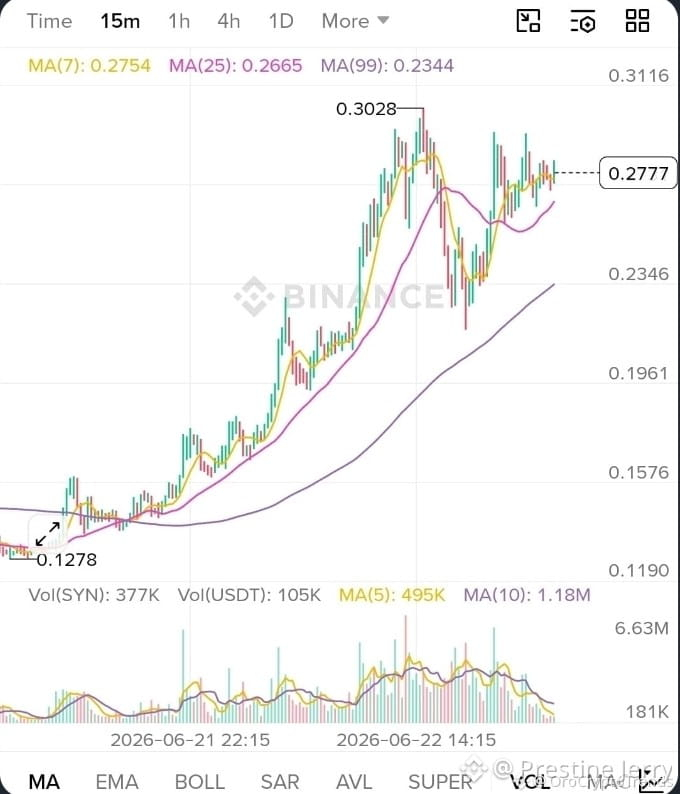
Synapse (SYN) has been impossible to ignore lately. Every time I pull up the chart, it seems to be moving straight up.
A 70% daily move is already impressive, but the bigger picture is even more remarkable, with gains exceeding 600% in just a few weeks. Not long ago, SYN was trading around $0.05. Now it's holding near $0.27, and the market is paying attention.
My first reaction was to dismiss it as another hype-driven crypto rally. But after digging deeper, the volume tells a different story. Participation appears genuine, and buyers continue to step in. That said, the move feels stretched. Price has accelerated far beyond its slower-moving averages without spending much time building support along the way.
Many traders are calling this the start of altseason. Maybe they're right. Part of me sees the argument, but another part remains cautious. We've seen these rapid rotations before—everyone rushes in after the breakout, momentum fades, and the market spends weeks consolidating. Then again, crypto momentum rarely follows what seems logical or sustainable.
What's most interesting is that lower timeframes still look relatively stable. The trend remains strong, yet the market also appears overheated. That's a combination that deserves attention.
The setup looks straightforward on the surface, but I have a feeling there's more going on beneath it.
#write2earn🌐💹 #orocryptotrends
$SYN
Synapse (SYN) has been impossible to ignore lately. Every time I pull up the chart, it seems to be moving straight up.
A 70% daily move is already impressive, but the bigger picture is even more remarkable, with gains exceeding 600% in just a few weeks. Not long ago, SYN was trading around $0.05. Now it's holding near $0.27, and the market is paying attention.
My first reaction was to dismiss it as another hype-driven crypto rally. But after digging deeper, the volume tells a different story. Participation appears genuine, and buyers continue to step in. That said, the move feels stretched. Price has accelerated far beyond its slower-moving averages without spending much time building support along the way.
Many traders are calling this the start of altseason. Maybe they're right. Part of me sees the argument, but another part remains cautious. We've seen these rapid rotations before—everyone rushes in after the breakout, momentum fades, and the market spends weeks consolidating. Then again, crypto momentum rarely follows what seems logical or sustainable.
What's most interesting is that lower timeframes still look relatively stable. The trend remains strong, yet the market also appears overheated. That's a combination that deserves attention.
The setup looks straightforward on the surface, but I have a feeling there's more going on beneath it.
#write2earn🌐💹 #orocryptotrends
Synapse (SYN) has been impossible to ignore lately. Every time I pull up the chart, it seems to be moving straight up.
A 70% daily move is already impressive, but the bigger picture is even more remarkable, with gains exceeding 600% in just a few weeks. Not long ago, SYN was trading around $0.05. Now it's holding near $0.27, and the market is paying attention.
My first reaction was to dismiss it as another hype-driven crypto rally. But after digging deeper, the volume tells a different story. Participation appears genuine, and buyers continue to step in. That said, the move feels stretched. Price has accelerated far beyond its slower-moving averages without spending much time building support along the way.
Many traders are calling this the start of altseason. Maybe they're right. Part of me sees the argument, but another part remains cautious. We've seen these rapid rotations before—everyone rushes in after the breakout, momentum fades, and the market spends weeks consolidating. Then again, crypto momentum rarely follows what seems logical or sustainable.
What's most interesting is that lower timeframes still look relatively stable. The trend remains strong, yet the market also appears overheated. That's a combination that deserves attention.
The setup looks straightforward on the surface, but I have a feeling there's more going on beneath it.
#write2earn🌐💹 #orocryptotrends
1
261
#StrategyReservesExceedDebtBy$48B
#orocryptotrends #Write2Earn
I keep seeing people focus on debt numbers and immediately assume the worst. But this one is kind of interesting because the other side of the balance sheet matters too.
The idea behind #StrategyReservesExceedDebtBy$48B is getting attention because the company’s reserve strategy has created a situation where the asset side is being compared against the debt side in a very different way than traditional companies.
Honestly, I think people are missing the bigger debate here.
A lot of investors still look at debt as automatically dangerous. And yes, leverage can destroy companies when the asset behind it collapses. But if the underlying strategy keeps generating enough value, the conversation changes.
Wait — maybe that’s the part people are arguing about.
Is this actually a strong treasury strategy, or are we just watching a new type of risk that hasn’t been fully tested yet?
Because crypto companies and crypto-linked firms are basically experimenting with balance sheets in ways we haven’t really seen before. Traditional finance has rules and models for this. Crypto is still writing them.
The $48B gap sounds impressive, but the real question isn’t just how big the reserves are.
It’s whether the system can survive when market conditions turn ugly.
I’m still watching how this plays out. Feels simple on the surface, but maybe it isn’t.
#StrategyReservesExceedDebtBy$48B
#orocryptotrends #Write2Earn
I keep seeing people focus on debt numbers and immediately assume the worst. But this one is kind of interesting because the other side of the balance sheet matters too.
The idea behind #StrategyReservesExceedDebtBy$48B is getting attention because the company’s reserve strategy has created a situation where the asset side is being compared against the debt side in a very different way than traditional companies.
Honestly, I think people are missing the bigger debate here.
A lot of investors still look at debt as automatically dangerous. And yes, leverage can destroy companies when the asset behind it collapses. But if the underlying strategy keeps generating enough value, the conversation changes.
Wait — maybe that’s the part people are arguing about.
Is this actually a strong treasury strategy, or are we just watching a new type of risk that hasn’t been fully tested yet?
Because crypto companies and crypto-linked firms are basically experimenting with balance sheets in ways we haven’t really seen before. Traditional finance has rules and models for this. Crypto is still writing them.
The $48B gap sounds impressive, but the real question isn’t just how big the reserves are.
It’s whether the system can survive when market conditions turn ugly.
I’m still watching how this plays out. Feels simple on the surface, but maybe it isn’t.
#orocryptotrends #Write2Earn
I keep seeing people focus on debt numbers and immediately assume the worst. But this one is kind of interesting because the other side of the balance sheet matters too.
The idea behind #StrategyReservesExceedDebtBy$48B is getting attention because the company’s reserve strategy has created a situation where the asset side is being compared against the debt side in a very different way than traditional companies.
Honestly, I think people are missing the bigger debate here.
A lot of investors still look at debt as automatically dangerous. And yes, leverage can destroy companies when the asset behind it collapses. But if the underlying strategy keeps generating enough value, the conversation changes.
Wait — maybe that’s the part people are arguing about.
Is this actually a strong treasury strategy, or are we just watching a new type of risk that hasn’t been fully tested yet?
Because crypto companies and crypto-linked firms are basically experimenting with balance sheets in ways we haven’t really seen before. Traditional finance has rules and models for this. Crypto is still writing them.
The $48B gap sounds impressive, but the real question isn’t just how big the reserves are.
It’s whether the system can survive when market conditions turn ugly.
I’m still watching how this plays out. Feels simple on the surface, but maybe it isn’t.
175
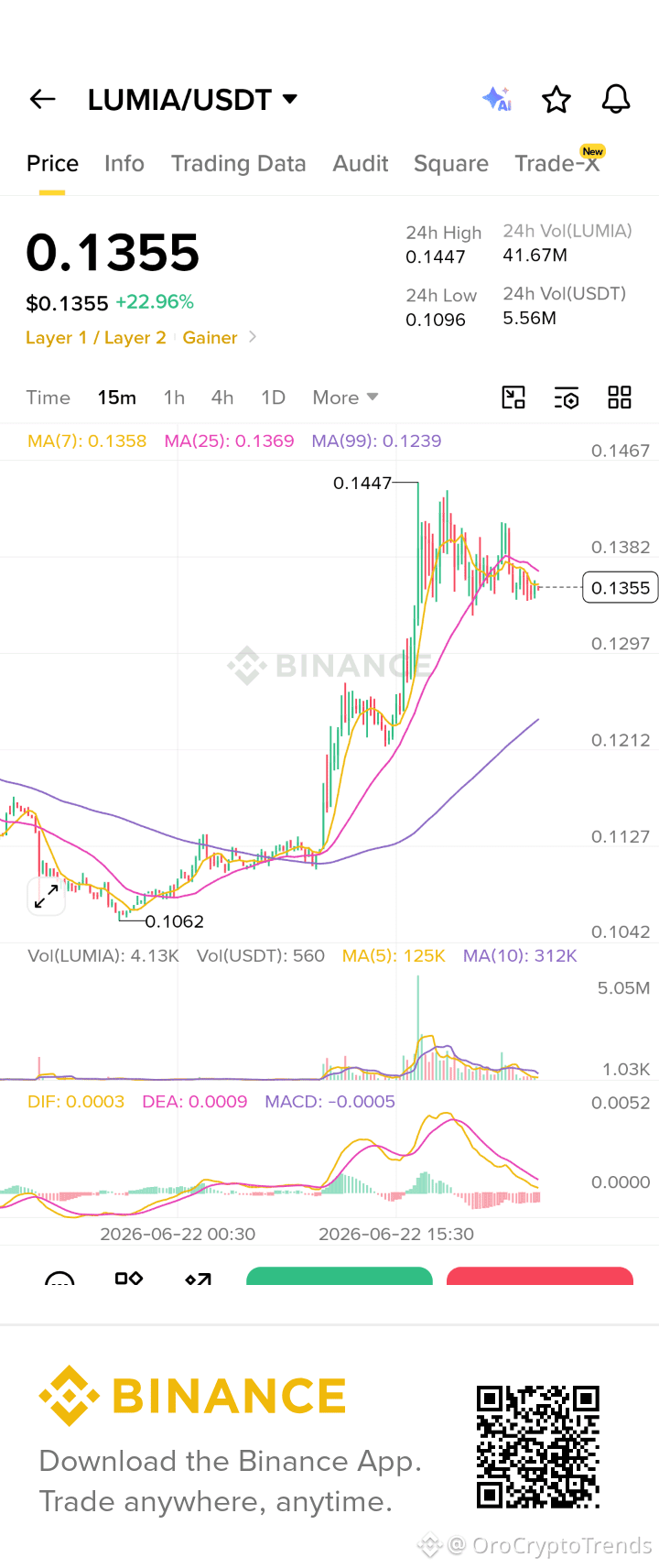
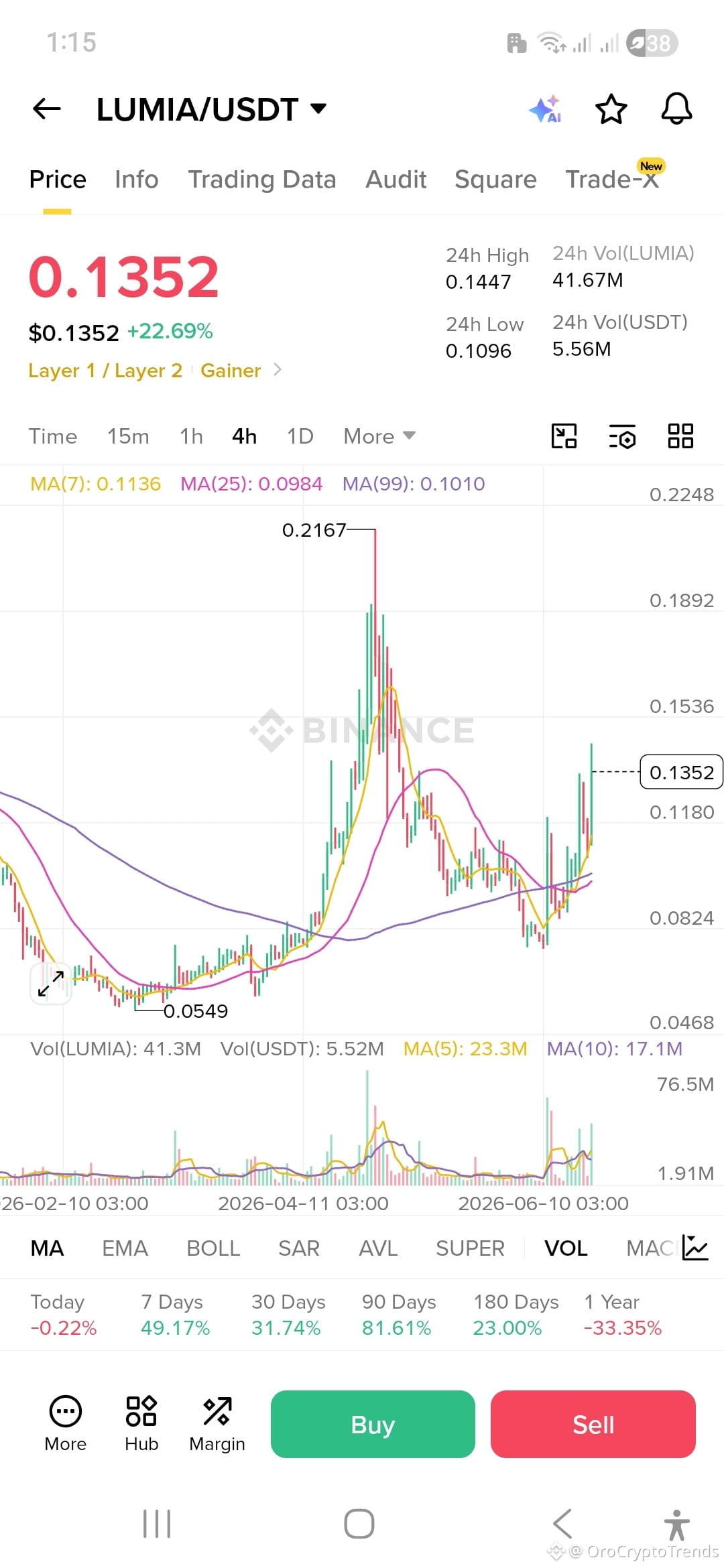
honestly I’ve been watching LUMIA and it’s kind of confusing right now.
like it’s up +22% in a day, and higher timeframes still look fine… moving averages still pointing up, structure still bullish in current market context.
but when I zoom in it feels different. 15m chart especially… it’s not really pushing anymore. it’s just kind of sitting there. MACD is also slowing down, and price is just squeezing instead of expanding. I don’t know, I might be overthinking it but that usually isn’t what strong continuation looks like.
I remember seeing this kind of thing before last year on a different low cap, everyone was still calling it breakout phase and then it just chopped for days and flushed late longs. Not saying that’s what happens here, but the behavior rhymes.
what’s weird is both things can be true at once. higher timeframe still up. lower timeframe already tired. and that mismatch usually doesn’t resolve instantly, it just turns into messy price action.
so I get why people are still bullish. it does look clean on the surface.
but also… it slightly feels like the easy part of the move already happened?
maybe it continues, maybe it resets first. not sure.
still trying to figure out what this really changes.
$LUMIA #orocryptotrends #Write2Earn
{spot}(LUMIAUSDT)
honestly I’ve been watching LUMIA and it’s kind of confusing right now.
like it’s up +22% in a day, and higher timeframes still look fine… moving averages still pointing up, structure still bullish in current market context.
but when I zoom in it feels different. 15m chart especially… it’s not really pushing anymore. it’s just kind of sitting there. MACD is also slowing down, and price is just squeezing instead of expanding. I don’t know, I might be overthinking it but that usually isn’t what strong continuation looks like.
I remember seeing this kind of thing before last year on a different low cap, everyone was still calling it breakout phase and then it just chopped for days and flushed late longs. Not saying that’s what happens here, but the behavior rhymes.
what’s weird is both things can be true at once. higher timeframe still up. lower timeframe already tired. and that mismatch usually doesn’t resolve instantly, it just turns into messy price action.
so I get why people are still bullish. it does look clean on the surface.
but also… it slightly feels like the easy part of the move already happened?
maybe it continues, maybe it resets first. not sure.
still trying to figure out what this really changes.
$LUMIA #orocryptotrends #Write2Earn
like it’s up +22% in a day, and higher timeframes still look fine… moving averages still pointing up, structure still bullish in current market context.
but when I zoom in it feels different. 15m chart especially… it’s not really pushing anymore. it’s just kind of sitting there. MACD is also slowing down, and price is just squeezing instead of expanding. I don’t know, I might be overthinking it but that usually isn’t what strong continuation looks like.
I remember seeing this kind of thing before last year on a different low cap, everyone was still calling it breakout phase and then it just chopped for days and flushed late longs. Not saying that’s what happens here, but the behavior rhymes.
what’s weird is both things can be true at once. higher timeframe still up. lower timeframe already tired. and that mismatch usually doesn’t resolve instantly, it just turns into messy price action.
so I get why people are still bullish. it does look clean on the surface.
but also… it slightly feels like the easy part of the move already happened?
maybe it continues, maybe it resets first. not sure.
still trying to figure out what this really changes.
$LUMIA #orocryptotrends #Write2Earn
2
1
828
$BTC #BTC #orocryptotrends
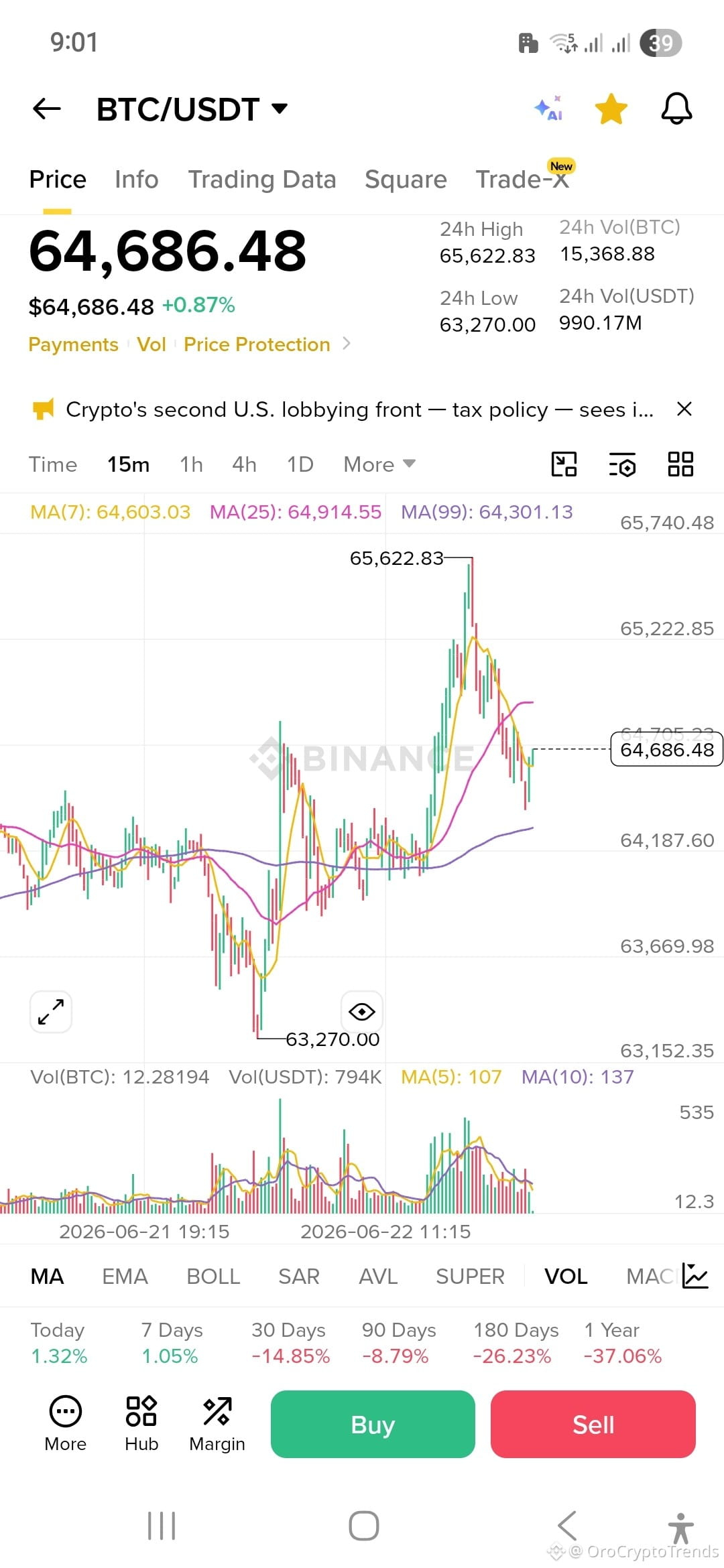
95k → 59k → 65k.
The range is getting tighter.
The narrative is getting louder.
Funny how that works.
Everyone's talking about recovery.
About reclaim. About the next leg.
But zoom out for a second —
MA(99) on the daily is still sitting at $72k.
We're at $64.6k.
That's not recovery. That's still inside the damage.
The spike to $65,622 today came on a geopolitical headline.
Pulled back almost immediately.
So I'm just watching. Not calling direction.
Just noticing that the loudest moments in a market are usually the least confirmed ones.
What actually changes the structure here? Curious what you're seeing.
what closes the gap between $65k and $72k?
#Write2Earn
$BTC #BTC #orocryptotrends
95k → 59k → 65k.
The range is getting tighter.
The narrative is getting louder.
Funny how that works.
Everyone's talking about recovery.
About reclaim. About the next leg.
But zoom out for a second —
MA(99) on the daily is still sitting at $72k.
We're at $64.6k.
That's not recovery. That's still inside the damage.
The spike to $65,622 today came on a geopolitical headline.
Pulled back almost immediately.
So I'm just watching. Not calling direction.
Just noticing that the loudest moments in a market are usually the least confirmed ones.
What actually changes the structure here? Curious what you're seeing.
what closes the gap between $65k and $72k?
#Write2Earn
95k → 59k → 65k.
The range is getting tighter.
The narrative is getting louder.
Funny how that works.
Everyone's talking about recovery.
About reclaim. About the next leg.
But zoom out for a second —
MA(99) on the daily is still sitting at $72k.
We're at $64.6k.
That's not recovery. That's still inside the damage.
The spike to $65,622 today came on a geopolitical headline.
Pulled back almost immediately.
So I'm just watching. Not calling direction.
Just noticing that the loudest moments in a market are usually the least confirmed ones.
What actually changes the structure here? Curious what you're seeing.
what closes the gap between $65k and $72k?
#Write2Earn
1
1.2k
$BTC
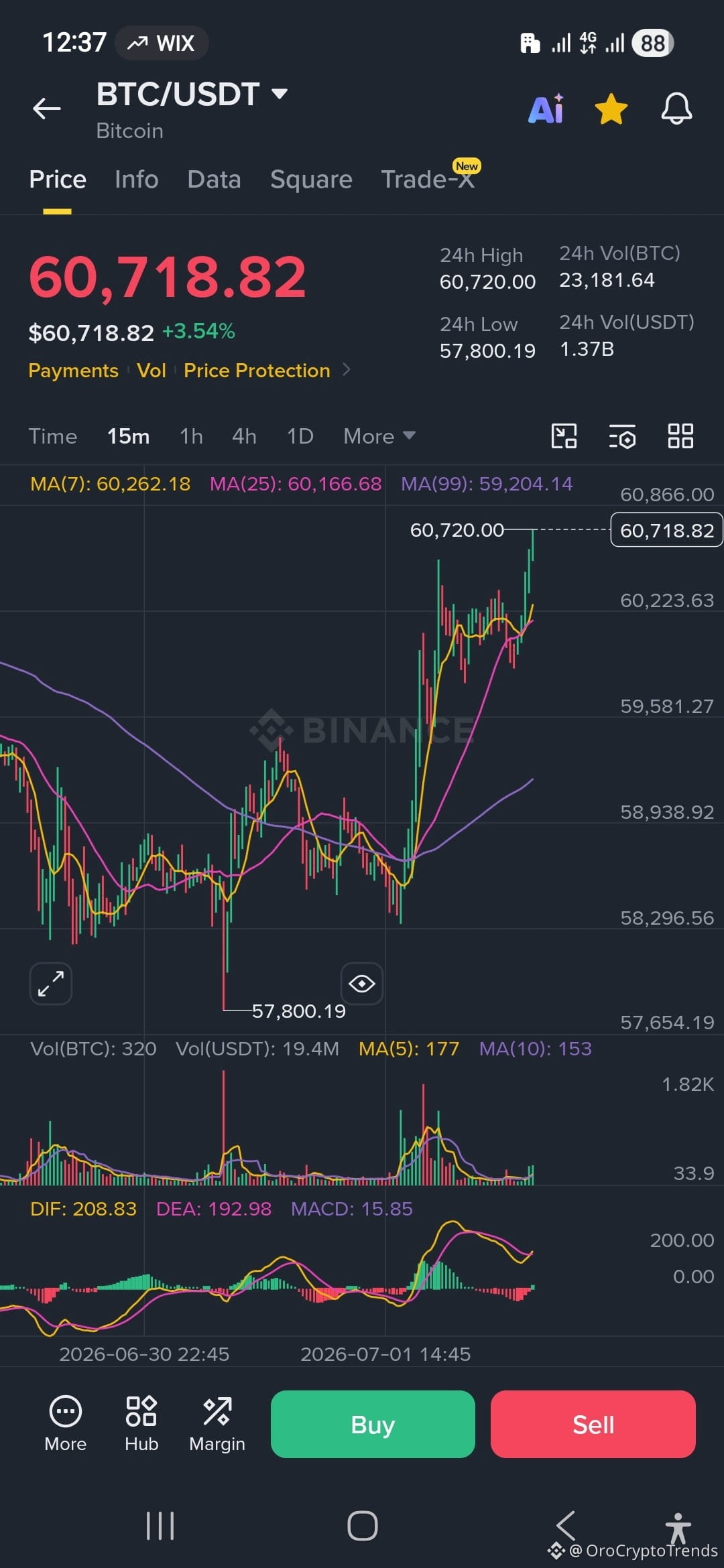
okay something actually changed on the BTC chart this morning and I'm trying to be careful about how much I read into it because I've been wrong about recoveries on this chart before.
but the 15m just realigned. all three moving averages — MA7, MA25, MA99 — sitting below price and starting to turn up. I've been staring at this chart for weeks where those same MAs were stacked above price like a ceiling. today that flipped. on the short timeframes at least.
the 1H MACD is the thing I keep going back to. DIF at 346, DEA at 184. that gap — that's the widest positive spread I've seen on this chart in weeks. histogram at +162. and the 15m volume is actually above its moving average right now, which sounds like nothing but genuinely hasn't happened on a bullish candle in a long time on this chart.
the 4H complicates it though. MA99 at $62,260. that's almost $1,500 overhead still. and 4H volume is running at about 31% of normal. so the bigger timeframe hasn't confirmed anything yet, the buying hasn't really shown up in size, and we're still well below where the 4H structure starts to matter.
I remember the last time the short-term MAs realigned briefly — I want to say late June, maybe — and it looked like something for about six hours and then rolled back over. this feels more extended than that. the range today is nearly $3,000 from low to high, which is the biggest single-day range in a while.
$60,720 is where price stalled. that's the number I'd want to see accepted, not just touched.
still not sure if this is the real one or just the most convincing-looking false start yet.
#Write2Earn #orocryptotrends
$BTC
okay something actually changed on the BTC chart this morning and I'm trying to be careful about how much I read into it because I've been wrong about recoveries on this chart before.
but the 15m just realigned. all three moving averages — MA7, MA25, MA99 — sitting below price and starting to turn up. I've been staring at this chart for weeks where those same MAs were stacked above price like a ceiling. today that flipped. on the short timeframes at least.
the 1H MACD is the thing I keep going back to. DIF at 346, DEA at 184. that gap — that's the widest positive spread I've seen on this chart in weeks. histogram at +162. and the 15m volume is actually above its moving average right now, which sounds like nothing but genuinely hasn't happened on a bullish candle in a long time on this chart.
the 4H complicates it though. MA99 at $62,260. that's almost $1,500 overhead still. and 4H volume is running at about 31% of normal. so the bigger timeframe hasn't confirmed anything yet, the buying hasn't really shown up in size, and we're still well below where the 4H structure starts to matter.
I remember the last time the short-term MAs realigned briefly — I want to say late June, maybe — and it looked like something for about six hours and then rolled back over. this feels more extended than that. the range today is nearly $3,000 from low to high, which is the biggest single-day range in a while.
$60,720 is where price stalled. that's the number I'd want to see accepted, not just touched.
still not sure if this is the real one or just the most convincing-looking false start yet.
#Write2Earn #orocryptotrends
okay something actually changed on the BTC chart this morning and I'm trying to be careful about how much I read into it because I've been wrong about recoveries on this chart before.
but the 15m just realigned. all three moving averages — MA7, MA25, MA99 — sitting below price and starting to turn up. I've been staring at this chart for weeks where those same MAs were stacked above price like a ceiling. today that flipped. on the short timeframes at least.
the 1H MACD is the thing I keep going back to. DIF at 346, DEA at 184. that gap — that's the widest positive spread I've seen on this chart in weeks. histogram at +162. and the 15m volume is actually above its moving average right now, which sounds like nothing but genuinely hasn't happened on a bullish candle in a long time on this chart.
the 4H complicates it though. MA99 at $62,260. that's almost $1,500 overhead still. and 4H volume is running at about 31% of normal. so the bigger timeframe hasn't confirmed anything yet, the buying hasn't really shown up in size, and we're still well below where the 4H structure starts to matter.
I remember the last time the short-term MAs realigned briefly — I want to say late June, maybe — and it looked like something for about six hours and then rolled back over. this feels more extended than that. the range today is nearly $3,000 from low to high, which is the biggest single-day range in a while.
$60,720 is where price stalled. that's the number I'd want to see accepted, not just touched.
still not sure if this is the real one or just the most convincing-looking false start yet.
#Write2Earn #orocryptotrends
2
2k

·
--
ETH vừa chạy từ 1.505 lên 1.778 chỉ trong khoảng một tuần và các mốc thời gian (timeline) ngay lập tức đã gọi đó là sự thay đổi xu hướng. Tôi lại nhìn theo cách khác.
Đây là điều thực sự đúng: các đường trung bình động ở khung thời gian thấp đang được sắp xếp hoàn hảo — MA(7) nằm trên MA(25) nằm trên MA(99), MACD chuyển sang dương, và khối lượng đang tăng lên trong đợt đẩy giá. Đó là cấu trúc tăng giá “đúng bài”. Tôi không hề phủ nhận phần đó.
Nhưng nhìn xa hơn ra khung ngày: MA(99) vẫn đang dốc xuống từ đỉnh tháng 3 quanh mức 2.465. Chúng ta vẫn chưa vượt qua được đường xu hướng dài hạn — hiện chúng ta đang bật lên dữ dội ngay dưới nó. Phần lớn mọi người nghĩ rằng việc lấy lại được một nửa mức giảm (drawdown) đồng nghĩa với việc xu hướng giảm đã kết thúc. Điều đó không đúng. Một nhịp hồi 55% từ một đáy chính là thứ xảy ra đúng trong các đợt “bullish” phục hồi của thị trường gấu (bear-market relief rallies).
Điểm khó chịu là: nhịp tăng này lại cực kỳ “sạch” — gần như không có nến đỏ nào trong suốt quá trình đi lên, cũng không có nhịp điều chỉnh để quay lại kiểm tra (retest) hỗ trợ. Hoặc đây là sự tích lũy thật sự, hoặc là một thị trường còn rất ít lực cản vì phần lớn người bán đã rời đi. Hai kịch bản này trông giống nhau cho đến khi giá nói cho bạn biết đó là cái nào.
Tôi nghĩ vùng 1.778–1.800 mới là bài kiểm tra thật, chứ không phải 1.700.
Hay là mọi người chỉ hào hứng khi thấy ETH xanh trở lại và gọi đó là xu hướng?
#ETH #Write2Earn #orocryptotrends
ETH vừa chạy từ 1.505 lên 1.778 chỉ trong khoảng một tuần và các mốc thời gian (timeline) ngay lập tức đã gọi đó là sự thay đổi xu hướng. Tôi lại nhìn theo cách khác.
Đây là điều thực sự đúng: các đường trung bình động ở khung thời gian thấp đang được sắp xếp hoàn hảo — MA(7) nằm trên MA(25) nằm trên MA(99), MACD chuyển sang dương, và khối lượng đang tăng lên trong đợt đẩy giá. Đó là cấu trúc tăng giá “đúng bài”. Tôi không hề phủ nhận phần đó.
Nhưng nhìn xa hơn ra khung ngày: MA(99) vẫn đang dốc xuống từ đỉnh tháng 3 quanh mức 2.465. Chúng ta vẫn chưa vượt qua được đường xu hướng dài hạn — hiện chúng ta đang bật lên dữ dội ngay dưới nó. Phần lớn mọi người nghĩ rằng việc lấy lại được một nửa mức giảm (drawdown) đồng nghĩa với việc xu hướng giảm đã kết thúc. Điều đó không đúng. Một nhịp hồi 55% từ một đáy chính là thứ xảy ra đúng trong các đợt “bullish” phục hồi của thị trường gấu (bear-market relief rallies).
Điểm khó chịu là: nhịp tăng này lại cực kỳ “sạch” — gần như không có nến đỏ nào trong suốt quá trình đi lên, cũng không có nhịp điều chỉnh để quay lại kiểm tra (retest) hỗ trợ. Hoặc đây là sự tích lũy thật sự, hoặc là một thị trường còn rất ít lực cản vì phần lớn người bán đã rời đi. Hai kịch bản này trông giống nhau cho đến khi giá nói cho bạn biết đó là cái nào.
Tôi nghĩ vùng 1.778–1.800 mới là bài kiểm tra thật, chứ không phải 1.700.
Hay là mọi người chỉ hào hứng khi thấy ETH xanh trở lại và gọi đó là xu hướng?
#ETH #Write2Earn #orocryptotrends
Đây là điều thực sự đúng: các đường trung bình động ở khung thời gian thấp đang được sắp xếp hoàn hảo — MA(7) nằm trên MA(25) nằm trên MA(99), MACD chuyển sang dương, và khối lượng đang tăng lên trong đợt đẩy giá. Đó là cấu trúc tăng giá “đúng bài”. Tôi không hề phủ nhận phần đó.
Nhưng nhìn xa hơn ra khung ngày: MA(99) vẫn đang dốc xuống từ đỉnh tháng 3 quanh mức 2.465. Chúng ta vẫn chưa vượt qua được đường xu hướng dài hạn — hiện chúng ta đang bật lên dữ dội ngay dưới nó. Phần lớn mọi người nghĩ rằng việc lấy lại được một nửa mức giảm (drawdown) đồng nghĩa với việc xu hướng giảm đã kết thúc. Điều đó không đúng. Một nhịp hồi 55% từ một đáy chính là thứ xảy ra đúng trong các đợt “bullish” phục hồi của thị trường gấu (bear-market relief rallies).
Điểm khó chịu là: nhịp tăng này lại cực kỳ “sạch” — gần như không có nến đỏ nào trong suốt quá trình đi lên, cũng không có nhịp điều chỉnh để quay lại kiểm tra (retest) hỗ trợ. Hoặc đây là sự tích lũy thật sự, hoặc là một thị trường còn rất ít lực cản vì phần lớn người bán đã rời đi. Hai kịch bản này trông giống nhau cho đến khi giá nói cho bạn biết đó là cái nào.
Tôi nghĩ vùng 1.778–1.800 mới là bài kiểm tra thật, chứ không phải 1.700.
Hay là mọi người chỉ hào hứng khi thấy ETH xanh trở lại và gọi đó là xu hướng?
#ETH #Write2Earn #orocryptotrends
OroCryptoTrends
·
--
$ETH Everyone's calling this an "ETH breakout" — I think that word is doing a lot of work it hasn't earned
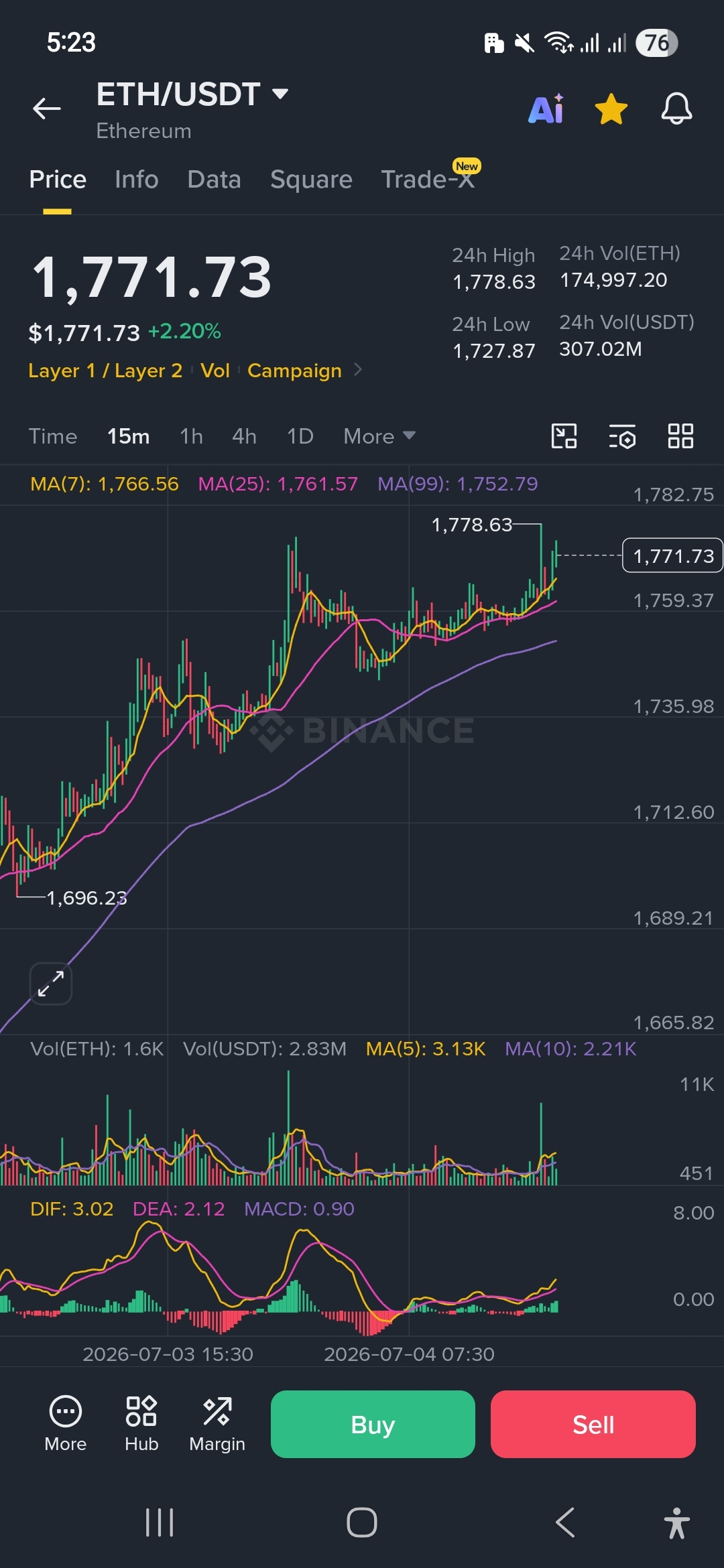
ETH just ran from 1,505 to 1,778 in about a week and the timelines are already calling it a trend change. I keep seeing this differently.
Here's what's actually true: the moving averages on the lower timeframes are stacked perfectly — MA(7) above MA(25) above MA(99), MACD flipping positive, volume picking up on the push. That's textbook bullish structure. I'm not disputing that part.
But zoom out to the daily and MA(99) is still pointing down from the March high near 2,465. We're not above the long-term trendline — we're bouncing hard underneath it. Most people think reclaiming half the drawdown means the downtrend is over. That doesn't hold up. A 55% retrace off a low is exactly what happens in bear-market relief rallies too.
Here's the uncomfortable part: this rally has been unusually clean — almost no red candles on the way up, no pullback to retest support. That's either genuine accumulation, or it's a market with very little resistance left because most sellers already left. Those look identical until price tells you which one it was.
I think 1,778-1,800 is the real test, not 1,700.
Or is everyone just excited to see ETH green again and calling it a trend?
#ETH #Write2Earn #orocryptotrends
ETH just ran from 1,505 to 1,778 in about a week and the timelines are already calling it a trend change. I keep seeing this differently.
Here's what's actually true: the moving averages on the lower timeframes are stacked perfectly — MA(7) above MA(25) above MA(99), MACD flipping positive, volume picking up on the push. That's textbook bullish structure. I'm not disputing that part.
But zoom out to the daily and MA(99) is still pointing down from the March high near 2,465. We're not above the long-term trendline — we're bouncing hard underneath it. Most people think reclaiming half the drawdown means the downtrend is over. That doesn't hold up. A 55% retrace off a low is exactly what happens in bear-market relief rallies too.
Here's the uncomfortable part: this rally has been unusually clean — almost no red candles on the way up, no pullback to retest support. That's either genuine accumulation, or it's a market with very little resistance left because most sellers already left. Those look identical until price tells you which one it was.
I think 1,778-1,800 is the real test, not 1,700.
Or is everyone just excited to see ETH green again and calling it a trend?
#ETH #Write2Earn #orocryptotrends
1
2
666
$BTC okay I've been staring at BTC charts for a bit and I'm genuinely not sure what to think.
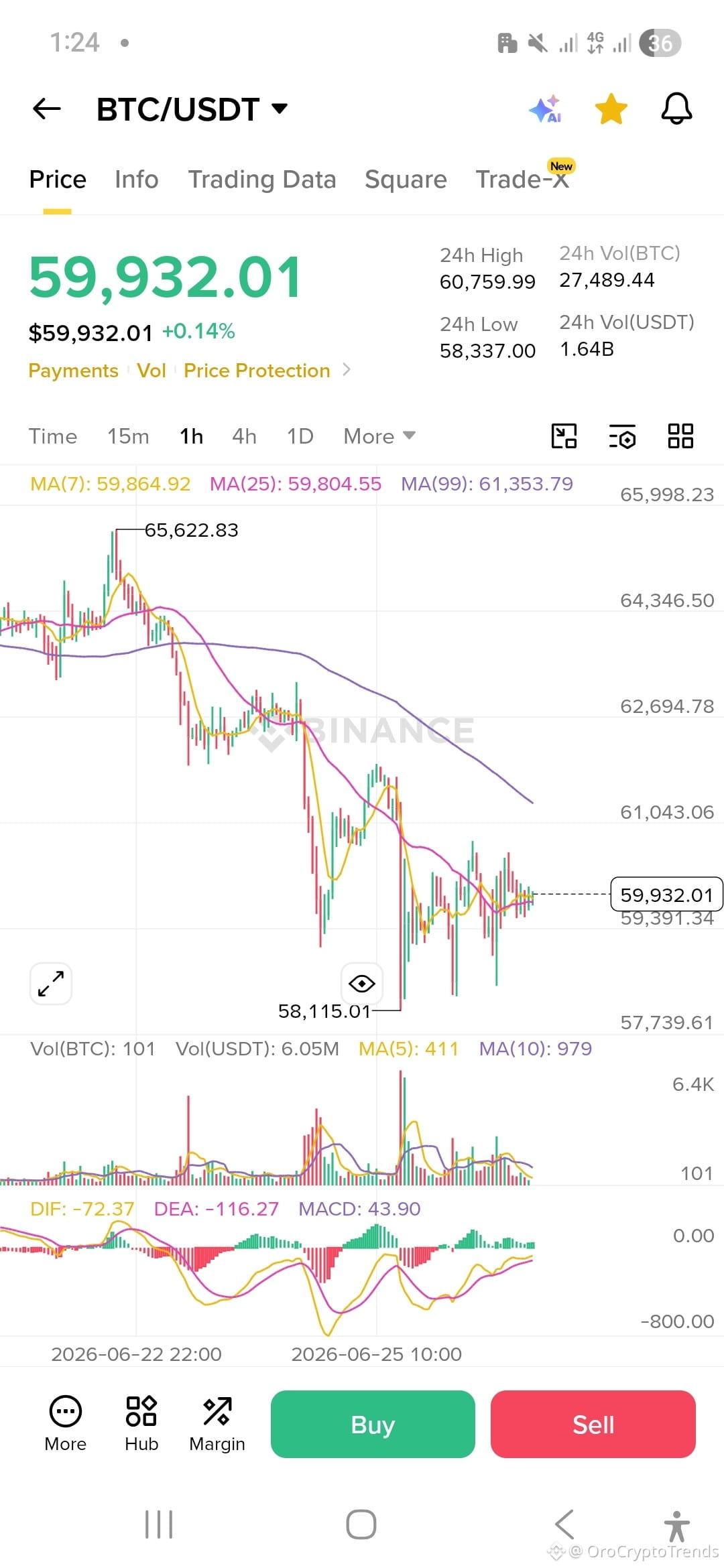
so we're at $59,940. basically $60K. and the 15-minute chart looks… actually okay? price is above MA7, MA25, MA99 on that timeframe. MACD histogram is positive at 11.14. that's something.
and then the 1H is similar. DIF crossing above DEA, price above the short-term averages. on the surface this looks like a bounce holding.
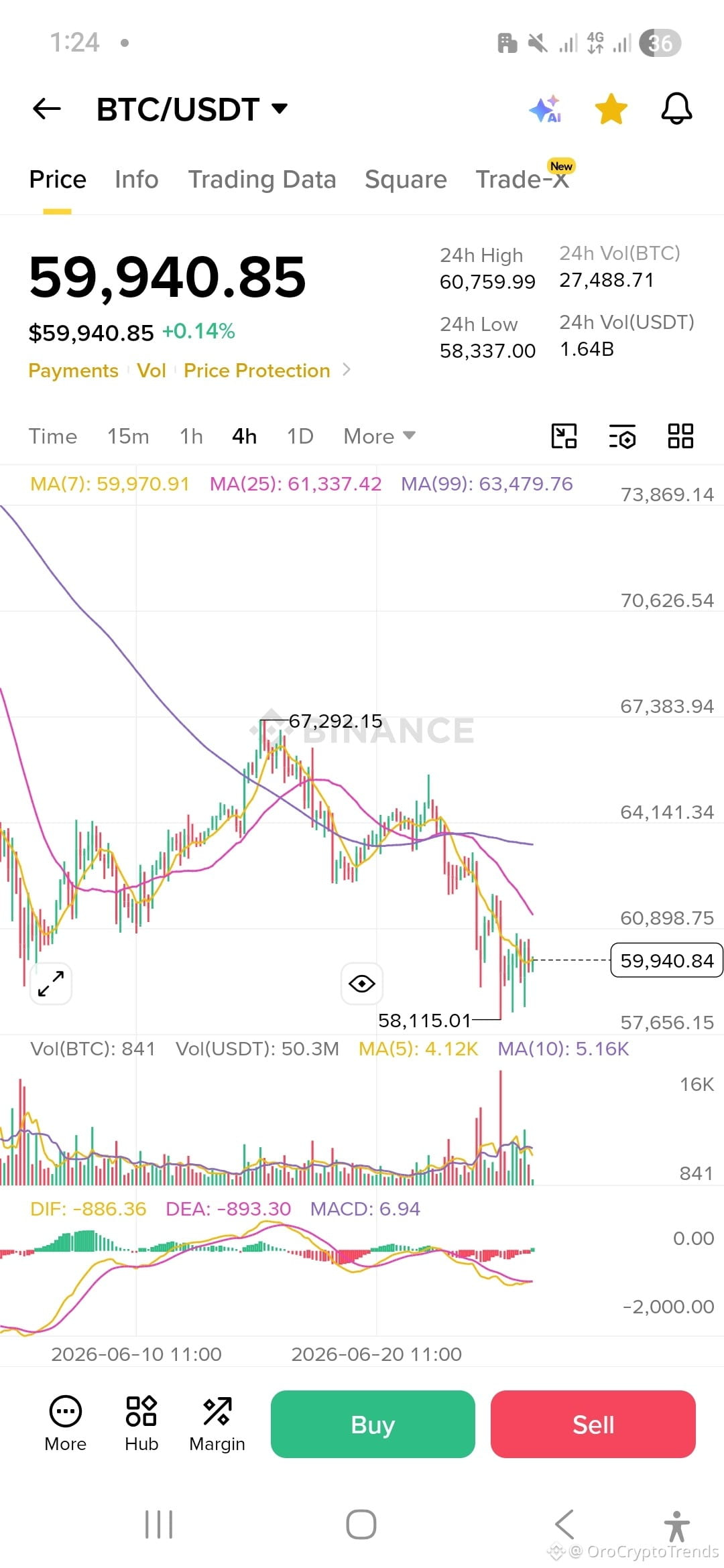
but then I switched to the 4H and… yeah. it's not pretty. price is below MA7 at $59,970, below MA25 at $61,337, below MA99 at $63,479. and the chart shows this clear drop from $67,292 down to $58,115 which happened fairly recently. that's a significant structural move down.
wait — the 4H MACD is also technically crossing positive right now. DIF at -886, DEA at -893. so technically yes it's crossing. but from that deep? I don't know if that means much yet.
the thing that keeps bothering me is the volume. on the 4H, current candle volume is 841 BTC. the 10-period average is over 5,000. on the 1H it's even worse, 101 BTC vs an average near 979. there's just... nobody here.
I remember looking at setups like this before — where the short-term looks fine but the 4H is still structurally broken and volume is missing. it usually didn't end well for the bulls.
$61,337 feels like the real test. until then I'm not calling this anything.
still trying to figure out what this bounce really changes.
#orocryptotrends #Write2Earn
$BTC okay I've been staring at BTC charts for a bit and I'm genuinely not sure what to think.
so we're at $59,940. basically $60K. and the 15-minute chart looks… actually okay? price is above MA7, MA25, MA99 on that timeframe. MACD histogram is positive at 11.14. that's something.
and then the 1H is similar. DIF crossing above DEA, price above the short-term averages. on the surface this looks like a bounce holding.
but then I switched to the 4H and… yeah. it's not pretty. price is below MA7 at $59,970, below MA25 at $61,337, below MA99 at $63,479. and the chart shows this clear drop from $67,292 down to $58,115 which happened fairly recently. that's a significant structural move down.
wait — the 4H MACD is also technically crossing positive right now. DIF at -886, DEA at -893. so technically yes it's crossing. but from that deep? I don't know if that means much yet.
the thing that keeps bothering me is the volume. on the 4H, current candle volume is 841 BTC. the 10-period average is over 5,000. on the 1H it's even worse, 101 BTC vs an average near 979. there's just... nobody here.
I remember looking at setups like this before — where the short-term looks fine but the 4H is still structurally broken and volume is missing. it usually didn't end well for the bulls.
$61,337 feels like the real test. until then I'm not calling this anything.
still trying to figure out what this bounce really changes.
#orocryptotrends #Write2Earn
so we're at $59,940. basically $60K. and the 15-minute chart looks… actually okay? price is above MA7, MA25, MA99 on that timeframe. MACD histogram is positive at 11.14. that's something.
and then the 1H is similar. DIF crossing above DEA, price above the short-term averages. on the surface this looks like a bounce holding.
but then I switched to the 4H and… yeah. it's not pretty. price is below MA7 at $59,970, below MA25 at $61,337, below MA99 at $63,479. and the chart shows this clear drop from $67,292 down to $58,115 which happened fairly recently. that's a significant structural move down.
wait — the 4H MACD is also technically crossing positive right now. DIF at -886, DEA at -893. so technically yes it's crossing. but from that deep? I don't know if that means much yet.
the thing that keeps bothering me is the volume. on the 4H, current candle volume is 841 BTC. the 10-period average is over 5,000. on the 1H it's even worse, 101 BTC vs an average near 979. there's just... nobody here.
I remember looking at setups like this before — where the short-term looks fine but the 4H is still structurally broken and volume is missing. it usually didn't end well for the bulls.
$61,337 feels like the real test. until then I'm not calling this anything.
still trying to figure out what this bounce really changes.
#orocryptotrends #Write2Earn
3
1.8k
$BTC
Staring at BTC charts for the past hour and I genuinely don't know what to make of this.
So price is sitting right around $65,450. Up about 2.1% today, which — fine. Decent move.
The 4-hour chart looks clean. Like actually clean. MA7, MA25, MA99 all stacked below price. That's the kind of structure you want to see.
But then I switched to the daily and just… stopped.
The daily MA99 is at $72,270. Current price is $65,450. That's almost a $7,000 gap. And I don't know why I keep coming back to that number but I can't shake it. The shorter timeframes are saying one thing and the daily is quietly saying something else entirely.
I remember looking at a similar setup last cycle — where everything under the daily looked bullish and then the weekly just… didn't cooperate.
Wait — maybe that's not a fair comparison. The volume today is nearly $850M USDT. That's not nothing. And the news flow is kind of interesting. Strive added 759 BTC at $65,850 average — so they're actually slightly offside right now. Not by a lot but still. And then there's a whale wallet that added $3.5M margin to increase BTC exposure at these levels.
Either these are smart entries or they're the kind of moves that look brave before they look wrong.
The $65,500 high hasn't broken yet either. Three attempts, same ceiling.
Still trying to figure out what this really changes.
#BTC $BTC #orocryptotrends #Write2Earn
$BTC
Staring at BTC charts for the past hour and I genuinely don't know what to make of this.
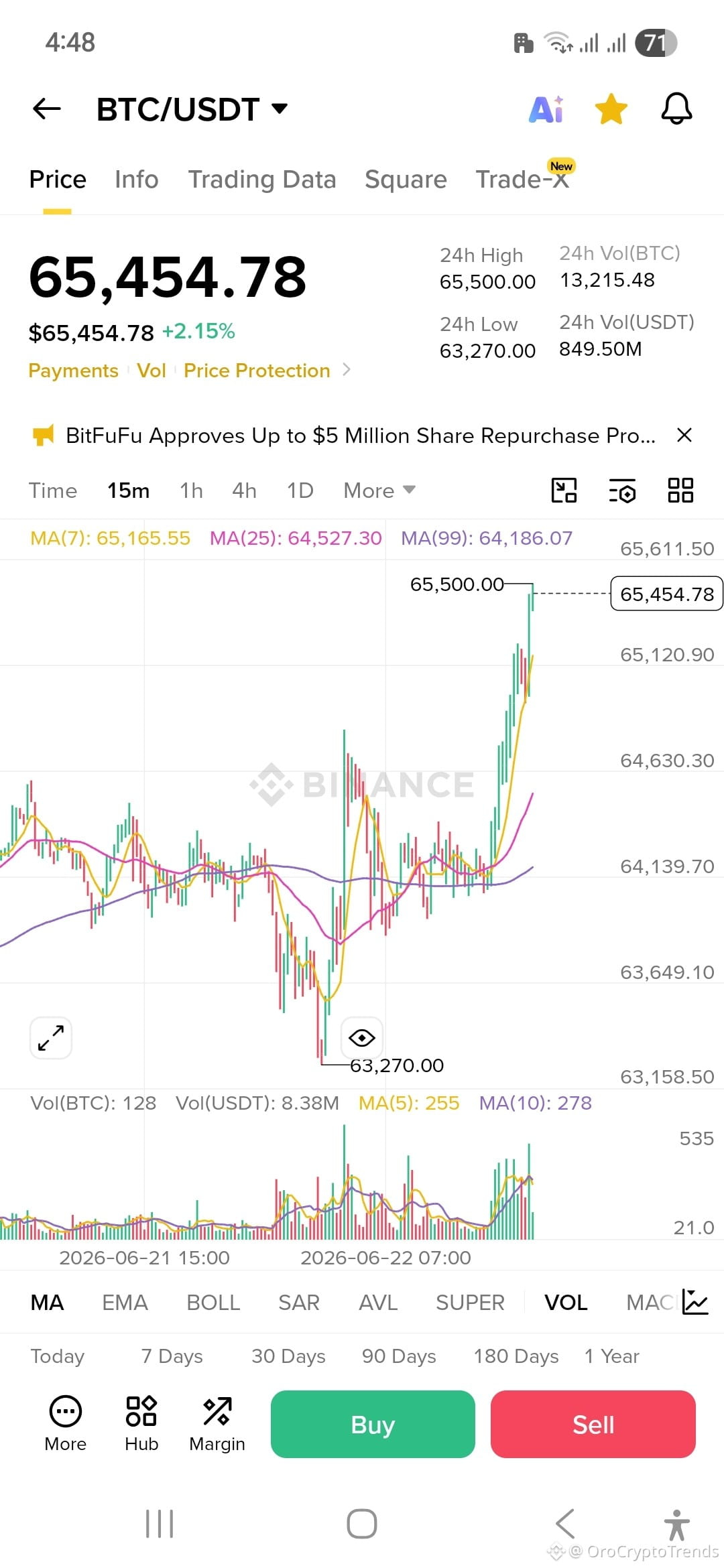
So price is sitting right around $65,450. Up about 2.1% today, which — fine. Decent move.
The 4-hour chart looks clean. Like actually clean. MA7, MA25, MA99 all stacked below price. That's the kind of structure you want to see.
But then I switched to the daily and just… stopped.
The daily MA99 is at $72,270. Current price is $65,450. That's almost a $7,000 gap. And I don't know why I keep coming back to that number but I can't shake it. The shorter timeframes are saying one thing and the daily is quietly saying something else entirely.
I remember looking at a similar setup last cycle — where everything under the daily looked bullish and then the weekly just… didn't cooperate.
Wait — maybe that's not a fair comparison. The volume today is nearly $850M USDT. That's not nothing. And the news flow is kind of interesting. Strive added 759 BTC at $65,850 average — so they're actually slightly offside right now. Not by a lot but still. And then there's a whale wallet that added $3.5M margin to increase BTC exposure at these levels.
Either these are smart entries or they're the kind of moves that look brave before they look wrong.
The $65,500 high hasn't broken yet either. Three attempts, same ceiling.
Still trying to figure out what this really changes.
#BTC $BTC #orocryptotrends #Write2Earn
Staring at BTC charts for the past hour and I genuinely don't know what to make of this.
So price is sitting right around $65,450. Up about 2.1% today, which — fine. Decent move.
The 4-hour chart looks clean. Like actually clean. MA7, MA25, MA99 all stacked below price. That's the kind of structure you want to see.
But then I switched to the daily and just… stopped.
The daily MA99 is at $72,270. Current price is $65,450. That's almost a $7,000 gap. And I don't know why I keep coming back to that number but I can't shake it. The shorter timeframes are saying one thing and the daily is quietly saying something else entirely.
I remember looking at a similar setup last cycle — where everything under the daily looked bullish and then the weekly just… didn't cooperate.
Wait — maybe that's not a fair comparison. The volume today is nearly $850M USDT. That's not nothing. And the news flow is kind of interesting. Strive added 759 BTC at $65,850 average — so they're actually slightly offside right now. Not by a lot but still. And then there's a whale wallet that added $3.5M margin to increase BTC exposure at these levels.
Either these are smart entries or they're the kind of moves that look brave before they look wrong.
The $65,500 high hasn't broken yet either. Three attempts, same ceiling.
Still trying to figure out what this really changes.
#BTC $BTC #orocryptotrends #Write2Earn
1
2
2.5k
Connectez-vous pour découvrir plus de contenu
Rejoignez la communauté mondiale des adeptes de cryptomonnaies sur Binance Square
⚡️ Suviez les dernières informations importantes sur les cryptomonnaies.
💬 Jugé digne de confiance par la plus grande plateforme d’échange de cryptomonnaies au monde.
👍 Découvrez les connaissances que partagent les créateurs vérifiés.
Adresse e-mail/Nº de téléphone
Sujets d’actualité
1
#ZcashETFPostsFirstWeeklyOutflow$93.6M
47,509 vues
143 mentions
2
#GreekPoliceBustCryptoScamRingArrest17
123,786 vues
900 mentions
3
#BitcoinRejectedAt$87K
143,201 vues
199 mentions
4
#FedOctoberRateHikeOddsFallTo17%
153,786 vues
1,129 mentions
5
#NvidiaHitsRecordHighUp2.4%
111,043 vues
804 mentions
6
#CanaryFilesAmendedS1ForPEPEETF
27,219 vues
559 mentions
7
#BitcoinParesGainsAfterRallyTo$86.5K
52,452 vues
169 mentions
8
#CerebrasSinksNearly20%OnReportNvidiaToPowerOpenAI
133,483 vues
1,179 mentions
9
#SECProposesCryptoCustodyRules
183,631 vues
1,453 mentions
10
#SECApproves3xLongCryptoCommodityETPs
85,243 vues
714 mentions