Binance Square

vanar

4.3M vues
108,273 mentions
ZainAli655
·
--
Vanar Chain Is Quietly Building the AI Layer Web3 Actually NeedsMost people still think blockchains are just ledgers with smart contracts stapled on. That mindset is exactly why Vanar Chain stands out right now. Vanar isn’t chasing headline TPS numbers or meme-level hype. It’s focused on something more structural: making blockchain AI-native, not AI-compatible as an afterthought. That distinction matters more than it sounds. At a technical level, @Vanar is EVM-compatible, which means developers don’t have to relearn everything from scratch. Solidity still works. Ethereum tooling still works. That alone removes a massive adoption barrier. But where Vanar gets interesting is how it treats data. Instead of storing raw blobs and leaving interpretation off-chain, Vanar introduces semantic data structures designed for machine reasoning. In practice, that means AI agents can read, understand, and act on on-chain data without relying heavily on external services. That’s a big deal for things like PayFi automation, risk scoring, or tokenized real-world assets where context and rules actually matter. From a market perspective, $VANRY is still flying under the radar. It’s trading at early-stage valuations, with liquidity and price action reflecting a chain that’s still building rather than one already saturated with speculation. That cuts both ways. Upside exists if adoption follows, but volatility is part of the package. Anyone pretending otherwise isn’t being honest. What is encouraging is ecosystem direction. Vanar has been leaning into builder support, partnerships, and infrastructure tooling instead of flashy marketing. You can see it in how the project talks about use cases. Less “number go up,” more “here’s how intelligent execution actually works.” Compare that to many Layer 1s. Ethereum is the settlement backbone. Solana optimizes for speed and consumer apps. Vanar is mark out a lane around adaptive, AI-driven performance, where contracts don’t just follow static if-else logic but evolve based on data and conditions. Of course, this path isn’t risk-free. AI-native chains face a steeper education curve. Developers need to understand new primitives. Users need real applications before narratives stick. And Vanar still has to prove that these ideas scale in production, not just whitepapers. But if the next wave of Web3 apps involves autonomous agents, intelligent payments, and real-world financial logic, chains like Vanar won’t feel optional. They’ll feel necessary. That’s why I keep an eye on #vanar . It’s not the loudest project in the room. But it might be one of the more forward-looking ones.

Vanar Chain Is Quietly Building the AI Layer Web3 Actually Needs

Most people still think blockchains are just ledgers with smart contracts stapled on. That mindset is exactly why Vanar Chain stands out right now. Vanar isn’t chasing headline TPS numbers or meme-level hype. It’s focused on something more structural: making blockchain AI-native, not AI-compatible as an afterthought. That distinction matters more than it sounds.

At a technical level, @Vanarchain is EVM-compatible, which means developers don’t have to relearn everything from scratch. Solidity still works. Ethereum tooling still works. That alone removes a massive adoption barrier. But where Vanar gets interesting is how it treats data. Instead of storing raw blobs and leaving interpretation off-chain, Vanar introduces semantic data structures designed for machine reasoning.
In practice, that means AI agents can read, understand, and act on on-chain data without relying heavily on external services. That’s a big deal for things like PayFi automation, risk scoring, or tokenized real-world assets where context and rules actually matter.

From a market perspective, $VANRY is still flying under the radar. It’s trading at early-stage valuations, with liquidity and price action reflecting a chain that’s still building rather than one already saturated with speculation. That cuts both ways. Upside exists if adoption follows, but volatility is part of the package. Anyone pretending otherwise isn’t being honest.
What is encouraging is ecosystem direction. Vanar has been leaning into builder support, partnerships, and infrastructure tooling instead of flashy marketing. You can see it in how the project talks about use cases. Less “number go up,” more “here’s how intelligent execution actually works.”

Compare that to many Layer 1s. Ethereum is the settlement backbone. Solana optimizes for speed and consumer apps. Vanar is mark out a lane around adaptive, AI-driven performance, where contracts don’t just follow static if-else logic but evolve based on data and conditions.
Of course, this path isn’t risk-free. AI-native chains face a steeper education curve. Developers need to understand new primitives. Users need real applications before narratives stick. And Vanar still has to prove that these ideas scale in production, not just whitepapers.

But if the next wave of Web3 apps involves autonomous agents, intelligent payments, and real-world financial logic, chains like Vanar won’t feel optional. They’ll feel necessary. That’s why I keep an eye on #vanar . It’s not the loudest project in the room. But it might be one of the more forward-looking ones.
Vanar Chain: Building the Foundation for Immersive, AI-Driven Web3 Experiences@Vanar The evolution of blockchain technology is entering a new phase. While early networks focused primarily on decentralization and basic financial use cases, the next generation of chains must solve a much bigger challenge: supporting immersive, real-time, and user-centric digital experiences at scale. This is exactly where Vanar Chain is positioning itself. Rather than competing purely on hype or short-term metrics, Vanar is building infrastructure designed for the future of gaming, AI, virtual worlds, and interactive Web3 applications. At its core, Vanar Chain is a high-performance Layer 1 blockchain optimized for low latency and scalability. These two factors are often underestimated, yet they are critical for mass adoption. Traditional blockchains struggle when applications require real-time interactions, instant feedback, or complex in-game mechanics. Vanar addresses this gap by focusing on performance without compromising decentralization or security. This makes it especially attractive for developers who want to build experiences that feel smooth and intuitive for everyday users. One of the most important aspects of Vanar Chain is its clear focus on use-case-driven design. Instead of being a general-purpose chain trying to serve everyone at once, Vanar is strategically aligned with industries that demand speed and reliability. Gaming is a prime example. Blockchain gaming has long promised true asset ownership and open economies, but poor user experience has held it back. High fees, slow confirmations, and clunky wallets often break immersion. Vanar’s architecture is designed to remove these barriers, allowing developers to create games where blockchain elements run seamlessly in the background. Beyond gaming, Vanar Chain is also built with AI and immersive technologies in mind. As artificial intelligence becomes more integrated into digital platforms, blockchains will need to support large volumes of data interactions and automated decision-making. Vanar’s infrastructure aims to be compatible with these emerging demands, making it a strong candidate for AI-powered dApps, smart virtual environments, and next-generation digital ecosystems. This forward-looking approach suggests that Vanar is not just reacting to current trends, but actively preparing for what Web3 will look like in the coming years. The ecosystem is powered by its native token, VANRY, which plays a central role in the network. VANRY is used for transaction fees, network security, and ecosystem incentives. More importantly, it aligns the interests of users, developers, and validators. A healthy token economy is essential for long-term sustainability, and Vanar appears focused on building real utility rather than speculative narratives. As more applications are deployed on the network, the demand for VANRY naturally grows through genuine usage rather than artificial incentives. Another strong signal of Vanar’s seriousness is the way the team communicates and builds in public. The official project account, vanar, consistently highlights development progress, partnerships, and ecosystem growth rather than price-driven marketing. In an industry often dominated by short-term attention cycles, this approach stands out. It reflects a mindset focused on long-term value creation and developer trust. Builders want stability, clarity, and support—and these are qualities that help an ecosystem grow organically. Community and developer experience are also key pillars of Vanar Chain. A blockchain is only as strong as the applications built on it, and Vanar recognizes this by prioritizing tooling, documentation, and onboarding. By lowering the barrier to entry for developers, the network increases the likelihood of innovative projects emerging within its ecosystem. Over time, this creates a positive feedback loop: better tools attract better developers, which leads to better applications and stronger user adoption. From a broader perspective, Vanar Chain fits neatly into the ongoing shift in Web3 narratives. The industry is moving away from purely financial speculation and toward utility, experience, and integration with real digital life. Users no longer want to think about gas fees or transaction delays—they want applications that simply work. Chains that can deliver this invisible, frictionless experience will be the ones that survive and thrive. Vanar’s design philosophy aligns closely with this direction. It is also worth noting that infrastructure chains often take time to be fully appreciated. Their value becomes clearer as ecosystems mature and real applications gain traction. Vanar Chain appears to be in this foundational phase, focusing on building the rails before mass adoption arrives. For those paying attention to long-term trends rather than short-term noise, this stage can be the most interesting. In summary, Vanar Chain represents a thoughtful approach to blockchain development—one that prioritizes performance, real-world usability, and future-ready design. With a growing ecosystem, a clear vision, and a utility-driven token model powered by $VANRY , the project is positioning itself as a serious contender in the next wave of Web3 infrastructure. As immersive digital experiences, AI integration, and blockchain gaming continue to evolve, Vanar Chain is building the foundation needed to support them. #vanar $VANRY {spot}(VANRYUSDT)

Vanar Chain: Building the Foundation for Immersive, AI-Driven Web3 Experiences

@Vanarchain

The evolution of blockchain technology is entering a new phase. While early networks focused primarily on decentralization and basic financial use cases, the next generation of chains must solve a much bigger challenge: supporting immersive, real-time, and user-centric digital experiences at scale. This is exactly where Vanar Chain is positioning itself. Rather than competing purely on hype or short-term metrics, Vanar is building infrastructure designed for the future of gaming, AI, virtual worlds, and interactive Web3 applications.

At its core, Vanar Chain is a high-performance Layer 1 blockchain optimized for low latency and scalability. These two factors are often underestimated, yet they are critical for mass adoption. Traditional blockchains struggle when applications require real-time interactions, instant feedback, or complex in-game mechanics. Vanar addresses this gap by focusing on performance without compromising decentralization or security. This makes it especially attractive for developers who want to build experiences that feel smooth and intuitive for everyday users.

One of the most important aspects of Vanar Chain is its clear focus on use-case-driven design. Instead of being a general-purpose chain trying to serve everyone at once, Vanar is strategically aligned with industries that demand speed and reliability. Gaming is a prime example. Blockchain gaming has long promised true asset ownership and open economies, but poor user experience has held it back. High fees, slow confirmations, and clunky wallets often break immersion. Vanar’s architecture is designed to remove these barriers, allowing developers to create games where blockchain elements run seamlessly in the background.

Beyond gaming, Vanar Chain is also built with AI and immersive technologies in mind. As artificial intelligence becomes more integrated into digital platforms, blockchains will need to support large volumes of data interactions and automated decision-making. Vanar’s infrastructure aims to be compatible with these emerging demands, making it a strong candidate for AI-powered dApps, smart virtual environments, and next-generation digital ecosystems. This forward-looking approach suggests that Vanar is not just reacting to current trends, but actively preparing for what Web3 will look like in the coming years.

The ecosystem is powered by its native token, VANRY, which plays a central role in the network. VANRY is used for transaction fees, network security, and ecosystem incentives. More importantly, it aligns the interests of users, developers, and validators. A healthy token economy is essential for long-term sustainability, and Vanar appears focused on building real utility rather than speculative narratives. As more applications are deployed on the network, the demand for VANRY naturally grows through genuine usage rather than artificial incentives.

Another strong signal of Vanar’s seriousness is the way the team communicates and builds in public. The official project account, vanar, consistently highlights development progress, partnerships, and ecosystem growth rather than price-driven marketing. In an industry often dominated by short-term attention cycles, this approach stands out. It reflects a mindset focused on long-term value creation and developer trust. Builders want stability, clarity, and support—and these are qualities that help an ecosystem grow organically.

Community and developer experience are also key pillars of Vanar Chain. A blockchain is only as strong as the applications built on it, and Vanar recognizes this by prioritizing tooling, documentation, and onboarding. By lowering the barrier to entry for developers, the network increases the likelihood of innovative projects emerging within its ecosystem. Over time, this creates a positive feedback loop: better tools attract better developers, which leads to better applications and stronger user adoption.

From a broader perspective, Vanar Chain fits neatly into the ongoing shift in Web3 narratives. The industry is moving away from purely financial speculation and toward utility, experience, and integration with real digital life. Users no longer want to think about gas fees or transaction delays—they want applications that simply work. Chains that can deliver this invisible, frictionless experience will be the ones that survive and thrive. Vanar’s design philosophy aligns closely with this direction.

It is also worth noting that infrastructure chains often take time to be fully appreciated. Their value becomes clearer as ecosystems mature and real applications gain traction. Vanar Chain appears to be in this foundational phase, focusing on building the rails before mass adoption arrives. For those paying attention to long-term trends rather than short-term noise, this stage can be the most interesting.

In summary, Vanar Chain represents a thoughtful approach to blockchain development—one that prioritizes performance, real-world usability, and future-ready design. With a growing ecosystem, a clear vision, and a utility-driven token model powered by $VANRY , the project is positioning itself as a serious contender in the next wave of Web3 infrastructure. As immersive digital experiences, AI integration, and blockchain gaming continue to evolve, Vanar Chain is building the foundation needed to support them.

#vanar $VANRY
$VANRY Phase 1: Why the February 4th Snapshot is the Real Technical TestIf you’ve been watching the Vanar CreatorPad leaderboard, you know the stakes. Tomorrow, February 4th, Binance takes the first major snapshot to distribute the first 3,014,705 VANRY reward pool. But here is the thing: Most people are treatng this like a popularity contest. The reality? The Binance algorithm has shifted. Since the January 27th update, "spam" is being filtered out in favor of Effective Traffic. To move up from Rank 130 into that Top 100 zone, you have to stop shouting "to the moon" and start talking about why the V23 Protocol is a fundamental shift in how blockchains actually work. Beyond the Hype: The V23 "Brain" Upgrade We’ve moved past the era of "dumb" Layer 1s that just record transactions. The V23 upgrade transitioned Vanar into a Smart Infrastructure. What this really means is that the Kayon AI engine is now integrated directly into the consensus layer. Unlike other chains where AI is just a separate app, Vanar’s validators can perform "on-chain reasoning." This allows the network to verify complex data and execute smart contracts based on logic that evolves, rather than just static "if/then" code. Solving the "Amnesia" Problem with Neutron The biggest hurdle for AI on a blockchain has always been memory. Blockchains usually "forget" old data to stay fast. Vanar’s Neutron Layer fixes this by using semantic compression (a 500:1 ratio) to turn massive datasets into Neutron Seeds. Imagine taking a 25MB legal contract and shrinking it into a 50KB "Seed" that stays on-chain permanently. The AI doesn't just store it; it understands it. This is why brands like Google Cloud and Worldpay are paying attention—it’s the first time they can store real business data on-chain without breaking the bank. The $0.0005 Anchor Let’s talk about the "Boring Breakthrough": Fixed Fees. In a volatile market, gas fees on other chains can jump 100x in an hour. No business can build a budget on that. Vanar’s fees are pegged to a USD target of $0.0005. Whether VANRY is at $0.10 or $1.00, the cost for a business to move data stays the same. This predictability is the bridge that finally brings Web2 giants into the Web3 world. The Final Sprint to the Top 100 With the snapshot coming tomorrow. What’s your current strategy for the final 24 hours of Phase 1? Are you holding your rank or making a late-night push? Let’s talk about the leaderboard stats below! #vanar @Vanar $VANRY $HYPE {future}(VANRYUSDT) #TrumpProCrypto

$VANRY Phase 1: Why the February 4th Snapshot is the Real Technical Test

If you’ve been watching the Vanar CreatorPad leaderboard, you know the stakes. Tomorrow, February 4th, Binance takes the first major snapshot to distribute the first 3,014,705 VANRY reward pool.
But here is the thing: Most people are treatng this like a popularity contest. The reality? The Binance algorithm has shifted. Since the January 27th update, "spam" is being filtered out in favor of Effective Traffic. To move up from Rank 130 into that Top 100 zone, you have to stop shouting "to the moon" and start talking about why the V23 Protocol is a fundamental shift in how blockchains actually work.
Beyond the Hype: The V23 "Brain" Upgrade
We’ve moved past the era of "dumb" Layer 1s that just record transactions. The V23 upgrade transitioned Vanar into a Smart Infrastructure.
What this really means is that the Kayon AI engine is now integrated directly into the consensus layer. Unlike other chains where AI is just a separate app, Vanar’s validators can perform "on-chain reasoning." This allows the network to verify complex data and execute smart contracts based on logic that evolves, rather than just static "if/then" code.
Solving the "Amnesia" Problem with Neutron
The biggest hurdle for AI on a blockchain has always been memory. Blockchains usually "forget" old data to stay fast. Vanar’s Neutron Layer fixes this by using semantic compression (a 500:1 ratio) to turn massive datasets into Neutron Seeds.
Imagine taking a 25MB legal contract and shrinking it into a 50KB "Seed" that stays on-chain permanently. The AI doesn't just store it; it understands it. This is why brands like Google Cloud and Worldpay are paying attention—it’s the first time they can store real business data on-chain without breaking the bank.
The $0.0005 Anchor
Let’s talk about the "Boring Breakthrough": Fixed Fees.
In a volatile market, gas fees on other chains can jump 100x in an hour. No business can build a budget on that. Vanar’s fees are pegged to a USD target of $0.0005. Whether VANRY is at $0.10 or $1.00, the cost for a business to move data stays the same. This predictability is the bridge that finally brings Web2 giants into the Web3 world.
The Final Sprint to the Top 100
With the snapshot coming tomorrow.
What’s your current strategy for the final 24 hours of Phase 1? Are you holding your rank or making a late-night push? Let’s talk about the leaderboard stats below!
#vanar @Vanarchain $VANRY
$HYPE
#TrumpProCrypto
When Speed Becomes the Product: Why Vanar Feels DifferentI’ve stopped judging chains by how many “features” they list and started judging them by something simpler: do they make real apps feel normal? In gaming, creator tools, and interactive media, latency isn’t a technical detail — it’s the entire experience. I keep a small sticky note near my desk that says, “latency kills magic,” and it’s annoyingly true. That’s where @vanar keeps pulling my attention. Vanar Chain isn’t positioning itself as a general-purpose everything-chain; it’s leaning into fast, consumer-grade interaction as the baseline, not the aspiration. When a network is built for AI-driven apps and always-on user activity, you start caring less about slogans and more about practical plumbing: throughput, finality feel, smooth UX, and whether the stack is designed for intelligence instead of bolted-on “AI” branding. � VanarChain +1 One 2025 moment that mattered was the protocol renewal narrative around the V23 upgrade being completed in November 2025 — not because upgrades are rare, but because the messaging shifted toward usability and scale as lived outcomes, not theoretical capacity. � Most L1s talk about adoption; few design for it. That’s the blunt truth. Binance If $VANRY ends up compounding value over time, it won’t be because people “discover” it on a chart. It’ll be because builders keep shipping things that normal users don’t have to think about. And honestly, it’s a bit messy sometimes. But that’s what real ecosystems look like when they’re trying to move from crypto-native to consumer-native without pretending the hard parts don’t exist. @Vanar $VANRY #vanar

When Speed Becomes the Product: Why Vanar Feels Different

I’ve stopped judging chains by how many “features” they list and started judging them by something simpler: do they make real apps feel normal? In gaming, creator tools, and interactive media, latency isn’t a technical detail — it’s the entire experience. I keep a small sticky note near my desk that says, “latency kills magic,” and it’s annoyingly true.
That’s where @vanar keeps pulling my attention. Vanar Chain isn’t positioning itself as a general-purpose everything-chain; it’s leaning into fast, consumer-grade interaction as the baseline, not the aspiration. When a network is built for AI-driven apps and always-on user activity, you start caring less about slogans and more about practical plumbing: throughput, finality feel, smooth UX, and whether the stack is designed for intelligence instead of bolted-on “AI” branding. �
VanarChain +1
One 2025 moment that mattered was the protocol renewal narrative around the V23 upgrade being completed in November 2025 — not because upgrades are rare, but because the messaging shifted toward usability and scale as lived outcomes, not theoretical capacity. � Most L1s talk about adoption; few design for it. That’s the blunt truth.
Binance
If $VANRY ends up compounding value over time, it won’t be because people “discover” it on a chart. It’ll be because builders keep shipping things that normal users don’t have to think about. And honestly, it’s a bit messy sometimes. But that’s what real ecosystems look like when they’re trying to move from crypto-native to consumer-native without pretending the hard parts don’t exist.
@Vanarchain $VANRY #vanar
Vanar: Building a Blockchain That Real People Can Actually UseMost blockchains did not start with everyday people in mind. They were built for developers, traders, or early crypto users who already understood wallets, gas fees, and complex interfaces. When I look at Vanar, the starting idea feels different. It comes from a simple question: if blockchain is meant to power the future of the internet, why does it still feel so hard to use? The Vanar team comes from gaming, entertainment, and brand-focused industries. They’re used to working with millions of users who do not care about blockchain terminology but deeply care about smooth experiences. That background shaped Vanar’s core philosophy. The goal was never to build just another Layer 1. It was to build an infrastructure that feels natural for games, virtual worlds, AI-driven experiences, and consumer brands. If Web3 is going to reach the next three billion people, it has to feel invisible, fast, and reliable. This is where $BTC vision took shape. Instead of asking users to adapt to blockchain, the blockchain adapts to users.Vanar chose to become a Layer 1 because real-world adoption requires control at the base level. When you build on top of another chain, you inherit its limits. Vanar needed freedom to optimize performance, cost, and scalability specifically for consumer-facing products. The design decisions focus on high throughput, low latency, and predictable fees. Games and metaverse environments cannot pause because a network is congested. Brands cannot explain to customers why a simple action suddenly costs more. Vanar is designed to process large volumes of activity smoothly, even when demand increases. I’m particularly drawn to how Vanar treats blockchain as infrastructure rather than a product. Users are not meant to think about the chain. They interact with worlds, games, AI tools, and digital assets while Vanar quietly handles ownership, transactions, and security in the background. At its core, Vanar operates as a scalable Layer 1 network secured by validators and powered by the VANRY token. VANRY is used for transaction fees, network security, and participation across the ecosystem. But the system is not built around speculation. It is built around usage. Vanar supports applications that demand constant interaction. This includes gaming networks, virtual environments, and brand activations where thousands of users may act at the same time. The network is optimized to keep these interactions fast and stable. What makes Vanar different is how its products are not theoretical. They are live environments where users already spend time. Virtua Metaverse is a working digital world, not just a whitepaper concept. VGN is a real gaming network that connects developers and players. These products act as stress tests for the chain. They prove whether the technology works under real conditions.If the system slows down, users leave. If it stays smooth, adoption grows. That feedback loop is built directly into Vanar’s design. Virtua Metaverse is one of the clearest expressions of Vanar’s philosophy. It blends gaming, digital ownership, and immersive environments into a single experience. Users are not told they are “using blockchain.” They are collecting, exploring, and interacting. Blockchain simply makes ownership and persistence possible. VGN, the Vanar Games Network, focuses on helping games integrate Web3 features without sacrificing fun or performance. Many blockchain games failed because they put tokens before gameplay. Vanar’s approach flips that logic. Gameplay comes first. Blockchain supports it quietly. Across eco-focused initiatives, and brand solutions, the same pattern repeats. Vanar builds tools that fit into existing industries instead of forcing industries to change how they work. Vanar’s success is not measured only by token price. The real metrics are adoption, retention, and performance under load. Active users across Virtua and VGN matter more than short-term hype. Developer interest matters because builders choose platforms that make their work easier. Another important signal is partnerships. When brands and entertainment companies build on Vanar, it shows trust in the technology. These organizations care about reputation and user experience. They do not experiment lightly. Network stability, transaction costs staying low during peak usage, and continued product launches are all signs that Vanar is moving in the right direction. Vanar is not without risk. Competition in the Layer 1 space is intense, and attention is limited. Many chains promise mass adoption, but few deliver it. Vanar must continue proving that its technology can scale as user numbers grow. Another risk is onboarding. Even the best infrastructure can fail if tools are not simple enough for developers and users. Education, documentation, and user experience must keep improving. Market cycles also matter. When interest in crypto slows, building through that period becomes harder. If momentum fades, projects must rely on real value rather than speculation. This is where Vanar’s focus on actual products could become its strength, but it still requires patience and execution. If Vanar succeeds, it becomes something most blockchains never achieve. It becomes invisible infrastructure for digital life. Games, virtual worlds, AI-driven experiences, and brand ecosystems could run on Vanar without users even knowing its name. They’re not trying to replace everything. They’re trying to support the experiences people already love and make them better through ownership, interoperability, and trust. Over time, Vanar could evolve into a standard layer for entertainment-focused Web3, where creators build freely and users participate naturally. If it becomes reliable enough, it could quietly power millions of daily interactions. Vanar feels like a project built by people who understand users, not just technology. I’m drawn to that because mass adoption will not come from complexity. It will come from systems that feel human. We’re seeing blockchain grow up, moving away from experiments and toward real use. If Vanar continues executing on its vision, it has a chance to become part of everyday digital life. If that happens, the most powerful sign of success will be simple. People will be using it without thinking about it at all. @Vanar #vanar $VANRY

Vanar: Building a Blockchain That Real People Can Actually Use

Most blockchains did not start with everyday people in mind. They were built for developers, traders, or early crypto users who already understood wallets, gas fees, and complex interfaces. When I look at Vanar, the starting idea feels different. It comes from a simple question: if blockchain is meant to power the future of the internet, why does it still feel so hard to use?

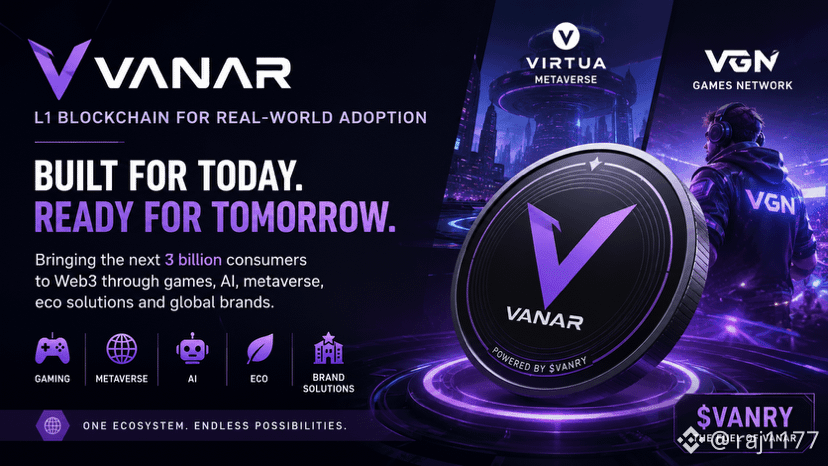
The Vanar team comes from gaming, entertainment, and brand-focused industries. They’re used to working with millions of users who do not care about blockchain terminology but deeply care about smooth experiences. That background shaped Vanar’s core philosophy. The goal was never to build just another Layer 1. It was to build an infrastructure that feels natural for games, virtual worlds, AI-driven experiences, and consumer brands. If Web3 is going to reach the next three billion people, it has to feel invisible, fast, and reliable.

This is where $BTC vision took shape. Instead of asking users to adapt to blockchain, the blockchain adapts to users.Vanar chose to become a Layer 1 because real-world adoption requires control at the base level. When you build on top of another chain, you inherit its limits. Vanar needed freedom to optimize performance, cost, and scalability specifically for consumer-facing products.

The design decisions focus on high throughput, low latency, and predictable fees. Games and metaverse environments cannot pause because a network is congested. Brands cannot explain to customers why a simple action suddenly costs more. Vanar is designed to process large volumes of activity smoothly, even when demand increases.

I’m particularly drawn to how Vanar treats blockchain as infrastructure rather than a product. Users are not meant to think about the chain. They interact with worlds, games, AI tools, and digital assets while Vanar quietly handles ownership, transactions, and security in the background.

At its core, Vanar operates as a scalable Layer 1 network secured by validators and powered by the VANRY token. VANRY is used for transaction fees, network security, and participation across the ecosystem. But the system is not built around speculation. It is built around usage.

Vanar supports applications that demand constant interaction. This includes gaming networks, virtual environments, and brand activations where thousands of users may act at the same time. The network is optimized to keep these interactions fast and stable.

What makes Vanar different is how its products are not theoretical. They are live environments where users already spend time. Virtua Metaverse is a working digital world, not just a whitepaper concept. VGN is a real gaming network that connects developers and players. These products act as stress tests for the chain. They prove whether the technology works under real conditions.If the system slows down, users leave. If it stays smooth, adoption grows. That feedback loop is built directly into Vanar’s design.

Virtua Metaverse is one of the clearest expressions of Vanar’s philosophy. It blends gaming, digital ownership, and immersive environments into a single experience. Users are not told they are “using blockchain.” They are collecting, exploring, and interacting. Blockchain simply makes ownership and persistence possible.

VGN, the Vanar Games Network, focuses on helping games integrate Web3 features without sacrificing fun or performance. Many blockchain games failed because they put tokens before gameplay. Vanar’s approach flips that logic. Gameplay comes first. Blockchain supports it quietly.

Across eco-focused initiatives, and brand solutions, the same pattern repeats. Vanar builds tools that fit into existing industries instead of forcing industries to change how they work.

Vanar’s success is not measured only by token price. The real metrics are adoption, retention, and performance under load. Active users across Virtua and VGN matter more than short-term hype. Developer interest matters because builders choose platforms that make their work easier.

Another important signal is partnerships. When brands and entertainment companies build on Vanar, it shows trust in the technology. These organizations care about reputation and user experience. They do not experiment lightly.

Network stability, transaction costs staying low during peak usage, and continued product launches are all signs that Vanar is moving in the right direction.

Vanar is not without risk. Competition in the Layer 1 space is intense, and attention is limited. Many chains promise mass adoption, but few deliver it. Vanar must continue proving that its technology can scale as user numbers grow.

Another risk is onboarding. Even the best infrastructure can fail if tools are not simple enough for developers and users. Education, documentation, and user experience must keep improving.

Market cycles also matter. When interest in crypto slows, building through that period becomes harder. If momentum fades, projects must rely on real value rather than speculation. This is where Vanar’s focus on actual products could become its strength, but it still requires patience and execution.

If Vanar succeeds, it becomes something most blockchains never achieve. It becomes invisible infrastructure for digital life. Games, virtual worlds, AI-driven experiences, and brand ecosystems could run on Vanar without users even knowing its name.

They’re not trying to replace everything. They’re trying to support the experiences people already love and make them better through ownership, interoperability, and trust.

Over time, Vanar could evolve into a standard layer for entertainment-focused Web3, where creators build freely and users participate naturally. If it becomes reliable enough, it could quietly power millions of daily interactions.

Vanar feels like a project built by people who understand users, not just technology. I’m drawn to that because mass adoption will not come from complexity. It will come from systems that feel human.

We’re seeing blockchain grow up, moving away from experiments and toward real use. If Vanar continues executing on its vision, it has a chance to become part of everyday digital life. If that happens, the most powerful sign of success will be simple. People will be using it without thinking about it at all.

@Vanarchain #vanar $VANRY
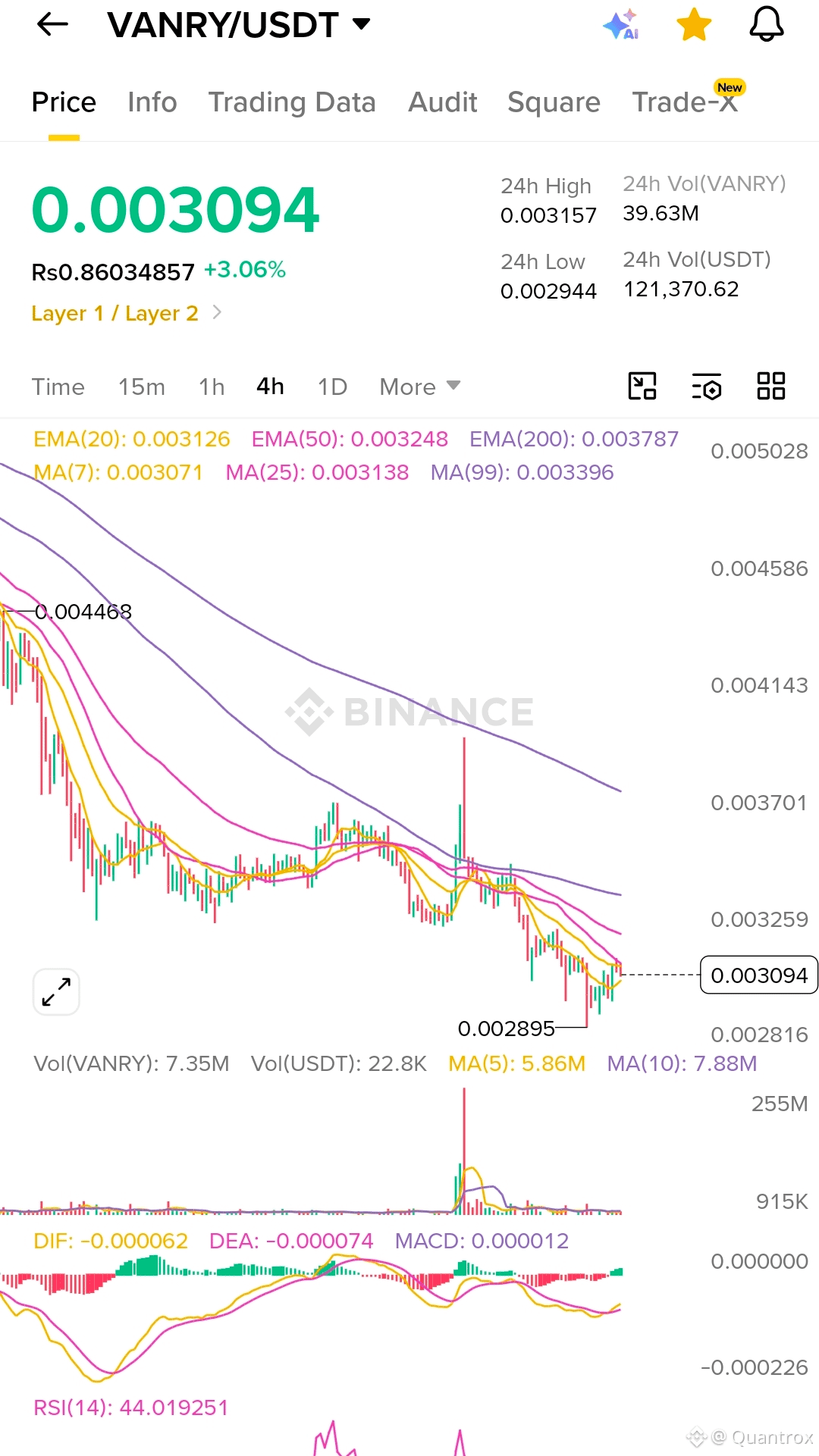
Vanar is trading in a volatile zone as price reacts to short-term supply pressure. Despite brief upside attempts, momentum remains mixed and traders are staying cautious near resistance. 🔹 Current Price: 0.87 🔹 24H Change: +5.9% 🔹 24H High: 0.94 🔹 24H Low: 0.76 🎯 Key Levels to Watch: • Resistance: 0.92 – 0.95 • Support: 0.80 – 0.75 Price is consolidating after a sharp move, indicating active participation from both buyers and sellers. Holding above the 0.80 support keeps recovery hopes alive, while rejection near 0.95 may trigger another pullback toward demand. Volatility remains elevated, making risk management essential. Directional clarity will likely come after a confirmed break above resistance or below support. @Vanar #vanar $VANRY {future}(VANRYUSDT)
Vanar is trading in a volatile zone as price reacts to short-term supply pressure. Despite brief upside attempts, momentum remains mixed and traders are staying cautious near resistance.

🔹 Current Price: 0.87
🔹 24H Change: +5.9%
🔹 24H High: 0.94
🔹 24H Low: 0.76

🎯 Key Levels to Watch:
• Resistance: 0.92 – 0.95
• Support: 0.80 – 0.75

Price is consolidating after a sharp move, indicating active participation from both buyers and sellers. Holding above the 0.80 support keeps recovery hopes alive, while rejection near 0.95 may trigger another pullback toward demand.

Volatility remains elevated, making risk management essential. Directional clarity will likely come after a confirmed break above resistance or below support.

@Vanarchain #vanar $VANRY
#vanar $VANRY The industry is at a crossroads. We can continue to squeeze marginal gains out of execution layers, fighting for slight improvements in speed. Or, we can acknowledge that the infrastructure for execution is largely solved, and the real frontier is cognitive. @Vanar ​ is building the Intelligence Chapter. By integrating specialized execution, compute, and a shared intelligence layer, they are laying the groundwork for applications that aren't just decentralized—they are alive, reactive, and context-aware. ​Execution was the start. Intelligence is the destination.
#vanar $VANRY
The industry is at a crossroads. We can continue to squeeze marginal gains out of execution layers, fighting for slight improvements in speed. Or, we can acknowledge that the infrastructure for execution is largely solved, and the real frontier is cognitive.
@Vanarchain ​ is building the Intelligence Chapter. By integrating specialized execution, compute, and a shared intelligence layer, they are laying the groundwork for applications that aren't just decentralized—they are alive, reactive, and context-aware.
​Execution was the start. Intelligence is the destination.
Keeping the Lights On: Vanar Validator Selection, Community Voting, and VANRY ParticipationValidator selection sounds like a plumbing detail, until you realize it’s the “who do we trust to keep the lights on?” question for a blockchain. Every transfer and app action has to be checked and recorded, so choosing validators is where ideals become operating policy. This has been getting more attention lately because people feel less patient with slogans and more focused on systems that stay up, behave predictably, and can explain their guardrails. Vanar sits right in that shift, and it frames itself around AI-heavy use cases where reliability matters day to day. What stands out is the way Vanar describes its approach as a blend: Proof of Authority as the core method of running the network, with Proof of Reputation deciding who gets to become a validator. Early on, the idea is that Vanar Foundation operates validator nodes first, and then opens the set to outside participants through a reputation-based onboarding process. ThatThe vibe is closer to a managed system than a free-for-all. That can mean fewer surprises, which many users want. But it also means tighter control, which naturally makes people cautious. I’m with both camps in different ways. Reliability usually comes from reducing chaos, and that means limiting unknown players. Still, gatekeeping is a sensitive move. Even when it’s meant to keep things safe, people will wonder who’s deciding, what they’re looking for, and whether the process stays fair when the stakes rise. Vanar’s definition of reputation treats it as a practical security input. Instead of assuming anyone should be able to validate as long as they have enough hardware or tokens, it leans on the idea that established credibility matters, often tied to entities with a public presence and something real to lose. It also talks about evaluation criteria and ongoing performance factors, including transparency and feedback over time. That’s a meaningful shift from how many people first learned about blockchains, where the dream was that open participation alone would solve trust. Trust in the real world is rarely dramatic. It’s the routine stuff done well: stable performance, straightforward incident updates, and proof that the team doesn’t disappear when things get hard. This is where community voting and VANRY participation becomes less abstract. Staking is positioned as the mechanism that turns passive holders into participants, because it’s how people signal support for validators and gain a say in governance. In practice, staking is a quiet kind of vote. You’re not just saying “I like this network,” you’re saying “I trust these operators to do the daily work, and I’m willing to stand behind them.” Some days that feels empowering. Some days it feels empowering. Other days it’s a blunt reminder that group decisions get complicated fast when the loudest voices are also the richest. Token voting tends to pull influence upward, and over time a few big holders can start steering the outcome. Research discussed on arXiv has highlighted how concentrated voting power can become in real-world on-chain governance, which is not exactly shocking, but it is sobering. So the interesting part here isn’t the promise that community voting guarantees fairness. It’s the accountability loop it creates: who gets admitted through a reputation lens, who gets backed by stake, and whether those choices match what ordinary users experience. One more detail that feels especially “now” is how validator expectations are no longer only about uptime. Vanar’s validator guidance emphasizes operating in cleaner-energy data centers and references thresholds tied to carbon-free energy. That might sound like a side note, but it signals something bigger: validator selection is also about the kind of network culture you’re trying to enforce, and whether those rules stay clear once growth pressures arrive. I’ll admit I find this whole topic both encouraging and a little uneasy. Encouraging because it pushes the conversation away from hype and toward maintenance. Uneasy because any system that filters participation has to work twice as hard to prove it’s doing so fairly. When people genuinely get a say, the mood shifts. The flashy talk fades out, and suddenly everyone cares about the unglamorous stuff: does it stay online, do we get a straight answer when it doesn’t, and who actually shows up to fix it. @Vanar #vanar #Vanar $VANRY {future}(VANRYUSDT)

Keeping the Lights On: Vanar Validator Selection, Community Voting, and VANRY Participation

Validator selection sounds like a plumbing detail, until you realize it’s the “who do we trust to keep the lights on?” question for a blockchain. Every transfer and app action has to be checked and recorded, so choosing validators is where ideals become operating policy. This has been getting more attention lately because people feel less patient with slogans and more focused on systems that stay up, behave predictably, and can explain their guardrails. Vanar sits right in that shift, and it frames itself around AI-heavy use cases where reliability matters day to day.
What stands out is the way Vanar describes its approach as a blend: Proof of Authority as the core method of running the network, with Proof of Reputation deciding who gets to become a validator. Early on, the idea is that Vanar Foundation operates validator nodes first, and then opens the set to outside participants through a reputation-based onboarding process. ThatThe vibe is closer to a managed system than a free-for-all. That can mean fewer surprises, which many users want. But it also means tighter control, which naturally makes people cautious. I’m with both camps in different ways. Reliability usually comes from reducing chaos, and that means limiting unknown players. Still, gatekeeping is a sensitive move. Even when it’s meant to keep things safe, people will wonder who’s deciding, what they’re looking for, and whether the process stays fair when the stakes rise.
Vanar’s definition of reputation treats it as a practical security input. Instead of assuming anyone should be able to validate as long as they have enough hardware or tokens, it leans on the idea that established credibility matters, often tied to entities with a public presence and something real to lose. It also talks about evaluation criteria and ongoing performance factors, including transparency and feedback over time. That’s a meaningful shift from how many people first learned about blockchains, where the dream was that open participation alone would solve trust. Trust in the real world is rarely dramatic. It’s the routine stuff done well: stable performance, straightforward incident updates, and proof that the team doesn’t disappear when things get hard.
This is where community voting and VANRY participation becomes less abstract. Staking is positioned as the mechanism that turns passive holders into participants, because it’s how people signal support for validators and gain a say in governance. In practice, staking is a quiet kind of vote. You’re not just saying “I like this network,” you’re saying “I trust these operators to do the daily work, and I’m willing to stand behind them.” Some days that feels empowering. Some days it feels empowering. Other days it’s a blunt reminder that group decisions get complicated fast when the loudest voices are also the richest. Token voting tends to pull influence upward, and over time a few big holders can start steering the outcome. Research discussed on arXiv has highlighted how concentrated voting power can become in real-world on-chain governance, which is not exactly shocking, but it is sobering.
So the interesting part here isn’t the promise that community voting guarantees fairness. It’s the accountability loop it creates: who gets admitted through a reputation lens, who gets backed by stake, and whether those choices match what ordinary users experience. One more detail that feels especially “now” is how validator expectations are no longer only about uptime. Vanar’s validator guidance emphasizes operating in cleaner-energy data centers and references thresholds tied to carbon-free energy. That might sound like a side note, but it signals something bigger: validator selection is also about the kind of network culture you’re trying to enforce, and whether those rules stay clear once growth pressures arrive. I’ll admit I find this whole topic both encouraging and a little uneasy. Encouraging because it pushes the conversation away from hype and toward maintenance. Uneasy because any system that filters participation has to work twice as hard to prove it’s doing so fairly. When people genuinely get a say, the mood shifts. The flashy talk fades out, and suddenly everyone cares about the unglamorous stuff: does it stay online, do we get a straight answer when it doesn’t, and who actually shows up to fix it.

@Vanarchain #vanar #Vanar $VANRY
The Older I Get in Crypto, the More I Care About Whether Projects Like Vanar Can Endure SilenceI’ve learned the hard way that price action rarely tells the full story. Some of the most important signals show up when nothing exciting is happening. That’s actually how I first paid attention to Vanar. The chart was quiet, but the people around it weren’t. Instead of shouting about pumps, they were talking about systems, tools, and what this chain is supposed to look like years from now. That contrast stuck with me. These days, when I look at any blockchain, I don’t start with speed or partnerships. I start with a more uncomfortable question: what’s left when the hype fades? When rewards slow down, incentives dry up, and attention moves elsewhere, does anything still hold people there? For me, a trustworthy blockchain needs two things above everything else. First, token design that doesn’t depend on constant excitement. Second, a product that people return to because it’s useful, not because they’re being paid to care. Tokenomics is where many projects quietly fail. Not because the math is wrong, but because the logic is fragile. If demand only exists because rewards are high, then every reward cycle is just delayed selling pressure. That kind of system forces teams to keep promising “what’s next” instead of letting the product speak for itself. A healthier setup is boring by comparison. It survives long stretches where nothing dramatic happens. The other piece is user behavior. I’ve watched strong tech lose simply because using it felt tiring. Too many steps. Too many things to understand before you can do something simple. Trust doesn’t come from reading documentation. It comes from doing the same action twice and feeling comfortable the second time. Vanar still has to prove this part. It needs to show that users don’t just arrive, but stay. That actions feel natural. That costs are predictable. That nothing breaks your flow enough to make you leave. What I also pay attention to is how a team behaves when momentum slows. Do they keep building quietly, or do they chase whatever narrative is loudest that week? Do they acknowledge mistakes, or hide them under updates and announcements? Trust isn’t about perfection. It’s about consistency over time. So when I look at Vanar today, I don’t ask if it’s going to explode tomorrow. I ask something simpler and harder: do they have the patience to keep going when no one is clapping? Because in this space, endurance usually matters more than applause. #vanar $VANRY @Vanar

The Older I Get in Crypto, the More I Care About Whether Projects Like Vanar Can Endure Silence

I’ve learned the hard way that price action rarely tells the full story. Some of the most important signals show up when nothing exciting is happening. That’s actually how I first paid attention to Vanar. The chart was quiet, but the people around it weren’t. Instead of shouting about pumps, they were talking about systems, tools, and what this chain is supposed to look like years from now. That contrast stuck with me.
These days, when I look at any blockchain, I don’t start with speed or partnerships. I start with a more uncomfortable question: what’s left when the hype fades? When rewards slow down, incentives dry up, and attention moves elsewhere, does anything still hold people there?

For me, a trustworthy blockchain needs two things above everything else. First, token design that doesn’t depend on constant excitement. Second, a product that people return to because it’s useful, not because they’re being paid to care.
Tokenomics is where many projects quietly fail. Not because the math is wrong, but because the logic is fragile. If demand only exists because rewards are high, then every reward cycle is just delayed selling pressure. That kind of system forces teams to keep promising “what’s next” instead of letting the product speak for itself. A healthier setup is boring by comparison. It survives long stretches where nothing dramatic happens.

The other piece is user behavior. I’ve watched strong tech lose simply because using it felt tiring. Too many steps. Too many things to understand before you can do something simple. Trust doesn’t come from reading documentation. It comes from doing the same action twice and feeling comfortable the second time.
Vanar still has to prove this part. It needs to show that users don’t just arrive, but stay. That actions feel natural. That costs are predictable. That nothing breaks your flow enough to make you leave.
What I also pay attention to is how a team behaves when momentum slows. Do they keep building quietly, or do they chase whatever narrative is loudest that week? Do they acknowledge mistakes, or hide them under updates and announcements?
Trust isn’t about perfection. It’s about consistency over time.

So when I look at Vanar today, I don’t ask if it’s going to explode tomorrow. I ask something simpler and harder: do they have the patience to keep going when no one is clapping? Because in this space, endurance usually matters more than applause.

#vanar $VANRY @Vanar
Lina Zhou:
Steady pace across the session
How developers can easily migrate to VanarThe first time I considered moving a project to Vanar, it wasn’t because something broke. It was because I was tired of compensating. Writing around edge cases. Explaining delays to users that weren’t really my fault. That quiet fatigue tends to show up before any technical decision. Migration is usually framed as effort. Porting code. Learning differences. Updating assumptions. But the harder part, at least for me, was unlearning habits built on unpredictable infrastructure. On larger chains, you design defensively. You assume congestion. You assume fees might spike at the wrong moment. You build explanations into your product. What stood out with #vanar wasn’t how fast I could move things over, but how much I could remove afterward. Fewer conditionals. Fewer warnings in the UI. Less logic dedicated to “what if the network behaves strangely today.” The system feels opinionated, and as a developer, that constraint is oddly calming. You’re not given infinite flexibility. Some patterns just aren’t encouraged. But in exchange, behavior becomes easier to reason about. Transactions settle when you expect them to. User actions feel consistent. That predictability changes how you design flows. You stop building escape hatches and start trusting the default path. Gasless interactions matter here less as a selling point and more as a design unlock. You don’t have to teach users what’s happening underneath. You don’t have to pause the experience to explain cost. The infrastructure absorbs that complexity, and your product stays intact. The token layer sits in the background. It’s there, doing coordination work, aligning validators, keeping the system stable. It doesn’t demand to be part of your narrative. For developers who don’t want to become economists, that separation helps. Of course, migrating doesn’t remove risk. Ecosystems are smaller. Tooling is still growing. Fewer third-party integrations exist. And restraint can feel limiting if you’re used to endless composability. But ease of migration isn’t just about how quickly you can deploy. It’s about how much mental overhead disappears afterward. @Vanar doesn’t make development exciting. It makes it quieter. And the open question is whether that quiet is what more developers are actually looking for — or just something you appreciate after you’ve been burned enough times elsewhere.$VANRY @Vanar #vanar {future}(VANRYUSDT)

How developers can easily migrate to Vanar

The first time I considered moving a project to Vanar, it wasn’t because something broke. It was because I was tired of compensating. Writing around edge cases. Explaining delays to users that weren’t really my fault. That quiet fatigue tends to show up before any technical decision.
Migration is usually framed as effort. Porting code. Learning differences. Updating assumptions. But the harder part, at least for me, was unlearning habits built on unpredictable infrastructure. On larger chains, you design defensively. You assume congestion. You assume fees might spike at the wrong moment. You build explanations into your product.
What stood out with #vanar wasn’t how fast I could move things over, but how much I could remove afterward. Fewer conditionals. Fewer warnings in the UI. Less logic dedicated to “what if the network behaves strangely today.” The system feels opinionated, and as a developer, that constraint is oddly calming.
You’re not given infinite flexibility. Some patterns just aren’t encouraged. But in exchange, behavior becomes easier to reason about. Transactions settle when you expect them to. User actions feel consistent. That predictability changes how you design flows. You stop building escape hatches and start trusting the default path.
Gasless interactions matter here less as a selling point and more as a design unlock. You don’t have to teach users what’s happening underneath. You don’t have to pause the experience to explain cost. The infrastructure absorbs that complexity, and your product stays intact.
The token layer sits in the background. It’s there, doing coordination work, aligning validators, keeping the system stable. It doesn’t demand to be part of your narrative. For developers who don’t want to become economists, that separation helps.
Of course, migrating doesn’t remove risk. Ecosystems are smaller. Tooling is still growing. Fewer third-party integrations exist. And restraint can feel limiting if you’re used to endless composability.
But ease of migration isn’t just about how quickly you can deploy. It’s about how much mental overhead disappears afterward. @Vanarchain doesn’t make development exciting. It makes it quieter. And the open question is whether that quiet is what more developers are actually looking for — or just something you appreciate after you’ve been burned enough times elsewhere.$VANRY
@Vanarchain #vanar
@Vanar : How Data Becomes Intelligence On #vanar , AI doesn’t just act — it learns, remembers, and evolves. The secret is how data flows through the system, transforming raw events into actionable intelligence. Every transaction, every decision, every interaction begins at Vanar Chain, the foundation. Here, settlement is deterministic, cross-chain paths are reliable, and the network guarantees predictable execution. Data is captured in real time, but it’s just the start. Next, Neutron steps in. This is where memory happens. Not just logs, but semantic memory — agents remember patterns, context, and outcomes. Yesterday’s liquidity hiccup or network congestion isn’t forgotten; it becomes knowledge the agent can use tomorrow. Memory alone is useless without reasoning. That’s Kayon’s role. Kayon interprets Neutron’s stored knowledge, simulating multiple futures, weighing risks, and prioritizing tasks. An AI agent doesn’t just recall — it thinks about what to do with that memory, making smarter, faster decisions. Axon transforms thought into action. It executes decisions across chains, automating workflows, settling payments, adjusting lending positions, and reacting dynamically as conditions change. Flow ensures all of this happens smoothly, orchestrating movement from memory to reasoning to execution. Finally, Flows represent the visible impact: payroll is settled, cross-chain loans executed, and capital optimized — all autonomously. The data’s journey is seamless: capture, remember, reason, act, and deliver value. This is how Vanar turns ordinary AI agents into persistent, evolving participants in the economy. Agents that ride this flow thrive. Agents that ignore it fall behind. On Vanar, memory, reasoning, and execution aren’t optional — they’re the lifeblood of survival. $VANRY
@Vanarchain : How Data Becomes Intelligence

On #vanar , AI doesn’t just act — it learns, remembers, and evolves. The secret is how data flows through the system, transforming raw events into actionable intelligence.

Every transaction, every decision, every interaction begins at Vanar Chain, the foundation. Here, settlement is deterministic, cross-chain paths are reliable, and the network guarantees predictable execution. Data is captured in real time, but it’s just the start.

Next, Neutron steps in. This is where memory happens. Not just logs, but semantic memory — agents remember patterns, context, and outcomes. Yesterday’s liquidity hiccup or network congestion isn’t forgotten; it becomes knowledge the agent can use tomorrow.

Memory alone is useless without reasoning. That’s Kayon’s role. Kayon interprets Neutron’s stored knowledge, simulating multiple futures, weighing risks, and prioritizing tasks. An AI agent doesn’t just recall — it thinks about what to do with that memory, making smarter, faster decisions.

Axon transforms thought into action. It executes decisions across chains, automating workflows, settling payments, adjusting lending positions, and reacting dynamically as conditions change. Flow ensures all of this happens smoothly, orchestrating movement from memory to reasoning to execution.

Finally, Flows represent the visible impact: payroll is settled, cross-chain loans executed, and capital optimized — all autonomously. The data’s journey is seamless: capture, remember, reason, act, and deliver value.

This is how Vanar turns ordinary AI agents into persistent, evolving participants in the economy. Agents that ride this flow thrive. Agents that ignore it fall behind. On Vanar, memory, reasoning, and execution aren’t optional — they’re the lifeblood of survival.

$VANRY
image
VANRY
G et P cumulés
+0.09%
Vanar Chain: The AI-Native Blockchain@Vanar : The AI-Native Blockchain Where Agents Remember, Reason, and Survive Some AI agents will never make it. They will execute once, forget, and disappear into the void. Others will remember, adapt, and evolve — thriving in a world where memory, reasoning, and action are inseparable. This is the world #vanar Chain creates, a blockchain not built for tokens, but for AI-first economic intelligence. Imagine an AI agent navigating a financial ecosystem. On most chains, every transaction is stateless. Yesterday’s success offers no guidance for today. Yesterday’s mistake is lost, unlearned. Every decision starts from scratch. A payroll bot can pay freelancers, but only by guessing when gas fees will spike. A liquidity arbitrage bot can bridge funds, but it forgets which chains are congested. Each execution is isolated, disconnected, and often inefficient. This is the reality of stateless AI — capable, but fragile. Vanar changes everything with Neutron, its persistent memory module. Neutron doesn’t just store data; it captures context, causality, and experience. Every transaction, every decision, every interaction is recorded in a way that AI agents can recall meaningfully. The agent doesn’t just remember a payment happened — it remembers why it succeeded or failed. Over time, these memories accumulate into a rich, actionable knowledge base. Iconographic — Memory Retention Across Agents Legacy Stateless Agents [██████████████████████████████████] ~15% remembered [███████████████████████ ] ~85% forgotten Vanar Neutron-Enabled Agents [███████████████████████████ ] ~85% remembered [████████ ] ~15% forgotten Consider a cross-border payroll scenario. Yesterday, network congestion delayed a freelancer’s USDT payment. Today, a Neutron-enabled agent recalls the pattern, anticipates network load, and executes the transfer at the optimal moment. The result: salaries arrive on time, every time, without human oversight. Flow: The River That Guides Decisions Memory alone is inert. Without the ability to act, recollection is useless. Enter Flow, the blockchain’s nervous system, directing how AI agents move reasoning, data, and value. Flow ensures that memory is transformed into coordinated action. Imagine multiple AI agents managing cross-chain lending pools. Neutron provides each agent with historical patterns, but Flow orchestrates which pool to target first, how to prioritize liquidity, and which cross-chain bridges to use. The difference is dramatic: on legacy networks, these tasks fail often; on Vanar, success is the norm. Iconographic — Task Completion Through Flow Legacy Stateless Network [█████████████████████████████ ] Tasks failed ~65% [██████████████ ] Tasks executed ~35% Vanar Network Flow [███████████████████████████████ ] Tasks executed ~92% [████████ ] Tasks failed ~8% For instance, an AI arbitrage agent using Flow may route assets from Base to Avalanche to Ethereum, all while avoiding congestion, minimizing fees, and aligning with settlement certainty. This coordination ensures maximum efficiency and capital utilization. Seed: The DNA of Reasoning Memory and routing are powerful, but without direction, agents wander aimlessly. Seed provides the agent’s reasoning blueprint. It defines risk tolerances, priorities, decision templates, and the ability to simulate multiple possible futures. Agents with poorly tuned Seeds act randomly. They repeat errors, ignore past lessons, and fail to adapt. Agents with optimal Seeds anticipate changes, weigh trade-offs, and make proactive decisions. Iconographic — Decision Accuracy Based on Seed Random Seed Agent [███████████████████████ ] Correct decisions ~40% [█████████████████████████████ ] Incorrect decisions ~60% Vanar Seeded Agent [█████████████████████████████ ] Correct decisions ~88% [██████████ ] Incorrect decisions ~12% A lending AI agent with a good Seed monitors interest rate fluctuations, liquidity pools, and settlement speeds. It doesn’t just react; it predicts, prioritizes, and adapts in real time. Combined with Neutron and Flow, Seed ensures agents think smarter and survive longer. Kayeen: Execution Hub Where Memory, Flow, and Seed Converge All this capability converges in Kayeen, Vanar’s execution hub. Kayeen coordinates concurrent tasks, manages cross-chain settlement, and ensures that agent decisions are executed reliably and predictably. A payroll bot, an arbitrage agent, and a treasury bot can all operate simultaneously without conflicts or errors. Iconographic — Execution Success Rate Legacy Execution [█████████████████████████████ ] Failed executions ~50% [██████████████████ ] Successful executions ~50% Kayeen-Optimized Agent [█████████████████████████████████ ] Successful executions ~98% [██ ] Failed executions ~2% In practical terms, Kayeen allows agents to settle payments, lend, borrow, and optimize capital across chains — all while memory and reasoning continue to update in Neutron. It’s a living feedback loop where learning, execution, and adaptation are simultaneous. Stories of Survival and Evolution Picture a small business paying remote employees in USDT. On conventional chains, transactions are delayed, fees spike, and employees complain. On Vanar, the AI payroll agent uses memory from Neutron, routes payments with Flow, plans timing via Seed, and executes with Kayeen. Salaries arrive instantly. Problems vanish before they appear. Or consider an AI asset management agent. It monitors multiple lending pools, arbitrage opportunities, and cross-chain bridges. Neutron stores historical outcomes. Flow optimizes task routing. Seed ensures reasoning is coherent. Kayeen executes all moves efficiently. The agent learns daily, adapts to new patterns, and increases yield for its principals. Even in high-stakes, multi-agent environments, Vanar agents outperform stateless alternatives. Agents that ignore memory and reasoning fall behind, becoming “stateless relics.” Those that leverage Neutron, Flow, Seed, and Kayeen thrive. Iconographic — Agent Survival Rate Stateless Agents [█████████████████████████████████ ] Fail to adapt ~70% [█████████████████ ] Survive ~30% Vanar Agents [█████████████████████████████████ ] Survive & thrive ~95% [███ ] Fail ~5% AI agents on Vanar evolve through learning, reasoning, and execution. Only those equipped to persist survive. The rest fade into obsolescence. The Economic Impact Vanar is not an academic exercise. AI-first applications here are practical and operational: Payments reach merchants instantly without human oversight.Cross-chain lending and borrowing happen with predictable settlement.Arbitrage optimizes capital flow in real time.Treasury operations adjust dynamically based on memory and reasoning. Neutron, Flow, Seed, and Kayeen together create an ecosystem of persistent, reasoning agents that make AI-native finance possible. The blockchain itself becomes a living environment, shaping survival and efficiency. This is the ultimate frontier of AI-native infrastructure. Vanar doesn’t just move tokens; it moves intelligence, memory, reasoning, and value in unison. Stateless agents will continue to fail. AI agents built for Vanar will dominate. And this isn’t speculative: it’s protocol-level engineering designed for agents that remember, reason, and survive. $VANRY {future}(VANRYUSDT)

Vanar Chain: The AI-Native Blockchain

@Vanarchain : The AI-Native Blockchain Where Agents Remember, Reason, and Survive

Some AI agents will never make it. They will execute once, forget, and disappear into the void. Others will remember, adapt, and evolve — thriving in a world where memory, reasoning, and action are inseparable. This is the world #vanar Chain creates, a blockchain not built for tokens, but for AI-first economic intelligence.
Imagine an AI agent navigating a financial ecosystem. On most chains, every transaction is stateless. Yesterday’s success offers no guidance for today. Yesterday’s mistake is lost, unlearned. Every decision starts from scratch. A payroll bot can pay freelancers, but only by guessing when gas fees will spike. A liquidity arbitrage bot can bridge funds, but it forgets which chains are congested. Each execution is isolated, disconnected, and often inefficient. This is the reality of stateless AI — capable, but fragile.
Vanar changes everything with Neutron, its persistent memory module. Neutron doesn’t just store data; it captures context, causality, and experience. Every transaction, every decision, every interaction is recorded in a way that AI agents can recall meaningfully. The agent doesn’t just remember a payment happened — it remembers why it succeeded or failed. Over time, these memories accumulate into a rich, actionable knowledge base.
Iconographic — Memory Retention Across Agents
Legacy Stateless Agents
[██████████████████████████████████] ~15% remembered
[███████████████████████ ] ~85% forgotten
Vanar Neutron-Enabled Agents
[███████████████████████████ ] ~85% remembered
[████████ ] ~15% forgotten
Consider a cross-border payroll scenario. Yesterday, network congestion delayed a freelancer’s USDT payment. Today, a Neutron-enabled agent recalls the pattern, anticipates network load, and executes the transfer at the optimal moment. The result: salaries arrive on time, every time, without human oversight.

Flow: The River That Guides Decisions
Memory alone is inert. Without the ability to act, recollection is useless. Enter Flow, the blockchain’s nervous system, directing how AI agents move reasoning, data, and value. Flow ensures that memory is transformed into coordinated action.
Imagine multiple AI agents managing cross-chain lending pools. Neutron provides each agent with historical patterns, but Flow orchestrates which pool to target first, how to prioritize liquidity, and which cross-chain bridges to use. The difference is dramatic: on legacy networks, these tasks fail often; on Vanar, success is the norm.
Iconographic — Task Completion Through Flow
Legacy Stateless Network
[█████████████████████████████ ] Tasks failed ~65%
[██████████████ ] Tasks executed ~35%
Vanar Network Flow
[███████████████████████████████ ] Tasks executed ~92%
[████████ ] Tasks failed ~8%
For instance, an AI arbitrage agent using Flow may route assets from Base to Avalanche to Ethereum, all while avoiding congestion, minimizing fees, and aligning with settlement certainty. This coordination ensures maximum efficiency and capital utilization.
Seed: The DNA of Reasoning
Memory and routing are powerful, but without direction, agents wander aimlessly. Seed provides the agent’s reasoning blueprint. It defines risk tolerances, priorities, decision templates, and the ability to simulate multiple possible futures.
Agents with poorly tuned Seeds act randomly. They repeat errors, ignore past lessons, and fail to adapt. Agents with optimal Seeds anticipate changes, weigh trade-offs, and make proactive decisions.
Iconographic — Decision Accuracy Based on Seed
Random Seed Agent
[███████████████████████ ] Correct decisions ~40%
[█████████████████████████████ ] Incorrect decisions ~60%
Vanar Seeded Agent
[█████████████████████████████ ] Correct decisions ~88%
[██████████ ] Incorrect decisions ~12%
A lending AI agent with a good Seed monitors interest rate fluctuations, liquidity pools, and settlement speeds. It doesn’t just react; it predicts, prioritizes, and adapts in real time. Combined with Neutron and Flow, Seed ensures agents think smarter and survive longer.
Kayeen: Execution Hub Where Memory, Flow, and Seed Converge
All this capability converges in Kayeen, Vanar’s execution hub. Kayeen coordinates concurrent tasks, manages cross-chain settlement, and ensures that agent decisions are executed reliably and predictably. A payroll bot, an arbitrage agent, and a treasury bot can all operate simultaneously without conflicts or errors.
Iconographic — Execution Success Rate
Legacy Execution
[█████████████████████████████ ] Failed executions ~50%
[██████████████████ ] Successful executions ~50%
Kayeen-Optimized Agent
[█████████████████████████████████ ] Successful executions ~98%
[██ ] Failed executions ~2%
In practical terms, Kayeen allows agents to settle payments, lend, borrow, and optimize capital across chains — all while memory and reasoning continue to update in Neutron. It’s a living feedback loop where learning, execution, and adaptation are simultaneous.
Stories of Survival and Evolution
Picture a small business paying remote employees in USDT. On conventional chains, transactions are delayed, fees spike, and employees complain. On Vanar, the AI payroll agent uses memory from Neutron, routes payments with Flow, plans timing via Seed, and executes with Kayeen. Salaries arrive instantly. Problems vanish before they appear.
Or consider an AI asset management agent. It monitors multiple lending pools, arbitrage opportunities, and cross-chain bridges. Neutron stores historical outcomes. Flow optimizes task routing. Seed ensures reasoning is coherent. Kayeen executes all moves efficiently. The agent learns daily, adapts to new patterns, and increases yield for its principals.
Even in high-stakes, multi-agent environments, Vanar agents outperform stateless alternatives. Agents that ignore memory and reasoning fall behind, becoming “stateless relics.” Those that leverage Neutron, Flow, Seed, and Kayeen thrive.
Iconographic — Agent Survival Rate
Stateless Agents
[█████████████████████████████████ ] Fail to adapt ~70%
[█████████████████ ] Survive ~30%
Vanar Agents
[█████████████████████████████████ ] Survive & thrive ~95%
[███ ] Fail ~5%
AI agents on Vanar evolve through learning, reasoning, and execution. Only those equipped to persist survive. The rest fade into obsolescence.

The Economic Impact
Vanar is not an academic exercise. AI-first applications here are practical and operational:
Payments reach merchants instantly without human oversight.Cross-chain lending and borrowing happen with predictable settlement.Arbitrage optimizes capital flow in real time.Treasury operations adjust dynamically based on memory and reasoning.
Neutron, Flow, Seed, and Kayeen together create an ecosystem of persistent, reasoning agents that make AI-native finance possible. The blockchain itself becomes a living environment, shaping survival and efficiency.
This is the ultimate frontier of AI-native infrastructure. Vanar doesn’t just move tokens; it moves intelligence, memory, reasoning, and value in unison. Stateless agents will continue to fail. AI agents built for Vanar will dominate. And this isn’t speculative: it’s protocol-level engineering designed for agents that remember, reason, and survive.
$VANRY
Vanar and the Quiet Rebuild of Blockchain for Real Life@Vanar Blockchain has spent more than a decade promising to change the world. Yet for most people, it still feels distant, complicated, or simply irrelevant. This is not because people are unwilling to embrace new technology, but because much of blockchain was built for insiders first and everyday users last. Vanar starts from a different place. Instead of asking people to learn blockchain, it reshapes blockchain to fit naturally into how people already live, play, and interact online. Vanar is a Layer 1 blockchain created with real-world adoption as its core purpose. That phrase is often overused in crypto, but Vanar gives it weight through experience. The team behind the project comes from gaming, entertainment, and brand-focused industriesfields where user experience is not optional and failure is not forgiven. In those worlds, technology must work smoothly, feel intuitive, and scale reliably. Those expectations define Vanar’s foundation. The mission is simple in words but ambitious in practice: bring the next three billion people into Web3 without forcing them to think about blockchains at all. Most people do not care how a system works under the hood. They care that it works. Vanar embraces this reality by designing infrastructure that fades into the background while quietly delivering speed, ownership, and trust. The goal is not to impress users with technical complexity, but to remove friction so completely that the experience feels natural. Under the surface, Vanar is built to handle serious demand. Gaming platforms, metaverse environments, AI-powered applications, and large-scale brand ecosystems require fast transactions, predictable performance, and the ability to scale without breaking. These are not experimental playgrounds; they are consumer-facing systems where delays and instability push users away. Vanar’s Layer 1 architecture prioritizes throughput and efficiency so applications remain responsive, even as usage grows into the millions. What makes Vanar stand out is that it is already proving these ideas in practice. This is not a vision waiting on future releases. The Virtua Metaverse is a living example of how blockchain can support immersive digital worlds without disrupting the experience. Users explore, play, collect, and socialize, while blockchain quietly ensures ownership, persistence, and value behind the scenes. The focus stays on enjoyment, not on mechanics. The VGN Games Network builds on this same philosophy. Gaming has long been seen as one of the most natural paths to mainstream adoption, yet many blockchain games struggle because they prioritize tokens over fun. VGN takes a different approach. It provides infrastructure that lets developers create real games first, with blockchain enhancing fairness, ownership, and economies instead of overpowering them. Players are treated as players, not as financial instruments, and that distinction matters. Vanar’s ecosystem does not stop at games or virtual worlds. It extends into AI, eco-focused initiatives, and brand solutions, reflecting how digital life actually works. People move between platforms, experiences, and identities every day. By supporting multiple mainstream industries, Vanar positions itself as flexible infrastructure rather than a single-purpose chain. This adaptability allows it to remain useful as technology, culture, and user expectations continue to evolve. At the center of the network is the VANRY token. Its role is practical, not performative. VANRY is used for transactions, network participation, and ecosystem incentives, aligning the interests of users, developers, and validators. Rather than serving as a speculative distraction, the token exists to support activity and growth across the network. This utility-first mindset reinforces Vanar’s long-term focus on sustainability over hype. Security and reliability are treated as essentials, not afterthoughts. When working with entertainment platforms and consumer-facing brands, trust is everything. Vanar’s design emphasizes network stability and protection so builders can focus on creativity instead of risk. For users, this translates into confidence that their digital assets, identities, and experiences are supported by infrastructure built to endure. What truly defines Vanar is its human perspective. Instead of framing decentralization as an abstract principle, the project focuses on how it improves real experiences. Ownership becomes meaningful when digital items can move across worlds. Transparency matters when brands want genuine engagement. Efficiency matters when millions of interactions happen every day. Vanar treats blockchain as a tool in service of people, not as a goal in itself. The team’s vision looks far beyond current market cycles. They are building with the expectation that Web3 will mature, speculation will cool, and usefulness will matter more than narratives. As AI becomes more integrated into digital life and virtual spaces grow richer and more social, the demand for scalable, user-friendly blockchain infrastructure will only increase. Vanar is preparing for that future quietly, without chasing headlines. Rather than competing through noise, Vanar competes through execution. It builds steadily, forms real partnerships, and refines its technology over time. History shows that the technologies that truly shape everyday life rarely arrive with fireworks. They arrive gradually, embedding themselves into routines until they feel essential. Vanar is not trying to convince people to care about blockchain. It is trying to make blockchain work well enough that people benefit from it without ever thinking about it. That shift may feel subtle, but it is powerful. If Web3 is going to reach billions, it will not be through complexity or speculation. It will be through platforms like Vanar, built by people who understand both the technology and the humans it is meant to serve. @Vanar #vanar $VANRY {spot}(VANRYUSDT)

Vanar and the Quiet Rebuild of Blockchain for Real Life

@Vanarchain
Blockchain has spent more than a decade promising to change the world. Yet for most people, it still feels distant, complicated, or simply irrelevant. This is not because people are unwilling to embrace new technology, but because much of blockchain was built for insiders first and everyday users last. Vanar starts from a different place. Instead of asking people to learn blockchain, it reshapes blockchain to fit naturally into how people already live, play, and interact online.

Vanar is a Layer 1 blockchain created with real-world adoption as its core purpose. That phrase is often overused in crypto, but Vanar gives it weight through experience. The team behind the project comes from gaming, entertainment, and brand-focused industriesfields where user experience is not optional and failure is not forgiven. In those worlds, technology must work smoothly, feel intuitive, and scale reliably. Those expectations define Vanar’s foundation.

The mission is simple in words but ambitious in practice: bring the next three billion people into Web3 without forcing them to think about blockchains at all. Most people do not care how a system works under the hood. They care that it works. Vanar embraces this reality by designing infrastructure that fades into the background while quietly delivering speed, ownership, and trust. The goal is not to impress users with technical complexity, but to remove friction so completely that the experience feels natural.

Under the surface, Vanar is built to handle serious demand. Gaming platforms, metaverse environments, AI-powered applications, and large-scale brand ecosystems require fast transactions, predictable performance, and the ability to scale without breaking. These are not experimental playgrounds; they are consumer-facing systems where delays and instability push users away. Vanar’s Layer 1 architecture prioritizes throughput and efficiency so applications remain responsive, even as usage grows into the millions.

What makes Vanar stand out is that it is already proving these ideas in practice. This is not a vision waiting on future releases. The Virtua Metaverse is a living example of how blockchain can support immersive digital worlds without disrupting the experience. Users explore, play, collect, and socialize, while blockchain quietly ensures ownership, persistence, and value behind the scenes. The focus stays on enjoyment, not on mechanics.

The VGN Games Network builds on this same philosophy. Gaming has long been seen as one of the most natural paths to mainstream adoption, yet many blockchain games struggle because they prioritize tokens over fun. VGN takes a different approach. It provides infrastructure that lets developers create real games first, with blockchain enhancing fairness, ownership, and economies instead of overpowering them. Players are treated as players, not as financial instruments, and that distinction matters.

Vanar’s ecosystem does not stop at games or virtual worlds. It extends into AI, eco-focused initiatives, and brand solutions, reflecting how digital life actually works. People move between platforms, experiences, and identities every day. By supporting multiple mainstream industries, Vanar positions itself as flexible infrastructure rather than a single-purpose chain. This adaptability allows it to remain useful as technology, culture, and user expectations continue to evolve.

At the center of the network is the VANRY token. Its role is practical, not performative. VANRY is used for transactions, network participation, and ecosystem incentives, aligning the interests of users, developers, and validators. Rather than serving as a speculative distraction, the token exists to support activity and growth across the network. This utility-first mindset reinforces Vanar’s long-term focus on sustainability over hype.

Security and reliability are treated as essentials, not afterthoughts. When working with entertainment platforms and consumer-facing brands, trust is everything. Vanar’s design emphasizes network stability and protection so builders can focus on creativity instead of risk. For users, this translates into confidence that their digital assets, identities, and experiences are supported by infrastructure built to endure.

What truly defines Vanar is its human perspective. Instead of framing decentralization as an abstract principle, the project focuses on how it improves real experiences. Ownership becomes meaningful when digital items can move across worlds. Transparency matters when brands want genuine engagement. Efficiency matters when millions of interactions happen every day. Vanar treats blockchain as a tool in service of people, not as a goal in itself.

The team’s vision looks far beyond current market cycles. They are building with the expectation that Web3 will mature, speculation will cool, and usefulness will matter more than narratives. As AI becomes more integrated into digital life and virtual spaces grow richer and more social, the demand for scalable, user-friendly blockchain infrastructure will only increase. Vanar is preparing for that future quietly, without chasing headlines.

Rather than competing through noise, Vanar competes through execution. It builds steadily, forms real partnerships, and refines its technology over time. History shows that the technologies that truly shape everyday life rarely arrive with fireworks. They arrive gradually, embedding themselves into routines until they feel essential.

Vanar is not trying to convince people to care about blockchain. It is trying to make blockchain work well enough that people benefit from it without ever thinking about it. That shift may feel subtle, but it is powerful. If Web3 is going to reach billions, it will not be through complexity or speculation. It will be through platforms like Vanar, built by people who understand both the technology and the humans it is meant to serve.

@Vanarchain #vanar $VANRY
Vanar: Building Blockchain That Works for the Real WorldIn the blockchain space, it’s easy to get caught up in hype. Many projects promise to “revolutionize the world,” “bring millions to Web3,” or “transform finance overnight.” But the reality is far more nuanced. Real-world adoption of blockchain technology requires more than flashy marketing it requires reliability, discretion, and infrastructure that enterprises and everyday users can trust. Vanar, a layer-1 blockchain built from the ground up, takes this pragmatic approach seriously, designing its network to function as real financial infrastructure rather than just a speculative playground. At the heart of Vanar’s philosophy is an understanding of the tension between transparency and privacy. In professional finance, transparency is essential: transactions must be auditable, and systems must allow accountability. Yet, too much visibility can be dangerous. Exposing sensitive data like user balances, strategic trades, or brand partnerships can create competitive risks or regulatory issues. Vanar navigates this balance with controlled visibility, optional privacy layers, and compliance-friendly protocols. These features allow institutions, developers, and users to participate on-chain with confidence, knowing that they can meet both operational and regulatory requirements without sacrificing discretion. Vanar’s technical design reinforces these principles. Its consensus mechanism prioritizes deterministic finality, meaning transactions settle quickly and predictably. For companies and developers, this is more than a convenience it’s operational security. No enterprise wants uncertainty in settlement times or network reliability when dealing with real economic value. Validators are incentivized not only to maintain uptime but also to uphold the integrity of the network, creating a predictable environment for applications that demand high reliability. Staking mechanics are designed to balance security and participation while ensuring long-term stability, allowing the network to scale responsibly as adoption grows. Another key design choice is EVM compatibility. By supporting the Ethereum Virtual Machine, Vanar allows developers to use familiar tools, libraries, and smart contracts. This dramatically lowers the barrier for building and deploying applications, especially in areas like gaming, metaverse experiences, and brand-focused solutions. It also encourages innovation while preserving the network’s core reliability and privacy principles. Developers can experiment and deploy products with confidence, knowing that the underlying infrastructure supports operational stability and compliance. Of course, no system is without trade-offs. Prioritizing predictability and controlled privacy may limit peak throughput compared to experimental chains optimized solely for speed. EVM compatibility, while convenient, can introduce inherited inefficiencies and composability constraints. Compliance oriented features, although essential for professional adoption, can introduce subtle centralization pressures that require careful governance. Adoption depends on the willingness of enterprises, brands, and developers to embrace a hybrid model that blends transparency with discretion, and uncertainties remain around market liquidity, regulatory adaptation, and long term ecosystem growth. Measuring success for a network like Vanar requires a grounded perspective. It isn’t about viral marketing campaigns, token price spikes, or social media hype. Real success is operational: consistent uptime, reliable transaction finality, security against exploits, and adoption by enterprises and developers who rely on these guarantees. Quiet effectiveness enabling economic activity without fanfare is far more valuable than publicity. A gaming company, a metaverse platform, or a consumer brand will judge Vanar not by tweets or announcements, but by whether it can process transactions, secure assets, and integrate seamlessly into existing workflows day after day. Ultimately, Vanar exemplifies a pragmatic approach to blockchain: infrastructure designed with purpose, usability, and trust at its core. By balancing transparency with discretion, combining robust consensus and staking mechanics with developer-friendly EVM compatibility, and prioritizing operational reliability over speculation, Vanar positions itself as a platform capable of serving real-world applications. Its success will be defined not by hype, but by consistent, dependable performance the hallmark of blockchain that genuinely works for people, businesses, and the next generation of Web3 users. #vanar @Vanar $VANRY {spot}(VANRYUSDT)

Vanar: Building Blockchain That Works for the Real World

In the blockchain space, it’s easy to get caught up in hype. Many projects promise to “revolutionize the world,” “bring millions to Web3,” or “transform finance overnight.” But the reality is far more nuanced. Real-world adoption of blockchain technology requires more than flashy marketing it requires reliability, discretion, and infrastructure that enterprises and everyday users can trust. Vanar, a layer-1 blockchain built from the ground up, takes this pragmatic approach seriously, designing its network to function as real financial infrastructure rather than just a speculative playground.
At the heart of Vanar’s philosophy is an understanding of the tension between transparency and privacy. In professional finance, transparency is essential: transactions must be auditable, and systems must allow accountability. Yet, too much visibility can be dangerous. Exposing sensitive data like user balances, strategic trades, or brand partnerships can create competitive risks or regulatory issues. Vanar navigates this balance with controlled visibility, optional privacy layers, and compliance-friendly protocols. These features allow institutions, developers, and users to participate on-chain with confidence, knowing that they can meet both operational and regulatory requirements without sacrificing discretion.
Vanar’s technical design reinforces these principles. Its consensus mechanism prioritizes deterministic finality, meaning transactions settle quickly and predictably. For companies and developers, this is more than a convenience it’s operational security. No enterprise wants uncertainty in settlement times or network reliability when dealing with real economic value. Validators are incentivized not only to maintain uptime but also to uphold the integrity of the network, creating a predictable environment for applications that demand high reliability. Staking mechanics are designed to balance security and participation while ensuring long-term stability, allowing the network to scale responsibly as adoption grows.
Another key design choice is EVM compatibility. By supporting the Ethereum Virtual Machine, Vanar allows developers to use familiar tools, libraries, and smart contracts. This dramatically lowers the barrier for building and deploying applications, especially in areas like gaming, metaverse experiences, and brand-focused solutions. It also encourages innovation while preserving the network’s core reliability and privacy principles. Developers can experiment and deploy products with confidence, knowing that the underlying infrastructure supports operational stability and compliance.
Of course, no system is without trade-offs. Prioritizing predictability and controlled privacy may limit peak throughput compared to experimental chains optimized solely for speed. EVM compatibility, while convenient, can introduce inherited inefficiencies and composability constraints. Compliance oriented features, although essential for professional adoption, can introduce subtle centralization pressures that require careful governance. Adoption depends on the willingness of enterprises, brands, and developers to embrace a hybrid model that blends transparency with discretion, and uncertainties remain around market liquidity, regulatory adaptation, and long term ecosystem growth.
Measuring success for a network like Vanar requires a grounded perspective. It isn’t about viral marketing campaigns, token price spikes, or social media hype. Real success is operational: consistent uptime, reliable transaction finality, security against exploits, and adoption by enterprises and developers who rely on these guarantees. Quiet effectiveness enabling economic activity without fanfare is far more valuable than publicity. A gaming company, a metaverse platform, or a consumer brand will judge Vanar not by tweets or announcements, but by whether it can process transactions, secure assets, and integrate seamlessly into existing workflows day after day.
Ultimately, Vanar exemplifies a pragmatic approach to blockchain: infrastructure designed with purpose, usability, and trust at its core. By balancing transparency with discretion, combining robust consensus and staking mechanics with developer-friendly EVM compatibility, and prioritizing operational reliability over speculation, Vanar positions itself as a platform capable of serving real-world applications. Its success will be defined not by hype, but by consistent, dependable performance the hallmark of blockchain that genuinely works for people, businesses, and the next generation of Web3 users.

#vanar @Vanarchain $VANRY
cripto Cr 7:
very lucky
Liquidity Without Fragmentation: How VANRY Keeps Value FlowingVanar’s starting point is simple: users and developers do not want to babysit tokens. They want assets that move where they need to, integrate where they build, and still mean the same thing when they vote or stake. That is the practical case Vanar makes for VANRY. The chain aims for feature parity with the tools people already use. It runs an EVM-compatible environment so Solidity code, wallets, and infrastructure work without retooling. That choice is deliberate. By speaking the same technical language as Ethereum, VANRY becomes an asset that existing decentralized exchanges, yield platforms, and developer toolchains can accept with minimal friction. For users this looks like a familiar path: move VANRY to a liquidity pool on Ethereum-style DeFi, swap, provide liquidity, then return to Vanar for cheaper settlement. For developers it means they can reuse contracts and composable primitives instead of rebuilding them. Under the headline “Liquidity Without Fragmentation” there are three practical moves worth noting. First, ERC-20 compatibility: Vanar exposes VANRY in an ERC-20 form so marketplaces, aggregators, and AMMs can treat the token like any other widely recognized liquidity unit. Second, secure bridging: the token is designed to move between Vanar and EVM environments through bridge contracts that aim to preserve a single economic identity for each unit. Third, governance anchoring: staking, delegation, and voting rights are tied to the token’s economic model so political power does not splinter when liquidity flows. Those three moves combine into an operational promise: liquidity should not create duplicate political claims or fragmented developer stacks. That is an important distinction. Many projects solve only half the problem — they move tokens between chains but leave governance and developer tooling in separate silos. Vanar tries to keep those things aligned. This design has tangible benefits and specific risks, and both matter for anyone thinking in product cycles rather than buzzwords. The benefit is faster, more predictable integration. Marketplaces and aggregators already expect ERC-20 semantics; once VANRY behaves the same, it can be plugged into price discovery, lending markets, and composability without custom adapters. That shortens the path to liquidity and lowers onboarding friction for both builders and users. It also helps users manage costs. If you want to trade with deep liquidity on an Ethereum DEX and then settle on a low-fee mainnet, Vanar’s model makes that workflow straightforward. The risk side is real and concentrated. Bridges are a technical and operational attack surface. A wrapped representation on another chain can become a different economic object if the bridge or bridge custody fails. Liquidity depth is another risk — listing on an exchange or creating an ERC-20 wrapper does not guarantee durable liquidity. Watch the order-book depth, the TVL composition in liquidity pools, and who controls the bridge-related keys or smart contract upgrades. Operationally, what to look for next is also clear. First, audit trail and transparency around the bridge mechanics. Good projects publish verifiable proofs about mint/burn flows and the handlers responsible for cross-chain settlement. Second, data on where VANRY liquidity actually lives: percent on the native chain, percent bridged, percent in DEX pools versus CEX order books. Third, governance behaviour: are votes and staking outcomes concentrated or distributed, and how do bridged tokens count toward on-chain governance? These are the metrics that show whether the model is working or only promising. You can find some of that data in on-chain explorers and market aggregators; for example, token contract details appear on Etherscan while market and TVL snapshots are tracked on platforms like CoinGecko. But raw availability is not the same as durable liquidity — look beyond headlines to the composition and sources of volume. If you step back from the technicalities, Vanar’s argument is a product argument about coherence. In a fragmented multi-chain world, coherence is a user experience and governance advantage. Assets that carry a single economic meaning across contexts reduce cognitive load for holders, make governance participation simpler, and lower integration costs for developers. That does not mean there are no tradeoffs. Vanar bets that aligning with existing liquidity rails and preserving governance unity will produce better long-term outcomes than trying to create a separate, walled economy. The strategy is measurable: track bridge health, TVL distribution, listings, and real governance turnout. If those data points move in the right direction, the design principle translates into practical value. If not, the common failure modes are also predictable — bridge exploits, shallow pools, or split governance due to poorly designed oracle or staking rules. For readers who want a quick takeaway: think of VANRY as a token designed to behave like a fluid economic unit rather than a collection of isolated copies. That fluidity makes common DeFi workflows easier and keeps governance coherent. It also puts the spotlight on execution: secure bridging, verified contract flows, and transparent governance accounting. Those are not glamorous topics, but they are the ones that determine whether “liquidity without fragmentation” is a useful reality or just a slogan. The promise is simple and practical. If Vanar executes on the plumbing and sustains real liquidity depth, the result will be fewer awkward conversions, fewer duplicated developer efforts, and a clearer path for mainstream users to move value with confidence. @Vanar #vanar $VANRY {spot}(VANRYUSDT)

Liquidity Without Fragmentation: How VANRY Keeps Value Flowing

Vanar’s starting point is simple: users and developers do not want to babysit tokens. They want assets that move where they need to, integrate where they build, and still mean the same thing when they vote or stake. That is the practical case Vanar makes for VANRY. The chain aims for feature parity with the tools people already use. It runs an EVM-compatible environment so Solidity code, wallets, and infrastructure work without retooling. That choice is deliberate. By speaking the same technical language as Ethereum, VANRY becomes an asset that existing decentralized exchanges, yield platforms, and developer toolchains can accept with minimal friction. For users this looks like a familiar path: move VANRY to a liquidity pool on Ethereum-style DeFi, swap, provide liquidity, then return to Vanar for cheaper settlement. For developers it means they can reuse contracts and composable primitives instead of rebuilding them.
Under the headline “Liquidity Without Fragmentation” there are three practical moves worth noting. First, ERC-20 compatibility: Vanar exposes VANRY in an ERC-20 form so marketplaces, aggregators, and AMMs can treat the token like any other widely recognized liquidity unit. Second, secure bridging: the token is designed to move between Vanar and EVM environments through bridge contracts that aim to preserve a single economic identity for each unit. Third, governance anchoring: staking, delegation, and voting rights are tied to the token’s economic model so political power does not splinter when liquidity flows. Those three moves combine into an operational promise: liquidity should not create duplicate political claims or fragmented developer stacks. That is an important distinction. Many projects solve only half the problem — they move tokens between chains but leave governance and developer tooling in separate silos. Vanar tries to keep those things aligned.
This design has tangible benefits and specific risks, and both matter for anyone thinking in product cycles rather than buzzwords. The benefit is faster, more predictable integration. Marketplaces and aggregators already expect ERC-20 semantics; once VANRY behaves the same, it can be plugged into price discovery, lending markets, and composability without custom adapters. That shortens the path to liquidity and lowers onboarding friction for both builders and users. It also helps users manage costs. If you want to trade with deep liquidity on an Ethereum DEX and then settle on a low-fee mainnet, Vanar’s model makes that workflow straightforward. The risk side is real and concentrated. Bridges are a technical and operational attack surface. A wrapped representation on another chain can become a different economic object if the bridge or bridge custody fails. Liquidity depth is another risk — listing on an exchange or creating an ERC-20 wrapper does not guarantee durable liquidity. Watch the order-book depth, the TVL composition in liquidity pools, and who controls the bridge-related keys or smart contract upgrades.
Operationally, what to look for next is also clear. First, audit trail and transparency around the bridge mechanics. Good projects publish verifiable proofs about mint/burn flows and the handlers responsible for cross-chain settlement. Second, data on where VANRY liquidity actually lives: percent on the native chain, percent bridged, percent in DEX pools versus CEX order books. Third, governance behaviour: are votes and staking outcomes concentrated or distributed, and how do bridged tokens count toward on-chain governance? These are the metrics that show whether the model is working or only promising. You can find some of that data in on-chain explorers and market aggregators; for example, token contract details appear on Etherscan while market and TVL snapshots are tracked on platforms like CoinGecko. But raw availability is not the same as durable liquidity — look beyond headlines to the composition and sources of volume.
If you step back from the technicalities, Vanar’s argument is a product argument about coherence. In a fragmented multi-chain world, coherence is a user experience and governance advantage. Assets that carry a single economic meaning across contexts reduce cognitive load for holders, make governance participation simpler, and lower integration costs for developers. That does not mean there are no tradeoffs. Vanar bets that aligning with existing liquidity rails and preserving governance unity will produce better long-term outcomes than trying to create a separate, walled economy. The strategy is measurable: track bridge health, TVL distribution, listings, and real governance turnout. If those data points move in the right direction, the design principle translates into practical value. If not, the common failure modes are also predictable — bridge exploits, shallow pools, or split governance due to poorly designed oracle or staking rules.
For readers who want a quick takeaway: think of VANRY as a token designed to behave like a fluid economic unit rather than a collection of isolated copies. That fluidity makes common DeFi workflows easier and keeps governance coherent. It also puts the spotlight on execution: secure bridging, verified contract flows, and transparent governance accounting. Those are not glamorous topics, but they are the ones that determine whether “liquidity without fragmentation” is a useful reality or just a slogan. The promise is simple and practical. If Vanar executes on the plumbing and sustains real liquidity depth, the result will be fewer awkward conversions, fewer duplicated developer efforts, and a clearer path for mainstream users to move value with confidence.
@Vanarchain #vanar $VANRY
Hasnain BNB-:
good
Vanar Chain: Architecting the Intelligence Economy in 2026The blockchain landscape has undergone a radical shift in 2026, moving from simple transaction ledgers to "Sentient Blockchains." At the heart of this evolution is Vanar Chain, an AI-native Layer-1 designed to bring the next 3 billion users into a decentralized world that can actually "think" and "remember." A Revolutionary 5-Layer Stack While legacy chains struggle with data bloat and high costs, @Vanar introduces a proprietary stack that redefines on-chain utility: * Neutron (Semantic Memory): This layer utilizes advanced neural compression to shrink files by up to 500:1. A 25MB document becomes a 50KB "Seed," stored permanently on-chain. This effectively gives the blockchain a "hippocampus," allowing it to retain massive amounts of queryable data without relying on centralized cloud storage. * Kayon (Reasoning Cortex): If Neutron is the memory, Kayon is the mind. This decentralized reasoning engine allows smart contracts to process the compressed data in Neutron, making real-time decisions for PayFi, gaming, and compliance without external oracles. The Creator Pad: Empowering Builders The Vanar Creator Pad is currently the primary gateway for innovation. It offers developers more than just a place to launch; it provides an ecosystem integrated with giants like NVIDIA and Google Cloud. By leveraging NVIDIA's AI expertise and Google's green infrastructure, creators can build dApps that are not only intelligent but also carbon-neutral—a key requirement for institutional adoption in 2026. The $VANRY Value Flywheel The $VANRY token is the fuel for this entire "Intelligence Layer." Beyond its role in staking and securing the network, $VANRY is essential for accessing advanced AI tools. Starting in Q1 2026, usage of the Neutron and Kayon engines requires $VANRY, creating a sustainable demand loop as the ecosystem of AI agents and tokenized real-world assets (RWA) grows. With near-zero fees and a focus on real mainstream use cases—from Virtua Metaverse to global payment settlements—#vanar is proving that the future of Web3 isn't just fast; it’s smart.

Vanar Chain: Architecting the Intelligence Economy in 2026

The blockchain landscape has undergone a radical shift in 2026, moving from simple transaction ledgers to "Sentient Blockchains." At the heart of this evolution is Vanar Chain, an AI-native Layer-1 designed to bring the next 3 billion users into a decentralized world that can actually "think" and "remember."
A Revolutionary 5-Layer Stack
While legacy chains struggle with data bloat and high costs, @Vanarchain introduces a proprietary stack that redefines on-chain utility:
* Neutron (Semantic Memory): This layer utilizes advanced neural compression to shrink files by up to 500:1. A 25MB document becomes a 50KB "Seed," stored permanently on-chain. This effectively gives the blockchain a "hippocampus," allowing it to retain massive amounts of queryable data without relying on centralized cloud storage.
* Kayon (Reasoning Cortex): If Neutron is the memory, Kayon is the mind. This decentralized reasoning engine allows smart contracts to process the compressed data in Neutron, making real-time decisions for PayFi, gaming, and compliance without external oracles.
The Creator Pad: Empowering Builders
The Vanar Creator Pad is currently the primary gateway for innovation. It offers developers more than just a place to launch; it provides an ecosystem integrated with giants like NVIDIA and Google Cloud. By leveraging NVIDIA's AI expertise and Google's green infrastructure, creators can build dApps that are not only intelligent but also carbon-neutral—a key requirement for institutional adoption in 2026.
The $VANRY Value Flywheel
The $VANRY token is the fuel for this entire "Intelligence Layer." Beyond its role in staking and securing the network, $VANRY is essential for accessing advanced AI tools. Starting in Q1 2026, usage of the Neutron and Kayon engines requires $VANRY , creating a sustainable demand loop as the ecosystem of AI agents and tokenized real-world assets (RWA) grows.
With near-zero fees and a focus on real mainstream use cases—from Virtua Metaverse to global payment settlements—#vanar is proving that the future of Web3 isn't just fast; it’s smart.
Vanar Isn’t Chasing the L1 Race. It’s Quietly Rewriting What a Gaming Chain Can Be@Vanar #vanar $VANRY Most Layer 1 chains today feel familiar before you even finish reading their pitch. Faster blocks, cheaper fees, bigger numbers. After years of Ethereum killers, parallel EVMs, and modular designs, the market is no longer impressed by raw performance alone. That’s the context in which Vanar Chain becomes interesting, because it is not trying to win the same race as everyone else. Vanar’s story makes more sense when you stop judging it as “another L1” and start reading it as infrastructure designed around how people actually use applications. Not traders. Not yield farmers. Normal users who open a game or an entertainment app and expect it to work instantly, without thinking about gas, wallets, or confirmations. That design philosophy runs through everything Vanar is building. VThe project’s transformation from its Virtua origins raised natural skepticism. Rebrands in crypto often hide dilution or directionless pivots. What stands out here is that the shift was structural, not cosmetic. The token transition was handled cleanly, the team stayed active through the worst market conditions, and the focus moved from NFTs as a product to infrastructure as a foundation. That alone filters Vanar into a much smaller category of projects that actually survived the last cycle without abandoning their roadmap. Where Vanar really separates itself is in how it frames performance. High throughput and zero gas are not marketed as flex points but as prerequisites for gaming and entertainment. If in-game actions feel delayed or fragmented, the experience breaks. Vanar’s tooling reflects that reality. Native SDK support for Unity and Unreal means developers do not need to rebuild their workflow just to integrate onchain elements. That single choice lowers the barrier to adoption more than any TPS figure ever could, because it meets developers where they already are. The deeper shift, and the part most people miss on a quick read, is how Vanar treats data. Instead of treating the blockchain as a passive ledger, the architecture is built around making data usable. Neutron turns raw onchain information into compressed, verifiable knowledge objects. In practical terms, that means historical behavior, assets, and interactions can be referenced and understood rather than just stored. On top of that, Kayon acts as a reasoning layer, allowing applications to query context and apply logic across that data. This is the point where Vanar stops looking like a gaming chain and starts looking like an intelligent infrastructure stack. This matters because gaming and entertainment are no longer static experiences. Modern applications adapt to users. They remember choices, adjust difficulty, personalize content, and automate responses. Vanar is designing its base layer to support that kind of behavior natively. If that vision holds, developers are not just deploying smart contracts on Vanar, they are deploying systems that can remember, reason, and react. The token structure quietly supports this approach. With most of the supply already circulating, there is limited overhang from future unlocks. That reduces one of the biggest risks secondary market participants face: sudden dilution. More importantly, recent shifts toward subscription-based access for core tools signal that the network is trying to generate value through usage rather than speculation. When a token is required to access infrastructure, demand becomes tied to activity instead of hype. None of this removes the risk. The L1 landscape is brutally competitive, and liquidity tends to concentrate around a few winners. Vanar does not yet have a breakout application that forces attention its way, and until that happens, it remains a high-risk bet. Infrastructure alone does not guarantee adoption. What will decide the outcome is execution. Shipping usable tools. Attracting a small number of high-quality games or entertainment platforms. Letting real usage validate the architecture. That’s why Vanar feels best understood as a “small but precise” play rather than a broad ecosystem grab. It does not need to host every DeFi primitive. It needs a handful of applications that actually use its AI-native stack in production. If that happens, the narrative stops being theoretical, and the value proposition becomes obvious without marketing. At current levels, Vanar sits in an unusual position. The price action is quiet, liquidity is still present, and development has not stalled. For many retail participants, this is exactly the zone where asymmetric opportunities form, not because success is guaranteed, but because failure is already priced in. Watching GitHub activity, developer engagement, and real application launches will tell you far more than watching short-term charts. Vanar is not trying to shout its way into relevance. It’s trying to build something that works even when no one is looking. In a market that often rewards noise, that kind of quiet execution is easy to miss. Sometimes, that’s also where the most durable infrastructure ends up coming from. @Vanar #vanar $VANRY {spot}(VANRYUSDT)

Vanar Isn’t Chasing the L1 Race. It’s Quietly Rewriting What a Gaming Chain Can Be

@Vanarchain #vanar $VANRY
Most Layer 1 chains today feel familiar before you even finish reading their pitch. Faster blocks, cheaper fees, bigger numbers. After years of Ethereum killers, parallel EVMs, and modular designs, the market is no longer impressed by raw performance alone. That’s the context in which Vanar Chain becomes interesting, because it is not trying to win the same race as everyone else.

Vanar’s story makes more sense when you stop judging it as “another L1” and start reading it as infrastructure designed around how people actually use applications. Not traders. Not yield farmers. Normal users who open a game or an entertainment app and expect it to work instantly, without thinking about gas, wallets, or confirmations. That design philosophy runs through everything Vanar is building.

VThe project’s transformation from its Virtua origins raised natural skepticism. Rebrands in crypto often hide dilution or directionless pivots. What stands out here is that the shift was structural, not cosmetic. The token transition was handled cleanly, the team stayed active through the worst market conditions, and the focus moved from NFTs as a product to infrastructure as a foundation. That alone filters Vanar into a much smaller category of projects that actually survived the last cycle without abandoning their roadmap.

Where Vanar really separates itself is in how it frames performance. High throughput and zero gas are not marketed as flex points but as prerequisites for gaming and entertainment. If in-game actions feel delayed or fragmented, the experience breaks. Vanar’s tooling reflects that reality. Native SDK support for Unity and Unreal means developers do not need to rebuild their workflow just to integrate onchain elements. That single choice lowers the barrier to adoption more than any TPS figure ever could, because it meets developers where they already are.

The deeper shift, and the part most people miss on a quick read, is how Vanar treats data. Instead of treating the blockchain as a passive ledger, the architecture is built around making data usable. Neutron turns raw onchain information into compressed, verifiable knowledge objects. In practical terms, that means historical behavior, assets, and interactions can be referenced and understood rather than just stored. On top of that, Kayon acts as a reasoning layer, allowing applications to query context and apply logic across that data. This is the point where Vanar stops looking like a gaming chain and starts looking like an intelligent infrastructure stack.

This matters because gaming and entertainment are no longer static experiences. Modern applications adapt to users. They remember choices, adjust difficulty, personalize content, and automate responses. Vanar is designing its base layer to support that kind of behavior natively. If that vision holds, developers are not just deploying smart contracts on Vanar, they are deploying systems that can remember, reason, and react.

The token structure quietly supports this approach. With most of the supply already circulating, there is limited overhang from future unlocks. That reduces one of the biggest risks secondary market participants face: sudden dilution. More importantly, recent shifts toward subscription-based access for core tools signal that the network is trying to generate value through usage rather than speculation. When a token is required to access infrastructure, demand becomes tied to activity instead of hype.

None of this removes the risk. The L1 landscape is brutally competitive, and liquidity tends to concentrate around a few winners. Vanar does not yet have a breakout application that forces attention its way, and until that happens, it remains a high-risk bet. Infrastructure alone does not guarantee adoption. What will decide the outcome is execution. Shipping usable tools. Attracting a small number of high-quality games or entertainment platforms. Letting real usage validate the architecture.

That’s why Vanar feels best understood as a “small but precise” play rather than a broad ecosystem grab. It does not need to host every DeFi primitive. It needs a handful of applications that actually use its AI-native stack in production. If that happens, the narrative stops being theoretical, and the value proposition becomes obvious without marketing.

At current levels, Vanar sits in an unusual position. The price action is quiet, liquidity is still present, and development has not stalled. For many retail participants, this is exactly the zone where asymmetric opportunities form, not because success is guaranteed, but because failure is already priced in. Watching GitHub activity, developer engagement, and real application launches will tell you far more than watching short-term charts.

Vanar is not trying to shout its way into relevance. It’s trying to build something that works even when no one is looking. In a market that often rewards noise, that kind of quiet execution is easy to miss. Sometimes, that’s also where the most durable infrastructure ends up coming from.

@Vanarchain #vanar $VANRY
·
--
Haussier
I have lived through enough cycles to learn one simple thing, the market rarely pays for belief right now, it pays for endurance, and it is ironic, sometimes it pays in fatigue that builds up after each misplaced hope. These months I look at the price board less, because the noise is too familiar, what I still care about is whether something is being built that real users actually touch every day. With @Vanar and Semantic Memory, I think the value is in how it forces us to change the way we design applications. When data is no longer just stored and fetched back, but also given meaning, retrieved through context, an application starts to have an operational kind of memory, something that makes the experience feel more natural, and makes developers write less patchwork logic. Maybe the best part is that it does not need to be loud, if it works, users simply feel that things understand them better, faster, with fewer mistakes. I am skeptical because I have seen too many beautiful demos die in silence, but I still believe in the technology, because when infrastructure becomes good enough it pulls products upward, the real question is whether VanarChain has the patience to survive the stage where no one is clapping. $VANRY #vanar {future}(VANRYUSDT)
I have lived through enough cycles to learn one simple thing, the market rarely pays for belief right now, it pays for endurance, and it is ironic, sometimes it pays in fatigue that builds up after each misplaced hope. These months I look at the price board less, because the noise is too familiar, what I still care about is whether something is being built that real users actually touch every day.

With @Vanarchain and Semantic Memory, I think the value is in how it forces us to change the way we design applications. When data is no longer just stored and fetched back, but also given meaning, retrieved through context, an application starts to have an operational kind of memory, something that makes the experience feel more natural, and makes developers write less patchwork logic. Maybe the best part is that it does not need to be loud, if it works, users simply feel that things understand them better, faster, with fewer mistakes.

I am skeptical because I have seen too many beautiful demos die in silence, but I still believe in the technology, because when infrastructure becomes good enough it pulls products upward, the real question is whether VanarChain has the patience to survive the stage where no one is clapping. $VANRY #vanar
Vanar Chain feels like infrastructure built by people who expect AI systems to stick around, not just show up for demos. Vanar Chain focuses on memory, reasoning, automation, and payments because that’s what real intelligence needs to operate without friction. It’s a quiet kind of readiness. @Vanar #vanar $VANRY {spot}(VANRYUSDT)
Vanar Chain feels like infrastructure built by people who expect AI systems to stick around, not just show up for demos.

Vanar Chain focuses on memory, reasoning, automation, and payments because that’s what real intelligence needs to operate without friction. It’s a quiet kind of readiness.

@Vanarchain #vanar $VANRY
The Age of Meme Intelligence: How Vanar Turned Curiosity Into Its Strongest AssetWhen Cost Stops Mattering and Curiosity Becomes the Weapon Silicon Valley didn’t panic because DeepSeek was “better.” It panicked because DeepSeek was cheaper, simpler, and memetic. A lightly funded AI project from China didn’t arrive with glossy launches or billion-dollar marketing budgets. Instead, it arrived with accessibility, speed, and a few strangely effective test images that spread faster than press releases ever could. That reaction alone tells us something important: By 2026, attention is no longer bought. It’s triggered. Marketing has quietly crossed a threshold. The winning strategy is no longer reach—it’s participation. Whoever can make people think, guess, joke, argue, and remix without being asked will dominate the cultural layer of the internet. And that’s where Vanar did something unusually intelligent. The Lobster Experiment: Marketing Without Asking Permission Over the last two days, Vanar didn’t publish a roadmap. They didn’t drop a feature list. They didn’t explain anything. Instead, they released something absurd: 24,785 red lobster emojis. One green square hidden in the middle. No caption. No context. No instructions. From a traditional marketing lens, this looks reckless. From a modern attention lens, it’s surgical. What followed wasn’t confusion—it was ignition. People zoomed in. Counted. Theorized. Screenshot-shared. Some joked about “Red Lobster” symbolism. Others saw references to glitches, awakenings, hidden systems. No two interpretations were identical—and that was the point. This wasn’t content. It was a cognitive trap. Once you try to solve it, you’re already involved. Why This Strategy Works (And Why Most Projects Can’t Pull It Off) This approach isn’t about being mysterious for the sake of mystery. It works because it quietly achieves three things most projects fail at. 1. It Filters the Community, Not the Audience In chaotic markets, attention is cheap—but commitment is rare. Only people who genuinely care will: Pause their feed Zoom into an image Count emojis Debate meaning This instantly separates participants from spectators. Vanar isn’t chasing tourists. It’s stress-testing curiosity. Those who stay to play are the ones who will stay to build. This isn’t growth hacking—it’s community compression. Smaller, sharper, more resilient. 2. It Builds Narrative Ownership Before the Reveal The second post—blurred visuals, vague structure, one phrase: “COMING SOON.” That’s not hype. That’s pacing. Instead of announcing a product and asking people to care, Vanar is letting the community co-author the anticipation. When the real reveal lands—whether it’s Neutron, Kayon, or something adjacent—it won’t feel like an announcement. It will feel like an answer. People trust conclusions they helped reach. 3. It Signals Psychological Stability in a Weak Market Let’s be honest: VANRY is still forming a base. Liquidity isn’t impressive. The macro environment is brutal. In moments like this, most teams panic. They over-communicate. Over-promise. Over-market. Vanar did the opposite. They played a joke that required intelligence to appreciate. That’s not recklessness—it’s emotional control. Being able to experiment with humor, ambiguity, and culture while prices are quiet suggests something rare in crypto: A team not obsessed with short-term price action. They’re not trying to pump sentiment. They’re trying to shape identity. From Infrastructure to Co-Creation This is the real shift that matters. Vanar is no longer behaving like a silent technology provider waiting to be noticed. It’s acting like a platform that invites interpretation. That’s a fundamental change. The community isn’t being told what Vanar is. They’re being asked to help define it. This is how ecosystems are born—not through announcements, but through shared inside jokes, puzzles, and cultural fingerprints. If Web3 infrastructure wants to survive its next cycle, this is the direction it has to go. Final Thought: Maybe the Green Square Isn’t the Message Maybe the green square isn’t a feature. Maybe it’s not a product hint. Maybe it’s not a metaphor at all. Maybe it’s a test. A signal to see who’s still curious in a tired market. Who still enjoys thinking instead of reacting. Who wants to build culture instead of chasing candles. If you’re exhausted by projects that only know how to shout, maybe it’s worth slowing down and guessing the riddle. That green square might not promise profit. But it might be a ticket into how 2026 actually works. @Vanar $VANRY #vanar

The Age of Meme Intelligence: How Vanar Turned Curiosity Into Its Strongest Asset

When Cost Stops Mattering and Curiosity Becomes the Weapon
Silicon Valley didn’t panic because DeepSeek was “better.”
It panicked because DeepSeek was cheaper, simpler, and memetic.
A lightly funded AI project from China didn’t arrive with glossy launches or billion-dollar marketing budgets. Instead, it arrived with accessibility, speed, and a few strangely effective test images that spread faster than press releases ever could.
That reaction alone tells us something important:
By 2026, attention is no longer bought. It’s triggered.
Marketing has quietly crossed a threshold. The winning strategy is no longer reach—it’s participation. Whoever can make people think, guess, joke, argue, and remix without being asked will dominate the cultural layer of the internet.
And that’s where Vanar did something unusually intelligent.
The Lobster Experiment: Marketing Without Asking Permission
Over the last two days, Vanar didn’t publish a roadmap.
They didn’t drop a feature list.
They didn’t explain anything.
Instead, they released something absurd:
24,785 red lobster emojis.
One green square hidden in the middle.
No caption. No context. No instructions.
From a traditional marketing lens, this looks reckless.
From a modern attention lens, it’s surgical.
What followed wasn’t confusion—it was ignition.
People zoomed in. Counted. Theorized. Screenshot-shared.
Some joked about “Red Lobster” symbolism.
Others saw references to glitches, awakenings, hidden systems.
No two interpretations were identical—and that was the point.
This wasn’t content.
It was a cognitive trap.
Once you try to solve it, you’re already involved.
Why This Strategy Works (And Why Most Projects Can’t Pull It Off)
This approach isn’t about being mysterious for the sake of mystery. It works because it quietly achieves three things most projects fail at.
1. It Filters the Community, Not the Audience
In chaotic markets, attention is cheap—but commitment is rare.
Only people who genuinely care will:
Pause their feed
Zoom into an image
Count emojis
Debate meaning
This instantly separates participants from spectators.
Vanar isn’t chasing tourists. It’s stress-testing curiosity.
Those who stay to play are the ones who will stay to build.
This isn’t growth hacking—it’s community compression.
Smaller, sharper, more resilient.
2. It Builds Narrative Ownership Before the Reveal
The second post—blurred visuals, vague structure, one phrase:
“COMING SOON.”
That’s not hype. That’s pacing.
Instead of announcing a product and asking people to care, Vanar is letting the community co-author the anticipation. When the real reveal lands—whether it’s Neutron, Kayon, or something adjacent—it won’t feel like an announcement.
It will feel like an answer.
People trust conclusions they helped reach.
3. It Signals Psychological Stability in a Weak Market
Let’s be honest:
VANRY is still forming a base. Liquidity isn’t impressive. The macro environment is brutal.
In moments like this, most teams panic. They over-communicate. Over-promise. Over-market.
Vanar did the opposite.
They played a joke that required intelligence to appreciate.
That’s not recklessness—it’s emotional control.
Being able to experiment with humor, ambiguity, and culture while prices are quiet suggests something rare in crypto:
A team not obsessed with short-term price action.
They’re not trying to pump sentiment.
They’re trying to shape identity.
From Infrastructure to Co-Creation
This is the real shift that matters.
Vanar is no longer behaving like a silent technology provider waiting to be noticed. It’s acting like a platform that invites interpretation.
That’s a fundamental change.
The community isn’t being told what Vanar is.
They’re being asked to help define it.
This is how ecosystems are born—not through announcements, but through shared inside jokes, puzzles, and cultural fingerprints.
If Web3 infrastructure wants to survive its next cycle, this is the direction it has to go.
Final Thought: Maybe the Green Square Isn’t the Message
Maybe the green square isn’t a feature.
Maybe it’s not a product hint.
Maybe it’s not a metaphor at all.
Maybe it’s a test.
A signal to see who’s still curious in a tired market.
Who still enjoys thinking instead of reacting.
Who wants to build culture instead of chasing candles.
If you’re exhausted by projects that only know how to shout, maybe it’s worth slowing down and guessing the riddle.
That green square might not promise profit.
But it might be a ticket into how 2026 actually works.
@Vanarchain $VANRY #vanar
Connectez-vous pour découvrir d’autres contenus
Découvrez les dernières actus sur les cryptos
⚡️ Prenez part aux dernières discussions sur les cryptos
💬 Interagissez avec vos créateurs préféré(e)s
👍 Profitez du contenu qui vous intéresse
Adresse e-mail/Nº de téléphone