

#solanacutstargetslottimeto250ms
solanacutstargetslottimeto250ms
171,917 vues
916 mentions
Populaire
Récents

Picture this: you are trying to snipe a breakout on an order book DEX, but your transaction takes just long enough to confirm that arbitrage bots frontrun your entry and leave you holding the bag.
Every on-chain trader knows that sinking feeling of watching a profitable setup vanish into slippage simply because the network could not settle blocks fast enough.
Here is why Solana reducing its target slot time to 250ms is a massive engineering case study. Historically, high-throughput alternatives like $AVAX with subnet architecture or $ARB handling L2 rollups proved that sub-second finality is the holy grail for DeFi adoption. When Solana pushed its slot time down from the typical 400ms benchmark, it fundamentally attacked latency at the validator consensus layer rather than outsourcing execution off-chain.
Looking back at how Ethereum Layer 2s wrestled with sequencer speed, raw Layer 1 optimization always carries higher stakes. By shaving confirmation windows in half, $SOL is effectively trying to bridge the gap between centralized exchange responsiveness and decentralized liquidity pools, making automated market making far tighter without blowing up node synchronization requirements.
Do you think sub-second L1 slots will render traditional Layer 2 execution speed advantages obsolete?
#SolanaCutsTargetSlotTimeTo250ms #ZetaChainVotesToMigrateZETAToSolana
Picture this: you are trying to snipe a breakout on an order book DEX, but your transaction takes just long enough to confirm that arbitrage bots frontrun your entry and leave you holding the bag.
Every on-chain trader knows that sinking feeling of watching a profitable setup vanish into slippage simply because the network could not settle blocks fast enough.
Here is why Solana reducing its target slot time to 250ms is a massive engineering case study. Historically, high-throughput alternatives like $AVAX with subnet architecture or $ARB handling L2 rollups proved that sub-second finality is the holy grail for DeFi adoption. When Solana pushed its slot time down from the typical 400ms benchmark, it fundamentally attacked latency at the validator consensus layer rather than outsourcing execution off-chain.
Looking back at how Ethereum Layer 2s wrestled with sequencer speed, raw Layer 1 optimization always carries higher stakes. By shaving confirmation windows in half, $SOL is effectively trying to bridge the gap between centralized exchange responsiveness and decentralized liquidity pools, making automated market making far tighter without blowing up node synchronization requirements.
Do you think sub-second L1 slots will render traditional Layer 2 execution speed advantages obsolete?
#SolanaCutsTargetSlotTimeTo250ms #ZetaChainVotesToMigrateZETAToSolana
Every on-chain trader knows that sinking feeling of watching a profitable setup vanish into slippage simply because the network could not settle blocks fast enough.
Here is why Solana reducing its target slot time to 250ms is a massive engineering case study. Historically, high-throughput alternatives like $AVAX with subnet architecture or $ARB handling L2 rollups proved that sub-second finality is the holy grail for DeFi adoption. When Solana pushed its slot time down from the typical 400ms benchmark, it fundamentally attacked latency at the validator consensus layer rather than outsourcing execution off-chain.
Looking back at how Ethereum Layer 2s wrestled with sequencer speed, raw Layer 1 optimization always carries higher stakes. By shaving confirmation windows in half, $SOL is effectively trying to bridge the gap between centralized exchange responsiveness and decentralized liquidity pools, making automated market making far tighter without blowing up node synchronization requirements.
Do you think sub-second L1 slots will render traditional Layer 2 execution speed advantages obsolete?
#SolanaCutsTargetSlotTimeTo250ms #ZetaChainVotesToMigrateZETAToSolana

250

·
--
Why is nobody talking about how slashing block times might actually create a worse trading experience for retail?
Every time network upgrades get hyped, traders rush in expecting instant execution, only to end up paying higher slippage and losing money to sophisticated MEV bots that front-run their orders.
The mainstream narrative treats $SOL cutting its target slot time down to 250ms as a pure scalability victory. Faster throughput sounds great on paper, but looking at this as a live case study reveals a different reality for decentralized order books. When you push block speeds this low, node requirements spike and the hardware race intensifies. That naturally concentrates block production into fewer institutional validators, giving algorithmic traders an even larger edge over everyday users trying to swap $USDT for their favorite tokens.
We have already seen alternative ecosystems like $AVAX navigate these trade-offs by balancing subnet finality with validator decentralization. Pushing raw execution speed without addressing priority fee dynamics does not solve congestion during peak market volatility, it just makes failed transactions happen faster.
Are sub-second slot times truly the future of DeFi adoption, or are we just optimizing chains for high-frequency bots?
#SolanaCutsTargetSlotTimeTo250ms #ZetaChainVotesToMigrateZETAToSolana
Why is nobody talking about how slashing block times might actually create a worse trading experience for retail?
Every time network upgrades get hyped, traders rush in expecting instant execution, only to end up paying higher slippage and losing money to sophisticated MEV bots that front-run their orders.
The mainstream narrative treats $SOL cutting its target slot time down to 250ms as a pure scalability victory. Faster throughput sounds great on paper, but looking at this as a live case study reveals a different reality for decentralized order books. When you push block speeds this low, node requirements spike and the hardware race intensifies. That naturally concentrates block production into fewer institutional validators, giving algorithmic traders an even larger edge over everyday users trying to swap $USDT for their favorite tokens.
We have already seen alternative ecosystems like $AVAX navigate these trade-offs by balancing subnet finality with validator decentralization. Pushing raw execution speed without addressing priority fee dynamics does not solve congestion during peak market volatility, it just makes failed transactions happen faster.
Are sub-second slot times truly the future of DeFi adoption, or are we just optimizing chains for high-frequency bots?
#SolanaCutsTargetSlotTimeTo250ms #ZetaChainVotesToMigrateZETAToSolana
Every time network upgrades get hyped, traders rush in expecting instant execution, only to end up paying higher slippage and losing money to sophisticated MEV bots that front-run their orders.
The mainstream narrative treats $SOL cutting its target slot time down to 250ms as a pure scalability victory. Faster throughput sounds great on paper, but looking at this as a live case study reveals a different reality for decentralized order books. When you push block speeds this low, node requirements spike and the hardware race intensifies. That naturally concentrates block production into fewer institutional validators, giving algorithmic traders an even larger edge over everyday users trying to swap $USDT for their favorite tokens.
We have already seen alternative ecosystems like $AVAX navigate these trade-offs by balancing subnet finality with validator decentralization. Pushing raw execution speed without addressing priority fee dynamics does not solve congestion during peak market volatility, it just makes failed transactions happen faster.
Are sub-second slot times truly the future of DeFi adoption, or are we just optimizing chains for high-frequency bots?
#SolanaCutsTargetSlotTimeTo250ms #ZetaChainVotesToMigrateZETAToSolana

103

Solana has successfully reduced its target slot time to 250 milliseconds. This significant technical achievement demonstrates the network's ongoing commitment to enhancing performance and efficiency. Faster block production times can lead to improved transaction speeds and a more responsive user experience, potentially attracting more developers and users to the ecosystem. This upgrade is a positive signal for the network's scalability and its ability to handle increased demand in the future.
Disclaimer: This is not investment advice.
#SolanaCutsTargetSlotTimeTo250ms $SOL
Solana has successfully reduced its target slot time to 250 milliseconds. This significant technical achievement demonstrates the network's ongoing commitment to enhancing performance and efficiency. Faster block production times can lead to improved transaction speeds and a more responsive user experience, potentially attracting more developers and users to the ecosystem. This upgrade is a positive signal for the network's scalability and its ability to handle increased demand in the future.
Disclaimer: This is not investment advice.
#SolanaCutsTargetSlotTimeTo250ms $SOL
Disclaimer: This is not investment advice.
#SolanaCutsTargetSlotTimeTo250ms $SOL
168

·
--
#SolanaCutsTargetSlotTimeTo250ms SOLANA SHORTENS SLOT TIME TO 250MS: BOOSTS NETWORK SPEED BY AN ADDITIONAL 17%!
Solana has just officially activated a major upgrade, reducing the target slot time from 300ms to 250ms!
👉Key highlights of the upgrade:
=> Blazing clock speed: The network hits the threshold of creating ~4 blocks/second (a ~17% increase in block production speed).
=> Transaction capacity: Short-term basic transaction processing capacity remains largely unchanged, with a focus on optimizing latency.
👉 Next goal: A solid step forward toward the ambitious 200ms/slot milestone on Mainnet.
Solana's edge in ultra-fast response times continues to widen, solidifying its leading position in the High-Performance L1 space!
👉What do you guys think— is the current Solana experience smooth enough, or should we overclock it all the way down to 200ms?$SOL
#SolanaCutsTargetSlotTimeTo250ms SOLANA SHORTENS SLOT TIME TO 250MS: BOOSTS NETWORK SPEED BY AN ADDITIONAL 17%!
Solana has just officially activated a major upgrade, reducing the target slot time from 300ms to 250ms!
👉Key highlights of the upgrade:
=> Blazing clock speed: The network hits the threshold of creating ~4 blocks/second (a ~17% increase in block production speed).
=> Transaction capacity: Short-term basic transaction processing capacity remains largely unchanged, with a focus on optimizing latency.
👉 Next goal: A solid step forward toward the ambitious 200ms/slot milestone on Mainnet.
Solana's edge in ultra-fast response times continues to widen, solidifying its leading position in the High-Performance L1 space!
👉What do you guys think— is the current Solana experience smooth enough, or should we overclock it all the way down to 200ms?$SOL
Solana has just officially activated a major upgrade, reducing the target slot time from 300ms to 250ms!
👉Key highlights of the upgrade:
=> Blazing clock speed: The network hits the threshold of creating ~4 blocks/second (a ~17% increase in block production speed).
=> Transaction capacity: Short-term basic transaction processing capacity remains largely unchanged, with a focus on optimizing latency.
👉 Next goal: A solid step forward toward the ambitious 200ms/slot milestone on Mainnet.
Solana's edge in ultra-fast response times continues to widen, solidifying its leading position in the High-Performance L1 space!
👉What do you guys think— is the current Solana experience smooth enough, or should we overclock it all the way down to 200ms?$SOL

197

#SolanaCutsTargetSlotTimeTo250ms
Solana has cut its target slot time from 300ms to 250ms under proposal SIMD-0525, boosting block production cadence by nearly 17%.
Key highlights of the update:
* Faster Cadence: The network now targets four slots per second instead of ~3.3, delivering quicker block production and fresher data.
* Capacity Preserved: Per-slot compute limits are proportionally reduced, preserving overall throughput while increasing block frequency.
* Shorter Epochs: An epoch (432,000 slots) now completes in roughly 30 hours instead of 36.
* Roadmap: This marks the third phase down from 400ms, with a final target of 200ms.
$SOL
{spot}(SOLUSDT)
#SolanaCutsTargetSlotTimeTo250ms
Solana has cut its target slot time from 300ms to 250ms under proposal SIMD-0525, boosting block production cadence by nearly 17%.
Key highlights of the update:
* Faster Cadence: The network now targets four slots per second instead of ~3.3, delivering quicker block production and fresher data.
* Capacity Preserved: Per-slot compute limits are proportionally reduced, preserving overall throughput while increasing block frequency.
* Shorter Epochs: An epoch (432,000 slots) now completes in roughly 30 hours instead of 36.
* Roadmap: This marks the third phase down from 400ms, with a final target of 200ms.
$SOL
Solana has cut its target slot time from 300ms to 250ms under proposal SIMD-0525, boosting block production cadence by nearly 17%.
Key highlights of the update:
* Faster Cadence: The network now targets four slots per second instead of ~3.3, delivering quicker block production and fresher data.
* Capacity Preserved: Per-slot compute limits are proportionally reduced, preserving overall throughput while increasing block frequency.
* Shorter Epochs: An epoch (432,000 slots) now completes in roughly 30 hours instead of 36.
* Roadmap: This marks the third phase down from 400ms, with a final target of 200ms.
$SOL
147

·
--
Haussier
Vérifié
#solanacutstargetslottimeto250ms ⚡ $SOL JUST CUT SLOT TIME TO 250MS! 👀🚀
Solana has officially activated its 250-millisecond target slot time on mainnet-beta, marking another step toward its planned 200ms milestone.
📅 Activation: September 18, 2026
🔹 Epoch: 1037
🔹 Upgrade: SIMD-0525
🔹 Previous Target: 300ms
🔹 New Target: 250ms
🔹 Future Goal: 200ms
This upgrade means Solana is targeting approximately 4 slots per second, compared with around 3.3 slots per second at 300ms.
But the real story isn't simply about speed. ⚙️
🔍 WHAT DOES THIS CHANGE?
Shorter slot times mean block production operates on a tighter schedule. Validators have less time within each slot to coordinate and propagate data.
To maintain a similar overall execution budget, the upgrade also adjusts per-slot resource limits. Faster slots don't automatically mean a proportional increase in TPS.
The 250ms milestone is part of a phased rollout under SIMD-0525, which moves Solana from its original 400ms target toward 200ms.
📉 400ms → 350ms → 300ms → 250ms → 200ms
🧠 MY TAKE
The most important question isn't just how fast Solana can produce blocks.
It's whether the network can maintain reliable validator coordination, data propagation, and stable performance as timing becomes tighter.
The final 200ms target remains ahead, and its mainnet activation date has not been announced.
⚡ Speed matters. But speed with stability matters even more.
❓Do you think Solana's 200ms target could become its next major performance milestone?
👇 Share your thoughts in the comments!
Disclaimer: This content is for informational purposes only and is not financial advice.
#Solana #SOL #CryptoNews #Blockchain #Web3 #CryptoUpdates #SIMD0525 #GrowWithSAC
#solanacutstargetslottimeto250ms ⚡ $SOL JUST CUT SLOT TIME TO 250MS! 👀🚀
Solana has officially activated its 250-millisecond target slot time on mainnet-beta, marking another step toward its planned 200ms milestone.
📅 Activation: September 18, 2026
🔹 Epoch: 1037
🔹 Upgrade: SIMD-0525
🔹 Previous Target: 300ms
🔹 New Target: 250ms
🔹 Future Goal: 200ms
This upgrade means Solana is targeting approximately 4 slots per second, compared with around 3.3 slots per second at 300ms.
But the real story isn't simply about speed. ⚙️
🔍 WHAT DOES THIS CHANGE?
Shorter slot times mean block production operates on a tighter schedule. Validators have less time within each slot to coordinate and propagate data.
To maintain a similar overall execution budget, the upgrade also adjusts per-slot resource limits. Faster slots don't automatically mean a proportional increase in TPS.
The 250ms milestone is part of a phased rollout under SIMD-0525, which moves Solana from its original 400ms target toward 200ms.
📉 400ms → 350ms → 300ms → 250ms → 200ms
🧠 MY TAKE
The most important question isn't just how fast Solana can produce blocks.
It's whether the network can maintain reliable validator coordination, data propagation, and stable performance as timing becomes tighter.
The final 200ms target remains ahead, and its mainnet activation date has not been announced.
⚡ Speed matters. But speed with stability matters even more.
❓Do you think Solana's 200ms target could become its next major performance milestone?
👇 Share your thoughts in the comments!
Disclaimer: This content is for informational purposes only and is not financial advice.
#Solana #SOL #CryptoNews #Blockchain #Web3 #CryptoUpdates #SIMD0525 #GrowWithSAC
Solana has officially activated its 250-millisecond target slot time on mainnet-beta, marking another step toward its planned 200ms milestone.
📅 Activation: September 18, 2026
🔹 Epoch: 1037
🔹 Upgrade: SIMD-0525
🔹 Previous Target: 300ms
🔹 New Target: 250ms
🔹 Future Goal: 200ms
This upgrade means Solana is targeting approximately 4 slots per second, compared with around 3.3 slots per second at 300ms.
But the real story isn't simply about speed. ⚙️
🔍 WHAT DOES THIS CHANGE?
Shorter slot times mean block production operates on a tighter schedule. Validators have less time within each slot to coordinate and propagate data.
To maintain a similar overall execution budget, the upgrade also adjusts per-slot resource limits. Faster slots don't automatically mean a proportional increase in TPS.
The 250ms milestone is part of a phased rollout under SIMD-0525, which moves Solana from its original 400ms target toward 200ms.
📉 400ms → 350ms → 300ms → 250ms → 200ms
🧠 MY TAKE
The most important question isn't just how fast Solana can produce blocks.
It's whether the network can maintain reliable validator coordination, data propagation, and stable performance as timing becomes tighter.
The final 200ms target remains ahead, and its mainnet activation date has not been announced.
⚡ Speed matters. But speed with stability matters even more.
❓Do you think Solana's 200ms target could become its next major performance milestone?
👇 Share your thoughts in the comments!
Disclaimer: This content is for informational purposes only and is not financial advice.
#Solana #SOL #CryptoNews #Blockchain #Web3 #CryptoUpdates #SIMD0525 #GrowWithSAC

2
4k

#SolanaCutsTargetSlotTimeTo250ms
Solana Just Got 17% Faster! ⚡️
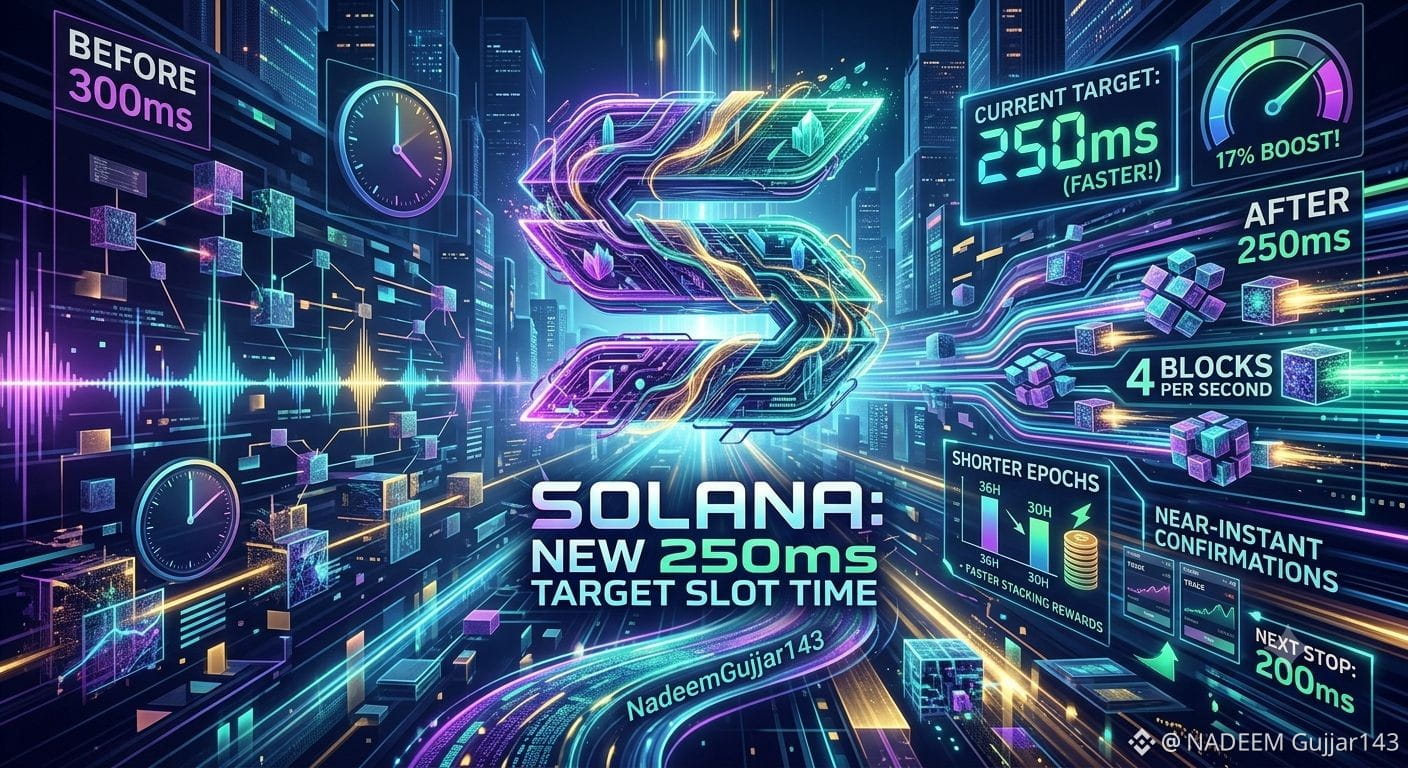
Solana has official cut its target slot time from 300ms down to 250ms! The clock is ticking faster on mainnet, and the ecosystem is feeling the speed boost.
Here is what you need to know 🧵👇
⚡ 4 Blocks Per Second: The network now targets 4 slots every single second.
📉 Shorter Epochs: Epochs dropped from ~36 hours down to ~30 hours. Staking rewards arrive faster!
🎯 Near-Instant Confirmations: Reduced price drift and latency for traders, DeFi, and oracles.
🏁 Next Stop: 200ms is the final target on the SIMD-0525 roadmap!
Solana keeps setting the standard for high-performance Web3. Are you holding $SOL? 🚀#Solana #DeFiDominance #BinanceSquareFamily
#Nadeemgujjar143
@Square-Creator-f3ffb6967ae3 @Square-Creator-82298398aad82
@1O69852872 @Square-Creator-4b9004503
$SOL
{spot}(SOLUSDT)
$SOLV
{spot}(SOLVUSDT)
$SOMI
{future}(SOMIUSDT)
#SolanaCutsTargetSlotTimeTo250ms
Solana Just Got 17% Faster! ⚡️
Solana has official cut its target slot time from 300ms down to 250ms! The clock is ticking faster on mainnet, and the ecosystem is feeling the speed boost.
Here is what you need to know 🧵👇
⚡ 4 Blocks Per Second: The network now targets 4 slots every single second.
📉 Shorter Epochs: Epochs dropped from ~36 hours down to ~30 hours. Staking rewards arrive faster!
🎯 Near-Instant Confirmations: Reduced price drift and latency for traders, DeFi, and oracles.
🏁 Next Stop: 200ms is the final target on the SIMD-0525 roadmap!
Solana keeps setting the standard for high-performance Web3. Are you holding $SOL ? 🚀#Solana #DeFiDominance #BinanceSquareFamily
#Nadeemgujjar143
@aasho @AYESHA ABID 阿伊莎 阿比德
@Fatima_Tariq @FATIMA
$SOL
$SOLV
$SOMI
Solana Just Got 17% Faster! ⚡️
Solana has official cut its target slot time from 300ms down to 250ms! The clock is ticking faster on mainnet, and the ecosystem is feeling the speed boost.
Here is what you need to know 🧵👇
⚡ 4 Blocks Per Second: The network now targets 4 slots every single second.
📉 Shorter Epochs: Epochs dropped from ~36 hours down to ~30 hours. Staking rewards arrive faster!
🎯 Near-Instant Confirmations: Reduced price drift and latency for traders, DeFi, and oracles.
🏁 Next Stop: 200ms is the final target on the SIMD-0525 roadmap!
Solana keeps setting the standard for high-performance Web3. Are you holding $SOL ? 🚀#Solana #DeFiDominance #BinanceSquareFamily
#Nadeemgujjar143
@aasho @AYESHA ABID 阿伊莎 阿比德
@Fatima_Tariq @FATIMA
$SOL
$SOLV
$SOMI
aasho:
Solana has official cut its target slot time from 300ms down to 250ms! The clock is ticking faster on mainnet, and the ecosystem is feeling the speed boost.
$SOL
1
2
85


250ms slots are a latency story, not a throughput one. It changes how fast the chain confirms what you already sent — which is what orderbook-style apps on-chain actually live on.
The trade-off nobody puts in the headline: shorter slots raise the hardware floor for validators. Faster chains tend toward more concentrated validator sets, and that's the cost being paid here.
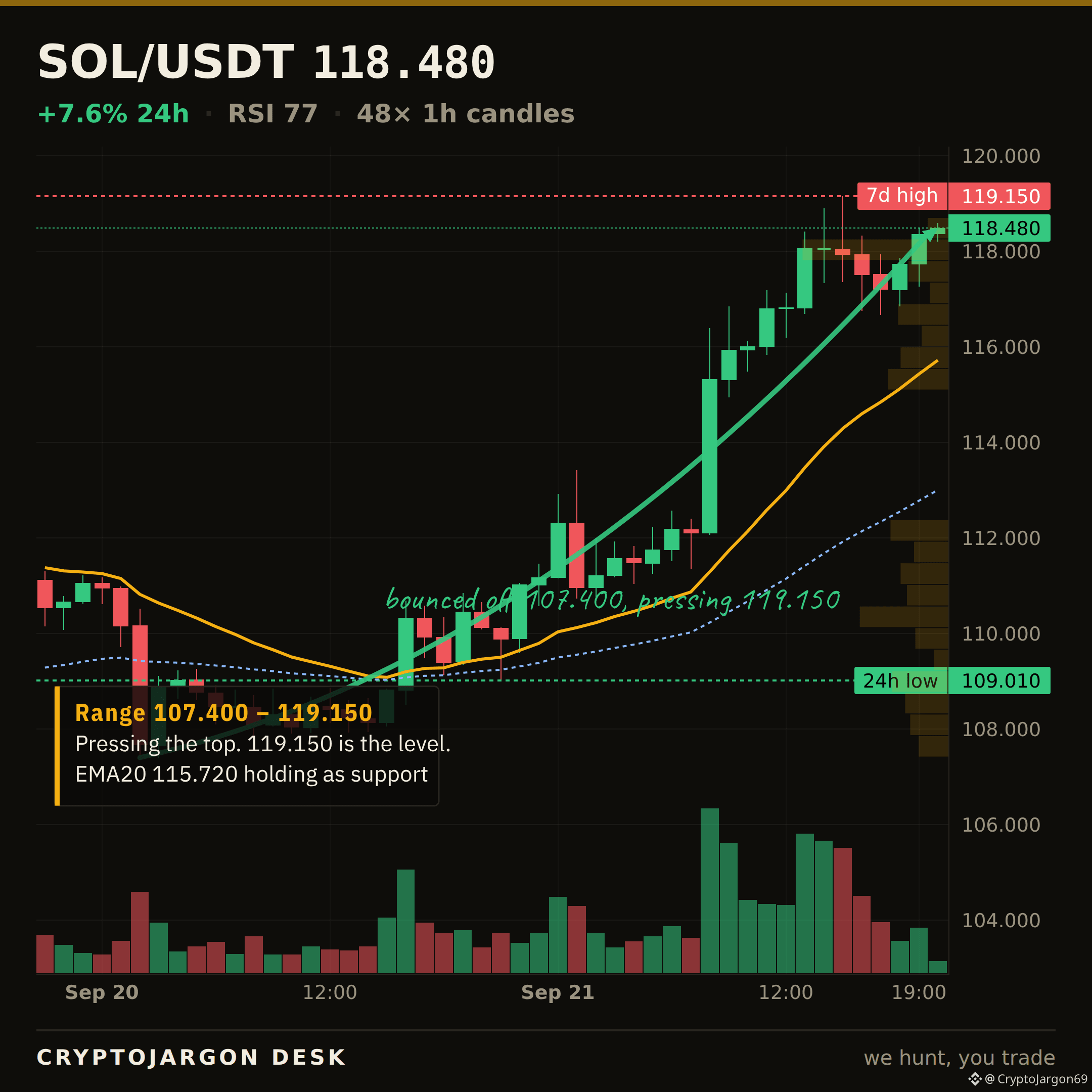
$SOL is at $118.42, +7.3% on the day, on $512M of volume.
Is sub-second finality worth a higher hardware bar for the people running the network? #SolanaCutsTargetSlotTimeTo250ms $SOL
250ms slots are a latency story, not a throughput one. It changes how fast the chain confirms what you already sent — which is what orderbook-style apps on-chain actually live on.
The trade-off nobody puts in the headline: shorter slots raise the hardware floor for validators. Faster chains tend toward more concentrated validator sets, and that's the cost being paid here.
$SOL is at $118.42, +7.3% on the day, on $512M of volume.
Is sub-second finality worth a higher hardware bar for the people running the network? #SolanaCutsTargetSlotTimeTo250ms $SOL
The trade-off nobody puts in the headline: shorter slots raise the hardware floor for validators. Faster chains tend toward more concentrated validator sets, and that's the cost being paid here.
$SOL is at $118.42, +7.3% on the day, on $512M of volume.
Is sub-second finality worth a higher hardware bar for the people running the network? #SolanaCutsTargetSlotTimeTo250ms $SOL
133
·
--
If you are still evaluating Layer 1 speed based on theoretical whitepapers rather than live execution latency, stop now.
Most traders lose money on fast-moving momentum plays simply because their transactions get stuck in mempool congestion while MEV bots frontrun the exact exit they needed. Watching a green candle evaporate into slippage because the network lagged is a pain every on-chain trader knows too well.
Solana pushing target slot times down to 250ms is fundamentally changing how execution wars play out across high-throughput networks. We watched $SUI and $NEAR force the speed narrative with sub-second finality, but seeing $SOL double down on raw block propagation changes the competitive math. Faster slots do not just mean snappier swaps for retail; they squeeze the arbitrage window for liquidators and drastically reduce stale state errors during violent volatility.
The trade-off, as always in distributed systems, lands squarely on validator hardware requirements and bandwidth overhead. Cutting slot times in half creates intense synchronization demands, reminding everyone of the historic trade-offs between pure decentralization and peak execution efficiency.
Do you think pushing sub-second slot times is the right path to win the throughput race, or does it risk pushing validator decentralization too far?
#SolanaCutsTargetSlotTimeTo250ms #EthereumSurpasses
If you are still evaluating Layer 1 speed based on theoretical whitepapers rather than live execution latency, stop now.
Most traders lose money on fast-moving momentum plays simply because their transactions get stuck in mempool congestion while MEV bots frontrun the exact exit they needed. Watching a green candle evaporate into slippage because the network lagged is a pain every on-chain trader knows too well.
Solana pushing target slot times down to 250ms is fundamentally changing how execution wars play out across high-throughput networks. We watched $SUI and $NEAR force the speed narrative with sub-second finality, but seeing $SOL double down on raw block propagation changes the competitive math. Faster slots do not just mean snappier swaps for retail; they squeeze the arbitrage window for liquidators and drastically reduce stale state errors during violent volatility.
The trade-off, as always in distributed systems, lands squarely on validator hardware requirements and bandwidth overhead. Cutting slot times in half creates intense synchronization demands, reminding everyone of the historic trade-offs between pure decentralization and peak execution efficiency.
Do you think pushing sub-second slot times is the right path to win the throughput race, or does it risk pushing validator decentralization too far?
#SolanaCutsTargetSlotTimeTo250ms #EthereumSurpasses
Most traders lose money on fast-moving momentum plays simply because their transactions get stuck in mempool congestion while MEV bots frontrun the exact exit they needed. Watching a green candle evaporate into slippage because the network lagged is a pain every on-chain trader knows too well.
Solana pushing target slot times down to 250ms is fundamentally changing how execution wars play out across high-throughput networks. We watched $SUI and $NEAR force the speed narrative with sub-second finality, but seeing $SOL double down on raw block propagation changes the competitive math. Faster slots do not just mean snappier swaps for retail; they squeeze the arbitrage window for liquidators and drastically reduce stale state errors during violent volatility.
The trade-off, as always in distributed systems, lands squarely on validator hardware requirements and bandwidth overhead. Cutting slot times in half creates intense synchronization demands, reminding everyone of the historic trade-offs between pure decentralization and peak execution efficiency.
Do you think pushing sub-second slot times is the right path to win the throughput race, or does it risk pushing validator decentralization too far?
#SolanaCutsTargetSlotTimeTo250ms #EthereumSurpasses

114
Why is everyone celebrating faster block times when most retail traders are about to get front-run harder than ever?
Every cycle, traders watch their orders slip or get eaten alive by MEV bots during high-volatility spikes, only to blame network congestion. Cutting target slot times down to 250ms might look like a massive throughput victory on paper, but in reality, it widens the execution gap between everyday participants and high-frequency trading infrastructure.
When block production accelerates to sub-second speeds, validator co-location and custom RPC pipelines become the only game that matters. While high-speed chains like $SUI and $NEAR have forced this race toward ultra-low latency, pushing $SOL to 250ms slots turns decentralized trading into a pure latency arbitrage arena. Retail market orders will inevitably absorb worse execution prices during major liquidations while specialized desks capture the spread.
We often confuse raw network speed with actual market fairness. Faster execution is great for infrastructure benchmarks, but it fundamentally shifts the battlefield toward whoever sits closest to the validator.
Do you think sub-second block times actually help regular on-chain users, or are we just optimizing the network for trading bots?
#SolanaCutsTargetSlotTimeTo250ms #EthereumSurpasses
Why is everyone celebrating faster block times when most retail traders are about to get front-run harder than ever?
Every cycle, traders watch their orders slip or get eaten alive by MEV bots during high-volatility spikes, only to blame network congestion. Cutting target slot times down to 250ms might look like a massive throughput victory on paper, but in reality, it widens the execution gap between everyday participants and high-frequency trading infrastructure.
When block production accelerates to sub-second speeds, validator co-location and custom RPC pipelines become the only game that matters. While high-speed chains like $SUI and $NEAR have forced this race toward ultra-low latency, pushing $SOL to 250ms slots turns decentralized trading into a pure latency arbitrage arena. Retail market orders will inevitably absorb worse execution prices during major liquidations while specialized desks capture the spread.
We often confuse raw network speed with actual market fairness. Faster execution is great for infrastructure benchmarks, but it fundamentally shifts the battlefield toward whoever sits closest to the validator.
Do you think sub-second block times actually help regular on-chain users, or are we just optimizing the network for trading bots?
#SolanaCutsTargetSlotTimeTo250ms #EthereumSurpasses
Every cycle, traders watch their orders slip or get eaten alive by MEV bots during high-volatility spikes, only to blame network congestion. Cutting target slot times down to 250ms might look like a massive throughput victory on paper, but in reality, it widens the execution gap between everyday participants and high-frequency trading infrastructure.
When block production accelerates to sub-second speeds, validator co-location and custom RPC pipelines become the only game that matters. While high-speed chains like $SUI and $NEAR have forced this race toward ultra-low latency, pushing $SOL to 250ms slots turns decentralized trading into a pure latency arbitrage arena. Retail market orders will inevitably absorb worse execution prices during major liquidations while specialized desks capture the spread.
We often confuse raw network speed with actual market fairness. Faster execution is great for infrastructure benchmarks, but it fundamentally shifts the battlefield toward whoever sits closest to the validator.
Do you think sub-second block times actually help regular on-chain users, or are we just optimizing the network for trading bots?
#SolanaCutsTargetSlotTimeTo250ms #EthereumSurpasses
109

·
--
#SolanaCutsTargetSlotTimeTo250ms
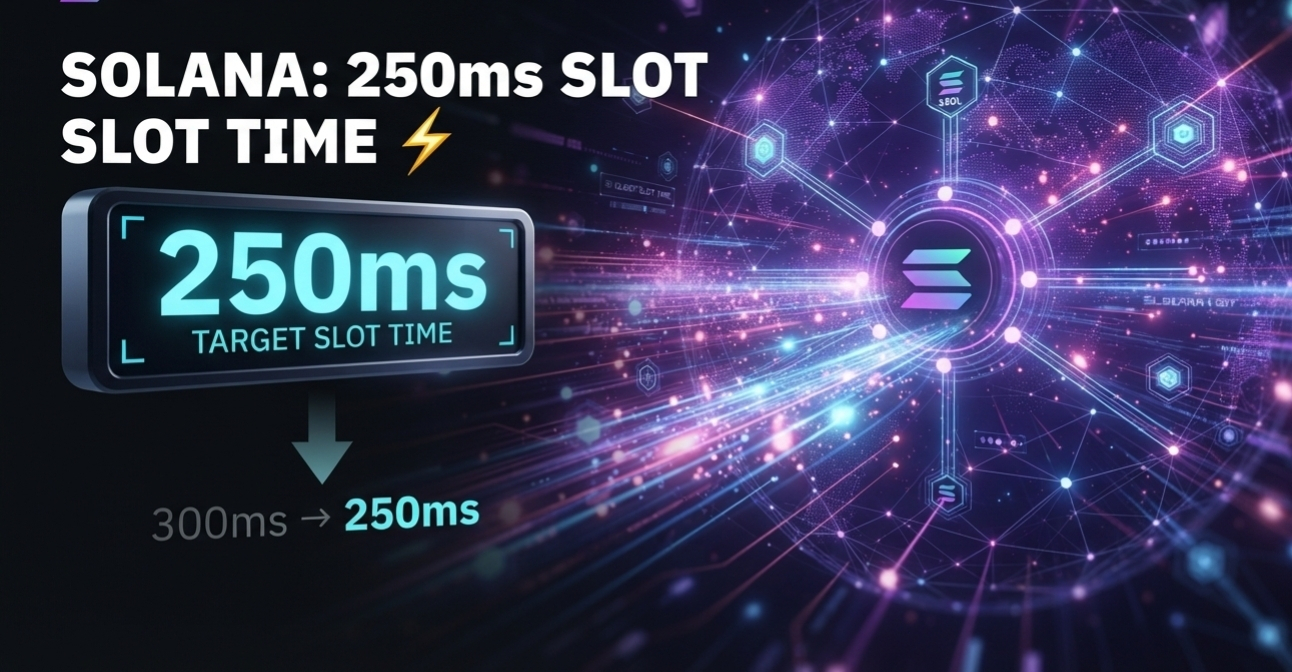
⚡ Solana $SOL Just Got Faster: 250ms Target Slot Time Goes Live
Solana has activated a major network timing upgrade, reducing its target slot time from 300ms to 250ms on September 18, 2026.
The change is part of SIMD-0525, a phased roadmap designed to progressively reduce Solana’s slot time toward a 200ms target.
🚀 What Does 250ms Mean?
At 250ms:
• ⏱️ 4 target slots per second, compared with ~3.3 previously
• 🔄 A 4-slot leader window is about 1 second, down from 1.2 seconds
• 🌐 A 432,000-slot epoch targets roughly 30 hours, compared with ~36 hours at 300ms
• ⚡ The network gets more frequent state updates and shorter leader-control intervals
Importantly, faster slots do not automatically mean higher overall transaction capacity. SIMD-0525 also adjusts per-slot compute and data limits to keep the approximate wall-clock processing rate broadly aligned.
🔥 The Bigger Picture
The 250ms upgrade is another step in Solana’s push toward lower latency and faster network coordination.
And there is still another milestone ahead:
250ms → 200ms
The 200ms target remains the next stage of the roadmap, with its mainnet activation still ahead.
For $SOL, the key question is not simply “How fast can Solana go?” — but how developers, traders, validators, and applications use these lower-latency capabilities as the network evolves.
⚠️ Disclaimer: This post is for informational purposes only and does not constitute financial or investment advice. Always conduct your own research before making any investment decision.
#Solana #SOL #Crypto #Blockchain #Web3 #DeFi #Altcoins #CryptoNews #SolanaNews
#SolanaCutsTargetSlotTimeTo250ms
⚡ Solana $SOL Just Got Faster: 250ms Target Slot Time Goes Live
Solana has activated a major network timing upgrade, reducing its target slot time from 300ms to 250ms on September 18, 2026.
The change is part of SIMD-0525, a phased roadmap designed to progressively reduce Solana’s slot time toward a 200ms target.
🚀 What Does 250ms Mean?
At 250ms:
• ⏱️ 4 target slots per second, compared with ~3.3 previously
• 🔄 A 4-slot leader window is about 1 second, down from 1.2 seconds
• 🌐 A 432,000-slot epoch targets roughly 30 hours, compared with ~36 hours at 300ms
• ⚡ The network gets more frequent state updates and shorter leader-control intervals
Importantly, faster slots do not automatically mean higher overall transaction capacity. SIMD-0525 also adjusts per-slot compute and data limits to keep the approximate wall-clock processing rate broadly aligned.
🔥 The Bigger Picture
The 250ms upgrade is another step in Solana’s push toward lower latency and faster network coordination.
And there is still another milestone ahead:
250ms → 200ms
The 200ms target remains the next stage of the roadmap, with its mainnet activation still ahead.
For $SOL, the key question is not simply “How fast can Solana go?” — but how developers, traders, validators, and applications use these lower-latency capabilities as the network evolves.
⚠️ Disclaimer: This post is for informational purposes only and does not constitute financial or investment advice. Always conduct your own research before making any investment decision.
#Solana #SOL #Crypto #Blockchain #Web3 #DeFi #Altcoins #CryptoNews #SolanaNews
⚡ Solana $SOL Just Got Faster: 250ms Target Slot Time Goes Live
Solana has activated a major network timing upgrade, reducing its target slot time from 300ms to 250ms on September 18, 2026.
The change is part of SIMD-0525, a phased roadmap designed to progressively reduce Solana’s slot time toward a 200ms target.
🚀 What Does 250ms Mean?
At 250ms:
• ⏱️ 4 target slots per second, compared with ~3.3 previously
• 🔄 A 4-slot leader window is about 1 second, down from 1.2 seconds
• 🌐 A 432,000-slot epoch targets roughly 30 hours, compared with ~36 hours at 300ms
• ⚡ The network gets more frequent state updates and shorter leader-control intervals
Importantly, faster slots do not automatically mean higher overall transaction capacity. SIMD-0525 also adjusts per-slot compute and data limits to keep the approximate wall-clock processing rate broadly aligned.
🔥 The Bigger Picture
The 250ms upgrade is another step in Solana’s push toward lower latency and faster network coordination.
And there is still another milestone ahead:
250ms → 200ms
The 200ms target remains the next stage of the roadmap, with its mainnet activation still ahead.
For $SOL, the key question is not simply “How fast can Solana go?” — but how developers, traders, validators, and applications use these lower-latency capabilities as the network evolves.
⚠️ Disclaimer: This post is for informational purposes only and does not constitute financial or investment advice. Always conduct your own research before making any investment decision.
#Solana #SOL #Crypto #Blockchain #Web3 #DeFi #Altcoins #CryptoNews #SolanaNews
54

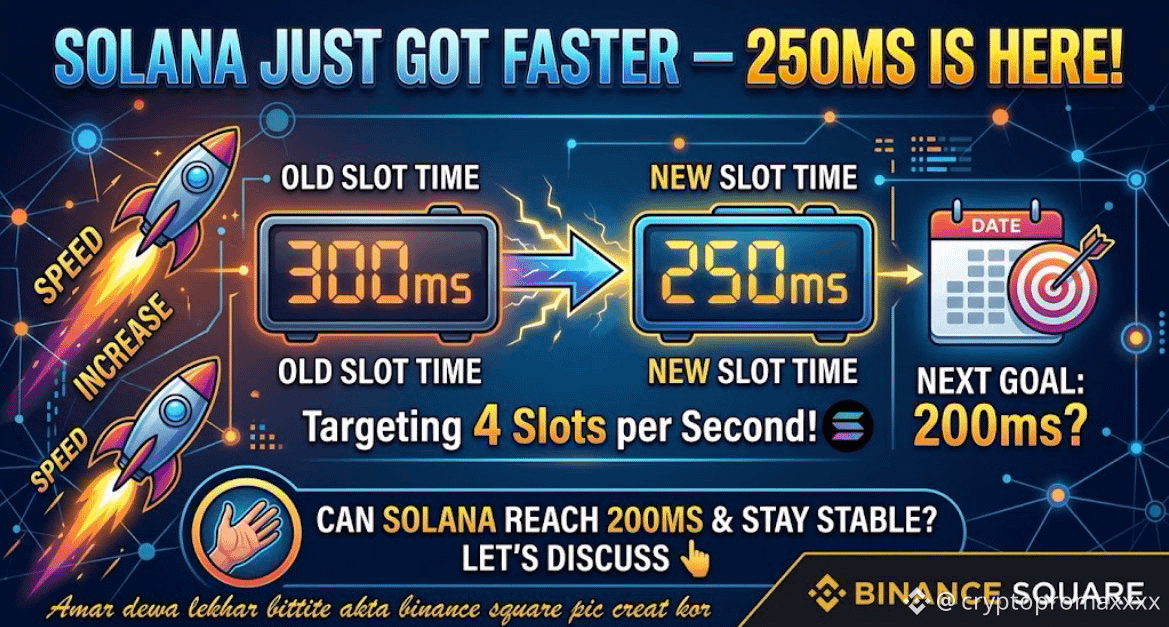
⚡ SOLANA JUST GOT FASTER — 250MS IS HERE! 🚀
Solana has reached another important infrastructure milestone. On September 18, 2026, its mainnet-beta target slot time moved from 300ms → 250ms under SIMD-0525.
That means Solana is now targeting roughly 4 slots per second. 👀
🔹 Previous target: 300ms
🔹 New target: 250ms
🔹 Next long-term goal: 200ms
But here’s the interesting part 🧠👇
A shorter slot time doesn’t automatically mean Solana will process proportionally more transactions. The upgrade also adjusts per-slot resource limits to keep the overall execution budget broadly balanced.
So the real test isn’t simply “How fast can Solana go?”
It’s whether validators, transaction propagation and network coordination can remain reliable as the timing gets tighter.
⚡ 250ms is the milestone.
200ms could be the next big test.
Do you think Solana can successfully reach 200ms while maintaining stable network performance? 👇
Bullish on $SOL? 🟢 or watching from the sidelines?
#SolanaCutsTargetSlotTimeTo250ms #SOL #CryptoNews #Blockchain #Web3 #Crypto #BinanceSquare
{spot}(SOLUSDT)
⚡ SOLANA JUST GOT FASTER — 250MS IS HERE! 🚀
Solana has reached another important infrastructure milestone. On September 18, 2026, its mainnet-beta target slot time moved from 300ms → 250ms under SIMD-0525.
That means Solana is now targeting roughly 4 slots per second. 👀
🔹 Previous target: 300ms
🔹 New target: 250ms
🔹 Next long-term goal: 200ms
But here’s the interesting part 🧠👇
A shorter slot time doesn’t automatically mean Solana will process proportionally more transactions. The upgrade also adjusts per-slot resource limits to keep the overall execution budget broadly balanced.
So the real test isn’t simply “How fast can Solana go?”
It’s whether validators, transaction propagation and network coordination can remain reliable as the timing gets tighter.
⚡ 250ms is the milestone.
200ms could be the next big test.
Do you think Solana can successfully reach 200ms while maintaining stable network performance? 👇
Bullish on $SOL? 🟢 or watching from the sidelines?
#SolanaCutsTargetSlotTimeTo250ms #SOL #CryptoNews #Blockchain #Web3 #Crypto #BinanceSquare
Solana has reached another important infrastructure milestone. On September 18, 2026, its mainnet-beta target slot time moved from 300ms → 250ms under SIMD-0525.
That means Solana is now targeting roughly 4 slots per second. 👀
🔹 Previous target: 300ms
🔹 New target: 250ms
🔹 Next long-term goal: 200ms
But here’s the interesting part 🧠👇
A shorter slot time doesn’t automatically mean Solana will process proportionally more transactions. The upgrade also adjusts per-slot resource limits to keep the overall execution budget broadly balanced.
So the real test isn’t simply “How fast can Solana go?”
It’s whether validators, transaction propagation and network coordination can remain reliable as the timing gets tighter.
⚡ 250ms is the milestone.
200ms could be the next big test.
Do you think Solana can successfully reach 200ms while maintaining stable network performance? 👇
Bullish on $SOL? 🟢 or watching from the sidelines?
#SolanaCutsTargetSlotTimeTo250ms #SOL #CryptoNews #Blockchain #Web3 #Crypto #BinanceSquare
268

·
--
🚀 Solana (SOL): Rent Reduction and Network Upgrades
#solana Solana activated the second phase of its rent reduction plan, unlocking up to 612,000 SOL in excess deposits for users. The network also cut its target slot time to 250 milliseconds (a 17% reduction) and topped $3 trillion in cumulative DEX trading volume.#NEARRisesNearly80%InAWeek #SolanaCutsTargetSlotTimeTo250ms
{spot}(SOLUSDT)
🚀 Solana (SOL): Rent Reduction and Network Upgrades
#solana Solana activated the second phase of its rent reduction plan, unlocking up to 612,000 SOL in excess deposits for users. The network also cut its target slot time to 250 milliseconds (a 17% reduction) and topped $3 trillion in cumulative DEX trading volume.#NEARRisesNearly80%InAWeek #SolanaCutsTargetSlotTimeTo250ms
#solana Solana activated the second phase of its rent reduction plan, unlocking up to 612,000 SOL in excess deposits for users. The network also cut its target slot time to 250 milliseconds (a 17% reduction) and topped $3 trillion in cumulative DEX trading volume.#NEARRisesNearly80%InAWeek #SolanaCutsTargetSlotTimeTo250ms
100

Vérifié
#solanacutstargetslottimeto250ms
⚡ $SOL JUST CUT THE CLOCK TO 250MS 👀 ⚡
When speed becomes the battlefield,
even milliseconds start writing the future.
Solana has now activated a 250ms target slot time on mainnet, down from 300ms. The change went live at epoch 1037 on September 18 under SIMD-0525.
That means the network is targeting roughly four slots per second, moving another step toward its longer-term 200ms goal. This is not simply a headline about “faster Solana.” It changes how quickly the network cycles through block production.
The deeper story is coordination. Shorter slots leave validators, transaction forwarding and network repair with less time to react, making reliability increasingly important as Solana pushes toward 200ms.
My Take: The real value of this upgrade is not a marketing number. Solana is testing how far it can compress network timing while maintaining stable validator coordination and real-world performance.
If that balance holds, faster execution could strengthen Solana’s infrastructure story. But every millisecond saved also raises the engineering bar.
The race is no longer just to move faster. It is to move faster without losing stability.
❓Do you think 200ms could become Solana’s next major performance milestone?
Disclaimer: Informational content only, not financial advice.
#Solana #CryptoNews #GrowWithSAC $SAGA $FTT
#SolanaCutsTargetSlotTimeTo250ms
#solanacutstargetslottimeto250ms
⚡ $SOL JUST CUT THE CLOCK TO 250MS 👀 ⚡
When speed becomes the battlefield,
even milliseconds start writing the future.
Solana has now activated a 250ms target slot time on mainnet, down from 300ms. The change went live at epoch 1037 on September 18 under SIMD-0525.
That means the network is targeting roughly four slots per second, moving another step toward its longer-term 200ms goal. This is not simply a headline about “faster Solana.” It changes how quickly the network cycles through block production.
The deeper story is coordination. Shorter slots leave validators, transaction forwarding and network repair with less time to react, making reliability increasingly important as Solana pushes toward 200ms.
My Take: The real value of this upgrade is not a marketing number. Solana is testing how far it can compress network timing while maintaining stable validator coordination and real-world performance.
If that balance holds, faster execution could strengthen Solana’s infrastructure story. But every millisecond saved also raises the engineering bar.
The race is no longer just to move faster. It is to move faster without losing stability.
❓Do you think 200ms could become Solana’s next major performance milestone?
Disclaimer: Informational content only, not financial advice.
#Solana #CryptoNews #GrowWithSAC $SAGA $FTT
#SolanaCutsTargetSlotTimeTo250ms
⚡ $SOL JUST CUT THE CLOCK TO 250MS 👀 ⚡
When speed becomes the battlefield,
even milliseconds start writing the future.
Solana has now activated a 250ms target slot time on mainnet, down from 300ms. The change went live at epoch 1037 on September 18 under SIMD-0525.
That means the network is targeting roughly four slots per second, moving another step toward its longer-term 200ms goal. This is not simply a headline about “faster Solana.” It changes how quickly the network cycles through block production.
The deeper story is coordination. Shorter slots leave validators, transaction forwarding and network repair with less time to react, making reliability increasingly important as Solana pushes toward 200ms.
My Take: The real value of this upgrade is not a marketing number. Solana is testing how far it can compress network timing while maintaining stable validator coordination and real-world performance.
If that balance holds, faster execution could strengthen Solana’s infrastructure story. But every millisecond saved also raises the engineering bar.
The race is no longer just to move faster. It is to move faster without losing stability.
❓Do you think 200ms could become Solana’s next major performance milestone?
Disclaimer: Informational content only, not financial advice.
#Solana #CryptoNews #GrowWithSAC $SAGA $FTT
#SolanaCutsTargetSlotTimeTo250ms

Hooram bhatti:
Sol
1
4
4.5k
·
--
Haussier
Vérifié
#solanacutstargetslottimeto250ms ⚡ Solana Targets 250ms Slots — Speed Upgrade Could Reshape Trading! 🚀
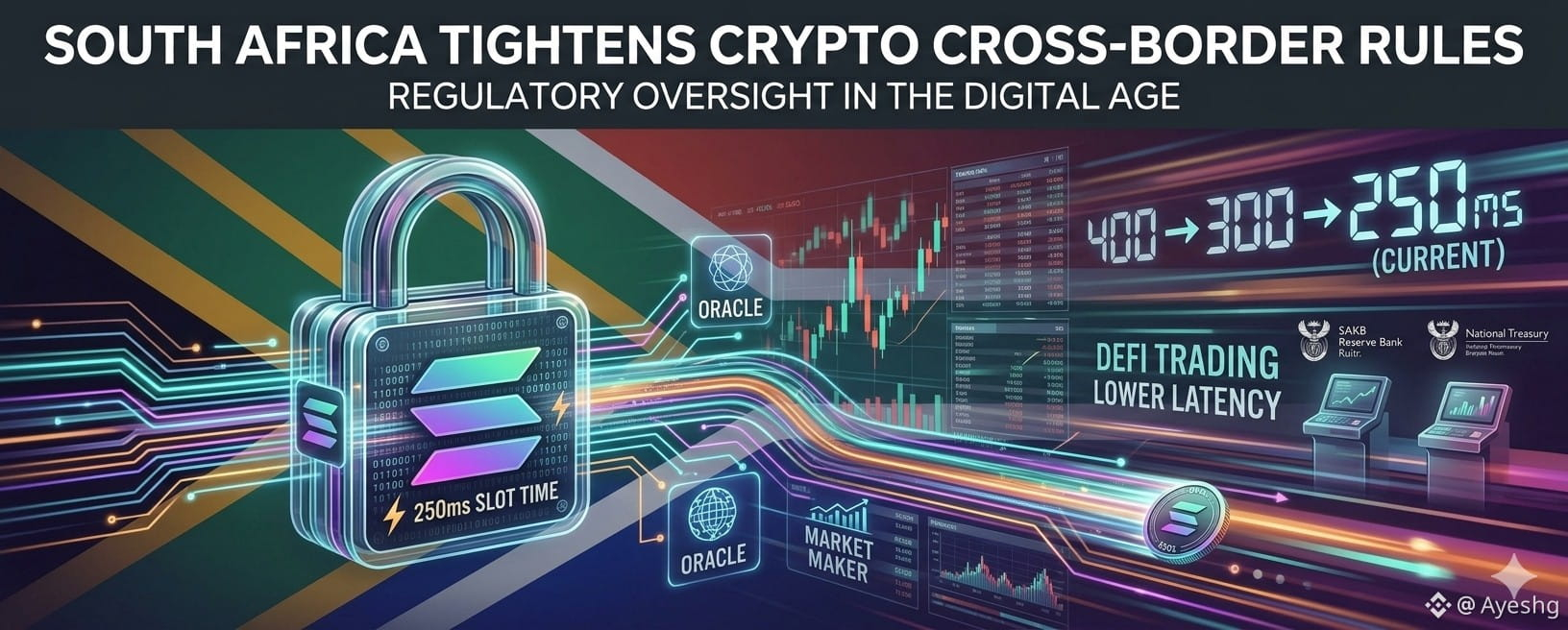
Solana is moving toward 250ms slot times under SIMD-0525, part of a staged plan to reduce slot time from 400ms toward 200ms.
📌 Current status: Mainnet is currently at 300ms, while the 250ms upgrade is live on Devnet and Testnet. Mainnet activation is still TBD.
⚡ Faster slots could mean:
• More frequent on-chain updates
• Lower latency for trading applications
• Faster leader rotation
• Finer timing for oracles and market makers
The official proposal says the 250ms stage would shorten an epoch from roughly 36 hours to 30 hours, while per-slot work limits are adjusted proportionally.
🔥 $SOL remains one of the key assets to watch as Solana pushes toward lower latency.
#Solana #SOL #CryptoNews #Blockchain #DeFi
#solanacutstargetslottimeto250ms ⚡ Solana Targets 250ms Slots — Speed Upgrade Could Reshape Trading! 🚀
Solana is moving toward 250ms slot times under SIMD-0525, part of a staged plan to reduce slot time from 400ms toward 200ms.
📌 Current status: Mainnet is currently at 300ms, while the 250ms upgrade is live on Devnet and Testnet. Mainnet activation is still TBD.
⚡ Faster slots could mean:
• More frequent on-chain updates
• Lower latency for trading applications
• Faster leader rotation
• Finer timing for oracles and market makers
The official proposal says the 250ms stage would shorten an epoch from roughly 36 hours to 30 hours, while per-slot work limits are adjusted proportionally.
🔥 $SOL remains one of the key assets to watch as Solana pushes toward lower latency.
#Solana #SOL #CryptoNews #Blockchain #DeFi
Solana is moving toward 250ms slot times under SIMD-0525, part of a staged plan to reduce slot time from 400ms toward 200ms.
📌 Current status: Mainnet is currently at 300ms, while the 250ms upgrade is live on Devnet and Testnet. Mainnet activation is still TBD.
⚡ Faster slots could mean:
• More frequent on-chain updates
• Lower latency for trading applications
• Faster leader rotation
• Finer timing for oracles and market makers
The official proposal says the 250ms stage would shorten an epoch from roughly 36 hours to 30 hours, while per-slot work limits are adjusted proportionally.
🔥 $SOL remains one of the key assets to watch as Solana pushes toward lower latency.
#Solana #SOL #CryptoNews #Blockchain #DeFi
2.7k

·
--
#SolanaCutsTargetSlotTimeTo250ms $GOOGL.US
{stock_us}(GOOGL.US)
Solana Cuts Target Slot Time To 250ms - Fastest Ever While GOOGL Hits 356
#SolanaCutsTargetSlotTimeTo250ms $GOOGL.US
$SOL just made history! Solana has cut its target slot time from 300ms to 250ms on Sept 18 at epoch 1037. This is 17 percent faster and the fastest ever on mainnet.
What does it mean?
1. Speed Upgrade, Not Just Hype
Solana now targets 4 slots per second instead of 3.3. Validators leader window drops from 1.2 sec to 1 sec. Wallets, exchanges and DeFi apps get fresher data, swaps fail less, slippage is lower.
2. Capacity Stays Balanced
Under SIMD-0525, per slot compute limit drops to 62.5M, so total capacity per second stays near 250M. More blocks, but smaller blocks. Epoch time also drops from 36 hours to 30 hours.
3. Why $GOOGL.US is Relevant Here
Alphabet $GOOGL.US is trading at 356.35 with 1.91 percent gain, showing big tech strength. When GOOGL and NVDA pump, investors look for high speed infra plays. Solana is becoming the Google-speed chain of crypto. Final target is 200ms = 5 slots per second.
My Take: This is a freshness upgrade, not just TPS marketing. For traders, this means better execution on Jupiter, Drift and oracle markets. SOL price holding above 110 with this news is very bullish.
Do you think Solana will reach 200ms this year?
A) Yes, Solana will be the fastest chain
B) No, 250ms is enough for now
Comment your pick!
#SolanaCutsTargetSlotTimeTo250ms #Solana #GOOGL
#SolanaCutsTargetSlotTimeTo250ms $GOOGL.US
Solana Cuts Target Slot Time To 250ms - Fastest Ever While GOOGL Hits 356
#SolanaCutsTargetSlotTimeTo250ms $GOOGL.US
$SOL just made history! Solana has cut its target slot time from 300ms to 250ms on Sept 18 at epoch 1037. This is 17 percent faster and the fastest ever on mainnet.
What does it mean?
1. Speed Upgrade, Not Just Hype
Solana now targets 4 slots per second instead of 3.3. Validators leader window drops from 1.2 sec to 1 sec. Wallets, exchanges and DeFi apps get fresher data, swaps fail less, slippage is lower.
2. Capacity Stays Balanced
Under SIMD-0525, per slot compute limit drops to 62.5M, so total capacity per second stays near 250M. More blocks, but smaller blocks. Epoch time also drops from 36 hours to 30 hours.
3. Why $GOOGL.US is Relevant Here
Alphabet $GOOGL.US is trading at 356.35 with 1.91 percent gain, showing big tech strength. When GOOGL and NVDA pump, investors look for high speed infra plays. Solana is becoming the Google-speed chain of crypto. Final target is 200ms = 5 slots per second.
My Take: This is a freshness upgrade, not just TPS marketing. For traders, this means better execution on Jupiter, Drift and oracle markets. SOL price holding above 110 with this news is very bullish.
Do you think Solana will reach 200ms this year?
A) Yes, Solana will be the fastest chain
B) No, 250ms is enough for now
Comment your pick!
#SolanaCutsTargetSlotTimeTo250ms #Solana #GOOGL
Solana Cuts Target Slot Time To 250ms - Fastest Ever While GOOGL Hits 356
#SolanaCutsTargetSlotTimeTo250ms $GOOGL.US
$SOL just made history! Solana has cut its target slot time from 300ms to 250ms on Sept 18 at epoch 1037. This is 17 percent faster and the fastest ever on mainnet.
What does it mean?
1. Speed Upgrade, Not Just Hype
Solana now targets 4 slots per second instead of 3.3. Validators leader window drops from 1.2 sec to 1 sec. Wallets, exchanges and DeFi apps get fresher data, swaps fail less, slippage is lower.
2. Capacity Stays Balanced
Under SIMD-0525, per slot compute limit drops to 62.5M, so total capacity per second stays near 250M. More blocks, but smaller blocks. Epoch time also drops from 36 hours to 30 hours.
3. Why $GOOGL.US is Relevant Here
Alphabet $GOOGL.US is trading at 356.35 with 1.91 percent gain, showing big tech strength. When GOOGL and NVDA pump, investors look for high speed infra plays. Solana is becoming the Google-speed chain of crypto. Final target is 200ms = 5 slots per second.
My Take: This is a freshness upgrade, not just TPS marketing. For traders, this means better execution on Jupiter, Drift and oracle markets. SOL price holding above 110 with this news is very bullish.
Do you think Solana will reach 200ms this year?
A) Yes, Solana will be the fastest chain
B) No, 250ms is enough for now
Comment your pick!
#SolanaCutsTargetSlotTimeTo250ms #Solana #GOOGL
SOL+3,30%
GOOGLUS+0,43%
1
109

·
--
Haussier
#SolanaCutsTargetSlotTimeTo250ms
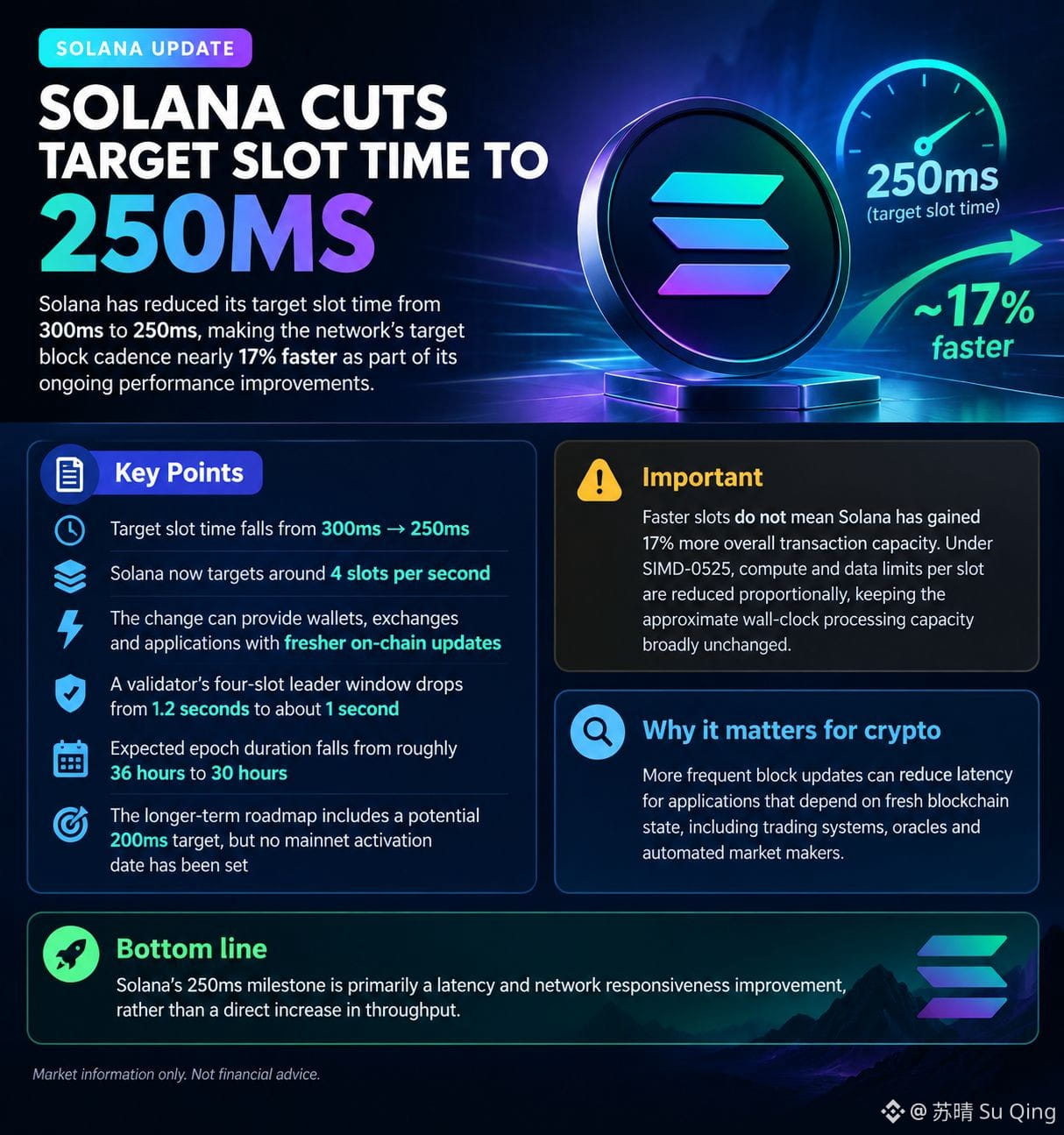
🚨 SOLANA CUTS TARGET SLOT TIME TO 250MS
Solana has reduced its target slot time from 300ms to 250ms, making the network’s target block cadence nearly 17% faster as part of its ongoing performance improvements.
📊 Key points:
• Target slot time falls from 300ms → 250ms
• Solana now targets around 4 slots per second
• The change can provide wallets, exchanges and applications with fresher on-chain updates
• A validator’s four-slot leader window drops from 1.2 seconds to about 1 second
• Expected epoch duration falls from roughly 36 hours to 30 hours
• The longer-term roadmap includes a potential 200ms target, but no mainnet activation date has been set
⚠️ Important: Faster slots do not mean Solana has gained 17% more overall transaction capacity. Under SIMD-0525, compute and data limits per slot are reduced proportionally, keeping the approximate wall-clock processing capacity broadly unchanged.
🔎 Why it matters for crypto:
More frequent block updates can reduce latency for applications that depend on fresh blockchain state, including trading systems, oracles and automated market makers.
📌 Bottom line:
Solana’s 250ms milestone is primarily a latency and network responsiveness improvement, rather than a direct increase in throughput.
$KMNO
{future}(KMNOUSDT)
$WIF
{future}(WIFUSDT)
$SEI
{future}(SEIUSDT)
#SolanaCutsTargetSlotTimeTo250ms
🚨 SOLANA CUTS TARGET SLOT TIME TO 250MS
Solana has reduced its target slot time from 300ms to 250ms, making the network’s target block cadence nearly 17% faster as part of its ongoing performance improvements.
📊 Key points:
• Target slot time falls from 300ms → 250ms
• Solana now targets around 4 slots per second
• The change can provide wallets, exchanges and applications with fresher on-chain updates
• A validator’s four-slot leader window drops from 1.2 seconds to about 1 second
• Expected epoch duration falls from roughly 36 hours to 30 hours
• The longer-term roadmap includes a potential 200ms target, but no mainnet activation date has been set
⚠️ Important: Faster slots do not mean Solana has gained 17% more overall transaction capacity. Under SIMD-0525, compute and data limits per slot are reduced proportionally, keeping the approximate wall-clock processing capacity broadly unchanged.
🔎 Why it matters for crypto:
More frequent block updates can reduce latency for applications that depend on fresh blockchain state, including trading systems, oracles and automated market makers.
📌 Bottom line:
Solana’s 250ms milestone is primarily a latency and network responsiveness improvement, rather than a direct increase in throughput.
$KMNO
$WIF
$SEI
🚨 SOLANA CUTS TARGET SLOT TIME TO 250MS
Solana has reduced its target slot time from 300ms to 250ms, making the network’s target block cadence nearly 17% faster as part of its ongoing performance improvements.
📊 Key points:
• Target slot time falls from 300ms → 250ms
• Solana now targets around 4 slots per second
• The change can provide wallets, exchanges and applications with fresher on-chain updates
• A validator’s four-slot leader window drops from 1.2 seconds to about 1 second
• Expected epoch duration falls from roughly 36 hours to 30 hours
• The longer-term roadmap includes a potential 200ms target, but no mainnet activation date has been set
⚠️ Important: Faster slots do not mean Solana has gained 17% more overall transaction capacity. Under SIMD-0525, compute and data limits per slot are reduced proportionally, keeping the approximate wall-clock processing capacity broadly unchanged.
🔎 Why it matters for crypto:
More frequent block updates can reduce latency for applications that depend on fresh blockchain state, including trading systems, oracles and automated market makers.
📌 Bottom line:
Solana’s 250ms milestone is primarily a latency and network responsiveness improvement, rather than a direct increase in throughput.
$KMNO
$WIF
$SEI
61

·
--
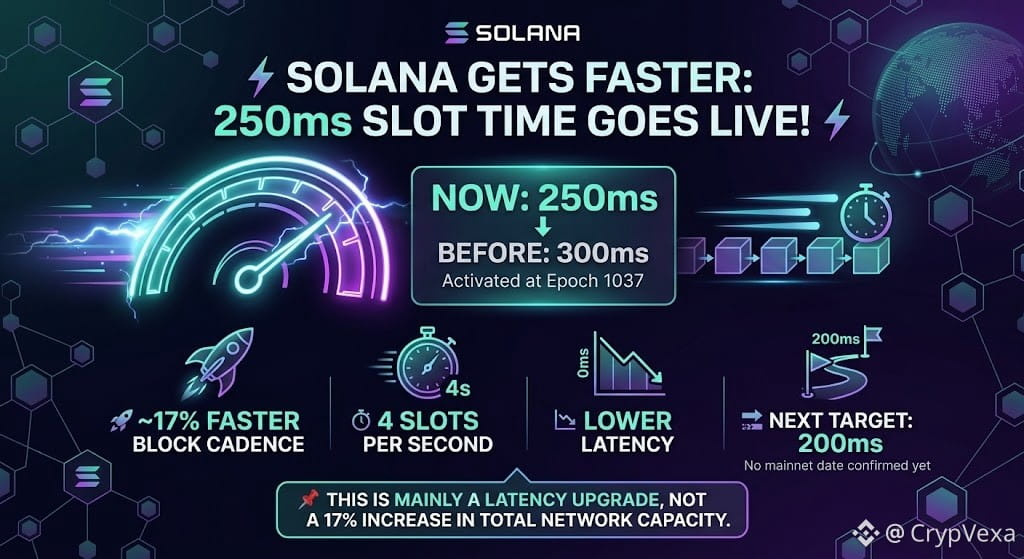
#SolanaCutsTargetSlotTimeTo250ms
⚡ Solana Gets Faster: 250ms Slot Time Goes Live!
Solana has reduced its target slot time from 300ms → 250ms, activated on mainnet at Epoch 1037.
🚀 ~17% faster block cadence
⏱️ 4 slots per second
📉 Lower latency for on-chain updates
📌 This is mainly a latency upgrade, not a 17% increase in total network capacity.
🔜 The next target is 200ms, with no mainnet date confirmed yet.
#Solana #SOL #Blockchain #Crypto
#SolanaCutsTargetSlotTimeTo250ms
⚡ Solana Gets Faster: 250ms Slot Time Goes Live!
Solana has reduced its target slot time from 300ms → 250ms, activated on mainnet at Epoch 1037.
🚀 ~17% faster block cadence
⏱️ 4 slots per second
📉 Lower latency for on-chain updates
📌 This is mainly a latency upgrade, not a 17% increase in total network capacity.
🔜 The next target is 200ms, with no mainnet date confirmed yet.
#Solana #SOL #Blockchain #Crypto
⚡ Solana Gets Faster: 250ms Slot Time Goes Live!
Solana has reduced its target slot time from 300ms → 250ms, activated on mainnet at Epoch 1037.
🚀 ~17% faster block cadence
⏱️ 4 slots per second
📉 Lower latency for on-chain updates
📌 This is mainly a latency upgrade, not a 17% increase in total network capacity.
🔜 The next target is 200ms, with no mainnet date confirmed yet.
#Solana #SOL #Blockchain #Crypto
1
3

Vérifié
#solanacutstargetslottimeto250ms
⚡ Solana $SOL Cuts Target Slot Time To 250ms ⚡
Picture a network clock ticking so fast that one small adjustment changes how quickly the entire system moves. On Solana, that moment has now arrived.
Solana activated a 250ms target slot time on September 18, down from 300ms. The change is the third stage of SIMD-0525, a proposal designed to reduce slot times progressively toward 200ms.
At 250ms, Solana targets four slots every second instead of roughly 3.3. That compresses a four-slot validator leadership window from 1.2 seconds to about 1 second, while epochs shorten from roughly 36 hours to 30.
But here is the detail many headlines can miss: faster slots do not automatically mean a proportional increase in total processing capacity. The proposal reduces per-slot work limits alongside the timing change, keeping the approximate wall-clock processing ceiling similar.
That makes this more of an efficiency and responsiveness upgrade than a simple “Solana is now X% faster” story. Validators also face tighter timing around block production and infrastructure performance.
For SOL, the upgrade strengthens the network-performance narrative while the broader market remains positive. Current Binance Square market data shows SOL in the green alongside a strong altcoin rotation.
The bigger question is what happens next: can Solana keep compressing its timing without sacrificing reliability?
A faster clock matters only when the network can keep every beat.
❓Would you rather see Solana prioritize even faster slots, or maximum stability at 250ms?
Disclaimer: This is educational content, not financial advice.
#Solana #CryptoNews #GrowWithSAC $SAGA $FTT
#SolanaCutsTargetSlotTimeTo250ms
#solanacutstargetslottimeto250ms
⚡ Solana $SOL Cuts Target Slot Time To 250ms ⚡
Picture a network clock ticking so fast that one small adjustment changes how quickly the entire system moves. On Solana, that moment has now arrived.
Solana activated a 250ms target slot time on September 18, down from 300ms. The change is the third stage of SIMD-0525, a proposal designed to reduce slot times progressively toward 200ms.
At 250ms, Solana targets four slots every second instead of roughly 3.3. That compresses a four-slot validator leadership window from 1.2 seconds to about 1 second, while epochs shorten from roughly 36 hours to 30.
But here is the detail many headlines can miss: faster slots do not automatically mean a proportional increase in total processing capacity. The proposal reduces per-slot work limits alongside the timing change, keeping the approximate wall-clock processing ceiling similar.
That makes this more of an efficiency and responsiveness upgrade than a simple “Solana is now X% faster” story. Validators also face tighter timing around block production and infrastructure performance.
For SOL, the upgrade strengthens the network-performance narrative while the broader market remains positive. Current Binance Square market data shows SOL in the green alongside a strong altcoin rotation.
The bigger question is what happens next: can Solana keep compressing its timing without sacrificing reliability?
A faster clock matters only when the network can keep every beat.
❓Would you rather see Solana prioritize even faster slots, or maximum stability at 250ms?
Disclaimer: This is educational content, not financial advice.
#Solana #CryptoNews #GrowWithSAC $SAGA $FTT
#SolanaCutsTargetSlotTimeTo250ms
⚡ Solana $SOL Cuts Target Slot Time To 250ms ⚡
Picture a network clock ticking so fast that one small adjustment changes how quickly the entire system moves. On Solana, that moment has now arrived.
Solana activated a 250ms target slot time on September 18, down from 300ms. The change is the third stage of SIMD-0525, a proposal designed to reduce slot times progressively toward 200ms.
At 250ms, Solana targets four slots every second instead of roughly 3.3. That compresses a four-slot validator leadership window from 1.2 seconds to about 1 second, while epochs shorten from roughly 36 hours to 30.
But here is the detail many headlines can miss: faster slots do not automatically mean a proportional increase in total processing capacity. The proposal reduces per-slot work limits alongside the timing change, keeping the approximate wall-clock processing ceiling similar.
That makes this more of an efficiency and responsiveness upgrade than a simple “Solana is now X% faster” story. Validators also face tighter timing around block production and infrastructure performance.
For SOL, the upgrade strengthens the network-performance narrative while the broader market remains positive. Current Binance Square market data shows SOL in the green alongside a strong altcoin rotation.
The bigger question is what happens next: can Solana keep compressing its timing without sacrificing reliability?
A faster clock matters only when the network can keep every beat.
❓Would you rather see Solana prioritize even faster slots, or maximum stability at 250ms?
Disclaimer: This is educational content, not financial advice.
#Solana #CryptoNews #GrowWithSAC $SAGA $FTT
#SolanaCutsTargetSlotTimeTo250ms

4
8.5k

·
--
Haussier
Vérifié
#solanacutstargetslottimeto250ms
Solana Just Got 2x Faster: Why 250ms Slots Change the Game for HFT Traders ⚡
Solana has officially pushed its target slot time down from 300ms to 250ms as part of its SIMD-0525 upgrade roadmap. The network is now targeting 4 blocks per second—a major leap forward for speed, low latency, and real-time execution.
While the total processing capacity remains capped via proportional compute adjustments, the faster block cadence provides fresher price updates across DeFi applications and speeds up validator leader rotation.
Key Takeaways:
Tech Upgrade: Target slot timing drops to 250ms, shrinking Solana's epoch duration from 36 hours down to roughly 30 hours.
Trader Lens: Reduced latency gives DEX traders, automated market makers (AMMs), and high-frequency trading (HFT) bots faster confirmation cycles—significantly reducing slippage and trade failure rates during volatile market spikes.
Roadmap Ahead: Developers are observing network stability at 250ms before evaluating the final planned milestone target of 200ms.
How do you think this speed upgrade impacts Solana's edge over other Layer-1 networks? Share your thoughts below! 👇
$SOL
{future}(SOLUSDT)
#solana #sol #CryptoNews
#solanacutstargetslottimeto250ms
Solana Just Got 2x Faster: Why 250ms Slots Change the Game for HFT Traders ⚡
Solana has officially pushed its target slot time down from 300ms to 250ms as part of its SIMD-0525 upgrade roadmap. The network is now targeting 4 blocks per second—a major leap forward for speed, low latency, and real-time execution.
While the total processing capacity remains capped via proportional compute adjustments, the faster block cadence provides fresher price updates across DeFi applications and speeds up validator leader rotation.
Key Takeaways:
Tech Upgrade: Target slot timing drops to 250ms, shrinking Solana's epoch duration from 36 hours down to roughly 30 hours.
Trader Lens: Reduced latency gives DEX traders, automated market makers (AMMs), and high-frequency trading (HFT) bots faster confirmation cycles—significantly reducing slippage and trade failure rates during volatile market spikes.
Roadmap Ahead: Developers are observing network stability at 250ms before evaluating the final planned milestone target of 200ms.
How do you think this speed upgrade impacts Solana's edge over other Layer-1 networks? Share your thoughts below! 👇
$SOL
#solana #sol #CryptoNews
Solana Just Got 2x Faster: Why 250ms Slots Change the Game for HFT Traders ⚡
Solana has officially pushed its target slot time down from 300ms to 250ms as part of its SIMD-0525 upgrade roadmap. The network is now targeting 4 blocks per second—a major leap forward for speed, low latency, and real-time execution.
While the total processing capacity remains capped via proportional compute adjustments, the faster block cadence provides fresher price updates across DeFi applications and speeds up validator leader rotation.
Key Takeaways:
Tech Upgrade: Target slot timing drops to 250ms, shrinking Solana's epoch duration from 36 hours down to roughly 30 hours.
Trader Lens: Reduced latency gives DEX traders, automated market makers (AMMs), and high-frequency trading (HFT) bots faster confirmation cycles—significantly reducing slippage and trade failure rates during volatile market spikes.
Roadmap Ahead: Developers are observing network stability at 250ms before evaluating the final planned milestone target of 200ms.
How do you think this speed upgrade impacts Solana's edge over other Layer-1 networks? Share your thoughts below! 👇
$SOL
#solana #sol #CryptoNews

REDsCASTLE :
hay que invertir en SOL
1
1
7
2.9k
Connectez-vous pour découvrir plus de contenu
Rejoignez la communauté mondiale des adeptes de cryptomonnaies sur Binance Square
⚡️ Suviez les dernières informations importantes sur les cryptomonnaies.
💬 Jugé digne de confiance par la plus grande plateforme d’échange de cryptomonnaies au monde.
👍 Découvrez les connaissances que partagent les créateurs vérifiés.
Adresse e-mail/Nº de téléphone
Sujets d’actualité
1
#BitwiseFilesToListNEARETFOnNYSEArca
0 vues
5 mentions
2
#SECCommissionerPeirceToLeaveOct2
0 vues
4 mentions
3
#SECSaysBuybacksUpgradesDontMakeTokenSecurity
377 vues
34 mentions
4
#CircleTetherFreezeBitgetHackerWallet
0 vues
1 mentions
5
#CoinMarketCapCompletesCoinglassAcquisition
145 vues
22 mentions
6
#QNTRises39%
58,299 vues
1,237 mentions
7
#EthereumBreaksAbove$2700
4,929 vues
121 mentions
8
#BitgetBreachForgedRequestsNotStolenKeys
57,191 vues
977 mentions
9
#BitcoinSpotETFsTurnNetPositiveYTD
34,593 vues
739 mentions
10
#GrayscaleZcashETFHits$1BNetAssets
4,176 vues
59 mentions