

#cryptotax
cryptotax
559,661 vues
1,267 mentions
Populaire
Récents

·
--
$BTC | October 31 is a lodgment deadline, not a planning window. FY2025-26 closed 30 June; you cannot harvest a loss now. What is left to fix is accuracy. On the desk I saw crypto tax overpaid more from a missing cost base than from any bad trade. Did every fee make it into your cost base, and did you claim the 50 percent CGT discount on anything held past 12 months? On a $10,000 gain that discount is the difference between $10,000 and $5,000 being taxed. SatoshiMacro's guide also covers the one-third SMSF discount, a regulated commitment, not a shortcut. My read: this late, the money left sits in record-keeping, not timing tricks. General information, not tax advice.
https://satoshimacro.com/guides/crypto/how-to-reduce-crypto-tax-australia/?utm_source=binance_square&utm_medium=social&utm_campaign=autopilot_short-2
#SatoshiMacro #CryptoTax #Australia #Bitcoin
$BTC | October 31 is a lodgment deadline, not a planning window. FY2025-26 closed 30 June; you cannot harvest a loss now. What is left to fix is accuracy. On the desk I saw crypto tax overpaid more from a missing cost base than from any bad trade. Did every fee make it into your cost base, and did you claim the 50 percent CGT discount on anything held past 12 months? On a $10,000 gain that discount is the difference between $10,000 and $5,000 being taxed. SatoshiMacro's guide also covers the one-third SMSF discount, a regulated commitment, not a shortcut. My read: this late, the money left sits in record-keeping, not timing tricks. General information, not tax advice.
https://satoshimacro.com/guides/crypto/how-to-reduce-crypto-tax-australia/?utm_source=binance_square&utm_medium=social&utm_campaign=autopilot_short-2
#SatoshiMacro #CryptoTax #Australia #Bitcoin
https://satoshimacro.com/guides/crypto/how-to-reduce-crypto-tax-australia/?utm_source=binance_square&utm_medium=social&utm_campaign=autopilot_short-2
#SatoshiMacro #CryptoTax #Australia #Bitcoin
40

🇮🇳 Indian crypto investors, the rules haven't changed:
30% flat tax 1% TDS No loss set-off
What did change: since April 2026, platforms report your trades to the tax department. Cross-border data sharing starts in 2027.
Track every trade.
#cryptoindia #cryptotax #VDA
🇮🇳 Indian crypto investors, the rules haven't changed:
30% flat tax 1% TDS No loss set-off
What did change: since April 2026, platforms report your trades to the tax department. Cross-border data sharing starts in 2027.
Track every trade.
#cryptoindia #cryptotax #VDA
30% flat tax 1% TDS No loss set-off
What did change: since April 2026, platforms report your trades to the tax department. Cross-border data sharing starts in 2027.
Track every trade.
#cryptoindia #cryptotax #VDA

1
1
·
--
Does Swapping One Crypto for Another Trigger Tax in Australia?$BTC | Does swapping one cryptocurrency for another trigger a tax bill in Australia, even when no cash ever touches a bank account? Yes. The ATO treats a crypto-to-crypto swap as a disposal of the first coin, the same CGT event triggered by a cash sale, and with the 31 October self-lodgment deadline three weeks away this is the mistake currently catching people who assume tax only applies once they cash out to AUD.
## Why does a swap count as a sale if no cash changes hands?
On the desk, the easiest mental error I used to correct in junior traders moving between instruments was assuming no cash movement means no tax event. Crypto works the same way. SatoshiMacro's crypto capital gains tax guide sets the ATO's position out plainly: most crypto held by individuals is a capital-gains-tax asset, not currency. Swap ETH for SOL, or any token for another, and you have disposed of the first asset at its market value on the day of the swap. The cost base on the new token resets from that value. No cash. Still a CGT event.
## How much tax actually applies?
The bill depends almost entirely on one date: the 12-month mark. Hold a crypto asset for more than 12 months before disposing of it, by sale or by swap, and individuals generally get a 50 percent CGT discount on the gain. Miss the window by even a few weeks and the full gain is taxable. No discount. No partial credit.
The guide's worked example is the cleanest version of this I have seen. Buy 1 ETH, fees included, for a $3,000 cost base. Sell it 14 months later for $5,000 in proceeds. The $2,000 capital gain is halved by the discount to a $1,000 taxable gain added to income. Compress the same trade into an 11-month hold instead and the full $2,000 lands on your return, not $1,000. That gap, not the headline rate, is what actually moves the final tax bill.
## What does that look like at real tax rates?
Someone on a 37 percent marginal rate effectively pays about 18.5 percent on a discounted long-term gain, against the full 37 percent on an undiscounted short-term one. That 18.5 percent figure is the one I point people to when they ask whether waiting a few weeks is worth it. It usually is.
## Does the rule change if you swap often, not just once?
It gets worse the more active you are, not better. Every DeFi rebalance, every stablecoin parking move, every token-to-token trade on a decentralised exchange is its own disposal with its own cost base and its own 12-month clock. A trader doing twenty swaps a year has twenty separate CGT events to track, not one annual number. I have seen traders assume a run of small swaps nets out to nothing because the portfolio value barely moved. It does not work that way. Each swap is judged on its own cost base and its own gain, win or loss, regardless of what the rest of the book did that year.
## Does the ATO actually see crypto-to-crypto activity?
Yes. The ATO runs a data-matching program that pulls account and transaction data from Australian crypto exchanges, the same AUSTRAC-registered platforms most traders already use. My read is that this makes the swap question less about audit risk and more about getting the cost base right before the exchange's own report reaches the Tax Office first.
## What should you actually do before 31 October?
Pull every swap from this financial year, not just every cash-out to AUD. For each one, ask a single question: was the asset held over or under 12 months at the point of disposal. A capital loss on crypto can be used to offset capital gains, including gains from other assets like shares, so a loss-making swap earlier in the year is not dead weight if you report it correctly.
None of this is advice tailored to your own position; it is the general mechanism the ATO applies to every disposal. In my experience the actual failure point is rarely the 12-month rule itself. It is cost-base record-keeping across three or four wallets and exchanges, where a swap on one platform quietly resets a cost base nobody wrote down.
https://satoshimacro.com/guides/crypto/crypto-capital-gains-tax-australia/?utm_source=binance_square&utm_medium=social&utm_campaign=autopilot_article
#SatoshiMacro #CryptoTax #Australia #Bitcoin
Does Swapping One Crypto for Another Trigger Tax in Australia?
$BTC | Does swapping one cryptocurrency for another trigger a tax bill in Australia, even when no cash ever touches a bank account? Yes. The ATO treats a crypto-to-crypto swap as a disposal of the first coin, the same CGT event triggered by a cash sale, and with the 31 October self-lodgment deadline three weeks away this is the mistake currently catching people who assume tax only applies once they cash out to AUD.
## Why does a swap count as a sale if no cash changes hands?
On the desk, the easiest mental error I used to correct in junior traders moving between instruments was assuming no cash movement means no tax event. Crypto works the same way. SatoshiMacro's crypto capital gains tax guide sets the ATO's position out plainly: most crypto held by individuals is a capital-gains-tax asset, not currency. Swap ETH for SOL, or any token for another, and you have disposed of the first asset at its market value on the day of the swap. The cost base on the new token resets from that value. No cash. Still a CGT event.
## How much tax actually applies?
The bill depends almost entirely on one date: the 12-month mark. Hold a crypto asset for more than 12 months before disposing of it, by sale or by swap, and individuals generally get a 50 percent CGT discount on the gain. Miss the window by even a few weeks and the full gain is taxable. No discount. No partial credit.
The guide's worked example is the cleanest version of this I have seen. Buy 1 ETH, fees included, for a $3,000 cost base. Sell it 14 months later for $5,000 in proceeds. The $2,000 capital gain is halved by the discount to a $1,000 taxable gain added to income. Compress the same trade into an 11-month hold instead and the full $2,000 lands on your return, not $1,000. That gap, not the headline rate, is what actually moves the final tax bill.
## What does that look like at real tax rates?
Someone on a 37 percent marginal rate effectively pays about 18.5 percent on a discounted long-term gain, against the full 37 percent on an undiscounted short-term one. That 18.5 percent figure is the one I point people to when they ask whether waiting a few weeks is worth it. It usually is.
## Does the rule change if you swap often, not just once?
It gets worse the more active you are, not better. Every DeFi rebalance, every stablecoin parking move, every token-to-token trade on a decentralised exchange is its own disposal with its own cost base and its own 12-month clock. A trader doing twenty swaps a year has twenty separate CGT events to track, not one annual number. I have seen traders assume a run of small swaps nets out to nothing because the portfolio value barely moved. It does not work that way. Each swap is judged on its own cost base and its own gain, win or loss, regardless of what the rest of the book did that year.
## Does the ATO actually see crypto-to-crypto activity?
Yes. The ATO runs a data-matching program that pulls account and transaction data from Australian crypto exchanges, the same AUSTRAC-registered platforms most traders already use. My read is that this makes the swap question less about audit risk and more about getting the cost base right before the exchange's own report reaches the Tax Office first.
## What should you actually do before 31 October?
Pull every swap from this financial year, not just every cash-out to AUD. For each one, ask a single question: was the asset held over or under 12 months at the point of disposal. A capital loss on crypto can be used to offset capital gains, including gains from other assets like shares, so a loss-making swap earlier in the year is not dead weight if you report it correctly.
None of this is advice tailored to your own position; it is the general mechanism the ATO applies to every disposal. In my experience the actual failure point is rarely the 12-month rule itself. It is cost-base record-keeping across three or four wallets and exchanges, where a swap on one platform quietly resets a cost base nobody wrote down.
https://satoshimacro.com/guides/crypto/crypto-capital-gains-tax-australia/?utm_source=binance_square&utm_medium=social&utm_campaign=autopilot_article
#SatoshiMacro #CryptoTax #Australia #Bitcoin
## Why does a swap count as a sale if no cash changes hands?
On the desk, the easiest mental error I used to correct in junior traders moving between instruments was assuming no cash movement means no tax event. Crypto works the same way. SatoshiMacro's crypto capital gains tax guide sets the ATO's position out plainly: most crypto held by individuals is a capital-gains-tax asset, not currency. Swap ETH for SOL, or any token for another, and you have disposed of the first asset at its market value on the day of the swap. The cost base on the new token resets from that value. No cash. Still a CGT event.
## How much tax actually applies?
The bill depends almost entirely on one date: the 12-month mark. Hold a crypto asset for more than 12 months before disposing of it, by sale or by swap, and individuals generally get a 50 percent CGT discount on the gain. Miss the window by even a few weeks and the full gain is taxable. No discount. No partial credit.
The guide's worked example is the cleanest version of this I have seen. Buy 1 ETH, fees included, for a $3,000 cost base. Sell it 14 months later for $5,000 in proceeds. The $2,000 capital gain is halved by the discount to a $1,000 taxable gain added to income. Compress the same trade into an 11-month hold instead and the full $2,000 lands on your return, not $1,000. That gap, not the headline rate, is what actually moves the final tax bill.
## What does that look like at real tax rates?
Someone on a 37 percent marginal rate effectively pays about 18.5 percent on a discounted long-term gain, against the full 37 percent on an undiscounted short-term one. That 18.5 percent figure is the one I point people to when they ask whether waiting a few weeks is worth it. It usually is.
## Does the rule change if you swap often, not just once?
It gets worse the more active you are, not better. Every DeFi rebalance, every stablecoin parking move, every token-to-token trade on a decentralised exchange is its own disposal with its own cost base and its own 12-month clock. A trader doing twenty swaps a year has twenty separate CGT events to track, not one annual number. I have seen traders assume a run of small swaps nets out to nothing because the portfolio value barely moved. It does not work that way. Each swap is judged on its own cost base and its own gain, win or loss, regardless of what the rest of the book did that year.
## Does the ATO actually see crypto-to-crypto activity?
Yes. The ATO runs a data-matching program that pulls account and transaction data from Australian crypto exchanges, the same AUSTRAC-registered platforms most traders already use. My read is that this makes the swap question less about audit risk and more about getting the cost base right before the exchange's own report reaches the Tax Office first.
## What should you actually do before 31 October?
Pull every swap from this financial year, not just every cash-out to AUD. For each one, ask a single question: was the asset held over or under 12 months at the point of disposal. A capital loss on crypto can be used to offset capital gains, including gains from other assets like shares, so a loss-making swap earlier in the year is not dead weight if you report it correctly.
None of this is advice tailored to your own position; it is the general mechanism the ATO applies to every disposal. In my experience the actual failure point is rarely the 12-month rule itself. It is cost-base record-keeping across three or four wallets and exchanges, where a swap on one platform quietly resets a cost base nobody wrote down.
https://satoshimacro.com/guides/crypto/crypto-capital-gains-tax-australia/?utm_source=binance_square&utm_medium=social&utm_campaign=autopilot_article
#SatoshiMacro #CryptoTax #Australia #Bitcoin
130
·
--
$BTC | Harvesting a crypto loss before 30 June sounds simple: sell, offset the gain. The ATO's test is narrower.
Section 102-15 ITAA 1997 lets a realised loss carry forward indefinitely against future gains, never ordinary income. Rebuy the same coin straight after with no real change in position and you risk Part IVA, the anti-avoidance rule. No US wash-sale rule here.
A trader on $130,000 income with $30,000 gains and $18,000 losses banks roughly $3,330 by harvesting before year end, a worked estimate, not tax advice.
On the desk the mistake I saw most was rebuying within hours. My read: harvest for a real reason, not the loss alone. SatoshiMacro's calculator models both sides.
https://satoshimacro.com/tools/crypto/calculators/tax-loss-harvesting-calculator/?utm_source=binance_square&utm_medium=social&utm_campaign=autopilot_short-2
#SatoshiMacro #CryptoTax #PartIVA #Bitcoin
$BTC | Harvesting a crypto loss before 30 June sounds simple: sell, offset the gain. The ATO's test is narrower.
Section 102-15 ITAA 1997 lets a realised loss carry forward indefinitely against future gains, never ordinary income. Rebuy the same coin straight after with no real change in position and you risk Part IVA, the anti-avoidance rule. No US wash-sale rule here.
A trader on $130,000 income with $30,000 gains and $18,000 losses banks roughly $3,330 by harvesting before year end, a worked estimate, not tax advice.
On the desk the mistake I saw most was rebuying within hours. My read: harvest for a real reason, not the loss alone. SatoshiMacro's calculator models both sides.
https://satoshimacro.com/tools/crypto/calculators/tax-loss-harvesting-calculator/?utm_source=binance_square&utm_medium=social&utm_campaign=autopilot_short-2
#SatoshiMacro #CryptoTax #PartIVA #Bitcoin
Section 102-15 ITAA 1997 lets a realised loss carry forward indefinitely against future gains, never ordinary income. Rebuy the same coin straight after with no real change in position and you risk Part IVA, the anti-avoidance rule. No US wash-sale rule here.
A trader on $130,000 income with $30,000 gains and $18,000 losses banks roughly $3,330 by harvesting before year end, a worked estimate, not tax advice.
On the desk the mistake I saw most was rebuying within hours. My read: harvest for a real reason, not the loss alone. SatoshiMacro's calculator models both sides.
https://satoshimacro.com/tools/crypto/calculators/tax-loss-harvesting-calculator/?utm_source=binance_square&utm_medium=social&utm_campaign=autopilot_short-2
#SatoshiMacro #CryptoTax #PartIVA #Bitcoin
1
45

🚨 ILLINOIS PAUSES AGGRESSIVE CRYPTO TRANSACTION TAX GIVING $BTC ROOM TO BREATHE! ⚡
📌 Illinois tried setting a wild precedent by levying a 0.2% tax on every single crypto transaction, regardless of whether a trader made a profit or took a loss. That structural friction threatened to choke order flow and penalize market participants simply for moving assets across wallets. 💡
⚖️ State officials and industry representatives just jointly petitioned to delay enforcement until July 2027. Pushing this regulatory friction into the future removes an immediate liquidity headwind, letting organic price action take center stage once again. 📊
💬 Does state-level regulation pose a genuine threat to local trading volume, or will legal pushback continuously neutralize these attempts? 👇
⚠️ Not financial advice. Always manage your risk. 🛡️
🏷️ #BTC #CryptoTax #Regulation #Macro #Crypto
🔥 💎
🚨 ILLINOIS PAUSES AGGRESSIVE CRYPTO TRANSACTION TAX GIVING $BTC ROOM TO BREATHE! ⚡
📌 Illinois tried setting a wild precedent by levying a 0.2% tax on every single crypto transaction, regardless of whether a trader made a profit or took a loss. That structural friction threatened to choke order flow and penalize market participants simply for moving assets across wallets. 💡
⚖️ State officials and industry representatives just jointly petitioned to delay enforcement until July 2027. Pushing this regulatory friction into the future removes an immediate liquidity headwind, letting organic price action take center stage once again. 📊
💬 Does state-level regulation pose a genuine threat to local trading volume, or will legal pushback continuously neutralize these attempts? 👇
⚠️ Not financial advice. Always manage your risk. 🛡️
🏷️ #BTC #CryptoTax #Regulation #Macro #Crypto
🔥 💎
📌 Illinois tried setting a wild precedent by levying a 0.2% tax on every single crypto transaction, regardless of whether a trader made a profit or took a loss. That structural friction threatened to choke order flow and penalize market participants simply for moving assets across wallets. 💡
⚖️ State officials and industry representatives just jointly petitioned to delay enforcement until July 2027. Pushing this regulatory friction into the future removes an immediate liquidity headwind, letting organic price action take center stage once again. 📊
💬 Does state-level regulation pose a genuine threat to local trading volume, or will legal pushback continuously neutralize these attempts? 👇
⚠️ Not financial advice. Always manage your risk. 🛡️
🏷️ #BTC #CryptoTax #Regulation #Macro #Crypto
🔥 💎
21
·
--
Which Crypto Tax Software Actually Handles the ATO's 12-Month CGT Discount Cleanly?$BTC | Which Australian crypto tax software actually gets the ATO's 12-month CGT discount right, not just advertised but built into the report structure? For a spot-only or lightly active portfolio, Syla is the cleanest implementation I have reviewed: the 50 percent individual discount and the one-third SMSF discount both apply automatically, and the output format mirrors the layout of the ATO's own return rather than needing manual mapping.
On the desk we used to joke that the hardest part of crypto tax was never the math, it was the transcription. That still holds for retail investors doing this themselves every lodgement season.
## Why "handles it cleanly" is the right test, not "handles it at all"
Every serious AU crypto tax tool claims CGT discount support. The gap is in how cleanly it gets applied and reported. SatoshiMacro's review of Syla found the 50 percent discount for individuals and family trusts holding past 12 months, plus a one-third discount for SMSFs in accumulation phase, both apply automatically rather than needing a manual override. The myTax-aligned report format matches the layout of the actual ATO individual return, which removes the step where most people make transcription errors.
## What that looks like on an actual position
Take a AUD 20,000 gain sitting just past the 12-month mark. An individual investor is taxed on AUD 10,000 of it under the 50 percent discount; the other half never enters assessable income. Run the same AUD 20,000 through an SMSF in accumulation phase and the one-third discount brings assessable income to roughly AUD 13,333. Neither number changes your marginal rate. Both change what you owe. Syla applies both automatically rather than asking the user to flag fund type and holding period by hand, which is where I have seen people get this wrong on cheaper or more generic software.
## Where the pricing actually sits
Syla's entry tier is AUD 59 for up to 100 transactions, the cheapest published starting price among the three major AU-built or AU-focused tools (Koinly starts at AUD 64, Summ at AUD 99). The referral discount drops that to roughly AUD 53. Scaling up, the tiers run AUD 149 for 1,000 transactions, AUD 199 for 10,000, and AUD 249 for 100,000. SatoshiMacro rates Syla 4.6 out of 5 overall, with ATO-specific reporting scoring 4.9, the highest sub-score on the review.
## The honest limitation
Syla is not the tool for a DeFi-heavy or multi-chain book. Integration coverage sits around 250 sources against Summ's 3,500-plus, and DeFi protocol support, roughly 50 protocols, is noticeably lighter. If your activity is mostly AU-exchange spot trading with a bit of staking, that gap never shows up. If you are running liquidity positions across a handful of L2s, it will.
My read: for a straightforward Australian portfolio, Syla's narrower scope is actually the point. It is built for one tax system, not retrofitted for one. Self-lodgement for the 2025/26 financial year is due 31 October 2026 under ATO rules, with failure-to-lodge penalties starting at AUD 313 per 28-day period, so the calculation needs to be right well before then, not just eventually.
https://satoshimacro.com/reviews/crypto/syla-review/?utm_source=binance_square&utm_medium=social&utm_campaign=autopilot_article
#SatoshiMacro #CryptoTax #TaxTime #Bitcoin
Which Crypto Tax Software Actually Handles the ATO's 12-Month CGT Discount Cleanly?
$BTC | Which Australian crypto tax software actually gets the ATO's 12-month CGT discount right, not just advertised but built into the report structure? For a spot-only or lightly active portfolio, Syla is the cleanest implementation I have reviewed: the 50 percent individual discount and the one-third SMSF discount both apply automatically, and the output format mirrors the layout of the ATO's own return rather than needing manual mapping.
On the desk we used to joke that the hardest part of crypto tax was never the math, it was the transcription. That still holds for retail investors doing this themselves every lodgement season.
## Why "handles it cleanly" is the right test, not "handles it at all"
Every serious AU crypto tax tool claims CGT discount support. The gap is in how cleanly it gets applied and reported. SatoshiMacro's review of Syla found the 50 percent discount for individuals and family trusts holding past 12 months, plus a one-third discount for SMSFs in accumulation phase, both apply automatically rather than needing a manual override. The myTax-aligned report format matches the layout of the actual ATO individual return, which removes the step where most people make transcription errors.
## What that looks like on an actual position
Take a AUD 20,000 gain sitting just past the 12-month mark. An individual investor is taxed on AUD 10,000 of it under the 50 percent discount; the other half never enters assessable income. Run the same AUD 20,000 through an SMSF in accumulation phase and the one-third discount brings assessable income to roughly AUD 13,333. Neither number changes your marginal rate. Both change what you owe. Syla applies both automatically rather than asking the user to flag fund type and holding period by hand, which is where I have seen people get this wrong on cheaper or more generic software.
## Where the pricing actually sits
Syla's entry tier is AUD 59 for up to 100 transactions, the cheapest published starting price among the three major AU-built or AU-focused tools (Koinly starts at AUD 64, Summ at AUD 99). The referral discount drops that to roughly AUD 53. Scaling up, the tiers run AUD 149 for 1,000 transactions, AUD 199 for 10,000, and AUD 249 for 100,000. SatoshiMacro rates Syla 4.6 out of 5 overall, with ATO-specific reporting scoring 4.9, the highest sub-score on the review.
## The honest limitation
Syla is not the tool for a DeFi-heavy or multi-chain book. Integration coverage sits around 250 sources against Summ's 3,500-plus, and DeFi protocol support, roughly 50 protocols, is noticeably lighter. If your activity is mostly AU-exchange spot trading with a bit of staking, that gap never shows up. If you are running liquidity positions across a handful of L2s, it will.
My read: for a straightforward Australian portfolio, Syla's narrower scope is actually the point. It is built for one tax system, not retrofitted for one. Self-lodgement for the 2025/26 financial year is due 31 October 2026 under ATO rules, with failure-to-lodge penalties starting at AUD 313 per 28-day period, so the calculation needs to be right well before then, not just eventually.
https://satoshimacro.com/reviews/crypto/syla-review/?utm_source=binance_square&utm_medium=social&utm_campaign=autopilot_article
#SatoshiMacro #CryptoTax #TaxTime #Bitcoin
On the desk we used to joke that the hardest part of crypto tax was never the math, it was the transcription. That still holds for retail investors doing this themselves every lodgement season.
## Why "handles it cleanly" is the right test, not "handles it at all"
Every serious AU crypto tax tool claims CGT discount support. The gap is in how cleanly it gets applied and reported. SatoshiMacro's review of Syla found the 50 percent discount for individuals and family trusts holding past 12 months, plus a one-third discount for SMSFs in accumulation phase, both apply automatically rather than needing a manual override. The myTax-aligned report format matches the layout of the actual ATO individual return, which removes the step where most people make transcription errors.
## What that looks like on an actual position
Take a AUD 20,000 gain sitting just past the 12-month mark. An individual investor is taxed on AUD 10,000 of it under the 50 percent discount; the other half never enters assessable income. Run the same AUD 20,000 through an SMSF in accumulation phase and the one-third discount brings assessable income to roughly AUD 13,333. Neither number changes your marginal rate. Both change what you owe. Syla applies both automatically rather than asking the user to flag fund type and holding period by hand, which is where I have seen people get this wrong on cheaper or more generic software.
## Where the pricing actually sits
Syla's entry tier is AUD 59 for up to 100 transactions, the cheapest published starting price among the three major AU-built or AU-focused tools (Koinly starts at AUD 64, Summ at AUD 99). The referral discount drops that to roughly AUD 53. Scaling up, the tiers run AUD 149 for 1,000 transactions, AUD 199 for 10,000, and AUD 249 for 100,000. SatoshiMacro rates Syla 4.6 out of 5 overall, with ATO-specific reporting scoring 4.9, the highest sub-score on the review.
## The honest limitation
Syla is not the tool for a DeFi-heavy or multi-chain book. Integration coverage sits around 250 sources against Summ's 3,500-plus, and DeFi protocol support, roughly 50 protocols, is noticeably lighter. If your activity is mostly AU-exchange spot trading with a bit of staking, that gap never shows up. If you are running liquidity positions across a handful of L2s, it will.
My read: for a straightforward Australian portfolio, Syla's narrower scope is actually the point. It is built for one tax system, not retrofitted for one. Self-lodgement for the 2025/26 financial year is due 31 October 2026 under ATO rules, with failure-to-lodge penalties starting at AUD 313 per 28-day period, so the calculation needs to be right well before then, not just eventually.
https://satoshimacro.com/reviews/crypto/syla-review/?utm_source=binance_square&utm_medium=social&utm_campaign=autopilot_article
#SatoshiMacro #CryptoTax #TaxTime #Bitcoin
1
76

⚖️ جمهوريون في مجلس الشيوخ الأمريكي يقترحون مشروع قانون لضريبة الأصول الرقمية
قدم أعضاء جمهوريون في مجلس الشيوخ الأمريكي مشروع قانون جديد يستهدف فرض ضرائب على الأصول الرقمية. تأتي هذه الخطوة كجزء من جهود متزايدة لتوضيح الإطار التنظيمي للعملات المشفرة في البلاد، مما قد يؤثر على كيفية التعامل معها مالياً وقانونياً مستقبلاً.
━━━━━━━━━━━━━━
📊 التأثير: 📈 مرتفع
🏷️ REGULATION
#CryptoTax #Regulation #DigitalAssets #USPolitics #Blockchain
📰 المصدر: cryptobriefing.com
⚖️ جمهوريون في مجلس الشيوخ الأمريكي يقترحون مشروع قانون لضريبة الأصول الرقمية
قدم أعضاء جمهوريون في مجلس الشيوخ الأمريكي مشروع قانون جديد يستهدف فرض ضرائب على الأصول الرقمية. تأتي هذه الخطوة كجزء من جهود متزايدة لتوضيح الإطار التنظيمي للعملات المشفرة في البلاد، مما قد يؤثر على كيفية التعامل معها مالياً وقانونياً مستقبلاً.
━━━━━━━━━━━━━━
📊 التأثير: 📈 مرتفع
🏷️ REGULATION
#CryptoTax #Regulation #DigitalAssets #USPolitics #Blockchain
📰 المصدر: cryptobriefing.com
قدم أعضاء جمهوريون في مجلس الشيوخ الأمريكي مشروع قانون جديد يستهدف فرض ضرائب على الأصول الرقمية. تأتي هذه الخطوة كجزء من جهود متزايدة لتوضيح الإطار التنظيمي للعملات المشفرة في البلاد، مما قد يؤثر على كيفية التعامل معها مالياً وقانونياً مستقبلاً.
━━━━━━━━━━━━━━
📊 التأثير: 📈 مرتفع
🏷️ REGULATION
#CryptoTax #Regulation #DigitalAssets #USPolitics #Blockchain
📰 المصدر: cryptobriefing.com
5

·
--
🚨 US SENATE DRAFTS NEW CRYPTO TAX BILL WHILE $MOVR READIES FOR VOLATILITY! ⚡
Cap Hill just dropped a fresh regulatory catalyst, proposing a structured tax framework for digital assets that is splitting market sentiment down the middle. Institutional desk traders see long-term clarity that opens the floodgates for smart money inflows, while short-term liquidity providers fear tightening conditions could shake out weak hands first. 🏦
Ecosystem plays like $MOVR and $GLMR are already reacting to the shift in narrative momentum, as order flow signals traders recalibrating risk ahead of legal finality. Regulatory clarity has historically weeded out noise to establish solid macro floors, but short-term order books could get volatile as liquidity adjusts. 📊
💬 Will this policy framework trigger institutional momentum or suppress short-term liquidity across altcoins? 👇
⚠️ Not financial advice. Always manage your risk. 🛡️
🏷️ #MOVR #GLMR #CryptoTax #Regulation #Altcoins
⚡ 🎯
🚨 US SENATE DRAFTS NEW CRYPTO TAX BILL WHILE $MOVR READIES FOR VOLATILITY! ⚡
Cap Hill just dropped a fresh regulatory catalyst, proposing a structured tax framework for digital assets that is splitting market sentiment down the middle. Institutional desk traders see long-term clarity that opens the floodgates for smart money inflows, while short-term liquidity providers fear tightening conditions could shake out weak hands first. 🏦
Ecosystem plays like $MOVR and $GLMR are already reacting to the shift in narrative momentum, as order flow signals traders recalibrating risk ahead of legal finality. Regulatory clarity has historically weeded out noise to establish solid macro floors, but short-term order books could get volatile as liquidity adjusts. 📊
💬 Will this policy framework trigger institutional momentum or suppress short-term liquidity across altcoins? 👇
⚠️ Not financial advice. Always manage your risk. 🛡️
🏷️ #MOVR #GLMR #CryptoTax #Regulation #Altcoins
⚡ 🎯
Cap Hill just dropped a fresh regulatory catalyst, proposing a structured tax framework for digital assets that is splitting market sentiment down the middle. Institutional desk traders see long-term clarity that opens the floodgates for smart money inflows, while short-term liquidity providers fear tightening conditions could shake out weak hands first. 🏦
Ecosystem plays like $MOVR and $GLMR are already reacting to the shift in narrative momentum, as order flow signals traders recalibrating risk ahead of legal finality. Regulatory clarity has historically weeded out noise to establish solid macro floors, but short-term order books could get volatile as liquidity adjusts. 📊
💬 Will this policy framework trigger institutional momentum or suppress short-term liquidity across altcoins? 👇
⚠️ Not financial advice. Always manage your risk. 🛡️
🏷️ #MOVR #GLMR #CryptoTax #Regulation #Altcoins
⚡ 🎯

32

·
--
US SENATE PROPOSES NEW CRYPTO TAX BILL IMPACTING REGULATION AND ALTS LIKE $MOVR 🚨
Institutional clarity versus short-term liquidity compression — that is the true dichotomy behind the newly introduced U.S. Senate crypto tax bill. 🦈 Smart money capital flows thrive on regulatory certainty, yet compliance friction often forces immediate order book recalibration across high-beta altcoins like $MOVR and $GLMR .
While critics anticipate a temporary liquidity drain as market makers adjust to tax transparency, long-term structural positioning heavily favors institutional absorption. 📊 Inefficiencies created by knee-jerk policy reactions typically present pristine fair value gap reclaims for sophisticated operators who read structural macro shifts.
💬 Will this bill unlock structural institutional bids, or trigger a liquidity cascade first? 👇
⚠️ Not financial advice. Always manage your risk. 🛡️
🏷️ #MOVR #GLMR #CryptoTax #Regulation #MarketStructure
🎯 🦈
US SENATE PROPOSES NEW CRYPTO TAX BILL IMPACTING REGULATION AND ALTS LIKE $MOVR 🚨
Institutional clarity versus short-term liquidity compression — that is the true dichotomy behind the newly introduced U.S. Senate crypto tax bill. 🦈 Smart money capital flows thrive on regulatory certainty, yet compliance friction often forces immediate order book recalibration across high-beta altcoins like $MOVR and $GLMR .
While critics anticipate a temporary liquidity drain as market makers adjust to tax transparency, long-term structural positioning heavily favors institutional absorption. 📊 Inefficiencies created by knee-jerk policy reactions typically present pristine fair value gap reclaims for sophisticated operators who read structural macro shifts.
💬 Will this bill unlock structural institutional bids, or trigger a liquidity cascade first? 👇
⚠️ Not financial advice. Always manage your risk. 🛡️
🏷️ #MOVR #GLMR #CryptoTax #Regulation #MarketStructure
🎯 🦈
Institutional clarity versus short-term liquidity compression — that is the true dichotomy behind the newly introduced U.S. Senate crypto tax bill. 🦈 Smart money capital flows thrive on regulatory certainty, yet compliance friction often forces immediate order book recalibration across high-beta altcoins like $MOVR and $GLMR .
While critics anticipate a temporary liquidity drain as market makers adjust to tax transparency, long-term structural positioning heavily favors institutional absorption. 📊 Inefficiencies created by knee-jerk policy reactions typically present pristine fair value gap reclaims for sophisticated operators who read structural macro shifts.
💬 Will this bill unlock structural institutional bids, or trigger a liquidity cascade first? 👇
⚠️ Not financial advice. Always manage your risk. 🛡️
🏷️ #MOVR #GLMR #CryptoTax #Regulation #MarketStructure
🎯 🦈

118

·
--
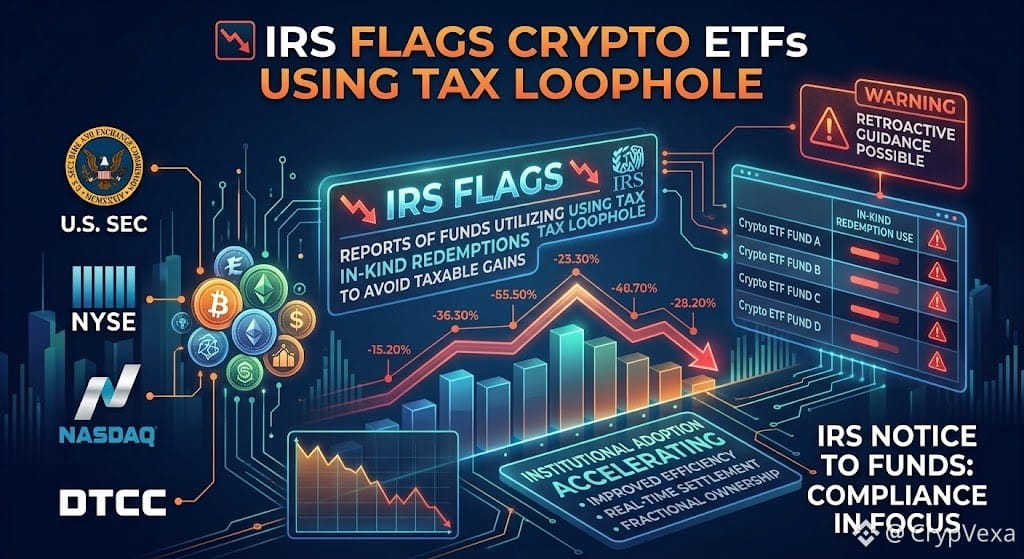
📉 IRS Flags Crypto ETF Tax Reporting Issue
🇺🇸 The IRS is drawing attention to digital-asset tax reporting, as crypto funds and brokers face increasingly detailed reporting requirements.
📋 U.S. rules now require brokers to report digital-asset proceeds, with Form 1099-DA covering sales made after 2025.
⚠️ The IRS also notes that published rulings generally apply retroactively unless otherwise stated, adding uncertainty around future tax guidance.
👀 Could tighter tax reporting become a bigger issue for crypto ETFs and institutional investors?
#CryptoETF #CryptoTax #IRS #CryptoNews
📉 IRS Flags Crypto ETF Tax Reporting Issue
🇺🇸 The IRS is drawing attention to digital-asset tax reporting, as crypto funds and brokers face increasingly detailed reporting requirements.
📋 U.S. rules now require brokers to report digital-asset proceeds, with Form 1099-DA covering sales made after 2025.
⚠️ The IRS also notes that published rulings generally apply retroactively unless otherwise stated, adding uncertainty around future tax guidance.
👀 Could tighter tax reporting become a bigger issue for crypto ETFs and institutional investors?
#CryptoETF #CryptoTax #IRS #CryptoNews
🇺🇸 The IRS is drawing attention to digital-asset tax reporting, as crypto funds and brokers face increasingly detailed reporting requirements.
📋 U.S. rules now require brokers to report digital-asset proceeds, with Form 1099-DA covering sales made after 2025.
⚠️ The IRS also notes that published rulings generally apply retroactively unless otherwise stated, adding uncertainty around future tax guidance.
👀 Could tighter tax reporting become a bigger issue for crypto ETFs and institutional investors?
#CryptoETF #CryptoTax #IRS #CryptoNews
1
54

·
--
伊利诺伊州加密税被叫停!0.2%税收推迟6个月,行业集体反抗见效了!这次加密玩家成功阻止仓促通过的税收法案。加密力量正在崛起!
Illinois crypto tax gets halted! 0.2% tax postponed for 6 months after industry pushback works! Crypto community successfully stops rushed tax bill. Crypto power is on the rise!
#CryptoTax #Regulation $BTC $ETH
伊利诺伊州加密税被叫停!0.2%税收推迟6个月,行业集体反抗见效了!这次加密玩家成功阻止仓促通过的税收法案。加密力量正在崛起!
Illinois crypto tax gets halted! 0.2% tax postponed for 6 months after industry pushback works! Crypto community successfully stops rushed tax bill. Crypto power is on the rise!
#CryptoTax #Regulation $BTC $ETH
Illinois crypto tax gets halted! 0.2% tax postponed for 6 months after industry pushback works! Crypto community successfully stops rushed tax bill. Crypto power is on the rise!
#CryptoTax #Regulation $BTC $ETH
367
·
--
Haussier
Crypto tax is still a headache, but ignoring it won't stop an audit.
Robin Singh, Founder & CEO of Koinly, answered Bitnxt's questions on what crypto investors keep getting wrong:
🔹 No specific guidance ≠ no tax obligation
🔹 Exchange reports (1099-DA, DAC8, CARF) are limited and often incorrect. If you buy on one exchange, move to a wallet and sell on another, no single exchange knows your real gain or loss
🔹 DeFi, bridges, airdrops and perps: Koinly takes the conservative approach where rules are unclear
🔹 AI handles transfer matching and error detection, but for tax judgments, ask an accountant, not ChatGPT
🔹 What's coming next: tokenized stocks and on-chain AI agents running thousands of transactions
💡 Robin's one habit: review your transactions monthly, not in deadline week.
Full interview on Bitnxt 👇
bitnxt.io/interviews/robin-singh-koinly
#cryptotax #Koinly #Bitnxt #BinanceSquare
Crypto tax is still a headache, but ignoring it won't stop an audit.
Robin Singh, Founder & CEO of Koinly, answered Bitnxt's questions on what crypto investors keep getting wrong:
🔹 No specific guidance ≠ no tax obligation
🔹 Exchange reports (1099-DA, DAC8, CARF) are limited and often incorrect. If you buy on one exchange, move to a wallet and sell on another, no single exchange knows your real gain or loss
🔹 DeFi, bridges, airdrops and perps: Koinly takes the conservative approach where rules are unclear
🔹 AI handles transfer matching and error detection, but for tax judgments, ask an accountant, not ChatGPT
🔹 What's coming next: tokenized stocks and on-chain AI agents running thousands of transactions
💡 Robin's one habit: review your transactions monthly, not in deadline week.
Full interview on Bitnxt 👇
bitnxt.io/interviews/robin-singh-koinly
#cryptotax #Koinly #Bitnxt #BinanceSquare
Robin Singh, Founder & CEO of Koinly, answered Bitnxt's questions on what crypto investors keep getting wrong:
🔹 No specific guidance ≠ no tax obligation
🔹 Exchange reports (1099-DA, DAC8, CARF) are limited and often incorrect. If you buy on one exchange, move to a wallet and sell on another, no single exchange knows your real gain or loss
🔹 DeFi, bridges, airdrops and perps: Koinly takes the conservative approach where rules are unclear
🔹 AI handles transfer matching and error detection, but for tax judgments, ask an accountant, not ChatGPT
🔹 What's coming next: tokenized stocks and on-chain AI agents running thousands of transactions
💡 Robin's one habit: review your transactions monthly, not in deadline week.
Full interview on Bitnxt 👇
bitnxt.io/interviews/robin-singh-koinly
#cryptotax #Koinly #Bitnxt #BinanceSquare

1
80

·
--
Illinois #cryptotax
Illinois is a state in the 🇺🇸 United States.
Starting in 2027, Illinois plans to impose a 0.2% tax on certain crypto transactions, based on the transaction value rather than profit or loss.
For example, a $100,000 crypto transaction = $200 tax, even if the trader loses money.
The rules are still in draft form and could change before implementation.
$BTC $ZEC $QNT
#SECChairWantsStockMarketsOnChain
#EarningsSeason
#USJobOpeningsFallToFiveMonthLow
#BinanceSquareFamily
Illinois #cryptotax
Illinois is a state in the 🇺🇸 United States.
Starting in 2027, Illinois plans to impose a 0.2% tax on certain crypto transactions, based on the transaction value rather than profit or loss.
For example, a $100,000 crypto transaction = $200 tax, even if the trader loses money.
The rules are still in draft form and could change before implementation.
$BTC $ZEC $QNT
#SECChairWantsStockMarketsOnChain
#EarningsSeason
#USJobOpeningsFallToFiveMonthLow
#BinanceSquareFamily
Illinois is a state in the 🇺🇸 United States.
Starting in 2027, Illinois plans to impose a 0.2% tax on certain crypto transactions, based on the transaction value rather than profit or loss.
For example, a $100,000 crypto transaction = $200 tax, even if the trader loses money.
The rules are still in draft form and could change before implementation.
$BTC $ZEC $QNT
#SECChairWantsStockMarketsOnChain
#EarningsSeason
#USJobOpeningsFallToFiveMonthLow
#BinanceSquareFamily

1
470

🚨 ILLINOIS PROPOSES TAXING ALL $BTC TRANSACTIONS REGARDLESS OF PROFIT OR LOSS BY 2027 ⚠️
A proposed Illinois tax framework aims to impose transaction taxes on crypto activity starting 2027, completely ignoring net gain or loss metrics. 📊 This institutional friction attempts to penalize high-frequency velocity, forcing algorithmic liquidity providers to re-evaluate regional operational routing.
From an order flow perspective, broad transactional levies create artificial friction, potentially driving liquidity offline or into privacy-centric smart contract layers. 💡 As state-level regulatory landscapes evolve, smart capital will inevitably seek friction-free execution venues long before implementation. 💬 Will state-level transaction taxes accelerate capital migration toward offshore liquidity pools? 👇
⚠️ Not financial advice. Always manage your risk. 🛡️
🏷️ #BTC #CryptoTax #Regulation #Macro
📊 🛡️
🚨 ILLINOIS PROPOSES TAXING ALL $BTC TRANSACTIONS REGARDLESS OF PROFIT OR LOSS BY 2027 ⚠️
A proposed Illinois tax framework aims to impose transaction taxes on crypto activity starting 2027, completely ignoring net gain or loss metrics. 📊 This institutional friction attempts to penalize high-frequency velocity, forcing algorithmic liquidity providers to re-evaluate regional operational routing.
From an order flow perspective, broad transactional levies create artificial friction, potentially driving liquidity offline or into privacy-centric smart contract layers. 💡 As state-level regulatory landscapes evolve, smart capital will inevitably seek friction-free execution venues long before implementation. 💬 Will state-level transaction taxes accelerate capital migration toward offshore liquidity pools? 👇
⚠️ Not financial advice. Always manage your risk. 🛡️
🏷️ #BTC #CryptoTax #Regulation #Macro
📊 🛡️
A proposed Illinois tax framework aims to impose transaction taxes on crypto activity starting 2027, completely ignoring net gain or loss metrics. 📊 This institutional friction attempts to penalize high-frequency velocity, forcing algorithmic liquidity providers to re-evaluate regional operational routing.
From an order flow perspective, broad transactional levies create artificial friction, potentially driving liquidity offline or into privacy-centric smart contract layers. 💡 As state-level regulatory landscapes evolve, smart capital will inevitably seek friction-free execution venues long before implementation. 💬 Will state-level transaction taxes accelerate capital migration toward offshore liquidity pools? 👇
⚠️ Not financial advice. Always manage your risk. 🛡️
🏷️ #BTC #CryptoTax #Regulation #Macro
📊 🛡️
24

·
--
Big US companies holding Bitcoin could owe cash tax on gains they never sold, and right now an IRS notice is all that keeps that from happening.
Accounting rules put crypto at fair value through net income, and the 15% corporate minimum tax starts from financial statement income... so an unrealised $BTC gain lands in the tax base. It applies to groups averaging over $1 billion a year of that income over three years, and Strategy and Coinbase ($MSTR $COIN) wrote to Treasury about it last year.
Notice 2025-49, issued 30 September 2025, lets a company elect to leave unrealised gains and losses on fair-value items out of that base. It's interim guidance the company has to opt into, and it covers fair-value items across the board, so trading securities and derivatives get the same relief as crypto.
Officials say revised proposed rules should land by the end of 2026. I'll be reading how they treat fair-value items in general, since a change there could narrow the relief for Bitcoin holders with no Bitcoin headline anywhere.
#Bitcoin #CryptoTax #Tax #Crypto
Big US companies holding Bitcoin could owe cash tax on gains they never sold, and right now an IRS notice is all that keeps that from happening.
Accounting rules put crypto at fair value through net income, and the 15% corporate minimum tax starts from financial statement income... so an unrealised $BTC gain lands in the tax base. It applies to groups averaging over $1 billion a year of that income over three years, and Strategy and Coinbase ($MSTR $COIN ) wrote to Treasury about it last year.
Notice 2025-49, issued 30 September 2025, lets a company elect to leave unrealised gains and losses on fair-value items out of that base. It's interim guidance the company has to opt into, and it covers fair-value items across the board, so trading securities and derivatives get the same relief as crypto.
Officials say revised proposed rules should land by the end of 2026. I'll be reading how they treat fair-value items in general, since a change there could narrow the relief for Bitcoin holders with no Bitcoin headline anywhere.
#Bitcoin #CryptoTax #Tax #Crypto
Accounting rules put crypto at fair value through net income, and the 15% corporate minimum tax starts from financial statement income... so an unrealised $BTC gain lands in the tax base. It applies to groups averaging over $1 billion a year of that income over three years, and Strategy and Coinbase ($MSTR $COIN ) wrote to Treasury about it last year.
Notice 2025-49, issued 30 September 2025, lets a company elect to leave unrealised gains and losses on fair-value items out of that base. It's interim guidance the company has to opt into, and it covers fair-value items across the board, so trading securities and derivatives get the same relief as crypto.
Officials say revised proposed rules should land by the end of 2026. I'll be reading how they treat fair-value items in general, since a change there could narrow the relief for Bitcoin holders with no Bitcoin headline anywhere.
#Bitcoin #CryptoTax #Tax #Crypto
340
·
--
$ETH | Most crypto tax software breaks on DeFi and staking activity. A CSV importer handles a spot buy fine, then chokes on a liquidity pool deposit or a staking reward from a smart contract.
On the desk we never trusted one data feed for anything material, and I check tax software the same way. SatoshiMacro's review of Summ found it classifies 1,500+ DeFi protocols across 30+ layer-2 chains, past the 800+ integrations most rivals stop at.
The ATO gives individuals a 50 percent CGT discount past 12 months, a third for a complying SMSF, only with a clean cost base. My read: tool choice matters more for a DeFi-heavy portfolio than a plain buy-and-hold wallet. It is not free, and our review rates it 4.7, not perfect.
https://satoshimacro.com/reviews/crypto/summ-review/?utm_source=binance_square&utm_medium=social&utm_campaign=autopilot_short-2
#SatoshiMacro #CryptoTax #DeFi #Bitcoin
$ETH | Most crypto tax software breaks on DeFi and staking activity. A CSV importer handles a spot buy fine, then chokes on a liquidity pool deposit or a staking reward from a smart contract.
On the desk we never trusted one data feed for anything material, and I check tax software the same way. SatoshiMacro's review of Summ found it classifies 1,500+ DeFi protocols across 30+ layer-2 chains, past the 800+ integrations most rivals stop at.
The ATO gives individuals a 50 percent CGT discount past 12 months, a third for a complying SMSF, only with a clean cost base. My read: tool choice matters more for a DeFi-heavy portfolio than a plain buy-and-hold wallet. It is not free, and our review rates it 4.7, not perfect.
https://satoshimacro.com/reviews/crypto/summ-review/?utm_source=binance_square&utm_medium=social&utm_campaign=autopilot_short-2
#SatoshiMacro #CryptoTax #DeFi #Bitcoin
On the desk we never trusted one data feed for anything material, and I check tax software the same way. SatoshiMacro's review of Summ found it classifies 1,500+ DeFi protocols across 30+ layer-2 chains, past the 800+ integrations most rivals stop at.
The ATO gives individuals a 50 percent CGT discount past 12 months, a third for a complying SMSF, only with a clean cost base. My read: tool choice matters more for a DeFi-heavy portfolio than a plain buy-and-hold wallet. It is not free, and our review rates it 4.7, not perfect.
https://satoshimacro.com/reviews/crypto/summ-review/?utm_source=binance_square&utm_medium=social&utm_campaign=autopilot_short-2
#SatoshiMacro #CryptoTax #DeFi #Bitcoin
47
·
--
$ETH | Mistake I still see AU stakers make: treating validator rewards like bank interest, taxed only on withdrawal. Wrong under Australian law.
Rewards are ordinary income at constructive receipt, AUD value that day. Sell later and a separate CGT event applies, using receipt-day value as cost base. On the desk I have watched traders miss this and scramble when the two events land in different years.
ATO's staking guidance treats each reward as a discrete income line; draft ruling TR 2025/D1 extends this to liquid staking. SatoshiMacro's worked example on a A$500,000 ETH stake: AUD 18,900 taxed at receipt alone, before disposal CGT.
My read: unrealised does not mean untaxed. Educational, not tax advice.
https://satoshimacro.com/guides/crypto/staking-tax-australia/?utm_source=binance_square&utm_medium=social&utm_campaign=autopilot_short-2
#SatoshiMacro #CryptoTax #StakingRewards #ATO
$ETH | Mistake I still see AU stakers make: treating validator rewards like bank interest, taxed only on withdrawal. Wrong under Australian law.
Rewards are ordinary income at constructive receipt, AUD value that day. Sell later and a separate CGT event applies, using receipt-day value as cost base. On the desk I have watched traders miss this and scramble when the two events land in different years.
ATO's staking guidance treats each reward as a discrete income line; draft ruling TR 2025/D1 extends this to liquid staking. SatoshiMacro's worked example on a A$500,000 ETH stake: AUD 18,900 taxed at receipt alone, before disposal CGT.
My read: unrealised does not mean untaxed. Educational, not tax advice.
https://satoshimacro.com/guides/crypto/staking-tax-australia/?utm_source=binance_square&utm_medium=social&utm_campaign=autopilot_short-2
#SatoshiMacro #CryptoTax #StakingRewards #ATO
Rewards are ordinary income at constructive receipt, AUD value that day. Sell later and a separate CGT event applies, using receipt-day value as cost base. On the desk I have watched traders miss this and scramble when the two events land in different years.
ATO's staking guidance treats each reward as a discrete income line; draft ruling TR 2025/D1 extends this to liquid staking. SatoshiMacro's worked example on a A$500,000 ETH stake: AUD 18,900 taxed at receipt alone, before disposal CGT.
My read: unrealised does not mean untaxed. Educational, not tax advice.
https://satoshimacro.com/guides/crypto/staking-tax-australia/?utm_source=binance_square&utm_medium=social&utm_campaign=autopilot_short-2
#SatoshiMacro #CryptoTax #StakingRewards #ATO
1
52
·
--
What Koinly's Free Plan Actually Buys You Before the 31 October ATO Deadline$BTC | Does Koinly's free plan actually let you reconcile a full Australian crypto tax year before you pay anything?
Yes, up to a point. Koinly's free tier tracks and previews up to 10,000 transactions for a full financial year at no cost, matching cost bases and showing every capital gain and loss line by line. What it will not hand you for free is the report you actually lodge with; the ATO myTax export only unlocks once you move to a paid tier, starting at AUD 64 a year.
## What the free preview actually covers
I have watched enough retail crypto portfolios come apart at reconciliation time to know the free tier is not a gimmick. Koinly's AUD 0 plan will ingest a full year of activity, up to 10,000 transactions, the same ceiling as its top paid Pro tier, and let you see every trade, swap and staking credit matched against a cost base across 800-plus supported exchanges and wallets. You get the number before you pay for the number. That is a genuinely useful checkpoint if you want to know, before EOFY pressure builds, whether your exchange exports are even complete, since a missing API key or an unsynced wallet shows up as a gap in the free preview exactly the way it would in the paid version.
## Where it stops, and what it costs to go further
The free plan is view only. Export the myTax-formatted report Koinly builds for the ATO lodgement screens and you are into paid tiers: AUD 64 a year for 100 transactions on the Newbie plan, AUD 103 for 1,000 on Hodler, AUD 165 for 3,000 on Trader, and AUD 239 for 10,000 or more on Pro. Say you traded through 340 events this year across two exchanges and a staking pool; the 100-transaction Newbie tier will not cover you, so the real entry price for a moderately active trader is the AUD 103 Hodler tier, not the AUD 64 headline figure most comparison tables lead with. Count your actual transaction rows in the free preview first, then buy the tier that covers that number, not the cheapest tier on the pricing page.
## Which tier actually matches SMSF and staking-heavy accounts
SMSF trustees get a specific carve-out worth checking before picking a tier: Koinly applies the one-third CGT discount SMSFs are entitled to, instead of the 50 percent discount that applies to individuals, and that distinction only shows up once you are far enough into setup to select an SMSF entity type. Staking-heavy accounts also tend to blow through the lower tiers fast, since every reward credit counts as a transaction line and gets taxed as ordinary income on receipt, separately from any later capital gain when the tokens are sold. A wallet earning weekly staking rewards for a full year can rack up 52 transaction rows on staking income alone before a single trade is counted, which is exactly the kind of volume the free preview will show you before you commit to Newbie at AUD 64 and discover mid-year you needed Hodler.
## Why the free tier still earns its keep even if you end up paying
Run the free preview now rather than in the last week of October. It will surface missing exchange connections, unmatched transfers and cost-base gaps while you still have time to email an exchange for a missing CSV, instead of discovering the hole the night before the 31 October self-lodgement deadline. Koinly's paid output applies the 50 percent CGT discount automatically to any parcel held over 12 months and classifies staking rewards as ordinary income on receipt, both handled the way the ATO actually wants them reported, not the way a spreadsheet built in a hurry usually gets them wrong.
## The honest limitation
Koinly's Australian integration list covers every AUSTRAC-registered exchange most retail traders use, and SatoshiMacro's Koinly review notes Trustpilot sits at 4.6 out of 5 across 2,252 Australian reviews, a meaningfully larger sample than most competitors carry. Where it is genuinely weaker is DeFi depth: 200-plus protocols supported against Summ's 1,500-plus, so a heavy DeFi or liquid-staking user will hit unmatched transactions the free preview cannot resolve on its own, and will end up manually tagging trades regardless of which tier they pay for. Koinly also disclosed a Mixpanel-side data exposure in December 2025, email addresses only, no passwords or transaction data, worth knowing even though it never touched tax records.
My read: run the free preview the moment your exchange statements are in hand, not after you have already decided which paid tier to buy. It tells you your real transaction count, which tells you your real tier, before you commit to a number a marketing page rounded down. For a straightforward retail investor without heavy DeFi exposure, matching the free preview against the eventual paid export is the best due diligence available at zero cost before the 31 October deadline. For anyone running an SMSF or a busy staking wallet, that same free check is what stops a AUD 64 plan turning into a mid-year upgrade.
None of this replaces a registered tax agent for a complicated year; a self-managed super fund with mixed staking and DeFi income is exactly the case where the myTax export becomes the starting document you hand to an accountant, not the final answer you lodge yourself. Treat the free preview as the step that tells you whether this year is simple enough to self-lodge at all.
https://satoshimacro.com/reviews/crypto/koinly-review/
#SatoshiMacro #CryptoTax #Koinly #Bitcoin
What Koinly's Free Plan Actually Buys You Before the 31 October ATO Deadline
$BTC | Does Koinly's free plan actually let you reconcile a full Australian crypto tax year before you pay anything?
Yes, up to a point. Koinly's free tier tracks and previews up to 10,000 transactions for a full financial year at no cost, matching cost bases and showing every capital gain and loss line by line. What it will not hand you for free is the report you actually lodge with; the ATO myTax export only unlocks once you move to a paid tier, starting at AUD 64 a year.
## What the free preview actually covers
I have watched enough retail crypto portfolios come apart at reconciliation time to know the free tier is not a gimmick. Koinly's AUD 0 plan will ingest a full year of activity, up to 10,000 transactions, the same ceiling as its top paid Pro tier, and let you see every trade, swap and staking credit matched against a cost base across 800-plus supported exchanges and wallets. You get the number before you pay for the number. That is a genuinely useful checkpoint if you want to know, before EOFY pressure builds, whether your exchange exports are even complete, since a missing API key or an unsynced wallet shows up as a gap in the free preview exactly the way it would in the paid version.
## Where it stops, and what it costs to go further
The free plan is view only. Export the myTax-formatted report Koinly builds for the ATO lodgement screens and you are into paid tiers: AUD 64 a year for 100 transactions on the Newbie plan, AUD 103 for 1,000 on Hodler, AUD 165 for 3,000 on Trader, and AUD 239 for 10,000 or more on Pro. Say you traded through 340 events this year across two exchanges and a staking pool; the 100-transaction Newbie tier will not cover you, so the real entry price for a moderately active trader is the AUD 103 Hodler tier, not the AUD 64 headline figure most comparison tables lead with. Count your actual transaction rows in the free preview first, then buy the tier that covers that number, not the cheapest tier on the pricing page.
## Which tier actually matches SMSF and staking-heavy accounts
SMSF trustees get a specific carve-out worth checking before picking a tier: Koinly applies the one-third CGT discount SMSFs are entitled to, instead of the 50 percent discount that applies to individuals, and that distinction only shows up once you are far enough into setup to select an SMSF entity type. Staking-heavy accounts also tend to blow through the lower tiers fast, since every reward credit counts as a transaction line and gets taxed as ordinary income on receipt, separately from any later capital gain when the tokens are sold. A wallet earning weekly staking rewards for a full year can rack up 52 transaction rows on staking income alone before a single trade is counted, which is exactly the kind of volume the free preview will show you before you commit to Newbie at AUD 64 and discover mid-year you needed Hodler.
## Why the free tier still earns its keep even if you end up paying
Run the free preview now rather than in the last week of October. It will surface missing exchange connections, unmatched transfers and cost-base gaps while you still have time to email an exchange for a missing CSV, instead of discovering the hole the night before the 31 October self-lodgement deadline. Koinly's paid output applies the 50 percent CGT discount automatically to any parcel held over 12 months and classifies staking rewards as ordinary income on receipt, both handled the way the ATO actually wants them reported, not the way a spreadsheet built in a hurry usually gets them wrong.
## The honest limitation
Koinly's Australian integration list covers every AUSTRAC-registered exchange most retail traders use, and SatoshiMacro's Koinly review notes Trustpilot sits at 4.6 out of 5 across 2,252 Australian reviews, a meaningfully larger sample than most competitors carry. Where it is genuinely weaker is DeFi depth: 200-plus protocols supported against Summ's 1,500-plus, so a heavy DeFi or liquid-staking user will hit unmatched transactions the free preview cannot resolve on its own, and will end up manually tagging trades regardless of which tier they pay for. Koinly also disclosed a Mixpanel-side data exposure in December 2025, email addresses only, no passwords or transaction data, worth knowing even though it never touched tax records.
My read: run the free preview the moment your exchange statements are in hand, not after you have already decided which paid tier to buy. It tells you your real transaction count, which tells you your real tier, before you commit to a number a marketing page rounded down. For a straightforward retail investor without heavy DeFi exposure, matching the free preview against the eventual paid export is the best due diligence available at zero cost before the 31 October deadline. For anyone running an SMSF or a busy staking wallet, that same free check is what stops a AUD 64 plan turning into a mid-year upgrade.
None of this replaces a registered tax agent for a complicated year; a self-managed super fund with mixed staking and DeFi income is exactly the case where the myTax export becomes the starting document you hand to an accountant, not the final answer you lodge yourself. Treat the free preview as the step that tells you whether this year is simple enough to self-lodge at all.
https://satoshimacro.com/reviews/crypto/koinly-review/
#SatoshiMacro #CryptoTax #Koinly #Bitcoin
Yes, up to a point. Koinly's free tier tracks and previews up to 10,000 transactions for a full financial year at no cost, matching cost bases and showing every capital gain and loss line by line. What it will not hand you for free is the report you actually lodge with; the ATO myTax export only unlocks once you move to a paid tier, starting at AUD 64 a year.
## What the free preview actually covers
I have watched enough retail crypto portfolios come apart at reconciliation time to know the free tier is not a gimmick. Koinly's AUD 0 plan will ingest a full year of activity, up to 10,000 transactions, the same ceiling as its top paid Pro tier, and let you see every trade, swap and staking credit matched against a cost base across 800-plus supported exchanges and wallets. You get the number before you pay for the number. That is a genuinely useful checkpoint if you want to know, before EOFY pressure builds, whether your exchange exports are even complete, since a missing API key or an unsynced wallet shows up as a gap in the free preview exactly the way it would in the paid version.
## Where it stops, and what it costs to go further
The free plan is view only. Export the myTax-formatted report Koinly builds for the ATO lodgement screens and you are into paid tiers: AUD 64 a year for 100 transactions on the Newbie plan, AUD 103 for 1,000 on Hodler, AUD 165 for 3,000 on Trader, and AUD 239 for 10,000 or more on Pro. Say you traded through 340 events this year across two exchanges and a staking pool; the 100-transaction Newbie tier will not cover you, so the real entry price for a moderately active trader is the AUD 103 Hodler tier, not the AUD 64 headline figure most comparison tables lead with. Count your actual transaction rows in the free preview first, then buy the tier that covers that number, not the cheapest tier on the pricing page.
## Which tier actually matches SMSF and staking-heavy accounts
SMSF trustees get a specific carve-out worth checking before picking a tier: Koinly applies the one-third CGT discount SMSFs are entitled to, instead of the 50 percent discount that applies to individuals, and that distinction only shows up once you are far enough into setup to select an SMSF entity type. Staking-heavy accounts also tend to blow through the lower tiers fast, since every reward credit counts as a transaction line and gets taxed as ordinary income on receipt, separately from any later capital gain when the tokens are sold. A wallet earning weekly staking rewards for a full year can rack up 52 transaction rows on staking income alone before a single trade is counted, which is exactly the kind of volume the free preview will show you before you commit to Newbie at AUD 64 and discover mid-year you needed Hodler.
## Why the free tier still earns its keep even if you end up paying
Run the free preview now rather than in the last week of October. It will surface missing exchange connections, unmatched transfers and cost-base gaps while you still have time to email an exchange for a missing CSV, instead of discovering the hole the night before the 31 October self-lodgement deadline. Koinly's paid output applies the 50 percent CGT discount automatically to any parcel held over 12 months and classifies staking rewards as ordinary income on receipt, both handled the way the ATO actually wants them reported, not the way a spreadsheet built in a hurry usually gets them wrong.
## The honest limitation
Koinly's Australian integration list covers every AUSTRAC-registered exchange most retail traders use, and SatoshiMacro's Koinly review notes Trustpilot sits at 4.6 out of 5 across 2,252 Australian reviews, a meaningfully larger sample than most competitors carry. Where it is genuinely weaker is DeFi depth: 200-plus protocols supported against Summ's 1,500-plus, so a heavy DeFi or liquid-staking user will hit unmatched transactions the free preview cannot resolve on its own, and will end up manually tagging trades regardless of which tier they pay for. Koinly also disclosed a Mixpanel-side data exposure in December 2025, email addresses only, no passwords or transaction data, worth knowing even though it never touched tax records.
My read: run the free preview the moment your exchange statements are in hand, not after you have already decided which paid tier to buy. It tells you your real transaction count, which tells you your real tier, before you commit to a number a marketing page rounded down. For a straightforward retail investor without heavy DeFi exposure, matching the free preview against the eventual paid export is the best due diligence available at zero cost before the 31 October deadline. For anyone running an SMSF or a busy staking wallet, that same free check is what stops a AUD 64 plan turning into a mid-year upgrade.
None of this replaces a registered tax agent for a complicated year; a self-managed super fund with mixed staking and DeFi income is exactly the case where the myTax export becomes the starting document you hand to an accountant, not the final answer you lodge yourself. Treat the free preview as the step that tells you whether this year is simple enough to self-lodge at all.
https://satoshimacro.com/reviews/crypto/koinly-review/
#SatoshiMacro #CryptoTax #Koinly #Bitcoin
1
68
·
--
Korean retail has no tax reason to dump coins before the 22% crypto tax starts on 1 January 2027, and I expect the year-end selling story to get written anyway.
For anything held from before 2027, the cost basis is the greater of what you actually paid and the market price on 31 December 2026. So a holder sitting on a big gain in $BTC or $ETH gets that year-end mark as their basis automatically, sold or not... selling in December to beat the tax saves them nothing.
The start date is still open, though. On 22 September a lawmaker from the governing party argued the tax should wait until the Digital Asset Basic Act passes. The government says January as scheduled, but it's been pushed back before, and the December budget round will most likely settle it.
If the won market sells hard into year-end, I'd look for a reason other than the tax. I'll be watching that December round.
#CryptoTax #Korea #Bitcoin #Crypto
Korean retail has no tax reason to dump coins before the 22% crypto tax starts on 1 January 2027, and I expect the year-end selling story to get written anyway.
For anything held from before 2027, the cost basis is the greater of what you actually paid and the market price on 31 December 2026. So a holder sitting on a big gain in $BTC or $ETH gets that year-end mark as their basis automatically, sold or not... selling in December to beat the tax saves them nothing.
The start date is still open, though. On 22 September a lawmaker from the governing party argued the tax should wait until the Digital Asset Basic Act passes. The government says January as scheduled, but it's been pushed back before, and the December budget round will most likely settle it.
If the won market sells hard into year-end, I'd look for a reason other than the tax. I'll be watching that December round.
#CryptoTax #Korea #Bitcoin #Crypto
For anything held from before 2027, the cost basis is the greater of what you actually paid and the market price on 31 December 2026. So a holder sitting on a big gain in $BTC or $ETH gets that year-end mark as their basis automatically, sold or not... selling in December to beat the tax saves them nothing.
The start date is still open, though. On 22 September a lawmaker from the governing party argued the tax should wait until the Digital Asset Basic Act passes. The government says January as scheduled, but it's been pushed back before, and the December budget round will most likely settle it.
If the won market sells hard into year-end, I'd look for a reason other than the tax. I'll be watching that December round.
#CryptoTax #Korea #Bitcoin #Crypto
99

·
--
📑 Crypto Tax: Don't Forget This After Booking Profits
Made good profit in the market? Great! But forgetting about tax obligations can land you in serious trouble later.
🔹 Which activities can be taxable?
✅ Selling crypto and converting to fiat
✅ Trading one coin for another (coin-to-coin trades)
✅ Rewards earned from staking or mining
✅ Buying goods/services with crypto
✅ Tokens received from airdrops
🔹 Why does it feel so hard to track?
📊 Transaction history scattered across multiple exchanges and wallets
📊 Every country has different tax rules — capital gains, income tax, different rates
📊 Calculating thousands of small trades manually is nearly impossible
🎯 How to make it easier:
✅ Keep records of every transaction (date, price, amount)
✅ Use crypto tax software — connect your exchange/wallet for automatic calculation
✅ Get a clear understanding of your own country's regulations
✅ Consult a tax professional if you're unsure
⚠️ Remember: "Crypto is decentralized, so I don't have to pay tax" is a myth. Most countries require you to report crypto income, and non-compliance can carry penalties.
I'm not a tax or legal advisor — this is general awareness information only. Consult a tax professional based on your own country's rules.
How do you track your crypto taxes? Let us know in the comments 👇
#Binance #CryptoTax #BinanceSquare #DYOR
📑 Crypto Tax: Don't Forget This After Booking Profits
Made good profit in the market? Great! But forgetting about tax obligations can land you in serious trouble later.
🔹 Which activities can be taxable?
✅ Selling crypto and converting to fiat
✅ Trading one coin for another (coin-to-coin trades)
✅ Rewards earned from staking or mining
✅ Buying goods/services with crypto
✅ Tokens received from airdrops
🔹 Why does it feel so hard to track?
📊 Transaction history scattered across multiple exchanges and wallets
📊 Every country has different tax rules — capital gains, income tax, different rates
📊 Calculating thousands of small trades manually is nearly impossible
🎯 How to make it easier:
✅ Keep records of every transaction (date, price, amount)
✅ Use crypto tax software — connect your exchange/wallet for automatic calculation
✅ Get a clear understanding of your own country's regulations
✅ Consult a tax professional if you're unsure
⚠️ Remember: "Crypto is decentralized, so I don't have to pay tax" is a myth. Most countries require you to report crypto income, and non-compliance can carry penalties.
I'm not a tax or legal advisor — this is general awareness information only. Consult a tax professional based on your own country's rules.
How do you track your crypto taxes? Let us know in the comments 👇
#Binance #CryptoTax #BinanceSquare #DYOR
Made good profit in the market? Great! But forgetting about tax obligations can land you in serious trouble later.
🔹 Which activities can be taxable?
✅ Selling crypto and converting to fiat
✅ Trading one coin for another (coin-to-coin trades)
✅ Rewards earned from staking or mining
✅ Buying goods/services with crypto
✅ Tokens received from airdrops
🔹 Why does it feel so hard to track?
📊 Transaction history scattered across multiple exchanges and wallets
📊 Every country has different tax rules — capital gains, income tax, different rates
📊 Calculating thousands of small trades manually is nearly impossible
🎯 How to make it easier:
✅ Keep records of every transaction (date, price, amount)
✅ Use crypto tax software — connect your exchange/wallet for automatic calculation
✅ Get a clear understanding of your own country's regulations
✅ Consult a tax professional if you're unsure
⚠️ Remember: "Crypto is decentralized, so I don't have to pay tax" is a myth. Most countries require you to report crypto income, and non-compliance can carry penalties.
I'm not a tax or legal advisor — this is general awareness information only. Consult a tax professional based on your own country's rules.
How do you track your crypto taxes? Let us know in the comments 👇
#Binance #CryptoTax #BinanceSquare #DYOR

75
Connectez-vous pour découvrir plus de contenu
Rejoignez la communauté mondiale des adeptes de cryptomonnaies sur Binance Square
⚡️ Suviez les dernières informations importantes sur les cryptomonnaies.
💬 Jugé digne de confiance par la plus grande plateforme d’échange de cryptomonnaies au monde.
👍 Découvrez les connaissances que partagent les créateurs vérifiés.
Adresse e-mail/Nº de téléphone
Sujets d’actualité
1
#Nikkei225Jumps2.5%ToThreeMonthHigh
123 vues
36 mentions
2
#DriftHackVictimsBeginClaims
66,969 vues
742 mentions
3
#SolanaTokenizedStockVolumeTops$4.4BInSeptember
7,476 vues
78 mentions
4
#BitcoinSpotETFsDraw$6.34BInflowsInQ3
25,340 vues
185 mentions
5
#EthereumValidatorExitQueueJumps392%
219,156 vues
1,787 mentions
6
#IMFApprovesElSalvador$138MWithBitcoinWaiver
20,974 vues
117 mentions
7
#SECHaltsCryptoETFReviewsAmidFundingLapse
342,490 vues
2,506 mentions
8
#ZcashETFPostsFirstWeeklyOutflow$93.6M
106,260 vues
280 mentions
9
#GreekPoliceBustCryptoScamRingArrest17
469,577 vues
3,061 mentions
10
#BitcoinRejectedAt$87K
243,356 vues
353 mentions