

I keep coming back to this uncomfortable thought that most people only notice infrastructure when it breaks. Nobody thinks emotionally about settlement layers or routing architecture when markets are green. We notice the visible things. Tokens. Charts. Narratives. Personalities. But underneath crypto, there is this quieter system constantly evolving in the background, almost like the nervous system of the industry rebuilding itself while everyone argues about price action on the surface.
That was honestly my first reaction when I started digging into $OPEN Network’s native Ethereum bridge. Not excitement exactly. More like curiosity mixed with a strange kind of caution. Because the announcement itself sounded simple enough. Assets moving natively between #Ethereum and #OpenLedger at the protocol layer. No custodians. No external contracts. No wrapped abstractions pretending to be the original asset. On paper, that sounds technical but straightforward. In practice, it quietly touches one of crypto’s oldest structural problems.
For years, interoperability has mostly meant adding another trust assumption somewhere in the middle. Bridges became these invisible risk warehouses carrying billions of dollars across fragmented ecosystems. And maybe the industry normalized that fragility because growth happened faster than reflection. We kept building cities before properly designing roads between them. Sometimes I wonder if crypto accidentally recreated the same settlement inefficiencies traditional finance spent decades trying to reduce.
@OpenLedger feels like an attempt to rethink that relationship from the infrastructure layer upward. The bridge is not positioned like an isolated product or external middleware. It behaves more like execution continuity between environments. That distinction matters because systems built for autonomous coordination cannot constantly rely on synthetic liquidity representations or fragmented settlement logic. Humans tolerate friction surprisingly well. Machines usually do not.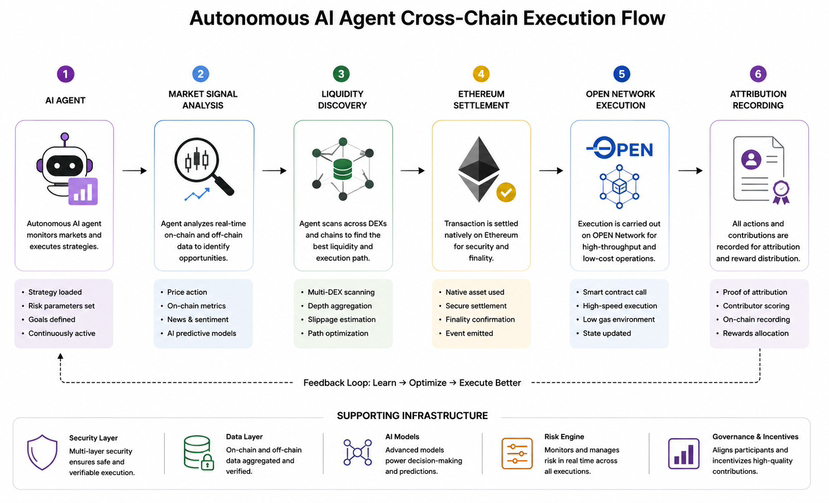
And that is probably the deeper story hiding underneath all this. I do not think OPEN Network is really optimizing only for human users anymore. It feels increasingly aligned with a future where autonomous AI systems become persistent economic participants themselves. Not theoretical AI. Operational AI. Agents coordinating liquidity, processing attribution data, routing execution paths, evaluating strategy conditions, and reacting continuously to real-time market environments.
Once you start looking through that lens, the architecture suddenly makes more sense.
OpenLedger’s broader ecosystem has already been moving toward this direction through its attribution economy framework. Datanets coordinating decentralized data contribution. OpenLoRA enabling composable model deployment systems. Contributor-level attribution tracking tied to AI-generated outputs. The bridge sits underneath those mechanisms almost quietly, but importantly. Because if intelligence itself becomes economically productive, then infrastructure starts determining how value flows between models, data providers, execution systems, and liquidity environments.
Community ecosystem tracking around OpenLedger suggests the network has already processed more than 19 million attribution-linked coordination events across decentralized AI systems, alongside over 1.4 million wallet interactions connected to contributor verification and autonomous execution environments. During periods of elevated network activity, coordination layers appear to have handled hundreds of thousands of execution settlements within relatively short operational windows. Maybe those numbers still look small beside Ethereum’s broader scale. But behavior matters more than raw size in early infrastructure transitions.
Traditional crypto activity usually revolves around isolated user actions. Swap. Stake. Bridge. Leave. AI native environments behave differently because participation becomes continuous rather than session-based. Autonomous systems do not “log off.” They optimize constantly. They respond to latency shifts, liquidity fragmentation, execution costs, attribution weighting, and changing strategy conditions in real time. Infrastructure originally designed for occasional human interaction starts revealing its limitations very quickly under machine-speed coordination.
I sometimes think about old shipping ports before standardized containers transformed global trade. Every transfer point introduced friction, delays, incompatible systems, manual verification problems. Trade existed, but coordination remained inefficient at scale. Then infrastructure quietly standardized around continuity rather than isolated movement. Maybe blockchain interoperability is entering a similar phase now. Less attention on individual transactions. More focus on seamless execution environments supporting intelligent systems operating continuously underneath the surface.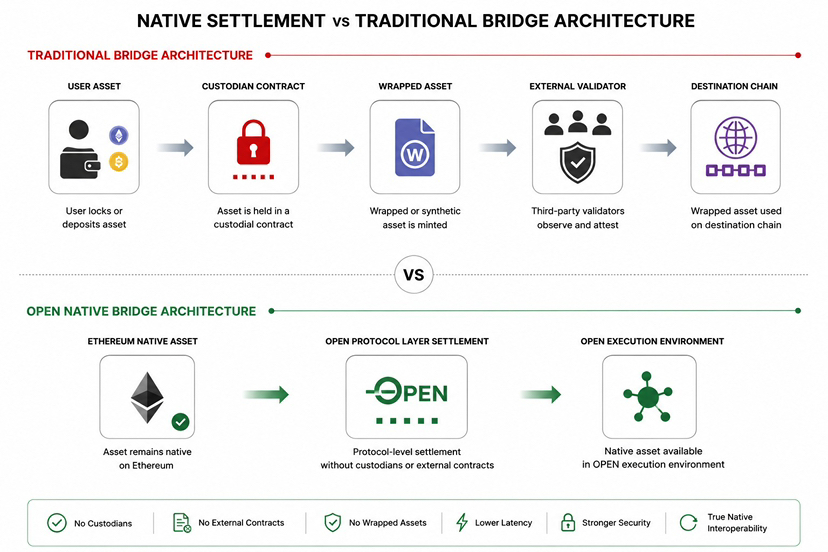
What makes OPEN Network interesting is that it does not seem obsessed with replacing Ethereum’s role in crypto. If anything, the architecture acknowledges Ethereum’s gravitational position openly. Liquidity, security assumptions, institutional trust, developer density, they still orbit Ethereum heavily. The native bridge feels less like competition and more like synchronization. That design choice feels psychologically important because mature infrastructure rarely succeeds by pretending existing liquidity centers no longer matter.
Still, I cannot convince myself this transition will unfold cleanly. AI native economic systems introduce entirely new categories of complexity into already fragile markets. Attribution sounds elegant philosophically until disagreements emerge around ownership weighting, behavioral contribution scoring, synthetic data contamination, or recursive optimization loops between autonomous agents. And cross-chain execution systems, even native ones, inevitably create new operational dependencies somewhere deeper in the stack.
There is also a quieter psychological shift happening underneath infrastructure abstraction itself. As systems become smoother, users gradually stop understanding where execution actually occurs. Intent replaces process awareness. People stop asking which chain handled settlement, where liquidity routed, how attribution was verified, or what