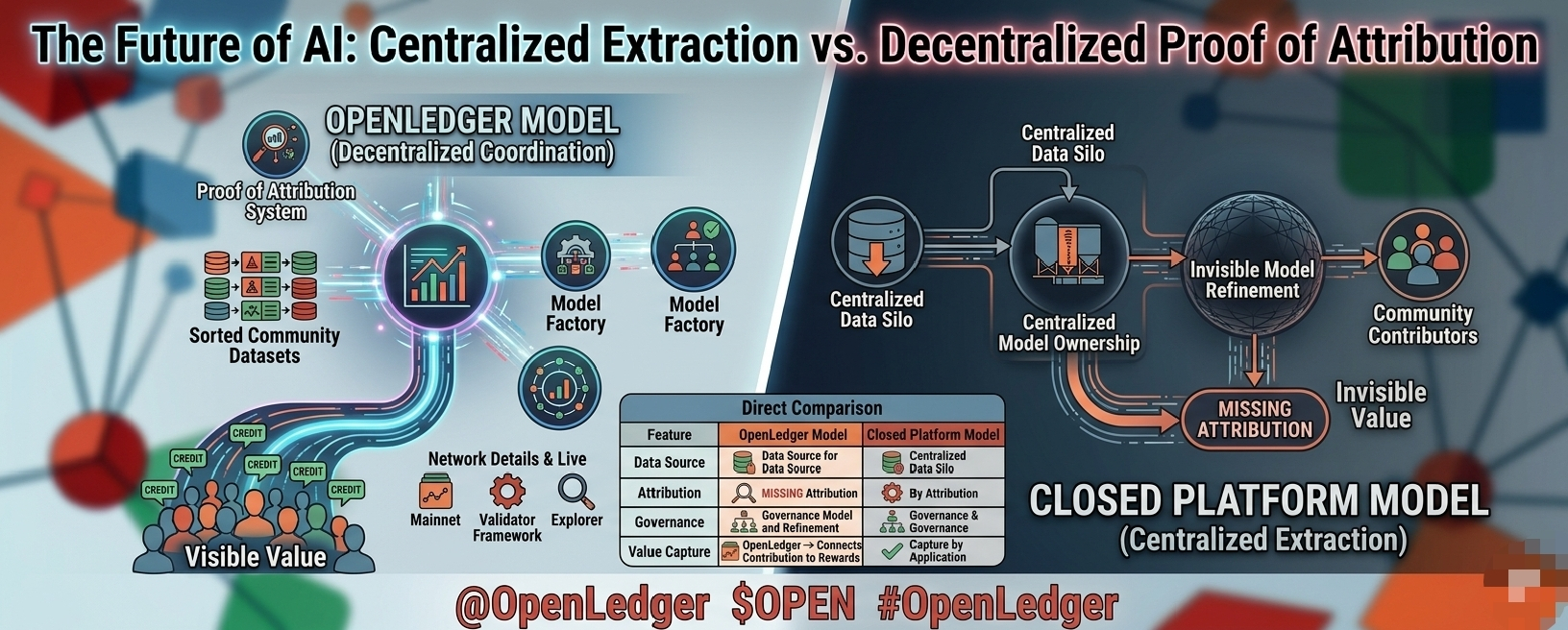

Most people experience AI through a clean interface. You type something, the system responds almost instantly, and the interaction feels effortless. But the closer you look, the more obvious it becomes that the real value in AI is not only coming from the final answer. It comes from everything underneath it. The data refinement, the testing, the fine tuning, the feedback loops, the people shaping how these systems behave over time. And most of that work is economically invisible.
That is the part I kept thinking about while looking into @OpenLedger .
A lot of people reduce OPEN to another AI-related crypto token but I think that framing misses the more interesting point entirely. OpenLedger is really exploring whether AI contribution can become measurable enough that contributors, builders and communities are not permanently disconnected from the value they help create.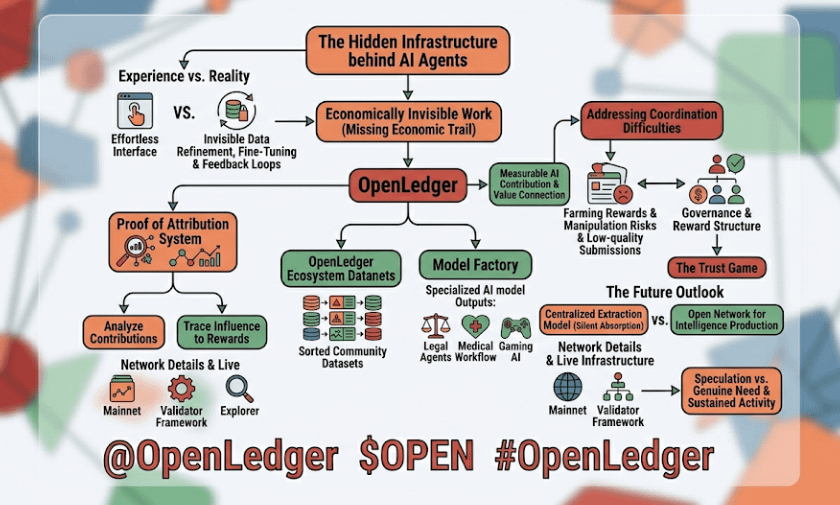
That sounds abstract at first, but the issue is becoming more practical as AI systems get more specialized.
Right now, the market still focuses heavily on giant general purpose models. But over time, a huge amount of economic activity may come from smaller domain-focused systems trained for specific environments. Legal agents. Financial research tools. Medical workflow assistants. Gaming models. Customer support systems trained around narrow datasets.
Those models do not necessarily win because they are larger. Sometimes they win because they are more precise.
And precision usually comes from focused data.
That creates a strange economic problem. The people contributing useful information, corrections, and feedback often disappear from the value chain once the model becomes commercially useful. The application captures revenue. The infrastructure layer captures attention. Meanwhile the contributors become impossible to track in any meaningful way.
OpenLedger’s core idea sits directly inside that gap.
Its Proof of Attribution system is designed to identify which contributions influence model behavior and connect those contributions to rewards later on. In simple terms, it is trying to create a system where useful participation leaves an economic trail instead of vanishing into the background.
Whether that works at scale is another question entirely. But I think the direction of the idea matters.
Because if AI eventually becomes an ecosystem of specialized agents, attribution becomes harder not easier.
Take something simple. Imagine a healthcare model refined over time by researchers, nurses, medical reviewers and real-world usage feedback. The final model may look like a single product from the outside but the intelligence inside it came from layered contributions across different people and stages. Current AI systems are very good at absorbing that value quietly. They are much worse at exposing where the value came from.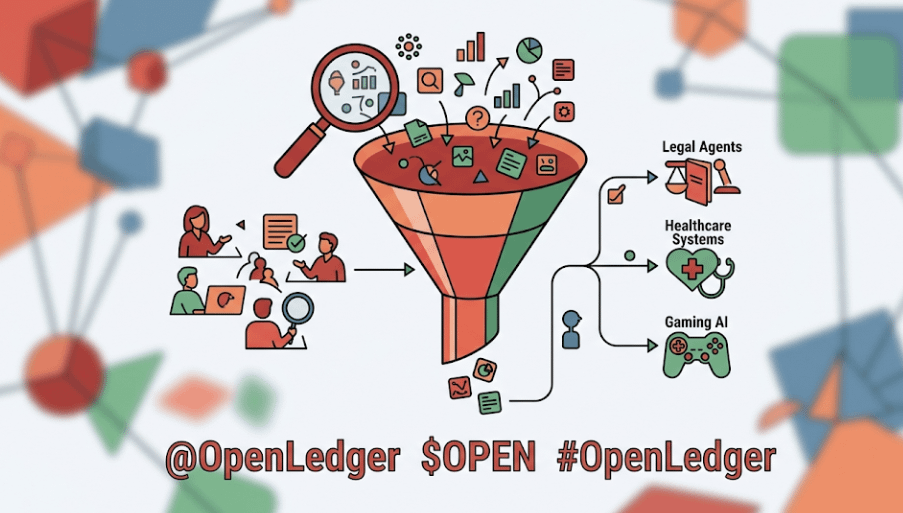
That is part of what OpenLedger is attempting to solve.
Its Datanets are meant to organize specialized community datasets, while the Model Factory gives developers infrastructure to build models around those datasets. The interesting part is not the branding. It is the coordination logic underneath it.
Better specialized AI usually does not come from throwing infinite data into a system. It often comes from cleaner, narrower, higher context information. A carefully maintained dataset inside one field can matter more than millions of generic examples scraped from the internet.
But contributors only stay engaged if the system feels worth contributing to.
And honestly, this is where most projects underestimate the difficulty.
The moment incentives exist people begin optimizing around incentives instead of quality. Some users will inevitably try to farm rewards with low-value submissions. Others will attempt to manipulate attribution signals or create artificial activity around weak models. Governance suddenly becomes extremely important because the network has to decide what counts as meaningful contribution and what counts as noise.
That sounds technical but it is really a human coordination problem.
If governance becomes concentrated, the system risks recreating the same imbalance it claims to fix. If rewards become too small or too confusing, contributors lose interest. If the attribution process feels unreliable trust weakens very quickly.
And trust is probably the entire game here.
The OPEN token only matters if the surrounding system produces real economic behavior. Otherwise it becomes another speculative asset disconnected from actual usage. The token is supposed to support payments, governance, incentives, and activity across the network but durable demand only appears if people repeatedly use the infrastructure because it solves a real coordination problem better than existing alternatives.
That is a much harder challenge than getting market attention for a few weeks.
The project already has live infrastructure attached to it including its mainnet, validator framework, explorer and network tools. That gives it operational rails instead of just theoretical positioning. But crypto markets have a habit of pricing future expectations long before adoption catches up.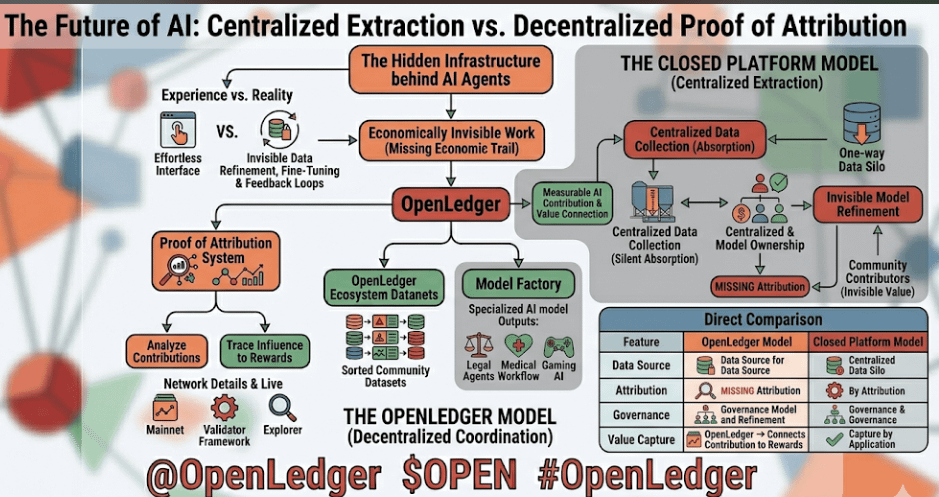
So the more important question is not whether OPEN can attract speculation.
It is whether specialized AI ecosystems genuinely need attribution based economics strongly enough to sustain long-term network activity.
I do not think the answer is obvious yet.
Most users still prioritize convenience over transparency. If attribution systems make products slower, more expensive or harder to integrate, builders may avoid them entirely. Regulators are also beginning to examine how AI licensing, token incentives and ownership rights intersect which adds another layer of uncertainty around projects operating in this space.
At the same time, the broader direction still feels important.
The future AI economy may not belong entirely to a handful of giant closed models. It may also depend on smaller systems built around domain expertise, trusted datasets and communities that continuously improve them. If that happens, the infrastructure connecting contribution to value becomes much more important than people currently assume.
That is why I think OpenLedger is more interesting as an economic coordination experiment than as a simple AI token narrative.
The project is effectively testing whether intelligence production can function more like an open network and less like a closed extraction model. Maybe that works. Maybe it does not.
But I think the underlying question is real.
Can AI value remain visible as it moves through the system or does it inevitably disappear into centralized platforms once commercialization begins?
That feels like the bigger conversation underneath OpenLedger.