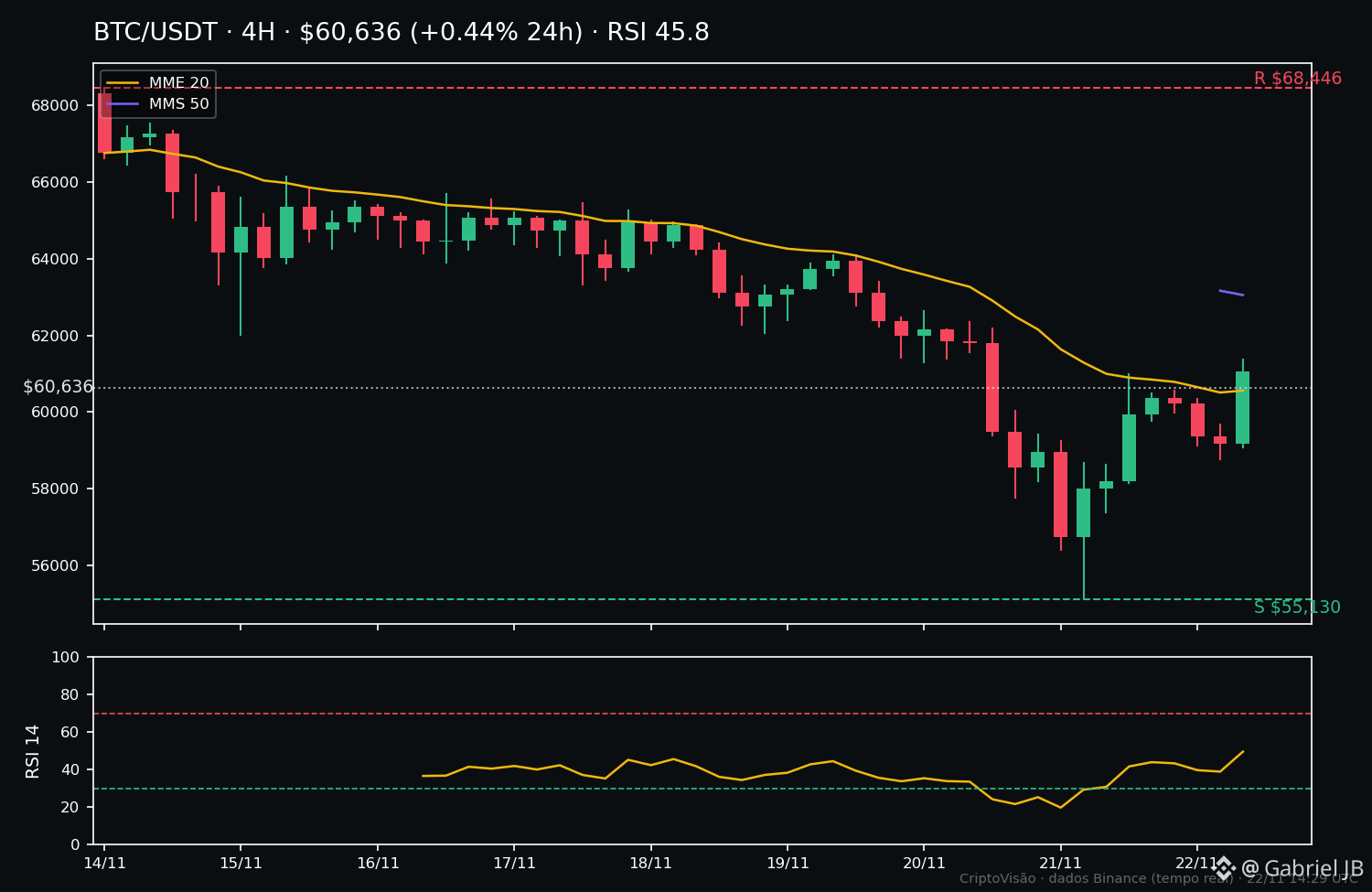
BTC tests the 20-period average: can your stop withstand $2,901 of noise? 📉
The $BTC is at $60,667, right up against the 20-period average ($60,551) — and the low over the last 24 hours was $58,769. Today's lesson: don't place your stop at a round number. Place it outside the noise.
Today's noise can be measured: 24-hour high of $61,670 minus low of $58,769 = a $2,901 swing in a single day. A stop at $60,000, just $667 below the price, would already have been triggered today — the low was $58,769.
The calculation, step by step, for a $1,000 account:
1. 1% rule: maximum risk per trade = $10.
2. Stop outside the noise: below the 24-hour low, at $58,500.
3. Risk per BTC: $60,667 - $58,500 = $2,167.
4. Position size: $10 ÷ $2,167 = 0.0046 BTC (about $280).
And the risk/reward filter: reaching the 50-period average ($63,052) would mean a gain of $2,385 — an R:R of 1.10:1, below the minimum of 2:1. The entry only passes the filter if the target is the 7-day high ($68,446), with an R:R of 3.59:1. The takeaway: a wide stop requires a distant target — or an entry closer to support.
Notice the contrast: entering near support, at $58,900, with the same $58,500 stop, risks only $400 per BTC — the 1% position size increases to 0.025 BTC (about $1,473), and the R:R to the 50-period average jumps to 10.38:1. Same risk, same stop — only your entry point changes.
Preserving capital is strategy No. 1. The stop protects you from noise; position size protects you from ruin.
What about you: do you place your stop at a round number or based on the chart structure? 👇
#Bitcoin #GestaoDeRisco #CriptoVisao